
Music is the universal language
“Glory to God in the highest heaven, and on earth peace to those on whom his favor rests.” - Luke 2:14
General Interest
Galahcore FX Ploverdrive review: focused boutique overdrive can help a board take flight

After a short break in our series taking a look at some of the choice offerings from NotPedals.com, we’re returning to the shelves of that ever-so-cool small builder marketplace to take a look at the Galahcore FX Ploverdrive – an interesting overdrive pedal with some uniquely Australian aviary inspiration.
The Ploverdrive is inspired by the masked lapwing, AKA the spur-winged plover. It’s an Aussie bird that’s known for defensively swooping at anything or anyone that threatens its nest – even, in some cases, airplanes. This aggressive territorial control is aided by its spurs – sharp outcrops of bone on its wings’ carpal joints that can make a curious cat’s day a lot worse.
In all it’s a good basis for thematically mapping onto an overdrive pedal, as the heart of the unit is the Spur control – a highly interactive tone control that gives the Ploverdrive a lot of its character. I’ll get onto the specifics of its functioning in a moment. The Spur control is joined by the more standard and self-explanatory gain and volume controls, with no other switches, leading to a pretty straightforward three-knob drive format housed in a 1590bb-sized enclosure adorned with some gorgeous art by Conrad Keely of the band …And You Will Know Us By The Trail Of Dead.
Build quality, along with the quality of the art’s printing, is top-notch – component selection tends towards the sturdy and the high-end. Jacks connect with a satisfying and firm clunk, and the potentiometers offer the kind of resistance that indicates a quality part. Everything else is all pretty within the remit of a ‘standard’ pedal – mono, 9V pedal power, so it’s time to plug in and get going.
In use
When I first fire up the Ploverdrive, I happen to have the Spur control all the way ‘down’ and the gain all the way up. There are few better ways to wake up in the morning – the Spur control, a little like a RAT’s filter, is wired ‘backwards’, in that anticlockwise means a brighter, more focused and more resonant sound. Combined with the higher gain setting its a very punchy sound indeed, and per the manual is voiced more for brightening up a neck pickup.
On the bridge pickup that brightening effect is a little too effective, but on the neck humbucker of a Telecaster Deluxe the Ploverdrive does indeed add a lot of clarity – impressive given that this is a pickup that can quickly overwhelm a gainy amp.
Rolling the Spur all the way to the soft, fluffy, not-yet-flying-baby-bird side of the dial, and things get more interesting still. Here you’ll find the basis of a great sound for warm, wooly leads – the sound is very rounded, no matter the pickup, and does invite some more singing, Claptony style playing – here, higher gain settings accentuate its smooth, sustaining character, rather than the sonic stabs of the less friendly side of the Spur control.
And speaking of gain – there’s a lot of it! We’re still firmly in overdrive territory here, it’s no HM-2, but atop a relatively clean sound from a Marshall-style amplifier, the Ploverdrive can add a decent amount of thick saturation by itself. However, in backing off the gain control and setting the Spur to something less extreme, the sound remains very characterful and perhaps shines a more flattering spotlight on the operation of the Spur control. The amount of volume on tap can absolutely invite the front end of your amp to the party too – which is always a good combo with a mid-gain overdrive that manages to keep things dynamic. Set right the Ploverdrive will be extremely honest as to how hard you’ve hit your strings.
But enough restraint – doesn’t this bird attack airplanes? Setting the Ploverdrive back to its aggressive stance and feeding it into a more gainy amp, even more avenues for Ploverdriven goodness open up. The slightly resonant ring to the brighter side of the Spur control means that for “chugging” it may not be the most ideal pedal – through faster playing your ear does tend to latch onto the more static factor of that resonant beak. Er, peak.
However, if you put a more generic metal sound out of your head for a moment you get an excellent tone for clanking noise rock in the vein of The Jesus Lizard and Shellac. The sharpness of the more extreme settings becomes a feature not a bug if you play it right – and the fact that the pedal remains dynamic the whole way up the gain lets you still express yourself through it, but the fact that its EQ curve is very much not flat and transparent remains a boon for this kind of music.
Should I buy a Ploverdrive?
Overall the Ploverdrive is an affordable but creatively-designed pedal that is easy to learn, and hard to master, in a very good way. The spur and gain controls are quite interactive with each other, and so I was still finding new sounds within the thing days into my testing. And that’s not to mention that it very much won me over by coming with a nanoblocks model of a bird, which, you know, more pedals could stand to do. If you like an overdrive that’s ready to make its presence known with an aggressive caw and an ambitious swoop at a Cessna, you won’t be disappointed in the Ploverdrive.
Check the pedal out at notpedals.com.
The post Galahcore FX Ploverdrive review: focused boutique overdrive can help a board take flight appeared first on Guitar.com | All Things Guitar.
Acoustic Soundboard: Strengthen Your Guitar with Structured Sides
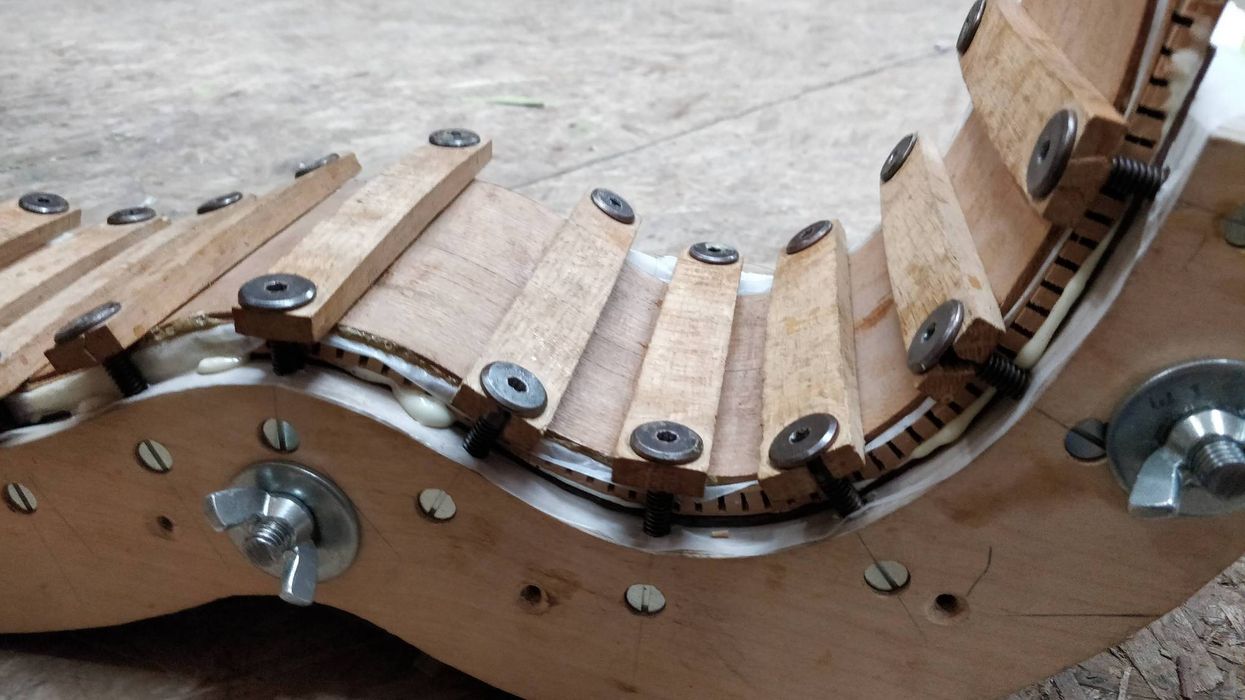
Most exciting new innovations in acoustic guitar have to do with the top, like new bracing systems, double tops, etc. This makes sense, because this is the main sound-producing component of the instrument. But a guitar is a whole system of parts that work together to produce sound, and the sides of the guitar play a significant role in this.
From an engineering perspective, there are two functions of guitar sides: first, to hold the structure of the guitar together and bear some of the tension of the strings; second, to transfer vibrations from the top to the back.
Traditional guitar sides are composed of a single layer of wood, which is bent into shape using heat. Then, kerfed liners are used to glue the sides to the top and back. This is the simplest way to construct sides, and it’s also the lightest method, since it involves the least wood. However, a single thin layer of wood is prone to cracking.
That’s not the only downside of traditional acoustic sides. They also absorb some of the energy of the vibrating top and back, which has a damping effect on the guitar, analogous to brake dampers in a car. Damping decreases the loudness and sustain of the guitar. To reduce the amount of damping, guitar sides should be as stiff as possible (without being too heavy) so that they transmit vibrations, rather than absorb them. This is the goal of structured sides.
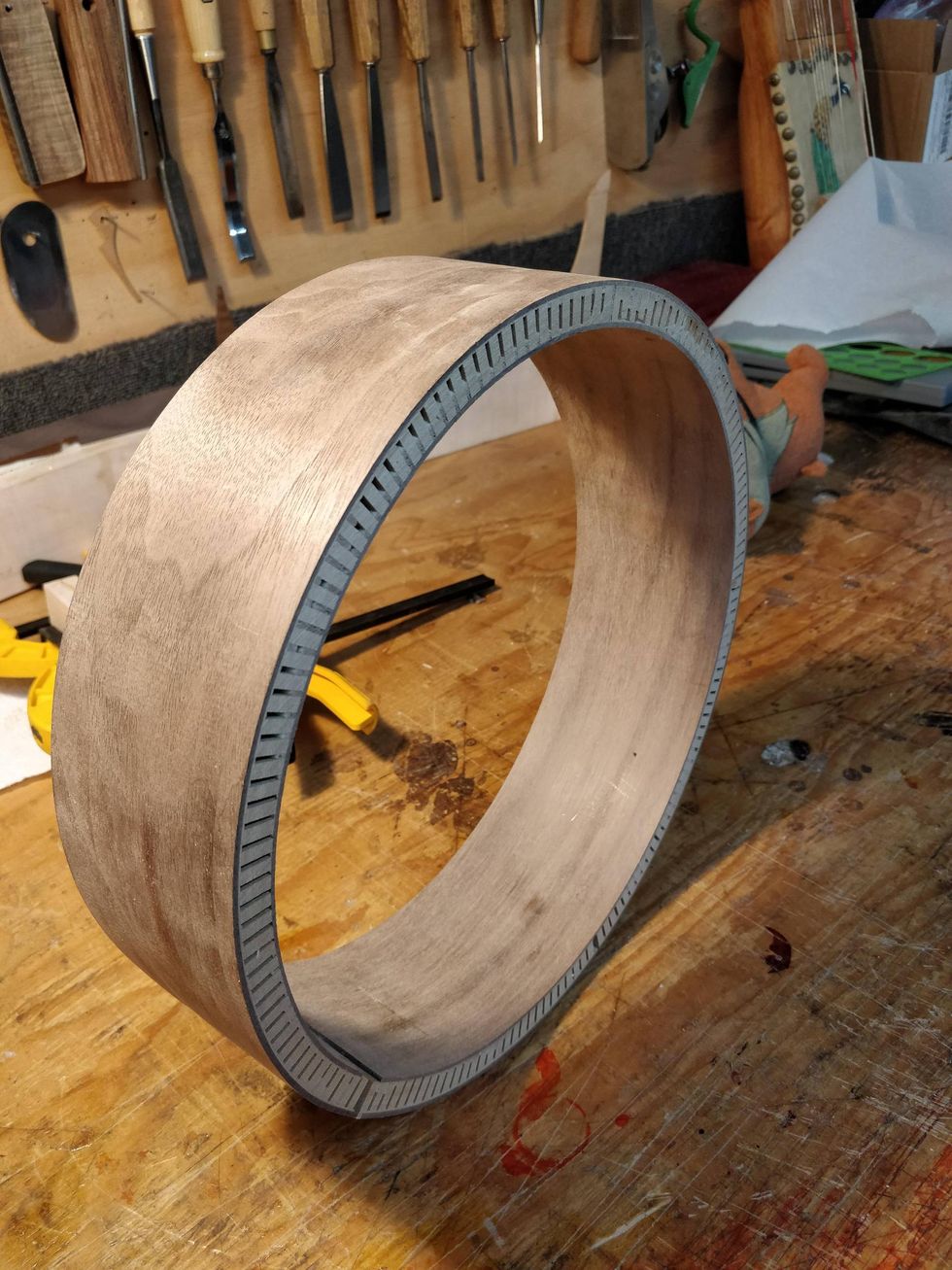
A logical way to increase the rigidity of the sides is to extend the top and bottom liners, making one big liner that spans the whole depth of the sides. This means the whole area of the side is reinforced, which in effect makes structured sides a type of laminated construct, with two plies. One ply is the outer “show” wood, and the other is the kerf bent piece that lines the inside. In general, lamination increases the rigidity of wood and helps counteract any internal stresses that may be present in one of the plies.
Several builders have contributed to the development of structured sides. Based on my research, the two-ply version was invented by Sheldon Schwartz. Another luthier, Allan Beardsell, then brought the idea to the workshop of Sergei de Jonge. While working at de Jonge’s shop, two founders of the Mile End Guitar Coop (Michael Kennedy and Jeremy Clark) learned about the technique. When they went on to found the coop, they took this technique with them and continued to experiment.
The next evolution was to add a third layer to the sides, thus making them even more stiff. This method was developed by Kennedy and Clark at the coop, and it’s currently the method that most of us in the coop use—the name “structured sides” comes from someone here. There are three plies: the outer show wood, the inner kerf bent layer, and a final thin layer on the inside of the guitar. The outermost and innermost layers are thin, solid pieces of hardwood. The inner kerf component is made of a lighter softwood, like cedar.
The physics of our three-ply sides are comparable to an I-beam. The stiffness of an I-beam comes from the two outer flanges. The middle section doesn’t add much rigidity; it simply holds the two flanges at a distance apart. The greater this distance, the more rigid your sides. Similarly, the inner kerf layer functions as a spacer for the outermost and innermost layers. This makes the sides much stiffer than if the two solid layers were glued directly together, meaning that structured sides have a higher stiffness-to-weight ratio than simply laminated sides. This also means that structured sides make the guitar more efficient by reducing the damping effect of the sides!
As a bonus, structured sides increase durability, doing a better job of supporting the body against the forces of string tension, so the back of the guitar can bear less of this stress. They also protect against side cracks and other damage; it takes a pretty big bump to the side of the guitar to get through all three plies.
Although structured sides were intended for acoustic guitars, I’ve been using the technique to build laminated banjo rims. This makes the banjo significantly lighter than a traditional solid rim. Recently, I built a tackhead banjo that weighed just 3.2 pounds when fully strung up!
All this said, I think there’s still plenty more room to experiment with sides. Maybe another filler material like Nomex could be used instead of the kerf layer. Maybe other instruments, like mandolins or upright basses, could benefit from structured sides? I look forward to seeing what the future holds for this technique!
Recording Dojo: When Is a Record Done?
Q: How do you know when the record is finished?
A: When the budget runs out.
It’s an old studio joke, but it sticks around because it points at something deeper than money. Budgets don’t just limit time—they force commitment. And nowhere is that more obvious than during the recording process, when the record still feels malleable enough to become anything.
That sense of possibility is intoxicating. It’s also dangerous.
I’ve lived this from both sides of the glass—first as a signed artist, aware of how the clock quietly ate into my recording money, and later as a producer watching artists wrestle with the same invisible tension. At some point, the record has to stop being an idea and start being a document.
Early in a tracking session, performances tend to arrive with a kind of clarity that’s hard to manufacture later. Musicians are alert. Intentions are strong. The red light still carries weight. You hear phrasing that commits, dynamics that breathe, and little mistakes that feel wonderfully human. The song is being captured, not negotiated.
Then something subtle shifts. Takes get more refined—and usually safer. Players start listening backward instead of playing forward. Energy gives way to self-correction. Suddenly the band is performing for the playback instead of for the moment. Technically, things may improve, but past a certain point the music begins to suffer. This is the point where the studio can easily stop being a temple of documentation and become a laboratory of doubt.
Unlimited recording time accelerates this process exponentially—especially in home studios. Without constraints, every decision becomes provisional. Mic choices stay “temporary.” Arrangements remain “open.” Performances are endlessly replaced and playlisted rather than committed to. The record never quite becomes real because nothing is allowed to harden into fact.
Some of my favorite records came together quickly and felt almost divinely inevitable. Parts were chosen. Tones and effects were printed. Performances were treated as events, not auditions. Not because they were flawless, but because they told the truth of that moment. And that truth is fragile. Chase it too long and it disappears.
“Records are never finished. They’re just released. The art is knowing when to let them go.”
One of the most useful questions you can pivot to during recording isn’t, “Can we do better?” but rather, “Are we improving the song—or just exhausting it?” Knowing when to ask that question isn’t about a fixed number of takes. It’s a feel. And if the answer isn’t immediately obvious, you’re probably already past the peak.
This is where experience earns its keep—not in knowing how to fix things later, but in knowing when not to defer decisions. Every time you avoid committing during tracking, you push weight downstream. You don’t eliminate risk; you relocate it. And by the time you reach mixing, the cost of that indecision gets paid with interest.
This is why mixing so often becomes the next battlefield. When performances, arrangements, and tones remain unresolved, the mix is forced to carry emotional weight it was never meant to bear. Engineers start chasing balance problems that are really performance problems, and tonal issues that should have been settled at the microphone. Endless tweaks follow—not because the mix is unfinished, but because the record never fully decided what it wanted to be.
Budgets—financial, temporal, or self-imposed—are what can help prevent that drift. They create gravity. They force choices out of the abstract and into the real world. They turn possibility into artifact.
Records aren’t finished when every option has been explored. They’re finished when enough of the right decisions have been made that they far outweigh the remaining ones.
Records are never finished. They’re just released. The art is knowing when to let them go. Until next time, namaste
.
New Substack Post - Flattening Boards by Hand
Hi, Everyone!
Check out my latest Substack post!
Stay tuned to this blog! I plan on updating the layout a bit and talk about some new woodworking ideas!


Mod Garage Tonewood Teardown: Fixing Up Your Bridge and Saddles
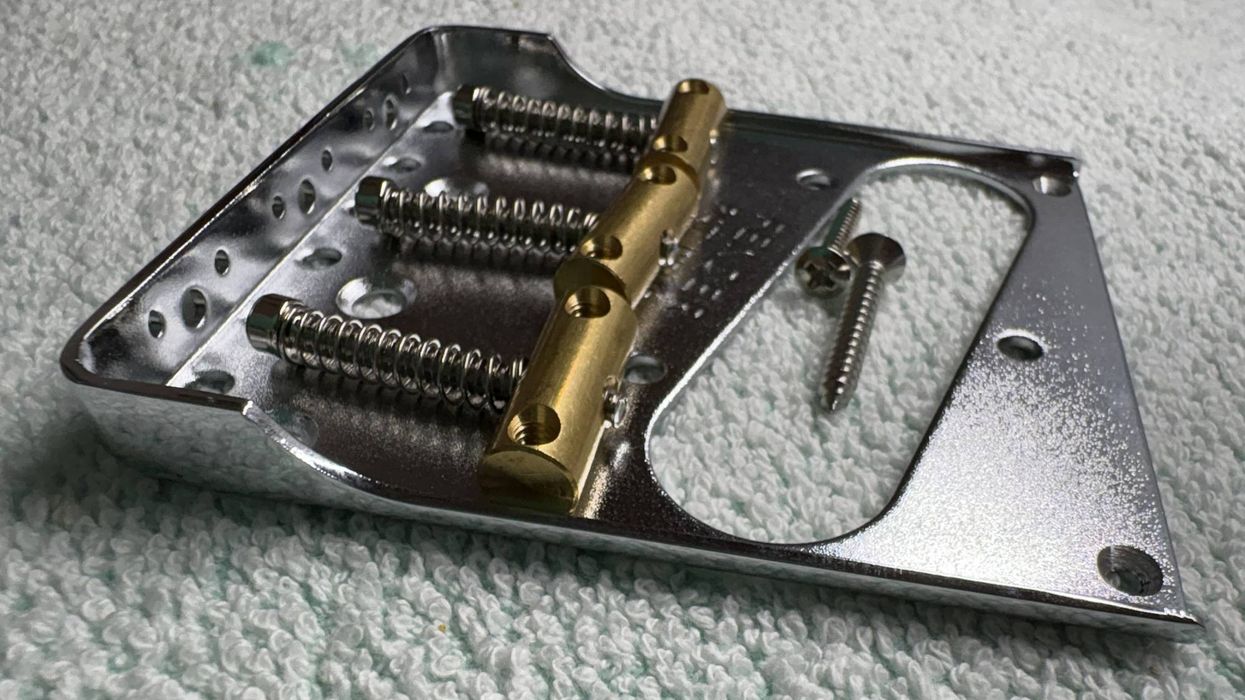
Hello, and welcome back to Mod Garage. Last month, we started to talk about the new bridge and saddles for our guitar, so let’s continue where we left off. In general, the two contact points where the strings meet the guitar are crucial and very important regarding playability, comfort, and tone. It’s always worth taking special care of the bridge and the nut on any electric guitar, and this month, we’re focusing on the bridge. Let’s break down the details of our replacement bridge and what we can expect from it.
The new bridge is much lighter than the stock model, which is great for getting a lighter-weight guitar. The overall weight of a guitar is a major factor for comfortability—a heavy guitar will add nothing to your life besides shoulder and back pain. Contrary to what you might read on the internet, science tells us it won’t increase sustain, nor add any “heavy” tone attributes to the amplified signal.
The thinner metal walls of the new bridge aren’t closed—a great attribute for reducing weight—and the double-cut “tapered walls” are a practical update, though some will disagree and prefer a bridge with vintage-style closed walls. There are countless bridge options for Telecasters, so find the best fit for your playing style. The edges of the short walls on my new bridge felt a little sharp, so I used some fine metal files and sanding paper to smooth them out. Your hand is resting on this surface, so you don’t want any jagged edges.
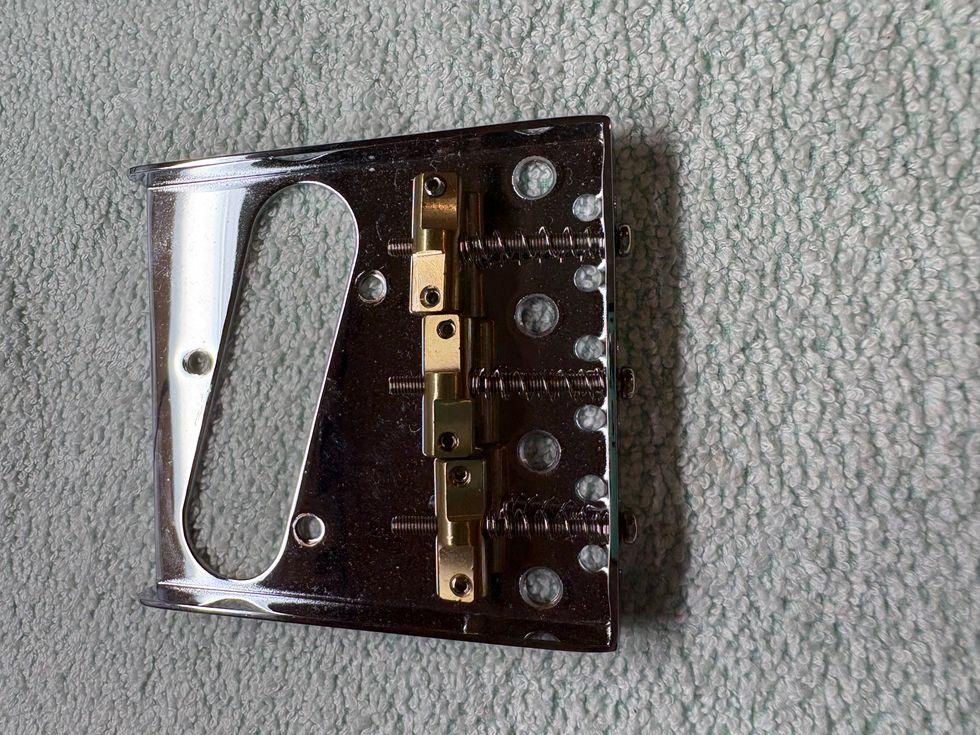
In addition to the classic string-through-body method, the new bridge also offers the late-’50s top-loading option, which means the strings are not running through the body but rather directly through the back of the bridge plate, giving you a gentler break angle. I recommend a bridge that provides you with both options. Top-loading your strings can give a feeling that some describe as “loose” and “rubbery,” but this route has its devotees, like the great Jim Campilongo, and it can make string bends a bit easier. Experiment to see if you like it or not. On my new bridge, all the holes for guiding the strings felt a bit gritty, so I spent some time taking care of any burrs.
The new bridge has two additional screw holes at the front, which is a very clever upgrade—two extra screws there will help join the front part of the bridge to the wood of the body. Speaking of screws, the stock bridge was attached with tiny, soft screws, which I replaced with standard-sized stainless-steel ones.
So why are these two additional screws a boon for our guitar? One of the most common culprits behind unwanted Telecaster feedback is the typical bridge plate itself. The Telecaster bridge system was designed in the 1940s by Leo Fender, and it was a crude design at best. Its function was to position the strings and offer a rough and easy adjustment of intonation and string height. Today, they don’t make them like they used to—the current-production Fender vintage bridge plates, as well as most budget aftermarket versions, are made from thin, hot-rolled steel in a deep-drawn process. This process produces parts very quickly and cheaply, but at a severe cost in quality. The steel used must be soft and thin to allow it to fold and bend in the corners, but sadly, this process creates internal stress in the material, which can bow the plate so that it can’t sit flat on the body. This often creates unwanted feedback on Telecasters.
The early bridge plates Fender made used a cold-rolled steel procedure to avoid this problem. Using two additional screws at the front of the bridge plate to firmly attach it to the body can minimize this issue. Our new bridge is straight as an arrow anyway, but it doesn’t hurt to secure it extra tight. To test your own bridge plate for any bowing, simply place it on a flat surface and check for wobbles. To level things out even more, I sanded the backside of the bridge, starting with 150-grit sandpaper and working my way up to 1,000.
Now, let’s have a look at the saddles. The classic T-style bridge sports three barrel saddles for intonation and height adjustment. As I said before: Crude at its best! Since this vintage bridge has two strings on each saddle, you’ll always be compromising on intonation. If you’re looking for perfect intonation, you should go with a new bridge with six individual saddles, like on a Stratocaster.
My new bridge came with three compensated saddles made from brass, which is the material used in the very early Fender days. These saddles are available in a large selection of materials, including steel, stainless steel, aluminium, diecast, and titanium, and also in compensated, uncompensated, smooth, threaded, and other configurations. (Differences between saddle materials are often audible when playing the guitar unamplified, but nearly none of these subtleties will present in the amplified tone.) For example, if you’re looking to shave off even more weight, I’d go with aluminum, but the brass saddles with my bridge are great quality, so I decided to keep them.
Our brass saddles are compensated for intonation in the most pragmatic way possible: slanted drill holes for the intonation screws. This not only looks quite vintage—it’s effective, too. The stock bridge uses a different compensation technique, which I described in my previous column. It works, too, but the look irritates me, and usually comes with some sharp edges. No matter what system you choose, take care to put the saddles in the right spot on the bridge plate. Typically, you can find an imprint on the underside of the saddles to indicate their position.
Our barrel saddles have a flat underside rather than being completely round, which makes it easier to do a low setup and—you guessed it— saves some precious weight! To make the surface of the saddles as glossy as possible, I polished them in several steps: first with a Dremel tool, before breaking the shine again with some super-fine Micro-Mesh to get to a used look without losing our smooth surface.
Finally, let’s talk about the height adjustment set screws, which are key for comfortability and tone. Depending on your preferred string action and the length of the set screws, chances are good that they’ll stick out a little bit from the top of the saddles. I find this super uncomfortable; bloody palms are not unusual with this quirk! Luckily, this problem is easy to solve.
These set screws are available in different lengths, and since they can make life so much easier for just a few cents, I recommend that you start building a solid collection of short and long versions. Rather than trying to level off the top of the set screws sticking out of the saddles, simply swap in a shorter screw and you’re done.
Take special care of the underside of the set screws, where they make contact with the bridge plate. It’s important to have the flattest, smoothest possible surface here—this is a spot where you can absolutely influence the amplified tone of your guitar. To hold these tiny set screws in place while filing and polishing their ends, I screw them into an old Telecaster saddle so they stick out, and lock the saddle in a vice afterwards. This way, you can work on the underside of the screws with files, sandpaper, or a Dremel. This takes some time, but is very important: I spent roughly 30 minutes with my six set screws, but I’m very happy with the result!
Next month, we’ll continue with our guitar’s pickup, electronics, and wiring. Our $259 budget for future investments remains untouched this month, but not for long! Stay tuned.
Until then ... keep on modding!
Rick Beato says excessive phone scrolling is the reason he can’t downpick like James Hetfield
![[L-R] Rick Beato and James Hetfield](https://guitar.com/wp-content/uploads/2026/03/Rick-Beato-James-Hetfield-hero@2000x1500.jpg)
Who’s got the most ferocious picking hand in metal? 99 times out of 100, that award would surely go to James Hetfield. The Metallica frontman is known for his relentless downpicking capabilities, which are still sharp as a tack in his 60s.
The stamina required to downpick eighth notes at 215bpm for extended stretches and across two-hour setlists is simply out of reach for many players. Your forearm also needs to be kept tremendously physically fit in order for the muscles to cope with the continuous strain.
In a new interview with podcaster Lex Fridman, music YouTuber Rick Beato explains his theory as to why his own downpicking isn’t what it used to be, and it has to do with his smartphone use, apparently…
“James and Kirk [Hammett, Metallica lead guitarist] – the downpicking… I used to be able to do that!” Beato says. “I just can’t do that anymore. It hurts my thumb.
“I think, honestly – I thought a lot about it – it’s like, ‘Why is it so painful, why is it so hard?’ It’s from swiping with your thumb on phones. And I think it affects that basal joint there.”
“I’m serious,” Beato confirms, adding: “I think that that’s actually right. Because I’m thinking, ‘Why does it hurt so much to do that, all the downstrokes and stuff? It’s gotta be something.’ It’s like, yeah, it’s from swiping with a phone.”
So what do you reckon? Do you also suffer thumb joint pain when trying to downpick thrash metal riffs, which may have been made worse by excessive TikTok doomscrolling? It’s an interesting theory, to say the least…
It’s worth noting, though, that even James Hetfield admits he finds Metallica’s relentless downpicking sections tricky at times.
“We all have our own certain songs that are a little difficult,” he said in January on Metallica’s own podcast, The Metallica Report. “Moth Into Flame, Master of Puppets, those are two that are, ‘Wow, those are a little difficult.’ I’m sure Lars [Ulrich, drummer] has his list; we all have our list. But we push through, and we help each other with it.”
The post Rick Beato says excessive phone scrolling is the reason he can’t downpick like James Hetfield appeared first on Guitar.com | All Things Guitar.
“Honestly, I wanted to grab my guitar and smash it through the wall!”: Zacky Vengeance on being put through his paces by Synyster Gates on Avenged Sevenfold’s latest album
![[L-R] Zacky Vengeance and Synyster Gates of Avenged Sevenfold](https://guitar.com/wp-content/uploads/2026/03/A7X-new-hero@2000x1500.jpg)
Avenged Sevenfold’s Synyster Gates has solidified himself as one of the most technically proficient and wildly creative guitarists in rock and metal music in the last 25 years. Known for his devilishly accurate sweep picking and fretboard-spanning rapid-fire solos, his face-melting guitar work is present across the Huntington Beach metallers’ discography.
And in a new podcast episode with YouTuber Nik Nocturnal, rhythm guitarist Zacky Vengeance reflects on trying to keep up with his co-guitarist while recording the band’s sprawling prog-influenced latest album, Life Is But A Dream…
“Dude, I’ve got to be in a band with fucking Synyster Gates!” he jokes. “That dude, he comes up with the craziest jazz chords – and he’s got long-ass fucking fingers… He can span seven, eight frets. And he can play faster than almost anyone. He just can.
“I always say there’s certain shit I cannot do. The same as you can’t run faster than [Jamaican sprinter] Usain Bolt at the Olympics. I can’t play shit as fast as he can play it, no matter how hard I try. I can set the metronome, I can try and try and try.
Zacky continues: “Even with Life Is But A Dream, I had to learn stuff that I’ve never even fathomed and chords I can’t even – but it’s fun! But at first, I mean, honestly, I wanted to grab my guitar and smash it through the wall. But once you’ve got it, you’re happy you did it.”
A highlight of Synyster Gates playing on Life Is But A Dream… comes with a ludicrous solo at the end of third track Nobody. Check it out below:
Elsewhere in the interview, Zacky Vengeance reflects on writing the riff for Waking the Fallen track Unholy Confessions, which remains one of the band’s biggest songs, and is often argued to be one of the quintessential metalcore riffs.
“It kind of blows my mind because having written that riff, I was a kid, you know? I was, like, 20 years old,” he says. “And you have no idea that it’s gonna have an impact when you’re writing it. It was a riff I was playing when I lived in my parents house, when we were touring in a van – running through it at soundcheck.
He explains that he wrote the riff as a byproduct of learning to play guitar. “I was a punk rock guitarist in high school – I grew up learning punk songs, like Bad Religion songs, Pennywise songs, and stuff like that.
“And then when me and Matt started Avenged, he started showing me stuff like At The Gates, Children of Bodom, In Flames, Pantera – shit that I wasn’t fully used to. And I was like this shit’s fucking awesome. I don’t know how to play it though. I can’t play this shit.
“So I was practicing and practicing. I’ve never taken any lessons but I was just trying to play what I heard and come up with riffs, and it was still a full learning phase. And honestly, with guitar, I don’t think there’s ever not a learning phase. I’m still learning.”
Zacky Vengeance is set to release his debut solo record, Dark Horse, on 3 April, 2026. Artistically, the project sees him use his real name, Zachary Baker.
The post “Honestly, I wanted to grab my guitar and smash it through the wall!”: Zacky Vengeance on being put through his paces by Synyster Gates on Avenged Sevenfold’s latest album appeared first on Guitar.com | All Things Guitar.
Mesa/Boogie has relaunched the Triple Rectifier – the amp that helped define metal music

Mesa/Boogie is reissuing its legendary Triple Rectifier amp head – which along with its lower-powered sibling, the Dual Rectifier – has been pivotal in shaping the sound and direction of the rock and metal genres since its launch in the early ‘90s.
Arriving on the heels of the reissue of the Dual Rectifier last year, the Triple Rectifier reissue – dubbed the 90s Triple Rectifier Solo Head – promises the same “layered harmonics, tight low end and percussive mid hit” that made the original such a classic, while sporting a blacked-out aesthetic: with a black chassis, black Speed knobs and black Diamond Plate.
“Since its original release in 1992, the Rectifier family has dominated – and in many ways reinvented – the sound of rock and heavy music, powering walls of crushing high gain for detuned crunch rhythms and bass lines that became the soundtrack of a generation,” Mesa/Boogie says.
Built in Petaluma, California, the 90s Triple Rectifier Solo Head is a metal-ready, 150-watt, Class A/B, all-tube monster packed with six Mesa 6L6 power tubes, and three 5U4GB rectifier tubes. It also features a maintenance-free fixed-bias design and bias switch which support alternate power tube types like EL34s.
 Credit: Mesa/Boogie
There’s also selectable Tube or Silicon Diode rectification, as well as a two-position BOLD/SPONGY power switch, allowing you to tweak the feel and response of the amplifier to your taste and preference.
In keeping with the original Triple Rectifier’s dual-channel design – later versions came with three channels, and the “Triple” refers instead to the inclusion of the three 5U4GB rectifier tubes – the new reissue features two independent channels, with Channel Style/Cloning voicing options plus Gain, Treble, Middle, Bass, Presence and Master dials for each channel. There’s also a tube-driven FX loop onboard, with a global output level control active when the loop is engaged. This loop is also engage-able via external switching.
Weighing just over 22kg, the 90s Triple Rectifier Solo Head’s chassis features marine-grade Baltic birch finished in Black Bronco vinyl with a black Diamond Plate grille. It also comes with a fitted slipcover to keep it safe in transit.
 Credit: Mesa/Boogie
“Following the excitement around last year’s Chrome edition of the ’90s Dual and Triple Rectifier Solo Heads, we wanted to honour one of the most iconic Custom Dress options in our history with a limited run of stealth-inspired ‘Blackout’ Triple Rectifiers,” says Doug West, Director of Tone Lab for Gibson Amplifiers and MESA/Boogie.
“These coveted heads feature the original black chassis, replacing the polished aluminium diamond plate and grille vent with black anodised versions, and swapping chrome speed knobs for sleek black ones.
“Back in the ‘90s, these upscale, blacked-out models dominated stages behind some of the biggest names in rock. Today, finding one on the pre-owned market usually means heavy wear from years of touring – so this is a rare chance to own one in pristine, brand-new condition.”
The 90s Triple Rectifier Solo Head is priced at £3,799. For more information, head to Mesa/Boogie.
The post Mesa/Boogie has relaunched the Triple Rectifier – the amp that helped define metal music appeared first on Guitar.com | All Things Guitar.
“It’s noisy, it’s crap, and we f**king love it”: Max Cavalera was so bad at guitar for Sepultura’s first gig, the guitarist from another band offered to tune his guitar for him

Imagine being so new to guitar that, at your first gig, the guitarist from another band has to step in and tune your instrument for you. That was the reality for Sepultura’s Max Cavalera, who remembers the moment with equal parts horror and humour.
In a new interview with Metal Hammer magazine, the rhythm guitarist reflects on the early days of his career and how the band got started.
“I wanted to be a drummer at first,” Cavalera explains. “[Iggor, his brother] was a born drummer, a natural talent, but he didn’t have a drum kit until [Sepultura’s third album, 1989’s] Beneath The Remains… He was way better than me, so I had to pick a new instrument and guitar seemed like the right choice.”
Even after picking up the guitar, the learning curve was steep. “I didn’t know how to play,” Cavalera admits. “I still remember when I learned the first riff of [Black Sabbath’s] Heaven And Hell, I ran out and did laps around the backyard. I was like, ‘I made it! I’m somebody!’ Ha ha ha! It was like a moment in a comedy movie.”
Which probably explains why the band’s first gig was… a bit of a mess.
“I remember playing with this band Overdose and they were really good, like a Brazilian version of Maiden,” says Cavalera. “The girls loved them. We were the opposite. The girls hated us, we didn’t know how to play. The guitar player from Overdose took my guitar and everything was out of tune. He said, ‘Let me tune the guitar for you, bro’, but it didn’t help my playing. It was just noise.”
Still, there were small victories amid the chaos.
“There were two guys wearing Motörhead shirts and they fucking loved the show!” Cavalera recalls. “‘You guys are the greatest thing ever! It’s noisy, it’s crap, and we fucking love it!’ Two guys out of a hundred. Ha ha ha!”
The post “It’s noisy, it’s crap, and we f**king love it”: Max Cavalera was so bad at guitar for Sepultura’s first gig, the guitarist from another band offered to tune his guitar for him appeared first on Guitar.com | All Things Guitar.
Two Notes Reload II review: is this the new king of amp-top attenuators?

$1,099/£999, two-notes.com
The original Two Notes Reload was something of a well-kept secret in guitar circles. In terms of profile, it was frequently outshone by the undoubtedly impressive Universal Audio OX Amp Top Box, but that was more to do with marketing than capabilities. It might not have had the stylish looks to become a constant feature in the background of every guitar influencer’s videos, but the Reload could go toe to toe with it in features and usability.
Perhaps the industrial appearance of the original Reload didn’t help its case against the undoubtedly nicely designed Ox Box, but for those in the know, it became a real weapon on stage and in the studio.
 Image: Adam Gasson
For starters, the original Reload came packaged with Two Notes’ cabinet emulator plugin, Wall Of Sound, which offered hundreds of different cabinet and mic options, many of them designed in conjunction with prestigious guitar amp and cabinet manufacturers.
It’s part of why many guitarists were disappointed when the original Reload was discontinued a few years back. But never fear, now the Reload is back in a completely redesigned package – is this the Ox-beater we’ve been waiting for?
Two Notes Reload II – what is it?
Two Notes claims the Reload II is a “ground-up rework” of the original, and this time the load response receives the stamp of approval from perhaps the most authoritative name in guitar speakers – Celestion.
“With a completely new load architecture developed for Reload II, it was essential that the response didn’t just perform well technically but behave in a way that felt authentic to both players and amplifier”, says Guillaume Pille, Two Notes founder and CEO. Collaborating closely with Celestion to ensure it met their expectations for real-world speaker behaviour, the design process culminated in an impedance curve inspired by Celestion’s iconic driver lineup, earning Reload II the industry-first Celestion-Approved Load Response badge.
 Image: Adam Gasson
Whereas most load boxes base their impedance curve of a single speaker or cabinet, the Reload II was instead developed by analysing and averaging impedance characteristics across a range of Celestion drivers. According to Guillaume, “this approach delivers a balanced, musically responsive load that works optimally across the broadest possible range of amplifiers, rather than being tailored to a single tonal reference”.
Two Notes Reload II – build quality and design
You’ll also have noticed that the Reload’s aesthetics have been given a serious upgrade here. Gone is the utilitarian metal casing and cheap-looking black knobs, replaced instead with an elegant brushed-steel front panel and neatly laid out control panel, beautifully flanked by faux-wood panelling. It still weighs a significant amount, but this is one of the few times that weight is an indication of quality, as serious components are required to absorb up to 200W of amp power.
Most guitarists will likely be looking at the Reload II for its attenuation and cab simulation, but it offers far more than that. It’s also a solid-state two-channel power amplifier capable of outputting 215 watts per channel from an amp or line level source, each with a stereo effects loop. The potential live and studio configurations possible would take up this entire review, but of particular interest is the ability to run a wet-dry-wet amp stereo setup using just one amplifier.
 Image: Adam Gasson
The line-in facility may be of particular interest to those playing through digital modellers. Should you wish to use them in a more traditional setup or even simply as an onstage monitor, then it can be run it direct into one of the two channels, which will power a cabinet or FRFR speaker.
Why would we need an effects loop in a loadbox? Well, the stereo effects loop will prove a godsend for those using single-channel or vintage amps without effects loops. Many vintage amps, including my ’85 Marshall JCM800, have no effects loop. This means everything, including modulation, reverb, or delay, must be routed through the front of the amp, which generally yields a tone completely enveloped by the effect. Using it via the Reload enables us to mix in these effects post-power and preamp section.
Two Notes Reload II – in use
With the luxury of several amps to choose from, I select the one with a tone that has been least accurately reproduced following attenuation over the years – my Mesa Mark IV head. I take a line from the speaker-out and plug into the Reload’s amp-in jack socket, setting the impedance to 8 ohms (4 and 16 ohms are also available), and then plug my 2×12 Mesa cab with Vintage 30s into one of the ‘cab-out’ sockets.
Like most Mesas, the Mark IV doesn’t rely on its 85-watt power section for overdrive, but even with a master volume it’s extremely difficult to generate usable tones at bedroom-friendly levels on its own – let’s see if the Reload II changes that.
Setting the master volume halfway and dialling in my usual gain-laden tone on the amp’s lead channel, I begin to crank up the oversized cab volume knob on the Reload II. One of the most coveted retained features of the original Reload that returns here is the ability to increase/decrease volume in a linear fashion with precise, smooth increments – all the way from barely audible to deafening.
 Image: Adam Gasson
At a very low volume, my sound is immediately recognisable, still in possession of the punch and grunt I was expecting, but without upsetting the neighbours. As per its predecessor, there are tone-shaping controls on the front of the unit, to dial back in any frequencies you may feel lost during the attenuation process. A common side effect of attenuation is a slight loss of high-end, and this can be compensated for on the Reload by turning up the presence control.
However, as I sweep through different volumes, I don’t feel the need to add additional presence or depth. Tube amps, irrespective of attenuation, always sound better with the volume up, so I choose to crank it up a little bit more, still within reasonable volumes. What I continue to experience is the information-laden guitar tone that I’ve come to expect from my beloved amp, and the loss of detail that feels inevitable with attenuation is barely perceptible, if it exists at all.
Connecting one of the two line-outs from the Reload into my audio interface, I load up the included Genome software. It seems quite a significant upgrade on the former Wall Of Sound cabinet emulation software in terms of appearance and features, and it’s straightforward enough to use without the manual. Input and output volumes feature at the top of the screen and directly underneath is a left-to-right signal chain of 10 blocks, which can be filled with a variety of applications such as amps, cabs, effects and so on.
The first step is to insert a DYN-IR cabinet. There are 16 dynamic cabinets free with the Genome, but fortunately, I’m also able to restore and use previous purchases I made via the Wall Of Sound app. So I load up a 2×12 Rectifier cabinet with Vintage 30 Celestion speakers. The cabinets are all dynamic, which means that you can move the position of the mic onto different areas of the speaker cone and at different distances. There is also a selection of mics to choose from, but my choice is a virtual Royer 121 ribbon mic pointed at the middle of the cone.
 Image: Adam Gasson
It’s a little sludgy sounding at first so, as I would in the physical world,I add a virtual Shure SM57 to balance out the low end and provide more high-mids. I’m quite blown away by the accuracy of the tone. In my opinion, many load boxes with cab emulation are a little fizzy in the top end and a great deal of tone shaping is required to achieve accurate emulation of the desired tone. Here though, my amp’s character is instantly recognisable.
To finesse further, I load a graphic EQ into my chain block and enact a low-cut on the lowest of frequencies, then finally I add a tiny bit of reverb to thicken up the sound a little. It sounds very impressive, and A/B’ing with both the actual mic signal using the same mic and cab, and our Fractal Audio Systems Axe FX III Mark IV profile (which is a superb recreation of the iconic amp) reveals very little difference at all.
Two Notes Reload II – should I buy one?
The original Reload, with its sensitive and accurate linear attenuation (not stepped-up volume like the Ox), was arguably one of the best attenuators on the market. The Reload II has really taken the attenuation accuracy much further and the Genome software (of which a lifetime license is provided) is much more user-friendly and feature-packed.
A grand is a lot of money to spend on any bit of hardware that doesn’t actually make any noise itself, but it’s worth remembering what you actually get here. Not only do you have a superb attenuator and uber-accurate cab simulation, but you also get a two-channel power amp, allowing a plethora of live and studio set-up options, including the ability to run a wet-dry-wet setup.
You also get Genome, with its plethora of effects and tone-shaping tools, which even in its infancy, delivers regular updates and a flow of third-party cabinets, which can’t be said of one of its main high-profile competitors.
Despite the hyperbole about amps facing their demise following the domination of digital modellers, reality tells us differently. These modellers wouldn’t exist without amps and the raison d’etre of two of the most popular – Kemper and Quad Cortex – is to profile your own amp. Guitarists will always love tube amps, but the difficulty of operating them within an acceptable volume whilst running the tubes hot is age-old, but this has now been comfortably addressed by the proliferation of load boxes. The Reload II has proven itself to be the best of them. Don’t let the price fool you – the package is worth every penny.
Two Notes Reload II – alternatives
The Fryette Power Station ($1,199 / £899) is the Reload II’s biggest competitor in my view. Having similar features, including a high-end amplifier attenuator, effects loop, a reactive load and the real kicker; it also possesses a 60-watt valve power stage built-in so it can be used to beef up the volume of any low-wattage amplifiers you may wish to use live. This is a highly regarded unit amongst guitars, preserving any amp’s tone in low volumes much better than the opposition. It doesn’t come with its own cabinet emulation software but does feature a line-out so that it can be used with third-party software.
The Universal Audio OX Reactive Amp Attenuator with Speaker Modelling ($1,499 / £1,259) is currently the industry standard loadbox and a mainstay in studios around the world. Featuring attenuation capabilities and a cab emulation software suite loaded with the most iconic of speakers, cabs, and microphones, its firmware and software updates are few and far between, but fans of the unit would argue that UA got it right first time, so updates are superfluous.
The Suhr Reactive Load Box ($599 / £419) is another hugely popular choice. With its impedance curve based on one of the most popular speakers, a Celestion Greenback in a 4×12 cab, its emulation is known to be warm and dynamic. It’s limited to an 8-ohm input but it’s unlikely to find many amps that don’t output this impedance.
The post Two Notes Reload II review: is this the new king of amp-top attenuators? appeared first on Guitar.com | All Things Guitar.
Steve Vai plays on cover of Van Halen’s Jump for 2026 World Cup anthem

Van Halen’s ’80s classic Jump has been given a fresh spin for the FIFA World Cup 2026, with guitar virtuoso Steve Vai lending his chops to the new cover.
The reimagined track arrives via Coca-Cola’s Real Thing Records label in partnership with Capitol Records, bringing together Latin pop heavyweight J Balvin, singer Amber Mark, Vai and Blink-182 drummer Travis Barker.
“Being a football fan means feeling everything at full volume – the joy, the heartbreak, and the hope that keeps you coming back,” says Joshua Burke, Head of Global Music & Culture Marketing at Coca-Cola. “Jump captures those shared highs and lows that unite fans everywhere. Coca-Cola and the FIFA World Cup have always brought people together, and we wanted this track to feel like that moment when millions of fans are singing the same feeling at once.”
While the original’s unmistakable synth stabs remain front and centre, the new version leans further into modern pop territory. Balvin delivers an extended rap verse, while Vai takes on guitar duties, recreating – and putting his own spin on – the iconic solo first made famous by the late Eddie Van Halen. The track was first teased earlier this year through Coca-Cola’s ‘Bubbling Up’ campaign as part of the build-up to the 2026 tournament.
Released on the band’s blockbuster 1984 album, Jump remains the most successful single in the Van Halen catalogue. At the time, its synth-driven hook marked a surprising pivot away from the band’s bluesy hard-rock formula. For some fans it was a shock; for everyone else, it was irresistible – and the gamble paid off, turning the track into one of the most recognisable arena anthems of the decade.
Its connection to sport runs deep too. Ahead of the 2012 Summer Olympics, Jump was voted most popular sporting anthem in a poll conducted of members PRS for Music.
“Van Halen’s Jump is one of those rare songs that transcends generations, so approaching it came with a lot of respect,” says Mark. “Being able to honor the original while bringing a modern perspective was incredibly special.”
Vai’s presence also adds a neat historical link to the Van Halen camp. In the mid-’80s, the guitarist joined David Lee Roth’s solo band following the singer’s split from Van Halen – a gig that saw him tackling Eddie’s famously acrobatic parts on songs like Panama and Hot for Teacher night after night.
The new single arrives alongside an animated music video directed and designed by McFlyy, featuring stylised versions of the performers and an animated cameo from football star Lamine Yamal as the road to the 2026 World Cup ramps up.
Listen to the track below.
The post Steve Vai plays on cover of Van Halen’s Jump for 2026 World Cup anthem appeared first on Guitar.com | All Things Guitar.
IK Multimedia Expands TONEX Ecosystem
Vintage Vault: How a Sunburst 1960 Gibson Les Paul Broke My Heart
I don’t usually give advice because, as a friend of mine pointed out a long time ago, “Giving someone advice makes you an accomplice.”
And yet, here I am being someone’s accomplice, because I’m about to give you some knowledge, straight from the chef: If you want to get a guitar collector to pay attention, mention these four little words, “Uncirculated sunburst Les Paul.” If their hearing is in order, you will have their complete and undivided attention.
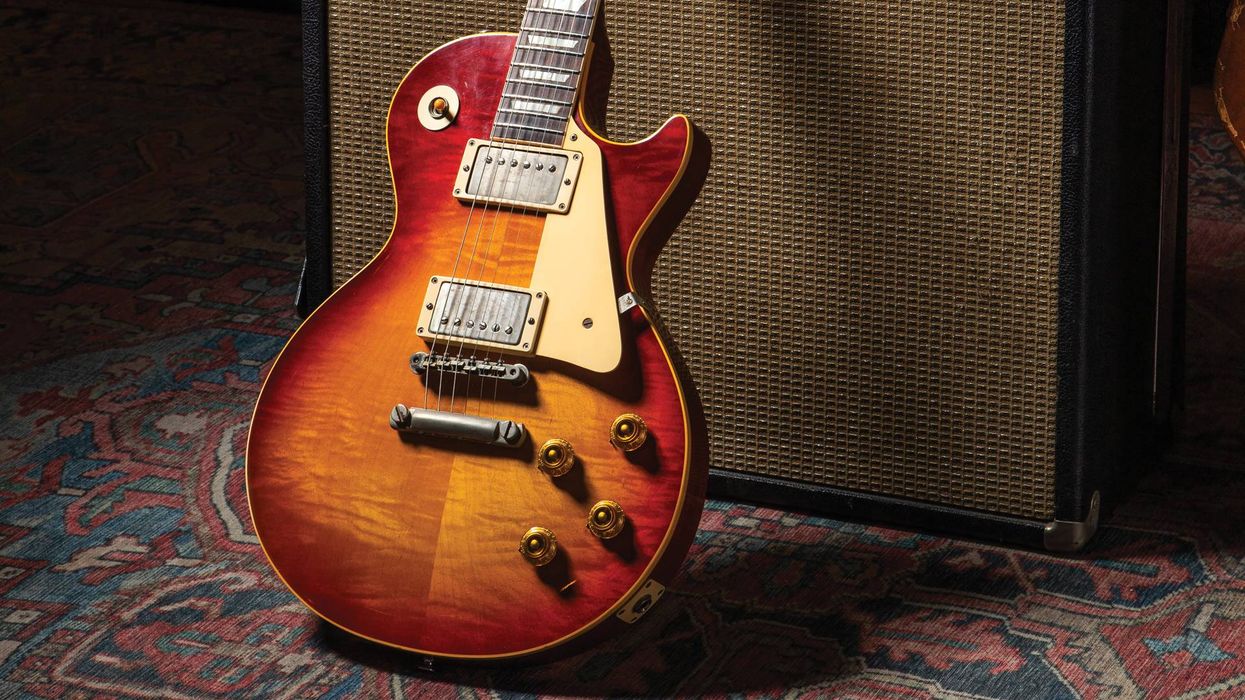
Carter Vintage recently picked up this gorgeous early-1960 Gibson Les Paul Standard from its second owner. He was quite discerning with his collecting choices. This 1960 ’burst is one of two sunbursts we brought back from his place on the East Coast, and there wasn’t a bad guitar in the whole bunch. In my conversation with him, the owner of the guitar told me he bought it in the early ’70s from the original owner. I asked him if he ever played the guitar professionally, or used it in a band—he hadn’t. He never played out with any guitar in his collection; he simply bought them because he thought they were cool, and guitars are a passion of his. He’d had the instrument for over half a century, and now it was time to pass it along to its next caretaker.
“This guitar has totally ruined other Les Pauls for me.”
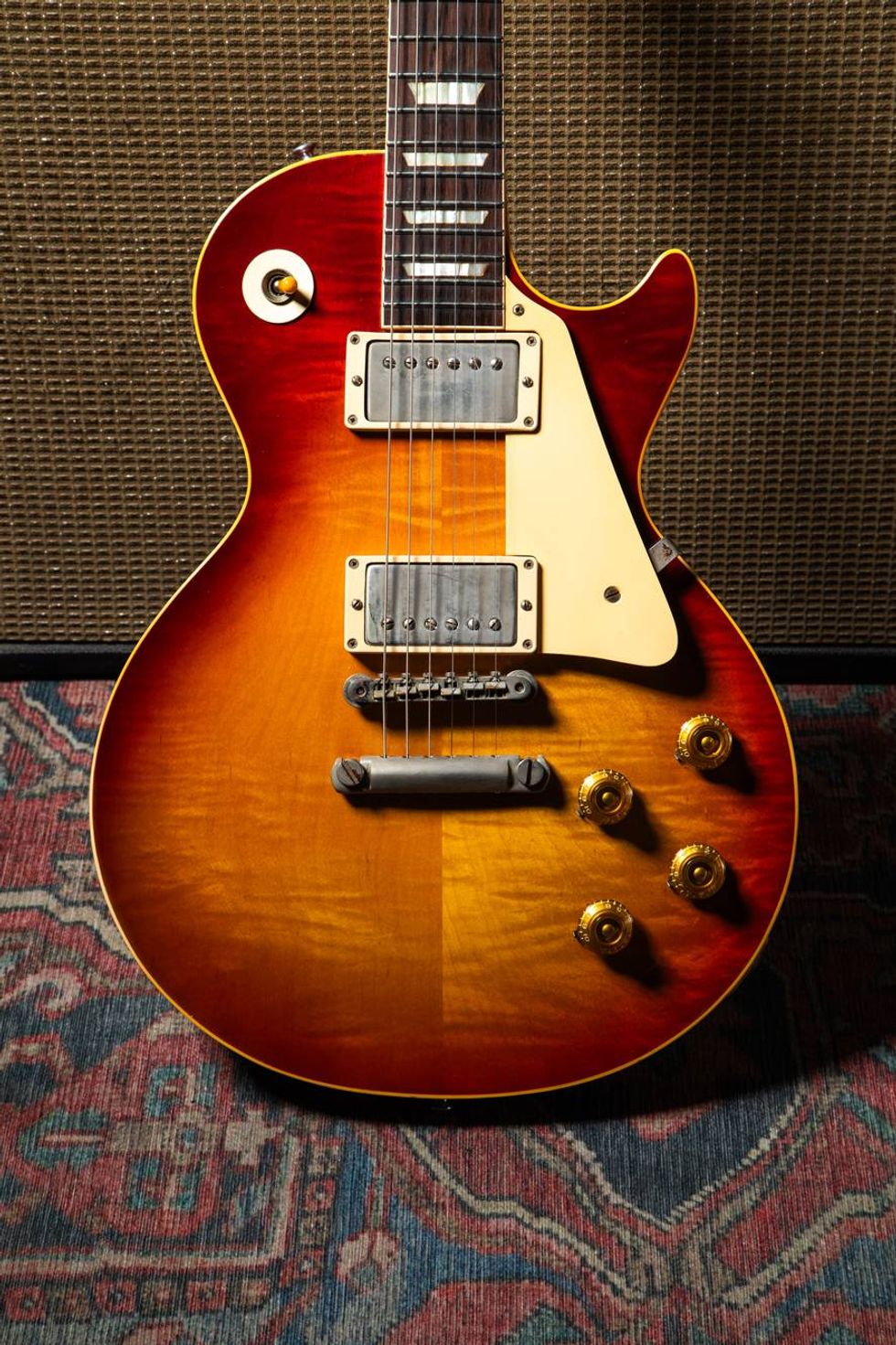
Whenever I open a brown 5-latch Gibson case with a late-’50s Les Paul Standard in it, the first place my eyes go is the top. This guitar definitely pushed all my “personal fave” buttons: Gorgeous figured maple, “action” (how the figuring on the top moves and lights up as you angle the guitar in the light), and the color all hit the spot for me. The top on this guitar is one of my favorite ’burst tops ever. It’s not an overly flashy, wildly flamed guitar like the Stanley ’burst, or Nikki, but at the same time it’s not subtle, or understated, like a plaintop would be. If I had my pick of tops for a ’burst, this guitar would win, and out of around 15 sunbursts we’ve had in the store over the past year, this one takes the cake.
The next thing you notice on this ’burst is the color, and it’s crazy good. No iced-tea ’burst, lemon-drop top, or anything like that here. The red in the sunburst has been preserved incredibly well, and it fades perfectly into the amber and gold of the body’s center. These guitars are now in their late sixties, and to find one that’s not severely faded out is a rare occurrence.
Now for the fun part—playing it! I picked the guitar up and was initially greeted by the slim neck. I don’t know about you but I really love, to the point of adoration, the slim necks on 1960-through-mid-’62 Gibsons. The old-school players called them “speed necks,” and that’s an excellent description. Once you learn how to relax while playing these things, you can really get around so effortlessly. I think this neck was actually taken down a bit slimmer than the way it came from the factory, because it’s in the “Jimmy Page Number 1” ballpark. Way back in the ’70s, I remember reading an interview in Guitar Player with Joe Walsh, and he said the thin-neck ’60s Les Pauls were his favorite for their sonics and feel. Joe knows guitars. That Page guy isn’t so bad either.
On to the sound. I was just talking with a big-time pro guitarist who plays for an even bigger-time country-music icon and, before plugging in the guitar, he posed a question that I hear quite often: “Sunburst Les Pauls, don’t they all sound great?” In a word, no. They definitely don’t all sound great. Some of them are about as forgettable as can be. My old friend Tom Murphy says that with the advent of the Murphy Lab finishing process at Gibson, they’ve caught up with the old guitars in how they sound and feel. As usual, Tom’s not wrong. I’ve heard some Murphy Lab guitars that can absolutely hang with their vintage counterparts. In some cases, they can lap the old guitar sonically. Not all the old ones sound great.
Back to our subject, this killer ’60 sunburst. Some rare vintage guitars sound and feel so good that nothing else even comes close. This 1960 ’burst is one of them. Bridge pickup, neck pickup, middle position, roll the tone off, roll it back up, turn the volume down, turn the volume up: There isn’t a switch position or control setting that isn’t absolutely stunning with this guitar. I’m more than a little bummed about the way this guitar sounds, the truth be told. My good friend Dave Cobb told me years ago that you have to be careful about what sonics you allow into your ears: “You can’t un-hear stuff, man. It’ll ruin you if you hear the wrong thing.”
This guitar has totally ruined other Les Pauls for me. Yes, it’s that good. For the life of me, I can’t quit hearing it in my head. But being ruined never felt so good. I love my job!
“I used to give Stephen s**t because he wasn’t a shredder like Eddie Van Halen”: Original Deftones bassist says he used to make fun of Stephen Carpenter’s guitar skills
![[L-R] Dominic Garcia and Stephen Carpenter](https://guitar.com/wp-content/uploads/2026/03/Deftones-hero@2000x1500.jpg)
Stephen Carpenter’s Deftones riffs have played a pivotal role in shaping the alt-metal genre. But his guitar skills haven’t always been universally admired.
In a new interview in the latest issue of Metal Hammer, original Deftones bassist Dominic Garcia – who held the post between 1988 and 1991 – remembers actively teasing Carpenter during the band’s early years for not being a “shredding guitar player”.
While Garcia was the band’s original bassist, he assumed the drummer position “around 1991 or 1992” after he says original drummer Abe Cunningham “left the Deftones” to join another band called Phallucy.
“I took over on drums and that’s when [bassist] Chi Cheng joined the group,” he says. “I loved Chi, he was really cool – he was into poetry and all this stuff. Just a wonderful, kind-hearted person.” Chi Cheng remained a member of the Deftones until 2008, when he was involved in a serious car crash in California. Cheng died in 2013 from a sudden cardiac arrest.
Garcia continues, explaining that Phallucy’s bassist quit, and the idea of him playing “two different instruments in two different bands” – drums in Deftones and bass in Phallucy – seemed “super-cool”.
“I found out from a third party that Stephen had got a guy named John Taylor to play drums in the Deftones,” he says. “I was a little bit heartbroken because I’d started the band, but we were still friends.”
He adds: “I used to give Stephen a load of shit because he wasn’t a shredding guitar player like Eddie Van Halen. I was just being a snob, a cocky kid, but maybe it was low-key bullying.”
As it stands, Stephen Carpenter is still not touring internationally with Deftones. In 2022, the guitarist announced his decision to step away from performing with the band outside the US. Many believed it was due to his anti-vax views around the time of the Covid pandemic. The guitarist has also noted his struggles with anxiety more recently.
Last year, frontman Chino Moreno noted he wasn’t sure the exact reason why Stephen Carpenter was refusing to tour with the band outside the US,
“I don’t want to speak for him. And even if I could, I still don’t have an answer,” he told Metal Hammer. “And if he does have an answer, I think it’d be great if one day he would share it. But yeah, we support him. We have to. He’s our friend. And his health, be it physically or mentally, always takes the forefront of anything.”
View the Deftones website for a full list of upcoming tour dates.
The post “I used to give Stephen s**t because he wasn’t a shredder like Eddie Van Halen”: Original Deftones bassist says he used to make fun of Stephen Carpenter’s guitar skills appeared first on Guitar.com | All Things Guitar.
“I didn’t know if I wanted to be on that train”: Original Trivium frontman explains why Matt Heafy’s “laser focus” on perfection made him leave the band

While Matt Heafy has very much been the face of American metal heroes Trivium for the bulk of their career, the band’s original frontman was Brad Lewter, who filled the spot between 1999 and 2000.
A year after their formation, the band recruited a young Heafy at only 13 years old. And despite his fledgling status, he played a pivotal role in driving the eventual success of the band.
In a new interview in the latest print issue of Metal Hammer, Lewter recalls the shift in the band’s dynamic after Heafy joined, explaining how the “determination” of Heafy and founding drummer Travis Smith had him questioning whether he “wanted to be on that train”.
“Heafy and Travis were really determined,” Lewter explains. “They’d be woodshedding, where you just sit and go over the same riff over and over again, whereas me and [founding member] Jarred [Bonaparte] had other things away from the music.
Lewter remembers Heafy’s “laser focus” and pursuit of perfectionism, adding: “His dad was very active in management and promotion and I didn’t know if I wanted to be on that train.”
The vocalist ultimately left the band in 2000 – a year after Matt Heafy joined – but admits he did later feel a sense of regret after witnessing the group’s success.
“There were some regrets about hopping off when I did – seeing them on MTV or touring with Metallica – but it wasn’t for me,” he says. “I’m more of an introvert. I’m an animator, and so I would sit in my comfortable space in a dark room in front of a screen.”
Things all worked out in the end, as Lewter is now a professor of animation at Ithaca College, New York.
“I am still friends with Heafy and his wife on social media,” he explains, “so I see the updates, and that’s not the kind of life I could sustain.”
Trivium’s last album was their 10th outing, In the Court of the Dragon, which landed in 2021. The band have confirmed a new album is in the works, with an eye to release it in late 2026 or early 2027.
The Orlando metallers also have a number of shows booked in Europe this summer. For tickets and a full list of dates, head to Trivium.org.
The post “I didn’t know if I wanted to be on that train”: Original Trivium frontman explains why Matt Heafy’s “laser focus” on perfection made him leave the band appeared first on Guitar.com | All Things Guitar.
Squeeze’s Glenn Tilbrook Comes Full Circle
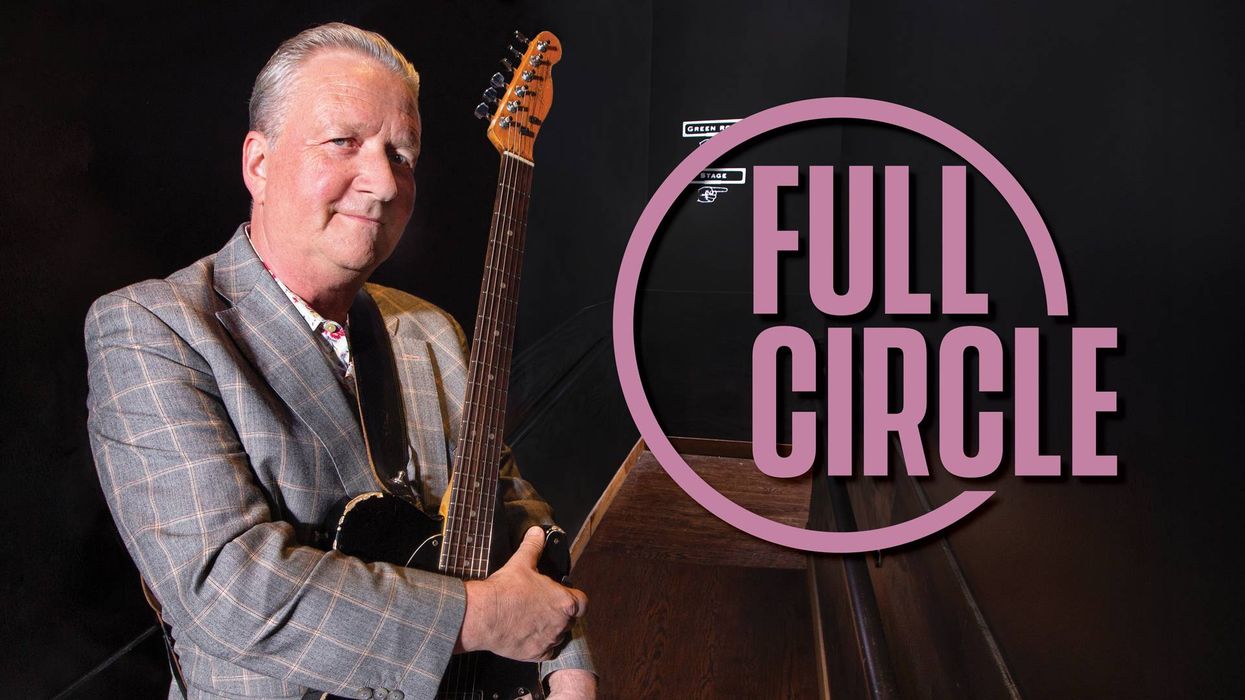
In the world of rock guitar, Glenn Tilbrook may be the ultimate IYKYK (“if you know, you know,” for us old-schoolers). Because anyone familiar with Squeeze, the band he co-founded in the 1970s, is aware that hiding in plain sight alongside his songwriting and lead vocals are some masterful guitar hooks, solos, and arrangements. In a Tilbrook appreciation titled “Humble Guitar God,” CultureSonar editor Al Cattabiani declared, “Simply put, he’s a quiet monster.”
Squeeze has been termed new wave, pub rock, power pop, post-punk, and more—always a sign that a good rock ’n’ roll band has multiple tools in its shed. In its 50-plus years, surviving breakups, hiatuses, and wholesale personnel changes, Tilbrook and Chris Difford have been its only constants. “Chris and I were writers, first and foremost, and we were an exciting rock band,” Tilbrook reflects. “We were probably better than most of our contemporaries, I would say. We were more rock ’n’ roll, and we could deliver as a band onstage.”
They still do. Though they had more success in the U.K. than in the States, folks everywhere seem able to hum “Tempted.” They were making videos as far back as their 1978 single, “Take Me I’m Yours,” three years before MTV came along, and were on American Bandstand in ’82. Top 10 hits in England like “Cool for Cats” and “Up the Junction” didn’t dent American charts, but crowds large and small sing along to them—as well as “Hourglass,” “Annie Get Your Gun,” “Black Coffee in Bed,” “Is That Love,” and “Pulling Mussels (from the Shell).”
In 1973, 18-year-old Chris Difford put a wanted ad in the window of a sweetshop in Blackheath, Southeast London. It sought a guitarist with influences like the Kinks, Lou Reed, and Glenn Miller. Tilbrook, three years younger, was the only person who responded.

Glenn Tilbrook’s Gear
Guitars and Basses
- 1954 Fender Telecaster
- 1966 Fender Telecaster (black) with Gene Parsons StringBender (added in ’75)
- 1954 Fender Stratocaster
- 1966 Gibson ES-345
- 1930s Gibson parlor acoustic
- Gibson Firebird
- Gibson ES-125
- Gibson ES-335
- Gretsch Chet Atkins Country Gentleman
- Jerry Jones Master Electric Sitar
- Taylor 665 12-string
- Avalon L10C
- Danny Ferrington custom f-hole guitar
- Martin nylon-string
- Hofner Violin Bass
- Fender 5-string bass
Amps
- Fender Blues Junior IV
- Fender Twin
Effects
- Dunlop Cry Baby
- Strymon Deco
- Strymon Flint
- Strymon Riverside
- Strymon El Capistan
They determined that Glenn was better equipped to put music to Chris’s lyrics. They were called “the new Lennon and McCartney,” an appellation nobody cares to be saddled with. In terms of a working model, they more closely resemble Bernie Taupin and Elton John. “Yes, exactly like that, in that order,” Tilbrook says. “Each one handwritten on the page, and I go off and do my thing, write the chord changes.”
Difford rarely offers any direction, leaving Tilbrook to his own devices. Glenn recounts, “When I was growing up, there were songbooks that just had the lyrics of the hit songs of the day, and that was a lot of how I learned. I could figure out how they went. If I didn’t know the song, I’d make up my own tune. I’ve written some stuff, but my lyrics aren’t very good. Chris was more developed as a songwriter.”
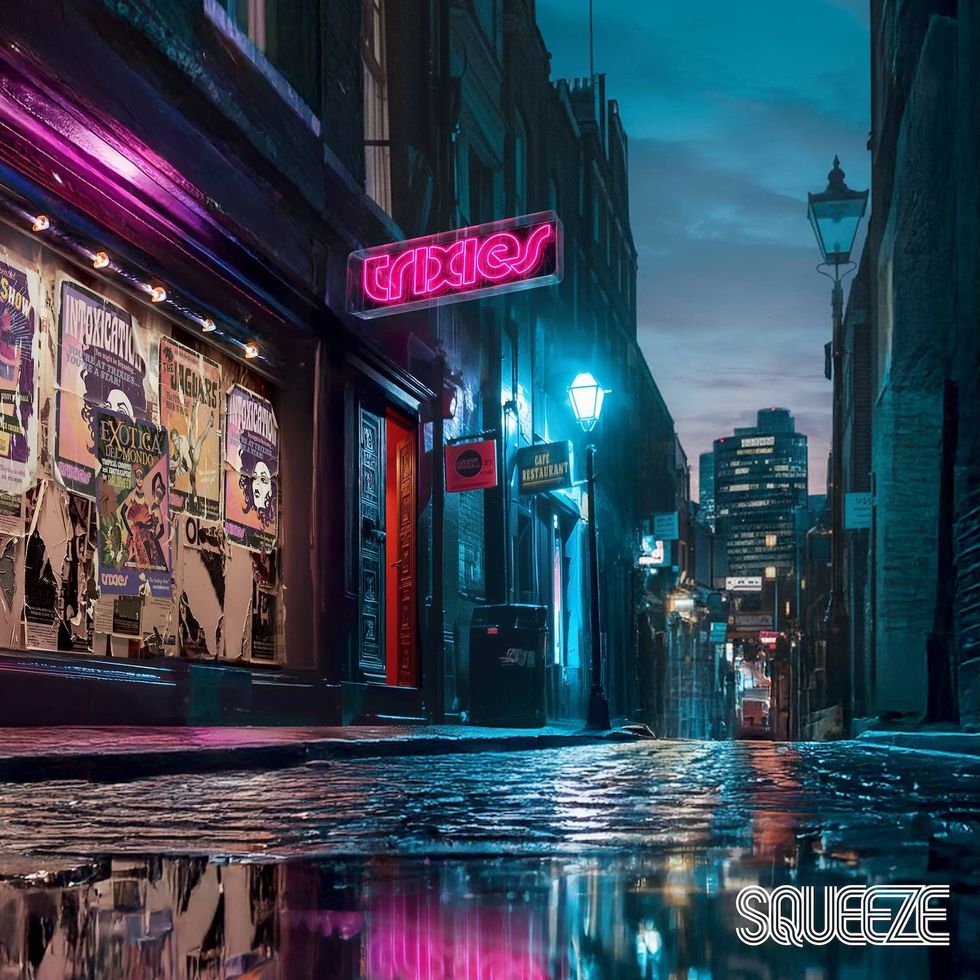
A window into the early stages of that partnership is the new Trixies. “It’s a set of songs that we demo-ed in 1974,” Tilbrook details, “obviously when we were hoping to get signed, but that didn’t happen. I’m honestly amazed at what we did at that point. It was more sophisticated than stuff we did quite a few years after that. Our manager said, ‘You have to simplify; otherwise, people won’t know who you are.’ We were all over the place, but the band couldn’t play it then. Now we can play it, so it’s really gratifying to see the path and development.”
Re-recorded with the current lineup, the new release is a concept album about a nightclub named Trixies. “‘Good Riddance,’ I actually did eight solos, and then I stitched it together,” Tilbrook says. “It reminded me of listening to shortwave radio as a kid, with stations drifting in and out. It’s my Gibson ES-125. I write 80 percent on keyboard—a lot of this on an RMI.”
“Chris [Difford] and I were writers, first and foremost, and we were an exciting rock band.”
A child's first album and concert may not be pivotal, but they’re often revealing. “Last Train to Clarksville,” with the layered guitars of Louie Shelton, Gerry McGee, and Wayne Irwin, prompted Tilbrook to fork over six shillings and eight pence for the single. “What a great record,” he exclaims 60 years later. Despite the controversial revelation that the Monkees didn’t play on their records, he declares, “They were a massive thing for me. To me, it absolutely was real. I think they made great pop records. The first concert I went to was at a folk club when I was 13, to see an Irish duo, Tír na nÓg. I was absolutely enchanted by them. Sort of whimsical folk music. Then the first bigger concert I saw was T. Rex. ‘Bang a Gong’ had just come out, and Electric Warrior, and that just blew my mind. Marc Bolan was such a weird songwriter and player. He wasn’t very good, but he was great at the same time. And the effect he had on the audience was also part of the experience and atmosphere. It was electrifying. I was literally buzzing.”
Bolan’s influence can be heard on “It’s Over” from Trixies. “The house band, the Jaguars, are through the prism of T. Rex, which was quite English. Bolan’s solos are really odd. I don’t know how he gets to the places he does and gets away with it. But he does.”
Sometimes as important as a first guitar is a tape recorder. “I started playing when I was six or seven, and I put a lot of time into it,” Tilbrook says. “I was fascinated, and there was music in the house, like Sinatra, Ella Fitzgerald, George Shearing. My nylon-string guitar didn’t have a make. I very much regretted painting it with wall paint when I was 11 or 12. It was still playable, but something changed about the sound, regrettably.”
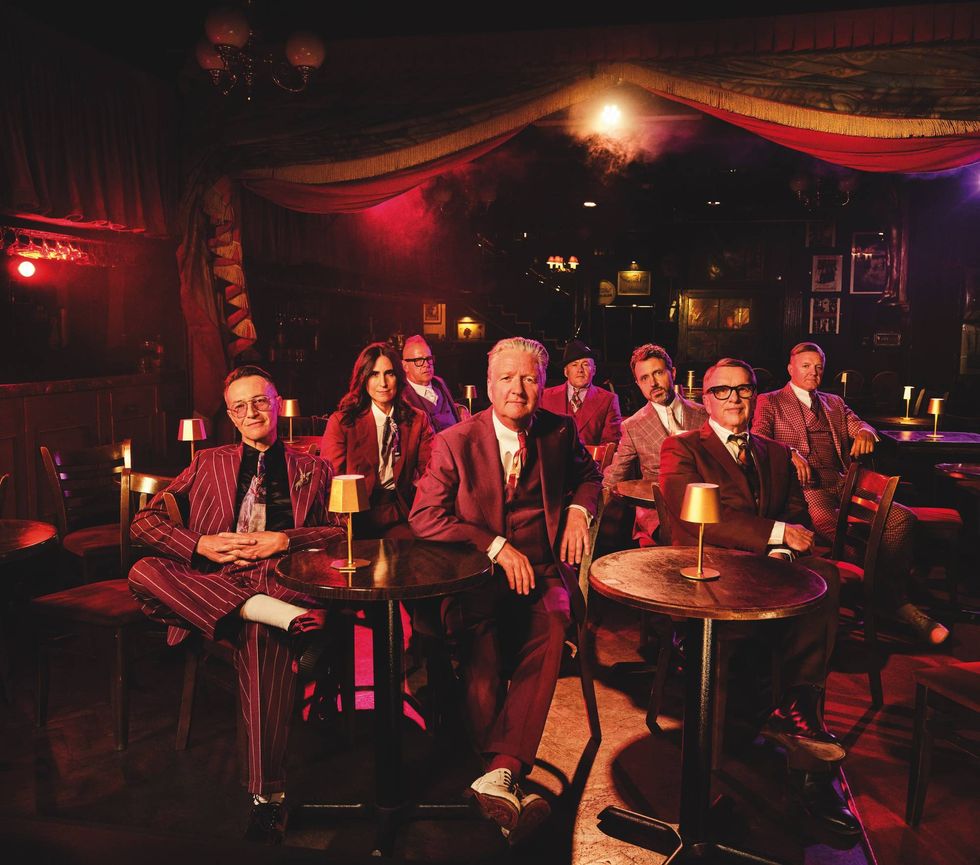
He continues, “Recently I’ve gone back to playing a nylon-string. It has such a lovely, emotive sound. I can remember the exact date that my dad bought me a cassette recorder—December 19, 1967. It was everything I wanted. The fact that I could record myself was pure pleasure. I loved learning, and by the time I was 12, I could play pretty well. I’ve had a studio since ’93, and the first things I could afford to work with were ADATs. They were absolutely brilliant and very game-changing for me.”
Squeeze’s 1977 EP, Packet of Three, and self-titled debut album the following year were produced by Velvet Underground alumnus John Cale. “Our manager got him to produce us,” Glenn explains. “Chris was into Velvet Underground before I was, but I really liked them, too. John didn’t like the pop side of us, and he didn’t much like our songs, and threw them out. But when he was engaged and onto something, he was one of the most inspirational people I ever worked with.”
Two subsequent albums were produced by John Wood, while Elvis Costello and Roger Bechirian took over for 1981’s East Side Story. “Elvis got us all working together, getting good takes,” Tilbrook offers. One of those takes was Costello’s decision to have keyboardist Paul Carrack, who’d replaced Jools Holland, take over lead vocals on “Tempted.” The song reflects Tilbrook’s affinity for the ’60s soul of Stax and Motown. “All that is in there,” he says. “Obviously, ’60s music is the bedrock of what I learned growing up. I don’t want to stay there as a writer, but it’s part of my DNA.”
“In the ’80s, guitar was such an uncool instrument in the U.K. But I had moments.”
Calling Tilbrook underrated as a guitarist barely covers it—as evidenced by everything from the muscular solo in “Pulling Mussels” to the restraint of “Black Coffee,” the staccato double-stops of “Is That Love,” and the say-it-all-in-13-seconds brilliance of “In Quintessence.” “I’ve not pushed myself forward as a guitar player,” he admits. “I think I do that more now. I wasn’t embarrassed, but in the ’80s, guitar was such an uncool instrument in the U.K. But I had moments.”
Some guitar influences he cites are surprising, and not the typical Clapton, Beck, Page. “I liked Kelly Joe Phelps a lot,” Tilbrook says. “Hendrix is my first big love, and my parents loved Wes Montgomery; I do too. Amos Garrett is another, and I’m a big Willie Nelson fan as a guitarist. In 1981, I went to see him with Elvis, and it was one of those defining moments for me. His voice, his songwriting, his artistry. I understood, with the help of Elvis, that all those barriers—‘We do that, we don’t do that’—are all nonsense. It’s delivering from the heart, and anyone can do that if you’re receptive to it.”
Tilbrook’s solos are smart without being pretentious, clever without being cute. And like his role in the band, they’re composed. Worked-out solos often get a bad rap, as if one must jump off a high dive and improvise or it’s cheating. But countless composed solos (Harrison, Fogerty, even Page) rank among rock’s most iconic. Tilbrook points out, “From Cool for Cats [1979] onward, I started working on constructing solos. I was influenced by Tony Peluso, who played the great solo on the Carpenters’ ‘Goodbye to Love.’ I love the melodic element of it. I began really working on a solo and then cutting it together. And then I’d learn it. That would be the solo—not improvised.”

For “Another Nail in My Heart,” he continues, “it’s such an unusual place for a solo, coming after the first verse and chorus. After I got the first bit right, I’d figure out where it’s going to go. That was an afternoon’s work to get it down. But it sounded interesting, and it sounded like it was part of the song then. It occupied another part of musical narrative. That really nailed the benefit of doing that.”
Although he doesn’t consider himself a gearhead, Tilbrook has an impressive collection of guitars. “I’ve never gotten rid of anything unless it’s been stolen. My first Strat, a ’58, which is still the best Strat I ever had, I bought from a guy in Steeleye Span. I used it on the early Squeeze albums, and then it got stolen in Liverpool. It still upsets me.”
Tilbrook continues, “When I tour, and almost always in the studio, I mostly use my black ’66 Tele. I use the B-bender sparingly, but it’s an integrated part of my playing now. The first record I used it on properly was ‘Hourglass.’ I used to use Strats, but since I went to the Tele, it really defines my sound. My ’54 Telecaster is the one that Elvis gave me in 1981 or ’82. Extremely generous of him. It’s a beautiful guitar. I’ve also got a lovely ’66 ES-345. It has such an amazing tone. I started using it in the studio, and it sends my playing to a different place, which I love.”
“Sixties music is the bedrock of what I learned growing up. I don’t want to stay there as a writer, but it’s part of my DNA.”
Tilbrook grew up playing nylon-string but switched to steel-string early on. “Now I have a Martin gut-string that I’ve absolutely fallen in love with,” he says. “And I’ve got one of those Jerry Jones electric sitar guitars. I used it on ‘Nirvana,’ from [2015’s] Cradle to the Grave. You can’t use those too often, though. I have a 12-string Taylor that says ‘Red Thunder’ on the neck. It was made for Robby Romero, front man of the band Red Thunder, but he didn’t want it.”
Apart from Squeeze’s ups and downs, including a 1984 splinter group and album, Difford & Tilbrook, Glenn has released a dozen solo records, including a series of demos, the side hustle Glenn Tilbrook & the Fluffers, and a collaboration with blues/pub-rockers Nine Below Zero. His most recent offering was 2014’s Happy Ending. “I wrote most of it, but there were a few I did with Chris Braide,” he says. “I wanted to do an album without drums, and it’s sort of referencing some of the early Tyrannosaurus Rex things, like Moroccan hand drums.”
When touring as a solo artist, Glenn manages to represent familiar Squeeze numbers with just one guitar—acoustic or electric. In November 2001, he set out on an American tour behind the wheel of a Cruise Master RV motor home, a route he still employs. Thankfully, his first excursion was filmed for the delightful documentary Glenn Tilbrook: One for the Road, released in 2004. “The thing about touring and seeing this country and being there was a great influence on me—as opposed to being in whatever tour bus, which is sort of isolating,” he says.
Another benefit? “Seeing what kind of musician people thought I was from Squeeze,” he continues. “First of all, to experience that decline in your career. We were never a massive band here, but we sold tickets. And then not, really. And back to playing clubs. I always knew that I loved it, but it was then that I knew I really loved it. Like, I’m good with that. I didn’t feel bitter about it. I’m very lucky to play music.”
Trixies brings the band back full circle. “When we split up last time,” Tilbrook says, “seeing Brian Wilson’s Pet Sounds tour and the amazing work that his band did, I thought, ‘If ever Squeeze get back together again, we should be like that.’” For the new tour, he continues, “We’ve been rehearsing the songs in the order they are on the record. It’s the first record where we thought, ‘You know what? We might just do all of it.’”
Wolfgang Van Halen reveals he and his dad jammed a song on the new Mammoth album before he died: “I taught him how to play it on guitar, and I played drums”
![[L-R] Eddie Van Halen and Wolfgang Van Halen](https://guitar.com/wp-content/uploads/2026/03/WVH-EVH-new-hero@2000x1500.jpg)
Wolfgang Van Halen has reflected on the time he and his late father Eddie Van Halen jammed on a song that would appear years later on his band Mammoth’s latest album, The End.
Guitar legend Eddie Van Halen tragically passed away in 2020 before the release of any music under his son Wolfgang’s band, Mammoth. The band’s first song, Distance, arrived a month after Eddie’s death, and served as a touching tribute from Wolfgang to his father.
But ideas that would later become Mammoth songs were in the works years beforehand, and as it turns out, Wolfgang even jammed one song in particular with Eddie way back in 2014.
Answering a fan’s question in a new edition of SiriusXM’s Trunk Nation with Eddie Trunk, Wolfgang remembers [via antiMusic] : “Actually in December of 2014 when I was getting ready to track what would be the beginning of Mammoth – it was January 2015 that we started the original tracks.
“I actually have a video – it’s a really terribly filmed video because it’s right next to my hi-hat on my cell phone, so it’s just all hi-hat, total noise.
“But on a song that actually ended up on The End – Selfish – I have a video of my dad and I jamming on that song in 2014, which is crazy to think that it came out last year. That’s how long that idea has been around.”
Wolfgang explains that the pair jammed the song through “a couple of times”.
“I taught him how to play it on guitar, and I got on drums… That’s a video I hold very close. I love that.”
He says the only reason he’s never shared the video with the world is because of the poor audio quality due to the camera placement.
“I don’t know, you can barely hear it,” he says. “I probably should have put the phone camera somewhere else. But yeah, we did. I don’t think it ever got out how stoked Dad was about it. He loved the music so much. And he heard a lot of what would end up on the next few albums, because the 28 songs I wrote at the very beginning of Mammoth in 2015, kind of got spread out because certain ideas weren’t done yet.”
While Wolfgang appears to be in a good spot now, he admits he still has moments of sadness when thinking about sharing his newest musical ideas with his father.
“It’s a tough, emotional thing,” he continues. “Every positive thing that happens to me has a tinge of sadness because it’s like, ‘Dang, I really wish I could have shared this with Dad. I wish he could have seen it. He would be stoked.’”
The post Wolfgang Van Halen reveals he and his dad jammed a song on the new Mammoth album before he died: “I taught him how to play it on guitar, and I played drums” appeared first on Guitar.com | All Things Guitar.
“Two of his right-hand fingers were bleeding afterwards”: Tony Visconti on Pete Townshend’s one-take David Bowie Heathen session

David Bowie producer Tony Visconti has shared new behind-the-scenes stories from the making of Heathen, including a blistering one-take guitar performance from Pete Townshend that left the Who legend with bleeding fingers.
In a new interview with Spin, Visconti revisits the 2002 record, his first full-album collaboration with Bowie since 1980, and the musicians who contributed to its sessions.
“As for working side-by-side in the studio, we both played many instruments, and I was singing backing vocals with him since the earliest albums,” Visconti says of his time with Bowie. “He was impatient. If we wanted a guitar part, we didn’t want to phone for a player and wait until that guitarist was free. David and I shared guitar duties frequently. We were a two-man band.”
Occasionally, outside musicians were brought in. One such cameo was Pete Townshend, whose appearance on Heathen happened largely by chance.
“Townshend dropped in for a visit when we were recording in Philip Glass’s studio, Looking Glass. They had a long chat, and I could see camaraderie between old friends,” the producer recalls. Before long, Bowie invited him to pick up a guitar.
“David asked him to play. He did, but we asked him to play a bit more aggressively, and he said, ‘Oh, do you mean Townshend Windmill Chords?’ He nailed it in one take. Two of his right-hand fingers were bleeding afterwards,” says Visconti.
Another contributor to the album was Foo Fighters frontman Dave Grohl, who played acoustic guitar on Bowie’s cover of Neil Young’s I’ve Been Waiting for You.
“The Grohl story is interesting,” Visconti says. “He played acoustic guitar, remotely from California, and sent us a file. His drumming would’ve been better, but that didn’t happen.”
The session also came with a price tag Visconti still finds hard to believe.
“Afterwards he sent David an invoice for $10,000. Sure, he was on top of his game, but that was ludicrous,” the producer says. “I don’t know if David actually paid him that much.”
The post “Two of his right-hand fingers were bleeding afterwards”: Tony Visconti on Pete Townshend’s one-take David Bowie Heathen session appeared first on Guitar.com | All Things Guitar.
“I made it with realism in mind”: Inside Masayoshi Takanaka’s ridiculous six-kilogram surfboard guitar

Nothing proves humans have free will quite like Japanese jazz fusion virtuoso Masayoshi Takanaka’s ridiculous red surfboard guitar.
Weighing around six kilograms and looking more like beach equipment than a stage instrument, the larger-than-life guitar will return to the spotlight this March. Takanaka’s first UK solo shows were originally booked for London’s Shepherd’s Bush Empire, but overwhelming demand saw them upgraded to two nights at Brixton Academy, where nearly 10,000 fans are expected to watch the 72-year-old shred his psychedelic surf classics with the lifeguard-board-turned-guitar in hand.
Created in collaboration with luthier Takeda Yutaka, the surfboard guitar was designed to capture the breezy, beachy essence of Takanaka’s psych-surf sound. It also doubles as a tribute to a late friend – an experience that prompted the guitarist to reflect on life’s fleeting nature.
“You can do what you like while you’re alive. When you’re dead, you can’t do anything. So I decided to make a surfboard guitar,” Takanaka says in an interview with Surfer Today. “I’m jumping the gun a bit, but I was thinking, ‘Oh, come to think of it, surfing was popular around the time of the Bubble Era… I have a summer song that goes well with it…’ and then I thought it would be interesting to make a surfing guitar. I heard it was hard to make.”
After exploring several options, Takanaka and Yutaka hollowed out a real surfboard to house a playable guitar inside.
“I made it with realism in mind,” the luthier explains. “The surfboard itself is hollow inside, so you can’t attach the neck or parts directly to it. So I attached the neck to a small wooden body and screwed it in from the back of the surfboard. In order not to sacrifice playability, we made sure it wasn’t too heavy and left enough clearance around the neck. Considering maintenance, the guitar part is removable.”
The surfboard guitar originally debuted in light blue on Takanaka’s 2004 and 2005 tours before being repainted bright red. Its complexity made the luthier vow never to attempt another, and its monstrous weight meant Takanaka could only play it for a few songs per show.
“It’s hard to play, as expected. I just play this because I wonder if people watching me will find it fun, but I wonder if some percentage of them think I’m stupid,” Takanaka admits. “So if I play two songs with this guitar at a concert, I will get a little more exhausted. So, I think it would be better to use it only occasionally.”
Fans hoping to see the surfboard guitar in action are in luck. Takanaka says he’d given the instrument away after years of touring with it in Japan, but managed to get it back for his upcoming world tour.
“Actually, I gave it away after using it at a lot of my shows in Japan,” the guitarist tells The Guardian. “I thought I didn’t need it any more. But life is short, and you have to do what you really want to do while you’re still alive – that was why I made the guitar in the first place.”
The post “I made it with realism in mind”: Inside Masayoshi Takanaka’s ridiculous six-kilogram surfboard guitar appeared first on Guitar.com | All Things Guitar.
“He says stuff off the top of his head, and I’m sure regrets it later”: Chris Poland says he “doesn’t hold a grudge” against Dave Mustaine over the “terrible s**t” he said about him after he left Megadeth

Former Megadeth guitarist Chris Poland has opened up about his early years with the thrash icons, recalling the intense musical chemistry – and often chaotic bond – he shared with frontman Dave Mustaine.
In a new interview with the Heavy Metal Mayhem radio show, Poland looks back on life with Mustaine in Megadeth’s formative days [via Blabbermouth]: “Me and Dave lived together in a rehearsal studio. We took ‘bird baths’ with cold water in a sink for a year. And then we toured repeatedly. We were together all the time. We were a real band when Megadeth first started. And once that happens, everybody kind of becomes brothers.”
“I know Dave said terrible shit about me [in the later years], but I don’t hold a grudge. And I understand,” the guitarist adds. “I know how Dave is. I know Dave. That’s how he is. He says stuff off the top of his head, and I’m sure regrets it later.”
Poland played on the band’s first two albums, Killing Is My Business… And Business Is Good! and Peace Sells… But Who’s Buying?, and returned as a guest on 2004’s The System Has Failed.
“When [Dave] asked me to play on The System Has Failed, I was, like, ‘Yeah, I’ll play on that. Of course I will,’” Poland recalls. “[It had] the same vibe that I got from the first two records. There’s something about when he writes riffs and I play over ‘em – there’s some kind of weird magic, man.”
On creative freedom in the early days, he explains, “The way it was with Dave was if you played something and he didn’t tell you not to play it, then you could play it. So when I did the descending harmonies on Peace Sells or I added some kind of minor note in a chord here or there, and he didn’t say, ‘Hey, don’t play that,’ then I’d play it.”
“But as far as writing, Dave wrote everything. All I did was play with a note here and there, or a harmony. But that’s the thing about Mustaine – I mean, he’s still writing riffs today that are fucking good. [Laughs] He’s the riff master.”
Reflecting on the musical style that drew him to Megadeth in the first place, Poland says, “The way I looked at [Megadeth’s music] was, ‘This is fast Led Zeppelin.’ I had a decent idea of how to get a good distorted sound, and so when the pedaling got involved, I just adapted to it. And then, of course, his spider chord thing – I learned a lot from Dave.”
The post “He says stuff off the top of his head, and I’m sure regrets it later”: Chris Poland says he “doesn’t hold a grudge” against Dave Mustaine over the “terrible s**t” he said about him after he left Megadeth appeared first on Guitar.com | All Things Guitar.
Pages
