
Music is the universal language
“Glory to God in the highest heaven, and on earth peace to those on whom his favor rests.” - Luke 2:14
General Interest
Iron Maiden have finally been inducted into the Rock and Roll Hall of Fame

It’s been a long road, but British heavy metal veterans Iron Maiden have finally been inducted into the Rock and Roll Hall of Fame.
Bruce Dickinson and co are part of the 2026 cohort of Rock Hall inductees, which also includes Oasis, Billy Idol, Wu-Tang Clan, Joy Division/New Order and Phil Collins.
While many have argued for Iron Maiden’s induction for years – owing to the indelible mark they’ve placed on the world of heavy metal for the last 50 years – the band themselves have repeatedly alluded to the fact they’re not bothered about receiving the commendation.
Speaking to The Telegraph in 2023 after Maiden were snubbed from the Rock Hall inductions, frontman Bruce Dickinson said: “We don’t give a monkey’s. Because the people that get us are not the people that run the music business establishment, whatever that is. Because that is largely run by people that can’t make a living doing anything else.”
“I don’t want to be in the Rock and Roll Hall of Fame,” Dickinson added.
And on a spoken word tour in 2018, Dickinson had even stronger words. “I actually think the Rock & Roll Hall of Fame is an utter and complete load of bollocks, to be honest with you,” he said [via Consequence of Sound]. He even told The Jerusalem Post in 2018 that he’d “refuse” an induction if offered.
But despite the band’s prior criticism of the institution, 2026 is finally Iron Maiden’s year.
“We’d like to thank the Rock & Roll Hall of Fame for including us (and former members who were all part of our story) in the 2026 roll call of inductees,” says Iron Maiden manager Rod Smallwood.
“Iron Maiden have always been about our relationship with our fans above anything else, including awards and industry accolades. However, having said that, it’s always nice to be recognised and honoured for any achievements within the music industry too!”
He goes on: “It also seems appropriate for the band to be inducted into the Rock & Roll Hall of Fame this year as we continue our 50th anniversary celebrations with our Run For Your Lives World Tour visiting the Americas and beyond.
“We would also like to congratulate our fellow 2026 inductees and extend our gratitude as ever to our fans for their loyalty, perseverance and support for over 50 years now! See you all, somewhere on tour.”
But Iron Maiden aren’t the only 2026 Rock Hall inductee with members sceptical of the institution. Oasis – who made waves in the music world in the past couple of years with one of the most widely anticipated tours ever – also join the Rock Hall this year.
But in a new post on X – which we read as ever so slightly sarcastic – Liam Gallagher writes: “I wanna thank all the people who voted for us. It’s a real honour ever since I was a little kid and singing in the shower I’d dream about one day being in the RnR hall of fame. It’s true what they say anything is possible if you have a dream.”
I wanna thank all the people who voted for us it’s a real honour ever since I was a little kid and singing in the shower I’d dream about 1 day being in the RnR hall of fame it’s true what they say anything is possible if you have a dream LG x
— Liam Gallagher (@liamgallagher) April 14, 2026
The 2026 Rock and Roll Hall of Fame induction ceremony will take place at the Peacock Theater in Los Angeles on 14 November.
For more info on this year’s inductees, head to rockhall.com.
The post Iron Maiden have finally been inducted into the Rock and Roll Hall of Fame appeared first on Guitar.com | All Things Guitar.
Epiphone unveils the all-new Futura Series – seven classic Gibson shapes with metal-ready pickups and colour-shifting finishes

Epiphone has unveiled its all-new Futura Series, pairing “iconic shapes with all-new attitude”, offering up a number of “killer new features not yet seen before in the Epiphone or Gibson lineup”.
The lineup comprises seven models spanning Gibson/Epiphone’s classic body shapes – there’s a Flying V, SG, ES-355, Firebird, Explorer, Les Paul and an RD – each sporting a striking new Chromashift colour-shifting finish, plus newly developed ProBucker Ignite pickups.
Those fresh ProBucker Ignite humbuckers appear to be aimed squarely at metal players, offering “clarity and punch for lead and rhythm without ever getting muddy”. They’re also wired for push/pull coil splitting plus additional phase options, meaning a “huge range of tones” is available via the Futura Series.
Further features present on each Futura Series guitar include ebony fingerboards with Super 400-style pearloid inlays, bound Modern C neck profiles and 10”-14” compound radius fingerboards for “super-smooth playability across all positions” of the neck.
Each guitar also sports Grover locking Rotomatic tuners with kidney buttons, a LockTone bridge and Stop Bar tailpiece, and Posi-Lok strap buttons. All Futura Series guitars feature a 24.75” scale length, but the RD Custom bumps that up to 25.5”, thus increasing string tension and positioning it as a great instrument for drop tunings.
Also, by going for a Futura RD Custom you could follow in the footsteps of a line of rock and metal greats, including Dave Grohl, Lee Malia of Bring Me The Horizon, Nirvana’s Krist Novoselic, and the Nameless Ghouls of Ghost…
“The Futura Series opens new worlds of possibility for players who don’t stand still – they’re built to move, pushing feel, sound, and style forward in a way that’s undeniably bold by design,” says Lewis McKinney III, Brand Manager of Epiphone.
There’s a variety of colour-shifting finishes on offer, too:
- Epiphone Futura Les Paul Custom – Twilight Shift, Firestorm Shift, Midnight Ember Shift
- Epiphone Futura RD Custom – Midnight Ember Shift, Twilight Shift, Firestorm Shift
- Epiphone Futura Explorer Custom – Dragonfly Shift, Firestorm Shift
- Epiphone Futura SG Custom – Nitro Shift, Midnight Ember Shift, Dragonfly Shift
- Epiphone Futura Flying V Custom – Solaris Shift, Quicksilver Shift
- Epiphone Futura ES-355 – Firestorm Shift, Dragonfly Shift, Midnight Ember Shift
- Epiphone Futura Firebird Custom – Firestorm Shift, Quicksilver Shift, Midnight Ember Shift, plus Guitar Center-exclusive Glacier Shift


Each Futura Series guitar is priced at $899 / 849. For more information, head to Gibson.com.
The post Epiphone unveils the all-new Futura Series – seven classic Gibson shapes with metal-ready pickups and colour-shifting finishes appeared first on Guitar.com | All Things Guitar.
Reverse Delay Pedal
Slipknot’s Jim Root explains why Fender Telecasters are like sunglasses

While many metal guitarists might reach for a Jackson, Charvel, or an ESP, Jim Root has consistently made the case that Fenders also belong in the metal conversation. A longtime Fender signature artist, the Slipknot guitarist currently has a signature Stratocaster, Telecaster and Jazzmaster to his name, all loaded with EMG pickups and characteristically minimal, metal-ready spec sheets.
And as he explains in a new video, it was precisely the fact Fender guitars weren’t typically associated with metal that drew him to the brand in the first place.
- READ MORE: Fender’s Vintera III Series has landed, with “a targeted focus on iconic moments in Fender history”
“The aesthetic of seeing all these legendary rock icons with a Telecaster, sort of mixed with… wanting to go against the grain of being in a band that was labelled as nu metal or metal…” he says.
“But I thought it would be cool to have something that’s just not even close to being associated with metal in a band like that. There’s sort of a juxtaposition to that, that to me is kind of like a ‘Fuck you.’
“…And that’s kind of the whole metal, punk rock, rock and roll attitude. It’s anti, and going against the grain. And if somebody tells you to do something, you’re gonna do the opposite.
“Everybody thought I should be coming out with some pointy metal guitar that’s got 12 points or whatever. No, how about we just do a classic slab iconic guitar? Guitars, in my opinion, are like sunglasses. The classics never go out of style. They’ll always be there. People will make their version of it, but there’s only one Fender Telecaster.
In 2026, Fender is celebrating 75 years of the Telecaster, after the now-legendary model was launched back in 1951. In fact, the Telecaster started life in late 1950 as the Broadcaster, but due to a trademark conflict with Gretsch over its Broadkaster drum kit, the Broadcaster was renamed the Telecaster the following year.
Just last month, Fender unveiled its line of limited-edition 75th Anniversary Telecasters, comprising five models across the brand’s Player II, American Professional and American Ultra II ranges, and including a Cabronita model.
The post Slipknot’s Jim Root explains why Fender Telecasters are like sunglasses appeared first on Guitar.com | All Things Guitar.
“Pretty please keep an eye out for these stolen guitars”: Mason Stoops is on a hunt for a stolen Jazzmaster and Gretsch Corvette following robbery

Just last year, Mason Stoops was on a manhunt for his stolen vintage gear. Unfortunately, it seems like his misfortune is colouring 2026 too; the Californian guitarist has had two of his most important guitars stolen from the back of his van.
Stoops shares the shocking news across a number of Instagram stories, explaining that his favourite 1965 Fender Jazzmaster and an ultra-rare 1961 Gretsch Corvette are “long gone”. The thief has also swiped a pair of Highland Dynamics Delta 4-7 mini preamplifiers, a 1970s Guyatone Wah-Fuzz and Stoops’ favourite green hat.
The guitarist isn’t taking the loss lying down, however. He’s shared plenty of specific details about each guitar to sabotage any plans of the culprit selling on his gear. “Pretty please keep an eye out for these stolen guitars, last seen in Highland Park Neighbourhood, Los Angeles,” he writes, before sharing a slew of photos of his cherished guitars.
In terms of the Jazzmaster, the guitar is already a pretty unique, thanks to its shellac ‘snake-fly green’ finish. Stoops also notes that it has a Mastery bridge, a broken rhythm switch, as well as a “cute lil’ apple sticker” on the headstock. The serial is 110229, while the neck is stamped with 4OCT64B.
 Credit: Mason Stoops
“I used on nearly every record I’ve been part of over the last five plus years,” he adds. “It’s a very good Jazzmaster that I will miss very much.”
Then, there’s the “mega rare” Gretsch Corvette, which Stoops explains was “used extensively on the most recent Mumford & Sons tour”. The guitar has a Fink Instruments steel bridge, as well as a ‘Mason’ branded sticker by the control knobs. The series number is 42736.
Stoops has asked anyone with information to come forward. And he’s being supported on his mission to reunite with his lost guitars; Joe Bonamassa has also shared the news of Stoops’ loss, urging his followers to keep an eye out.
“Los Angeles!” Bonamassa writes. “Let’s help our friend Stoops get his two beloved guitars back. This 65 Fender Jazzmaster and 61 Gretsch Corvette were stolen in the Highland Park area this morning… Please share because time is of the essence.”
The post “Pretty please keep an eye out for these stolen guitars”: Mason Stoops is on a hunt for a stolen Jazzmaster and Gretsch Corvette following robbery appeared first on Guitar.com | All Things Guitar.
Fender’s Vintera III Series has landed, with “a targeted focus on iconic moments in Fender history”

Fender’s vintage-inspired Vintera line just got a major overhaul with the introduction of the sprawling new Vintera III Series.
Like the previous Vintera and Vintera II lines, the new lineup captures the sounds, aesthetics and playability of ‘50s, ‘60s and ‘70s-era instruments, while this time zeroing in more precisely on specific periods and models from within those decades.
“Designed for players seeking true vintage character, the Vintera III Series introduces an all-new philosophy: a targeted focus on iconic moments in Fender history,” the brand says.
This refined direction, Fender says, marks a “significant evolution” from the previous Vintera and Vintera II lines, this time focusing on “distinct, era-defining designs”.
Each instrument in the range is made with “painstaking attention to detail”, capturing period-correct aesthetics and colours, and implementing carefully reconstructed necks and pickups.
Those faithfully recreated necks include classic V and D shapes of the mid- and late-’50s to the comfortable medium C profiles of the early ‘60s, plus the slimmer C shapes of the late ‘60s and early ‘70s.
 Credit: Fender
The pickups in each Vintera III guitar were created by Fender’s in-house engineers, who revisited the brand’s original archives for an accurate, period-correct tone.
Finally, each model is complete with an era-specific headstock, decals, fingerboard inlays, stamps and finishes.
“With the Vintera III Series, we set out to capture the defining moments that shaped Fender’s legacy,” says Max Gutnik, Fender’s Chief Product Officer.
“Rather than broadly representing entire decades, we focused on the most iconic specifications that players continue to seek out today. By zeroing in on these historic designs – from era-correct pickups and neck profiles to period-accurate aesthetics – we’re giving today’s musicians an authentic connection to the instruments that helped define modern music.”
The Vintera III Series is made up of 14 models in total: 10 electric guitars (four Stratocasters, three Telecasters, and a Jaguar, Jazzmaster and Mustang); plus two Jazz Basses, a Precision Bass and a Bass VI. Price-wise, they range between $1,249 and $1499. Take a look at a full list of models on offer below:
- Vintera III Late ‘50s Stratocaster
- Limited Edition Vintera III Late ‘50s Stratocaster
- Vintera III Early ‘60s Stratocaster
- Vintera III Late ‘60s Stratocaster
- Limited Edition Vintera III Early ‘60s Custom Telecaster
- Vintera III Late ‘50s Telecaster
- Vintera III Mid ‘60s Telecaster
- Vintera III Mid ‘60s Jazzmaster
- Vintera III Mid ‘60s Jaguar
- Vintera III Mid ‘60s Mustang
- Vintera III Early ‘60s Jazz Bass
- Vintera III Early ‘70s Jazz Bass
- Vintera III Late ‘60s Precision Bass
- Vintera III Early ‘60s Bass V
Learn more about the all-new Vintera III Series at Fender.
The post Fender’s Vintera III Series has landed, with “a targeted focus on iconic moments in Fender history” appeared first on Guitar.com | All Things Guitar.
“Alex gave me my first joint, and I got so f**king stoned”: Rush’s Geddy Lee recalls the first time he smoked marijuana at 13 – and he got so high it sabotaged his band rehearsal

When Rush’s Geddy Lee was 13, he was a pretty innocent young lad – until he met Alex Lifeson. Despite Lee now being in his 70s, he can clearly recall the day Lifeson first introduced him to the world of marijuana… and ultimately sabotaged his gig in a local band.
In a new interview with Prog magazine, Lee laughs when he remembers his first time getting stoned. “[Lifeson] was the one who introduced me to it,” Lee says. “I was playing in this other band whose drummer was a Who freak – he dreamed of being in The Who. Me and Al were hanging out… and he gave me my first joint. I got so fucking stoned.”
Unfortunately, it was only after getting thoroughly high that the penny dropped – Lee had somewhere to be. “Suddenly I went, ‘Shit, I have to go to rehearsal!’” he says.
Aware that he had been the one to corrupt Lee, tempting him to get stoned in the middle of the day, Lifeson offered to walk with Lee to his rehearsal. “Al came with me, and we were walking in slow motion across the park,” Lee remembers. “I got to the guy’s house, and he looked at me and went: ‘Look at your eyes, man. Are you stoned?’ He was freaking out like you’d expect your parents to freak out.”
“I was like, ‘This is a bummer, man! Al, this guy’s a drag!’” Lee laughs. “I said, ‘I gotta go home. How do I come down from this stuff?’ And [Lifeson] went, ‘You gotta drink Coca Cola. It brings you down.’ So, yeah, we kind of bonded over marijuana.”
While Lee adds that he’s “never touched the stuff since”, it’s a comment clearly made in jest. In the band’s 2010 documentary, Rush: Beyond the Lighted Stage, Lee admitted that Rush “were pretty high” while recording their 1975 record, Caress of Steel, adding that it clearly “sounds like it” too. He has even gone on record acknowledging that Rush fans are also prone to enjoy getting stoned. During the band’s appearance on Classic Albums series, he proudly labelled Rush crowds “the most aromatic audience” he knows of.
Lifeson has also been very vocal about his appreciation of marijuana. In fact, he even spoke to High Times in 2012 and revealed that a few Rush tracks were inspired by the ol’ hazy jane – namely the 1976 track Passage to Bangkok, which documents the best places to go to bag high-grade cannabis.
“It’s about a fun little journey to all the good places you could go to have a puff,” Lifeson explained. “We thought it would be kind of fun to write a song about that, and Neil [Peart] did it in a very eloquent way, I think. That song was probably written in a farmhouse, on an acoustic guitar, in front of a little cassette player of some sort. We would record like that and then go down in the basement and rehearse it.”
Elsewhere in the interview, Lifeson reflected on his relationship with the drug. “Do things go better with pot? Sometimes they do, sometimes they don’t,” he said. “I find that you can be very imaginative when stoned, you can be very creative – but implementation is sometimes difficult. In the past, there have been times when I’ve been really inspired in writing and came up with things that I would never otherwise think up. But the actual playing can be obstructed a little bit.”
He also recalled how him the band’s legendary drummer, the late Neil Peart, sometimes used to smoke before going out onstage. “In the very, very early days, occasionally – well, more than ‘occasionally’ – Neil and I would smoke a joint before going on,” he admitted. “I mean, this is in the mid-‘70s; I would never, ever do something like that now! I won’’ even have a sip of beer before a show, because I need to be extremely clear-headed.”
Now, the Rush pair are a bit more responsible. And they wont be high onstage during their Fifty Something Tour, which kicks off in Los Angeles on June 7. The group will perform in North America, South America, the UK, and Europe, finishing the tour on April 10, 2027, in Helsinki.
Head to Rush.com for full dates and ticket information.
The post “Alex gave me my first joint, and I got so f**king stoned”: Rush’s Geddy Lee recalls the first time he smoked marijuana at 13 – and he got so high it sabotaged his band rehearsal appeared first on Guitar.com | All Things Guitar.
“We wanted to do something a bit more fun. Keep people on their toes” Enter Shikari on surprise dropping their new record, and the importance of real live music

Blood-vessel popping post-hardcore. Sweeping orchestral movements. Technicolour industrial dubstep. Those are just a few of the flavours that hybrid rockers Enter Shikari have worked their way through over the last 25 years – yet, somehow, they’ve still got more tricks up their sleeve. Like… writing, recording and producing an entire record in secret, only to drop it totally out of the blue on a random Friday? That’s a pretty impressive trick, and one the band pulled off last week.
When we speak to guitarist Rory Clewlow, it’s the calm before the storm. He’s giddily aware of the chaos that will await when Shikari’s seventh studio album, Lose Your Self, drops outta nowhere in a few weeks time – but he’s also optimistic that fans will love it. “Our last album, A Kiss For The Whole World [2023] had such a big build up, and it even reached number one in the UK charts, which was amazing,” he reflects. “But this time we wanted to do something a bit more fun. Keep people on their toes.”
While the release comes as a surprise for fans, the contents certainly will not. With the ferocity of The Prodigy tousling with a bear, this latest instalment is just as frenetic, synthetic and politically charged as ever. From Lose Your Self’s opening slap of big beat drum and bass, to the bare-boned punk rock attitude of Can’t Keep My Hands Clean, it’s a one-stop-shop of all your Shikari essentials. And it’s all tied together by its desperate howl for unity in a divided world.
Together Stronger
The decision to release the record in one chunk is a symbolic reflection of the unifying power it contains. It carries the same vital torch Shikari have waved as far back as 2009’s Common Dreads cut Solidarity, certain that standing together against adversity is the best way to combat prejudice, challenge governing bodies and heal nations.
In order to rile up the masses, Lose Your Self embodies the old Shikari …Meltdown adage: “countries are just lines drawn in the sand with a stick”. The interconnectivity of humanity lies at the core of this record, with the band decrying baselessly divisive rhetoric and emphasising how “we are all one”, a fact that Find Out The Hard Way proudly proclaims with gusto.
As frontman Rou Reynolds quickly chips in to explain, the title is a twist on the phrase ‘lose yourself’, pointedly splitting the tie between ‘your’ and ‘self’ to highlight how society needs to shake its selfish, self-focused mentality to make progress. “‘Lose Yourself’ often simply means “switch off”, “go crazy”, “lose your mind” – Lose Your Self means almost the opposite,” he muses.
“The title encourages you to notice our shared reality, notice how you are connected to others, and to the natural world,” the singer continues. “It drops the idea that you are nothing but a self-interested individual — an idea relentlessly reinforced by our modern system.”
 Image: Kate Hook
Mass Effect
As a result Lose Your Self is rendered a command. And it’s a command that transcends the group’s records; even in the flesh, their live shows serve as a vital hub of community, allowing people to ‘lose their self’ and become a unified mass of eager, sweaty bodies.
Their tight-knit, impassioned community serves as one of the band’s crowning achievements, and guitarist Clewlow is filled with pride when he reflects on it. “We often hear that Shikari shows feel like a safe space for people, a chance to mix and make loads of friends,” he says. “That’s been a theme throughout our whole career – that sense of unity and community. Seeing that first hand, it makes you viscerally feel the importance of live music.”
It’s exactly why the group kicked off this new era with a show at Manchester’s Satan’s Hollow, a tiny 400-cap venue that allowed them to get up close and personal with their fanbase. In November, they’ll be kicking off their boldest arena tour yet, but each ticket comes with a small levy towards the Music Venue Trust in support of those smaller independent venues.
“The world is becoming so disconnected because of social media, but music venues are a great space for connecting in the real world, realising what we all have in common and building a community,” Clewlow reflects. “It’s crucial for young people to have a place they can go and experience ‘analogue’ things like live music.”
Hard Graft
Of course, this new record is the perfect excuse to lure people out to a live show. From the chunky metallic guitars of Find Out The Hard Way to the climactic Dead In The Water, it’s a total home-run for the Shikari lads. They also wanted to throw in a few features to amplify Lose Your Self’s message of unity – namely Architects’ Sam Carter – but plans fell through.
“We originally asked Sam to be a guest vocalist on Dead In The Water in particular, and he was keen,” Clewlow recalls. “But he ultimately came back and said ‘Oh, dude, I shouldn’t – I’ve been doing too many features recently…’ His vocals would have been perfect, but maybe he can sing on it live later down the line.”
Though, there is somewhat of an elephant in the room. As Shikari continue to pioneer their own realm of politically-charged, future-thinking sound, it’s crucial to remain one step ahead of the curve – and, in the band’s case, that has meant decentralising the humble riff. As Clewlow explains, if a track doesn’t need guitar, there’s no point forcing it into the mix. “
“I’m actually constantly checking myself to make sure that my ego is not getting in the way of making good music,” Clewlow laughs. “In the past I might have protested, but now I can tell what’s best for the song. If that means no guitar, leave it out.”
Shifting Priorities
However, if you can’t hear a guitar on a Shikari track, that doesn’t mean it’s not buried in there. In order to evolve along with his band, Clewlow has learned to adapt his instrument.
“I love keeping up with new technologies, and my Kemper Profiler means that I can play my guitar like a synth,” he explains. “I always use the Kemper’s Formant Shift effect, which changes the form of the sound in a really interesting way. You can get some wild sounds that you’d never, ever guess came from a guitar.”
Take The Flick Of A Switch I, for example. The track has a constant synthetic presence – but it’s actually Clewlow working his Kemper magic. “I use it in almost every song on the album, but that track really stands out,” the guitarist notes, illustrating his point by performing his part acapella.
He nods his head in time, imagining each hit of the EDM-infused beat, while sounding out the thump of his foundational synth layer. “Before the drop, when you can really hear the synth hit, that’s actually me!”
Clewlow jokes about the irony of being a guitarist who “really enjoys not sounding like [he] plays guitar”, but that doesn’t mean he doesn’t love his instrument. In fact, he’s ridiculously excited by the potential of the guitar, ever fascinated by how versatile it proves to be. And technology is a massive help.
In the past, that came with hoarding countless pedals to explore new sounds. “My setup used to be a Gibson SG Standard, a Peavey 5150, and a crazy pedalboard,” he recalls. “It just kept growing, every year. I’d be tap-dancing around on my pedals like crazy.”
While he does occasionally miss the tap-dancing sessions, a particularly wistful air colouring his tone when he recalls his Boss DD-3T (“it made an almost machine gun stutter, it was so much fun!”), he doesn’t regret shifting his set up to a Fender Telecaster American Ultra and a Kemper Profiler.
The change happened during the recording of 2015’s The Mindsweep, and it has allowed him to explore far more sonic ground with a fraction of the gear. “All the pedals were getting so complicated,” he admits. “I’ve still got the pedals in storage, and I’ve got a load of guitars, but that set up does it for me. I like to keep things minimal, as simple as possible, with the least points of potential failure as possible.”
Keep It Simple
As simple as it is, Clewlow insists that the Tele and Kemper combo is a total killer. A few extras sometimes play their part (“I throw in a DigiTech Whammy for good measure,” he grins), but he’s confident in his setup. It’s all he tours with, and it’s never let him down.
Though, he was sceptical about switching to a profiler at first. “It sounds ridiculous now, but when it first came out, I was certain it wouldn’t be as good as a real amp,” he admits. “But when I first profiled my 5150, it was excellent. That’s actually still the main sound I use – I just love the attack, there’s something about it that’s so satisfying.
“But I also love the Peavey 6505 profile, and, paired with my Tele, that’s one of my favourite sounds. It’s great having the option to flick between the Peavey profiles so easily… I’m very satisfied with my wacky Kemper!”
It’s not the first time Clewlow’s scepticism has been proved wrong. Even his switch to a Tele was dubious. “The first guitar I ever bought was a Tele – and I didn’t know anything about guitars at the time,” he explains. “Because of that, I just thought of it as a ‘beginner’ guitar. It was never on my radar for Enter Shikari. When our producer Dan Weller encouraged me to try out a 70s Telecaster during the recording of The Mindsweep, I realised how wrong I’d been.”
Captivated by the Tele’s “gnarly” tone, Clewlow was instantly hooked. “It just gave me so much satisfaction, cranking the game, going for a neck pickup and playing properly heavy stuff,” he smiles. “It was one of those moments where I just realised I wanted to just use this all the time. It’s just a really unique sounding guitar. For me, no other guitar has a more distinctive sound than playing a Tele on a neck pickup.”
Group Effort
Across the entirety of Lose Your Self, Clewlow has plenty of stand-out moments, from the grandiose trilogy of Spaceship Earth tracks, waltzing between orchestral marvel and bounding riffs, to the gritty riffs of Shipwrecked!. However, he’s particularly fond of Dead In The Water, due to how it captures the Shikari family in action.
The track pops in a burst of fan gang vocals recorded at a gig. It’s yet another emblem of Shikari’s community, capturing the sound of their Shikari family nestled into the fabric of the record – and it also serves as a fun reminder of the band’s last jaunt around Japan. “We wanted a gang vocal just before the last chorus hits, so we got the whole of the Japanese audience to shout ‘DEAD!’ – but we did it quite sneakily,” Clewlow explains. “Rou just made a few weird noises into the mic to rile people up, then held the mic out to the crowd so everyone would parrot the noise back each time. One of them was ‘DEAD!’”
Though, Clewlow is most proud of how far the band have come sonically over the years. Back in the day, Shikari’s most ambitious technological feat was strapping torches to the end of their guitars; “it was very ‘futuristic’, like our own lightsabers… very handy for checking your set list between songs,” he laughs. Nowadays, they’re constantly treading new ground, grappling with new synthetic breakdowns and pushing for new sounds.
With such an unpredictable track record, Clewlow isn’t sure what’s next. But he’s always eager to get stuck in. “I think it’s good to explore different palettes – there’s no such thing as a ‘correct guitar part’, for example,” he explains. “There’s a million things you could play, a million ways a track can sound, and they’d all be interesting in their own ways. It’s bad to stress over ‘perfection’, because it limits you.”
“You can’t please everyone, you just need to please yourself and make music you love,” he concludes. “Which sounds like the equivalent of me sitting here saying “live, laugh, love”… but it’s true!”
The post “We wanted to do something a bit more fun. Keep people on their toes” Enter Shikari on surprise dropping their new record, and the importance of real live music appeared first on Guitar.com | All Things Guitar.
Gabe Noel & His Rickenbacker Vibrola Tenor Guitar
Musician/composer/arranger Gabe Noel (Sombr, Kendrick Lamar, Harry Styles, Dijon) shares his latest instrument acquisition, an incredibly rare 1930s Rickenbacker tenor guitar with a built-in motorized vibrola system.
He also jams with a player piano, proving that even the quirkiest of vintage instruments can sound great in the right hands.
We’ll share more on Gabe and this instrument in the 60th issue of our print magazine, out later in 2026. Subscribe to get it.
Register today for our 2026 Fretboard Summit in Chicago: https://fretboardsummit.org
It’s three days of concerts, workshops, panel discussions, a lutherie showcase and surprises, just for guitar lovers. The festival takes place August 20-22, 2026 at Chicago’s Old Town School.
Stills and filming by Jim Newberry
The post Gabe Noel & His Rickenbacker Vibrola Tenor Guitar first appeared on Fretboard Journal.
“You are my god”: Japan’s self-described “rocker” prime minister meets with Deep Purple ahead of Budokan Hall show

Japan’s 65-year-old conservative prime minister, Sanae Takaichi, told Deep Purple drummer Ian Paice “you are my god” ahead of the band’s show at Tokyo’s legendary Budokan Hall on Saturday.
Takaichi, who became Japan’s first-ever female prime minister in October last year, played keyboards in a Deep Purple tribute band and drums for a heavy metal group at university. She has reportedly been a fan of the group since grade school, which children in Japan attend until the age of 12, when she purchased their 1972 album, Machine Head.
“I can’t believe Deep Purple are here,” she beamed as she greeted the London metal five piece. “I have the deepest respect for the way you continue to make rock history while embracing new challenges and creating captivating music to this day.”
She added that she hopes the tour will promote cultural exchange between the UK and Japan and that their show will excite fans all over the country.
Meeting the band at Tokyo’s tourism office, she gifted Paice a pair of signed Japanese-made drumsticks, to which Paice told her: “You’re a drummer: we are friends!”.
Deep Purple are in Japan for their on-going world tour, which included a show at Budokan Hall, Tokyo. The legendary arena has welcomed the likes of The Beatles, Bob Dylan and ABBA, who performed their last-ever show at the venue in March 1980.
In 1972, Deep Purple released their Made in Japan live double album to critical acclaim, which included recordings from Budokan Hall, a venue the band have described as one of their favourites to play.
“It’s always a pleasure to come to Japan,” said Paice, “and this time we have an added bonus.”
Takaichi, who enjoyed a 92 per cent approval rating among young Japanese voters as recently as December, has repeatedly flexed her musical background and acumen.
In January, a clip of her drumming K-pop super-group BTS’s track “Dynamite” and the song “Golden” from hit Netflix film KPop Demon Hunters with South Korean president Lee Jae Myung went viral.
Takaichi also made multiple appearances on Babymetal’s Metal Radio, a Tokyo FM show hosted by members of the all-female Japanese metal band Babymetal, prior to her election.
She told them: “When I get irritated by my husband’s choice of words or behaviour, I play the electronic drums after he’s gone to bed. ‘Burn’ by Deep Purple is a staple. I play songs like this to let off steam.”
She repeated the anecdote to Deep Purple, joking: “These days, when I fight with my husband I drum to ‘Burn’ and cast a curse on him.”
Takaichi has been called Japan’s ‘Iron Lady’ for her adulation of Margaret Thatcher and her conservative social and economic views. She is also a member of the Nippon Kaigi, a nationalist lobby group, and is considered the protege of the country’s assassinated nationalist ex-prime minister, Shinzo Abe.
The post “You are my god”: Japan’s self-described “rocker” prime minister meets with Deep Purple ahead of Budokan Hall show appeared first on Guitar.com | All Things Guitar.
“I didn’t want to go into that situation again where you are an expendable guy”: Gus G on why he turned down all auditions following his stint in Ozzy Osbourne’s band
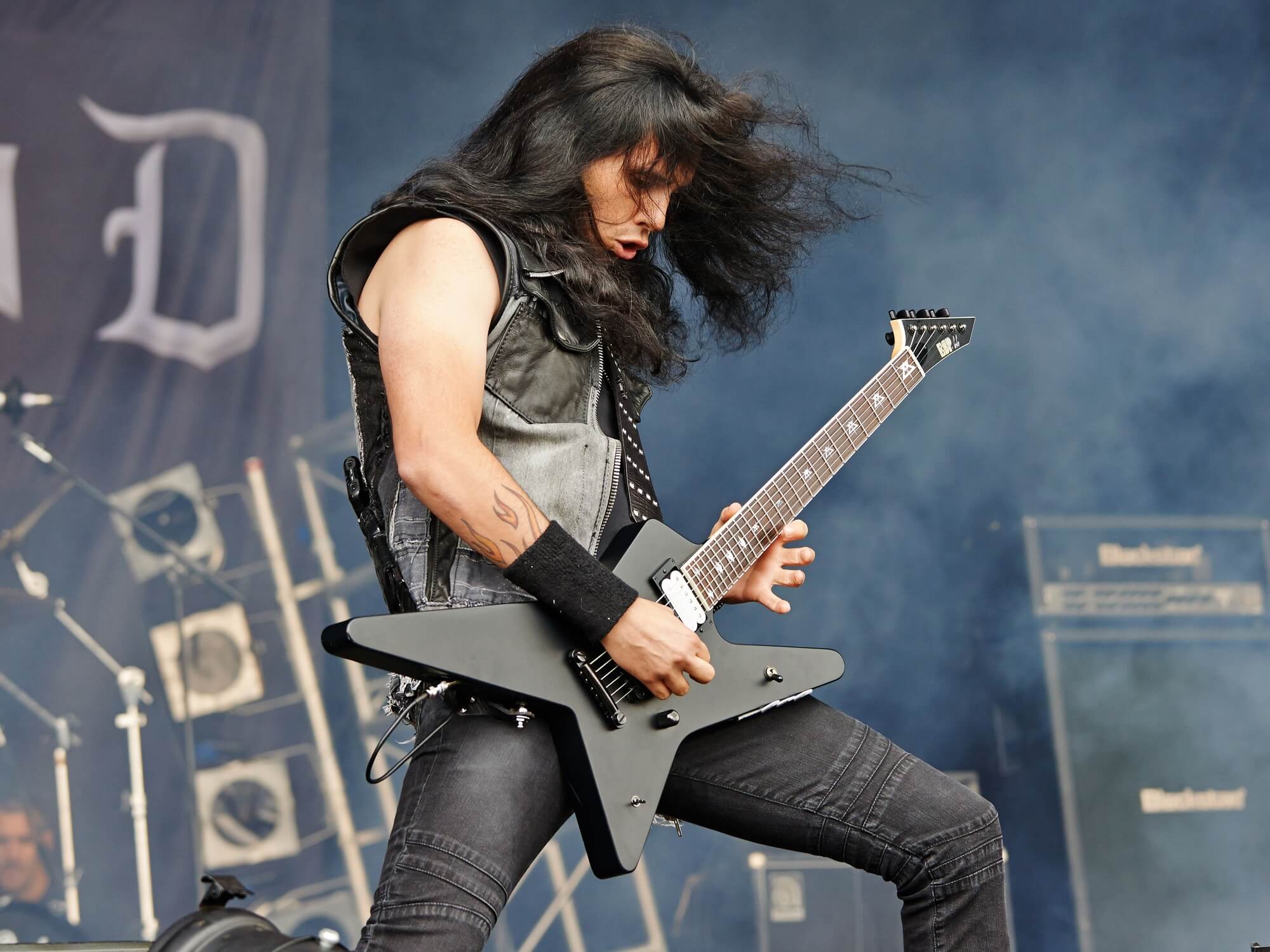
Despite serving as Ozzy Osbourne’s guitarist for 8 years, Gus G wasn’t surprised when he was asked to hand back guitar duties to his predecessor, Zakk Wylde, in 2017. Considering Wylde and Ozzy’s history, he considered their reunion “inevitable” – and, while there was no bad blood, he’s adamant he’ll never accept another gig that feels temporary.
While Gus doesn’t regret his years serving in Ozzy’s band, nowadays he only involves himself with his own band, Firewind, or projects that guarantee a level of job security. Speaking to The Metal Voice, the guitarist explains that, even if it means turning down big opportunities, he never wants to feel “expendable” again.
“It was a conscious decision for me after the Ozzy gig to not join other bands,” he says [via Blabbermouth]. “I’ve had offers to audition [and] potentially join much bigger bands than mine, but I didn’t want to go into that situation again where you are an expendable guy, and you don’t get to call the shots.”
He goes on to admit that all work post-Ozzy “is probably gonna be a downgrade anyway”, adding: “if you’re gonna downgrade, you might as well do it on your own terms… And I really enjoy calling my own shots!”
Of course, turning down big offers wasn’t always easy; in the past, he’s revealed in the past that he could have auditioned for Megadeth and Machine Head. However, it was crucial to stick to his guns. “I almost had to prove a point again,” the guitarist reflects. “I had my career pre-Ozzy with Firewind, and then, after Ozzy, I had to start from scratch again… I thought I would just pick it up wherever I left off, but it wasn’t like that.”
“I really had to go out there and play with smaller fees than before, grind for it, invest in it…” he adds. “[But] we’re in a good position now… and I love that freedom of calling the shots, having a great team [where] we can communicate, create our own future and our own opportunities.”
When Wylde was reinstated as Ozzy’s guitarist back in 2017, Gus could have easily kicked up a fuss. However, he’s always sang Ozzy and Wylde’s praises in the press. “I was bummed ‘cause I knew I’d probably never see [Ozzy] or play with him again… [but] it totally made sense,” he told Guitar World last year. “Ozzy and Zakk have so much history together; those guys had to get back at some point. It was inevitable.”
“Ozzy was always in my thoughts, and I hoped he’d get through [his illness],” Gus continues, reflecting on Ozzy’s unfortunate passing last year. “As for Zakk, I bumped into him at a festival in France a couple of years ago and we spoke a bit. He’s always been very nice to me.”
Gus is set to drop his fifth solo record, Steel Burner, On 24 April.
The post “I didn’t want to go into that situation again where you are an expendable guy”: Gus G on why he turned down all auditions following his stint in Ozzy Osbourne’s band appeared first on Guitar.com | All Things Guitar.
Massive trove of random rock memorabilia – including Eddie Van Halen’s 6th grade history homework – headed for auction

A massive auction of over 1,000 pieces of rock and roll history has gone live, offering items owned and played by the likes of Eddie Van Halen, Eric Clapton and Elvis Presley.
Now open for bidding, the 2026 April Rock & Roll Auction by Backstage Auctions is predicted to fetch upwards of seven figures overall, with a cumulative estimate of up to $1.5 million.
There are guitars aplenty, including an Italian-made acoustic Eko Ranger signed by Bob Dylan himself and two formerly owned by Keith Richards: a classic Gibson bearing his felt-tip signature, and a bespoke 2005 Duesenberg Starplayer Outlaw electric guitar custom–made for the Rolling Stone. The guitar, which Richards gave to McLagan as a birthday gift, features rhinestones, skull-shaped knobs and a pearlescent yellow mosaic finish on the body.
In fact, several museum-worthy pieces are up for grabs. There’s the custom 1994 Don Musser acoustic guitar played by Eddie Van Halen, which was a “key component” of Van Halen’s Billboard-topping 1995 album Balance, recorded at 5150 Studios.
The instrument was also used in a couple of tracks on follow-up Van Halen III, namely “Without You” and “New World”.
For the cinematically inclined, there’s Elvis Presley’s iconic sunburst Gibson acoustic which co-starred in his smash-hit 1964 film Viva Las Vegas. The movie, regarded as one of the King’s best, sees him play a race-car driver competing for the affection of Rusty, played by Ann-Margret. It was during filming that the pair first met and began a torrid affair. The couple were even rumoured to have briefly considered elopement.
But the standout of the collection is a stripped woodgrain 1965 Fender Telecaster with a Stratocaster neck, which the auction house describes as a “singular piece of rock and roll history”.
As well as the Stratocaster neck, part of an exchange with mod icon Steve Marriott, the chimeric guitar features a humbucker salvaged from a Gibson SG that Pete Townshend smashed to pieces during one of The Who’s iconic Marquee Club performances. The object was among McLagan’s prized possessions and was his “primary soulmate in his musical journey”.
Other notable pieces for sale include a 1974 black Fender Stratocaster owned and played on-stage by Eric Clapton and a Chinese-style Paiste gong extensively used by Keith Moon until his death in 1976.
Among the wonderfully niche and downright weird items of rock memorabilia is Eddie Van Halen’s 6th grade history homework on the Soviet Union, which earned the legendary guitarist to-be a solid B+ from his teacher Mrs Burton. And it could be yours for $500.
There’s also an “avant-garde” safety-pinned leather thong worn by Fee Waybill of The Tubes going for the same price. Or a purple felt-tip doodle by the late Kurt Cobain, which depicts a stick figure – “presumably himself”, as notes the auction house – about to be hit by a bus is commanding a lean $2,000. The scribble, says Backstage Auctions, “provide[s] insight into his creative mind”.
The collection chiefly comes from the personal archives of Rock and Roll Hall of Famer Ian McLagan, who passed away in Austin in December 2014. Best known for his work with the seminal English rock bands Small Faces and Faces, McLagan also toured with Bob Dylan and worked as a sideman for the Rolling Stones.
Learn more at Backstage Auctions.
The post Massive trove of random rock memorabilia – including Eddie Van Halen’s 6th grade history homework – headed for auction appeared first on Guitar.com | All Things Guitar.
Sammy Hagar claims he undergoes stem cell treatment to keep him in performing shape: “A singer cannot get trashed and still pull off shows”

What’s the secret to eternal youth? Former Van Halen vocalist Sammy Hagar, 78, reckons the answer is simple: stem cell treatment.
Speaking with the Daily Express US ahead of a six-show UK solo tour in July, his first in three decades, Hagar shared that he stays healthy and preserves his powerhouse voice through a regime of regular exercise, daily vitamins and stem cell therapy – an anti-aging treatment that uses specialised cells to repair and regenerate body tissue.
The Rock and Roll Hall of Famer explained: “I take things that stop my body from getting stiff – anti-inflammatories and vitamins, nutrition that you need in your body as you get older.
“I do stem cell therapy with an IV. I do it every six months. I put young stem cells in my body. And I feel the difference.”
Hagar first joined Van Halen in 1985 after David Lee Roth’s departure, and played with the band throughout the ’80s and ’90s before departing in 1996.
This means his arrival coincided with some of the band’s most debaucherous years, a lifestyle that had, in part, pushed his predecessor to quit the band at its pinnacle. During the aptly named “Van Hagar” era, Van Halen developed a more anthemic, synth-oriented sound.
Hagar conceded that he was down to party in his Van Halen years: “I was guilty as everyone else.” But, even then, he insisted on putting his health and work first. “I had a job to do. My job was more important than anything.”
He even told his managers to lock him in hotel rooms to remove him from the “undisciplined” partying of his bandmates. “It’s worked for me. I’ve run my life like this from day one. I used to never even drink and do any drugs of any kind.
“People say the most important thing is family, but it’s your job because if you don’t have a job and can’t support your family, then you’re an asshole. A singer cannot get trashed and still pull off shows.”
Hagar would rejoin Van Halen in 2003, before leaving for good two years later.
Hagar vocalist isn’t the only legendary rocker who has turned to stem cell treatment in their older age. The late Ozzy Osbourne publicly used experimental stem cells to manage his Parkinson’s disease. His Black Sabbath bandmate Tony Iommi also enlisted stem cells to repair damaged cartilage in his hand.
The post Sammy Hagar claims he undergoes stem cell treatment to keep him in performing shape: “A singer cannot get trashed and still pull off shows” appeared first on Guitar.com | All Things Guitar.
Sunn O))) Celebrate the Beginner’s Mind

Somatics, a field within body work, originated as a product of a cultural movement in the 18th century that focused on physical activity and strength-building. The principal element of somatics, which has gained prominence in the past decades in wellness culture and therapeutic contexts, is soma. On a surface level, soma is the perceived experience of the body, as distinct from the intellectual response to stimuli in your brain. The divide is easy to grasp. Maybe your brain thinks you’re at ease, but your body sends a different message: It’s tense, shaky, locked up. Our bodies can send us messages that our cerebrum might not be able to parse in the moment. The thought can be unsettling, but it can also be empowering and invigorating to acknowledge that the body can communicate in a way that defies conventional logic and easy explanation.
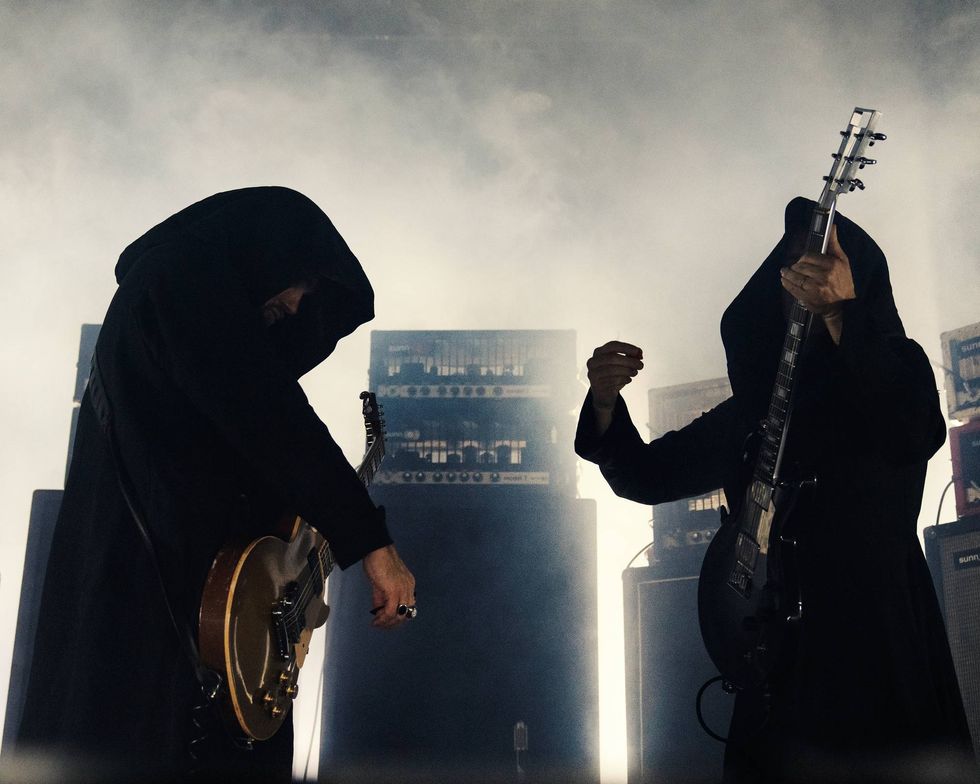
Somatics can help explain why some bands choose to work at volumes that most people consider dangerous. And they’re especially pertinent when discussing Sunn O))). The American duo of guitarists Greg Anderson and Stephen O’Malley has been making intoxicatingly loud music since 1997, flanked by a fortress of 100-watt Sunn Model T amplifier heads (the band’s name is self-evident) atop towering stacks of speaker cabinets. They’ve been described as drone metal, noise rock, doom, and ambient, and aside from regular collaborations with vocalists like Attila Csihar and select other heavy-music singers, Sunn O)))’s music is largely instrumental.
“That’s our band practice—hiking in the woods.”—Greg Anderson
Their new, self-titled record certainly is, and there is only one type of instrument present: electric guitar. The album’s six tracks, entirely performed by Anderson and O’Malley, unfurl slowly over the course of roughly 80 minutes; in the most complimentary way, these are not thinking songs—this is music that is perceived and experienced more than it is understood.
Even through headphones, the compositions have a palpable, breathtaking sense of mass and space. Guitar may be the only instrument on the record, but it is not the sole source of sound. Throughout the fourth track, “Mindrolling,” we hear running water, recorded in the woods around Bear Creek Studio in Woodinville, Washington. Just northeast of Seattle, a large window in the studio looks out onto the intoxicating perma-green of the Pacific northwest’s forest. You can feel the environment in Sunn O)))’s tracks. The power chords are as towering and knotted as an ancient Douglas fir; the distortion as enveloping and forgiving as the forest floor; the feedback as deep and powerful as the Pacific. This is music to listen to while lying back, spread-eagled, on a cliff face in a hard, thrilling wind.
For Anderson and O’Malley, though, the record is evidence of something else, something just as sacred. “It’s really, to me, a representation of my relationship with Stephen,” says Anderson. “I get a good feeling listening to it.”
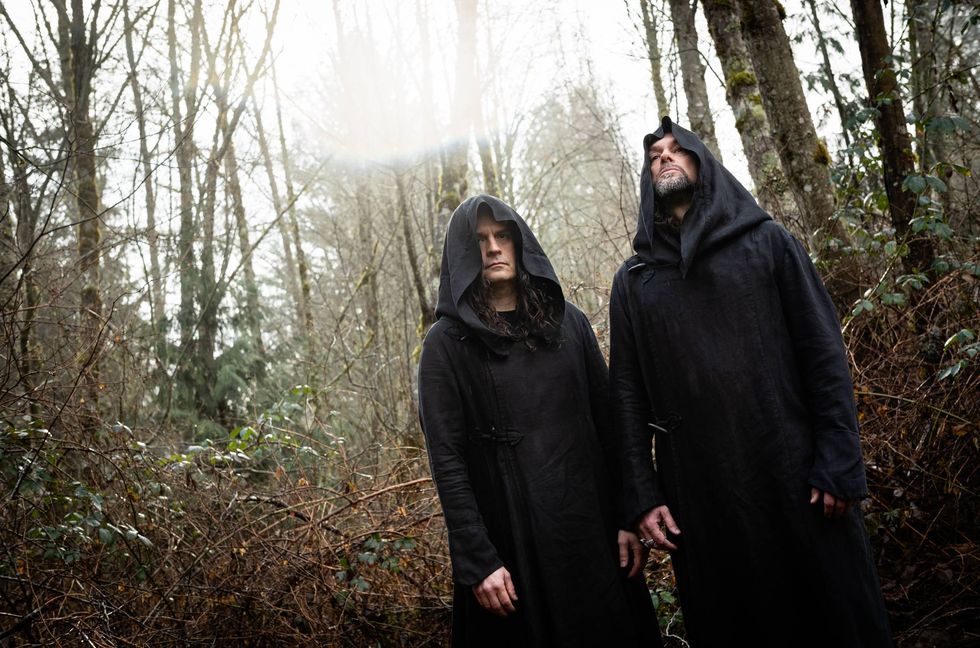
Sunn O))), the band’s 10th LP, arrives seven years after Pyroclasts. That seems like a long time to most people, remarks O’Malley, but he considers those years a natural part of “the arc of the creative process.” The new record, he says, is like a flower that emerged over the years. The duo worked with producer Brad Wood, sleeping in a farmhouse on the same property as Bear Creek Studio, which is itself housed in an old barn. Anderson and O’Malley would wake up, have coffee, then hike for a few hours in the forest nearby. After lunch, they’d meet up with Wood in the barn to work.
Anderson lives in Los Angeles, while O’Malley lives in Paris. When pandemic restrictions on concerts began to loosen, they started playing shows as a duo as a way to mitigate risk: Plenty of international tours had been thwarted, at great financial loss, by sudden changes in regional gathering restrictions. But the two-piece shows quickly became more than a logistical necessity. They felt fresh and open, says O’Malley, and he and Anderson were coming up with new ideas based on the limitations of only having two guitars onstage. “The fundamental ideas of the ensemble instrumentation were all there in the distortion,” says O’Malley. “I felt like I could hear it clearer in that abstract distortion and saturation. So we’ve continued on.”
“Whenever we play as a duo, it’s somewhat nostalgic,” says Anderson. “I didn’t know that there was another path forward from that. It turns out there was, and that’s what we were really excited about capturing on the recording—the development of what the duo had become.”
“The fundamental ideas of the ensemble instrumentation were all there in the distortion.”—Stephen O’Malley
Anderson brings up the idea of shoshin, a Zen Buddhist idea that celebrates having a beginner’s mind for all things in life. In the context of the band’s post-pandemic creativity, it suggested embracing the joy he felt in the first days of the project, such that the entire process—playing as a duo onstage and in the studio, focusing only on his friendship with O’Malley—felt like an embodiment of shoshin. The two of them felt joy, but they also felt newness, and explored it. That’s why they decided to create a new album: to document this unexpected expansion.
There was little creative preparation to be done; songs would be captured in the moment as living, breathing things. Both Anderson and O’Malley have Model Ts stashed around the world, from Los Angeles, to Paris, to Amsterdam. The 100-watt heads all have different personalities, insists O’Malley, not least because of the different voltages between American and European power supplies and how the transformers respond. They shipped Anderson’s collection—including Marshalls, Fenders, Hiwatts, Soldanos, Ampegs, Oranges, and, naturally, Sunns—from California to Bear Creek, and rented cabinets in Seattle. Wood placed mics everywhere: on each speaker of the 4x12s, around the room, even outside the room. In another area, smaller combos—including a Fender Champ, Deluxe, and Twin—were used for re-amping and running tape effects on solos. The variety of perspectives allowed Wood to sculpt the mass of distortion and create the record’s cavernous spatial signature.
Anderson relied on an Electro-Harmonix “Civil War” Big Muff, paired with his Pro Co RAT, and the band’s own signature pedal, the EarthQuaker Devices Life, to generate his guitar’s pillowy, bottomless low-end across the record. He likens rediscovering the might of the Big Muff, after all these years, to smoking pot or having sex for the first time. “That’s kind of the shoshin concept, too,” he notes. “Playing with the joy that you had when you first started playing, and trying to get back to that. That can be applied to many different elements, including combining a Big Muff with the RAT circuit.” O’Malley, meanwhile, has used the same ZVEX Super Hard On since 1997. Beginner’s mind, indeed.
Growing up, Anderson remembers seeing the Melvins in their early days, and the physicality of their gigs’ over-the-top volumes moved him. “That’s why I would follow them around like the Grateful Dead,” says Anderson. The same thing happened when he saw My Bloody Valentine in the early ’90s. “Of course you can hear the music, but to feel it in your bones, that was just something special,” he says. “I had a connection there that I got really addicted to. You can’t really get that on a recording, right?”
Part of the reason the band’s new record is self-titled is because it evokes the feeling of Sunn O))) at its most elemental: Anderson and O’Malley, together in a room, making electrifyingly loud compositions with their electric guitars. When the band first began, they weren’t concerned with playing live. Inspired by that mammoth wall of sound, the idea was to simply get in a room with as many amps as they could manage, get high, and play music together. When they caught on to the physical aspect of the project, they began to think about taking it to the realm of live performance. But that’s not an easy thing to do: The logistics of transporting and operating multiple 100-watt stacks are sticky, and even if you figure out how to do it, there are few venues willing to host such a performance. If a club can’t accommodate Sunn’s backline, or if they require acts to abide by a decibel limit, the band won’t play. (Anderson knows their backline is a lot: “It’s a mountain,” he says.) That can cross out certain cities entirely, but it’s non-negotiable. The volume is part of the band.
“I enjoy the aspect of danger, and I feel like a lot of that has been removed from art and music and film,” says Anderson. “I get it, I understand health and safety, but it also sort of bothers me, because then you’re taking that away from people. There are things that can be done to protect yourself. You’ve taken away that choice and that ability for people to experience it. It’s really loud, but it’s not a painful loud. It’s nearly all low end and low frequencies. There’s not that high, ice-pick, piercing sound in what we do. I equate it more to a warm bath. We’re not trying to damage people’s hearing. It’s not this aggressive moment at all. I understand why it could be interpreted that way, but that’s not the case. To me, the music is very soothing, and I’m grateful that people have gotten that and connected with it.
“It is overwhelming, and to be immersed in that, it does have this kind of comical angle to it sometimes,” Anderson continues. “Oftentimes, Stephen and I will laugh and say, ‘This is insane and amazing that we’re in this right now!’ I think that in itself is a reason to celebrate. It has this kind of celebratory atmosphere to it.”
“I enjoy the aspect of danger, and I feel like a lot of that has been removed from art and music and film. I seek out things that have that edge to it.”—Greg Anderson
Greg Anderson’s Gear
Guitar
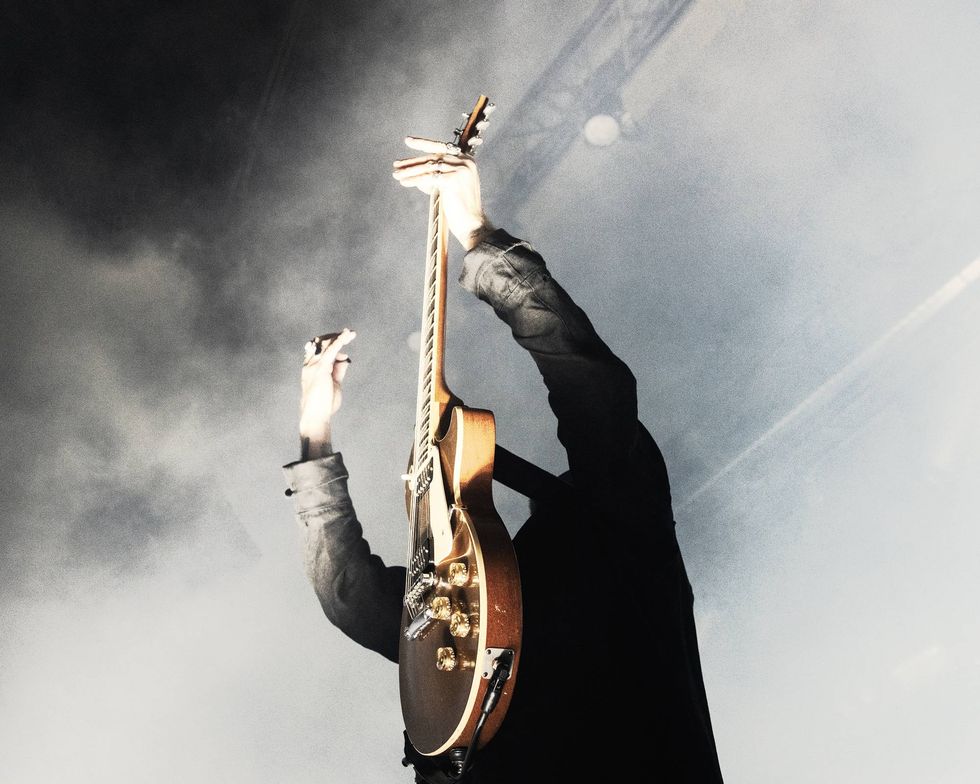
- 2005 Gibson Les Paul Deluxe goldtop with black DiMarzio P90 Super Distortion pickups
Amps
- Mid-’70s Sunn Model T
- Sunn 2000S
- Sunn 1200S
- Ampeg SVT “Blueline”
Effects
- Pro Co Turbo RAT (with LM308 chip)
- Electro-Harmonix/Sovtek “Civil War” Big Muff Pi
- EarthQuaker Devices White Light
- EarthQuaker Devices Life Pedal
- Aguilar Octamizer
- Ernie Ball VP JR
- 4-way splitter box
Anderson notes that he and O’Malley have always delighted in pushing the boundaries of their own expectations, to the point of deleting them entirely. That attitude is one of the keys to their longevity. “It sounds cliche, but I keep saying it over and over again, and it’s true: It’s about being open to different possibilities and ideas,” Anderson explains. “That’s why we’ve sustained, and that’s why it continues to be interesting. Every single band in my life that I’ve been involved with had an ending point. But Sunn O))) has transcended a lot of that.”
“Over time, each person grows in innumerable ways and transforms, and their tastes transform, their perception transforms,” says O’Malley. “It’s like you’re constantly shedding possible versions of yourself.” When you rewatch a film that you haven’t seen in five years, it might mean something entirely different to you. “I think that’s one of the strengths of our music, and the longevity of it, too: the openness to not only changing things, but changing the point of view of what it is.”

Stephen O’Malley’s Gear
Guitars
- Travis Bean “Deo Dei” TB1000A
- Electrical Guitar Company DS Ghost
Amps
- Sunn Model T
- Ampeg SVT
- Fender Twin Reverb
- Fender Champ
- Hiwatt DR103 Custom 100
- 1952 Supro combo
Effects
- Keeley-modded Pro Co RAT
- J. Rockett Audio Designs Archer
- Pete Cornish G-2
- Pete Cornish P-2
- “Ram’s Head” Big Muff clone
- OTO BIM
- OTO BAM
- Roland RE-201
- Fulltone Tube Tape Echo
- EarthQuaker Devices Black Ash
- Bright Onion Active Splitter Pedal with Phase Switching
- ZVEX Effects Super Hard On
So what exactly does “openness” mean? For Anderson and O’Malley, it’s throwing out the “rules” for being a band. They don’t practice; soundchecks before shows are the closest thing they have to rehearsals, and Anderson admits that he despises conventional “band practice.” He casts the idea of practice in a different light. For he and O’Malley, it’s not about strapping on their guitars and going over ideas together. While they were in Illinois to attend a celebration of life for longtime creative collaborator Steve Albini, the two of them went swimming in Lake Michigan. Being present together, at the memorial, going for a swim—that was practice. While they worked on the new record, they took plenty of hikes together in the Washington woods. “That’s our band practice,” says Anderson. “Hiking in the woods.” It doesn’t seem like a coincidence that communing with their surroundings, being present in their bodies, is central to their creative relationship.
“If I remove the word ‘band’ from ‘band practice,’ it makes more sense,” says O’Malley. “It’s the practice of being together. Music is about relationships and interaction.”
O’Malley continues. “I’m not saying going swimming gives me riff ideas, but when you’re in the waves, it’s quite immersive. Being in Illinois, to celebrate the life of a great master who also happened to be a friend, and then taking time to have pleasure by engaging with the ancient lake, it’s pretty powerful.”
David Lee Roth made a surprise appearance during Teddy Swims’ Coachella Festival set – and the pair covered Van Halen’s Jump

It wouldn’t be Coachella Festival without a few surprises – and this year was no exception. From the legendary Jack White’s last minute addition to the line-up to Billy Corgan hopping onstage to sing with alt-popstar Sombr, Coachella had some great treats for rock fans this year.
One particular standout came during R&B star Teddy Swims’ set on Friday (10 April). With a stage designed to look like an apartment, surprise guests would sporadically ‘ring the doorbell’, only for Swims to welcome them out to perform a track. While his other guests included singer-songwriter Vanessa Carlton and a pop-rocking Jonas Brother, Joe Jonas, one such guest happened to be the iconic Van Halen frontman David Lee Roth.
Swims was clearly honoured to be performing with Roth, considering his grand introduction. “Oh my God – it’s David Lee Roth from the best fucking band of all time, Van Halen!” he yells out into the audience. Then, with Roth by his side, Swims kicked into a hearty version of Van Halen’s timeless track, Jump.
And Roth certainly dressed up for the occasion. At age 71, he’s showing no signs of toning down the showmanship, decked out in an intricately beaded waistcoat, cravat and tight silver and black trousers. Throughout the set, he’s the vision of some kind of futuristic cowboy as he hypes up the crowd with glee.
Though the performance had a minor hiccup, with the pair missing a timing cue, it serves as a testament of how different generations of music can co-exist. Sombr’s performance with The Smashing Pumpkins’ Corgan also had a minor mic malfunction, but their performance of the Pumpkins’ marvellous 1979 went down a treat.
Last year, Olivia Rodrigo had a similar experience when Robert Smith emerged during her Coachella headline set, with the pair duetting their way through The Cure’s Friday I’m in Love and Just Like Heaven.
The post David Lee Roth made a surprise appearance during Teddy Swims’ Coachella Festival set – and the pair covered Van Halen’s Jump appeared first on Guitar.com | All Things Guitar.
“She is in every note I play”: How a widower used his wife’s ashes and wedding ring to craft the most beautifully poignant custom guitar

Teruya Guitars founder Micah Teruya has just completed his most personal build to date. Following a long battle with leukaemia, Teruya’s wife Karrah sadly passed away last August – but the luthier is ensuring that her spirit lives on through this beautiful custom-made electric guitar.
Rather than merely stowing Karrah’s ashes in an urn, Teruya has transformed his wife into something beautiful. The pastel pink Matriarch guitar serves as poignant one-of-a-kind axe in honour of Teruya’s late wife – and it’s even got Karrah’s ashes inlaid on the headstock, and her wedding ring embedded in the fretboard.
While Teruya often documents the entire process of his guitar builds, this project was kept under wraps until the final reveal. However, the craftsman did film the two most meaningful moments, when he is delicately inlaying Karrah’s ashes and her ring. He has shared the clips alongside some of his most cherished videos and memories of his wife. “The process was incredibly painful for me but I wanted to share this with you because of how much it means to me,” he writes on Instagram.
“Having to deal with the technical aspects of building a guitar colliding with the emotional weight of who I lost was unbearable,” he continues. “Often I could only work for 10-30 minutes on this before being physically and emotionally drained.”
Despite the pain, finishing the Matriarch guitar was a crucial part of processing his grief. “This guitar needed to be finished before I could continue on any other projects – it took me over 6 months to finish,” he admits. “Going through my camera roll for these clips of Karrah brought me to tears several times. She was so magnificent and beautiful. I wish all of you could have gotten to know her, she would have changed your world for the better.”
In another post, Teruya explains why he opted for the Matriarch name. “Karrah was the Matriarch of our family and friends, she dedicated everything in her life to bring all of us closer together…” he writes. “Nobody tells you that you can continue to love someone more even after they leave this life. I built this guitar to honour her life and her legacy in a way that is personal and sacred to me.”
In terms of the wedding ring on the fretboard, he also explains that its positioning holds a special, personal meaning. “Traditionally it would be placed in the 12th fret to mark the octave, however, we were married for 10 years, 11 months and 14 days, therefore I decided to place the ring between the 10th and 11th fret to symbolise how long we had been married,” he explains.
“This was the most painful experience I ever had building an instrument… but now she is in every note I play,” he concludes.
The post “She is in every note I play”: How a widower used his wife’s ashes and wedding ring to craft the most beautifully poignant custom guitar appeared first on Guitar.com | All Things Guitar.
Lyndon Laney, founder of Laney Amplification, has died

Lyndon Laney – founder of legendary British amp brand Laney Amplification – has died aged 77.
In a statement shared with Guitar.com, the brand confirms Laney’s passing, calling him a “creator, innovator and trusted figure whose passion for the industry was at the heart of his working life”.
Lyndon Laney founded Laney Amplification in 1967 at just 19 years old. The brand would become internationally respected in the decades following, and has helped shape the sound of many high-profile guitar players, including Lyndon Laney’s longtime friend, Tony Iommi of Black Sabbath.
Though perhaps primarily associated with Laney Amplification, Lyndon Laney was a successful industry veteran elsewhere, having developed several ventures which ultimately became what is now the Headstock Group.
- READ MORE: Laney’s new Prism-Mini is a pocket-sized smart amp ready to take on Positive Grid’s Spark GO
The group first expanded into the Pro Audio sector with the acquisition of HH Audio, followed by the development of Headstock Distribution, representing brands like Ibanez, Tama, Zildjian, Vic Firth and DiMarzio.
“Lyndon’s influence extended far beyond business success; he was admired for his warmth, integrity, humour and quiet determination,” Laney Brand Director Lee Wrathe says.
“Lyndon was not only a founder, but also a creator, innovator and trusted figure whose passion for industry was at the heart of his working life. His legacy continues through the business he built and through his son, James Laney, who proudly carries that vision forward.
“He will be greatly missed by his family, friends, colleagues and the wider music community.”
Among those who have paid tribute to Lyndon Laney is Tony Iommi, who says he is “absolutely devastated” at his friend’s passing.
“I’m so sad to say that I lost my very dear friend Lyndon Laney to cancer on Friday,” Iommi writes in a post on X. “I am absolutely devastated. We go back to the late ‘60s when I first met him and I started using his Laney amps. He was a really lovely guy and his great passion was building valve amps. He also loved his cars as I did as well, we had so much in common.
“We’d sit talking about ideas and what to build into my amplifiers. I am so honoured to have known him and his family. James, his son, has been running the company for some years now and he has carried on the business and has pushed it forward with some brilliant ideas. My deepest condolences go out to Lyndon’s wife Jan and son James.”
I’m so sad to say that I lost my very dear friend Lyndon Laney to Cancer on Friday. I am absolutely devastated. We go back to the late sixties when I first met him and I started using his Laney amps. He was a really lovely guy and his great passion was building valve amps. He… pic.twitter.com/qEXJChknLO
— Tony Iommi (@tonyiommi) April 13, 2026
The post Lyndon Laney, founder of Laney Amplification, has died appeared first on Guitar.com | All Things Guitar.
How Emerald Guitars changed the perception of carbon fibre guitars – and put the player’s needs at the heart of everything

While many CEOs of international instrument makers take the reins of a heritage company already decades or even centuries in existence, Emerald Guitars founder Alistair Hay came to the acoustic guitar via a very different route. His previous career in the high-adrenaline sport of Formula 1 powerboat racing established him as one of the world’s leading experts in the use of carbon fibre. But how did he come to start making guitars out of them?
Waiting for a delayed flight in 1999, Hay bought a guitar magazine, and while he flicked through the pages the idea came to him: take his expertise with carbon fibre, apply it to the acoustic guitar, and expand the sonic, aesthetic and ergonomic experience of players around the world.
 Emerald Guitars on the Guitar.com Cover. Image: Andy Ford for Guitar.com
The question you’re probably asking yourself here is, ‘Aren’t guitars made of wood?’ Well, most of the time – but not always. People have been trying to make electric guitars out of alternative materials for decades, but acoustic guitars are often a sticking point – after all, so much of their tone is created by the sympathetic vibrations of various bits of wood.
But there have been various attempts to make guitars out of carbon fibre over the years, some more successful than others. And if you wanted to know if the characteristics that make the material perfect for a world-championship carbon fibre motorboat can also make a good guitar, Alistair Hay is the man to ask.
“A racing boat has to actually work with the vibrations of the water: to flex and move. That really is the essence of a really good quality acoustic guitar too”
“That is a very interesting question,” Hay muses. “In actual fact, there’s a lot of similarities. When I worked for the raceboat champion, Bill Seebold, he would talk about tuning the boat and how a boat should flex and how it should move.
“A racing boat isn’t just about being super rigid. It has to actually work with the vibrations of the water, to flex and move. It’s a delicate balance. And let’s face it, that really is the essence of a really good quality acoustic guitar too.”
 Image: Andy Ford for Guitar.com
Pushing The Envelope
Since setting up Emerald in a workshop in Donegal, in the north west of Ireland, the brand has become known for building guitars with radical and striking designs that would be all but impossible to execute in wood.
Ergonomic curves and contours, bevelled edges and offset soundholes are all hallmarks of the brand. If you’ve been scrolling through the guitar-based corners of Tiktok and Instagram over the last few years, chances are you’ve done a double-take at one of these unconventional guitars in the hands of some of the most impressive players out there.
Social media has been a key driver in the recent success Emerald has enjoyed across the globe. So much so that last year the brand opened a US-based warehouse and showroom – run by Alistair’s brother Chris – to cope with the demand from across the pond, allowing the brand to reach more players than ever.
“A lot of the people that tell you to do something more conservative will actually have no interest in buying your work even if you do follow their advice”
But when you see someone like Nathaniel Murphy make effortless magic on an Emerald, it becomes abundantly clear that these designs are not just pieces to be enjoyed visually. Their wonderfully rich sound is also a vital component of Emerald’s success – even though finding that voice has been a process.
“Initially I just wanted these guitars to sound musical and sweet, and not sound synthetic or plastic,” Hay recalls.
“A lot of it was trial and error to begin with – seeing what made a carbon fibre guitar too bright or too dark, too quiet or just not musical. We started to learn the parameters and how things worked within our own designs. Essentially, these days our priorities are clarity of note with richness and warmth and power.”
 Image: Andy Ford for Guitar.com
Hole In One
In the quarter of a century that Emerald has been pushing the envelope, the brand has explored varied territory – from dreadnoughts and parlors to Weissenborn lap guitars, hybrid electric-acoustics and basses.
One common thread both sonically and visually to nearly all of these designs is the presence of an offset soundhole – positioned not in the traditional place beneath the strings, but on the guitar’s top horn right below the player’s ear. This design hallmark came about through trial and error.
“The very first guitar that I ever made was a dreadnought with a centre soundhole,” Hay explains. “I just made a mould from my own existing acoustic guitar as the basis, and to start with our designs were kind of traditional in that regard. They still had the shaped back and some nice details, but funnily enough at that time I had people telling me that our designs needed to be more traditional – like a straight copy of a Martin Dreadnought or a Gibson SJ-200, just in carbon fibre – honestly!
“It was at that point that I realised that a lot of the people that tell you to do something more conservative will actually have no interest in buying your work even if you do follow their advice.”
“Carbon fibre has allowed us to do things that would be unviable in wood”
Hay’s first two models, which had centre soundholes, “were nice guitars but just horrible flops from a commercial point of view”. Then he designed the X20 model, “which was a total game changer”: “It was the first guitar where I really started to look at ergonomics and designing a guitar that played to the strengths of carbon fibre rather than pandering to tradition.”
But even as Hay gained confidence in his abilities as a luthier, he was still second-guessing himself as a businessman.
“I knew I had something special with the X20, but you know what? After I made the first one, I had it sitting there for a year and a half before I was brave enough to actually put it onto the market,” he reveals.
“I was thinking it was too radical. That people weren’t going to take this right. And then we put it out there and it was a huge success. That was the pivotal moment for Emerald. That was the guitar that influenced everything else that we designed from then on.”
 Image: Andy Ford for Guitar.com
Comfort In Sound
This is what sets Emerald apart from other makers of carbon fibre guitars: this focus on designing an instrument that exploits the inherent advantages of the material to better accommodate the player.
Whether you’re holding an X20 dreadnought or a Virtuo hybrid, the contours and curves of the instrument fit around you more like an electric guitar than a traditional acoustic, enabling a different physical connection.
“Ergonomics is a huge part of what we do and how people feel and experience these guitars,” Hay agrees. “It’s definitely one of the things that we get the best feedback on.
“People just love to sit down and play our guitars for hours on end. Carbon fibre has allowed us to do things that would be unviable in wood. Some people think it’s all done in a computer but our design process is actually a lot more hands-on.”
“There’s a different mindset when you’re buying a carbon guitar. You can just think a little bit more creatively”
That process is both untraditional and more organic than you might expect in this era of CAD design.
“I start off with an outline on a big slab of household insulation foam,” he says. “It’s a cheap material and it’s very easy to manipulate. I cut it into shape with a jigsaw or a hand saw and then start to sand it into shape. So it’s a very tactile process, and something that I wouldn’t know how to even start to do on a computer.
“It allows me to make these little adjustments and then a solid physical shape that we’ll start to cast moulds from. That’s my design process: just feeling my way through it.”
 Image: Andy Ford for Guitar.com
Brace Yourself
Anyone steeped in the lore of acoustic guitars understands that the voicing of a traditional instrument revolves around the pattern of braces used to give the guitar’s top and back stability as they vibrate under tension. This is irrelevant with a carbon fibre guitar, so how does one voice an instrument in this way?
“We do control the stiffness of our soundboards, which is created by using different layers of carbon fibre,” Hay reveals. “If you were to look inside, you’re not going to see any bracing. It looks totally flat, but the top of an Emerald guitar can contain anything from two to eight layers of carbon in different areas of the top.
“Carbon fibre has a grain pattern and a stiffness to it that can be manipulated in just the same way as wood. The thing with carbon fibre is that we can repeat that pattern many times, whereas every piece of wood is unique.”
 Image: Andy Ford for Guitar.com
Wood And Steel
For a carbon fibre guitar company, Emerald still keeps quite an extensive wood library in its Donegal factory. This is because one of the company’s aesthetic calling cards is to embed a thin veneer of elaborately figured wood into the soundboard of the instrument.
Usually, these woods are the sort of elaborately figured materials other makers would keep to the back and sides – such as cocobolo, ziricote, royal ebony and quilted maple – but Emerald puts them front and centre, in a fan-driven flourish.
“Our clients have led so many of our decisions over the years,” Hay says. “Choosing a wood veneer allows each Emerald guitar to be unique, and that does matter. I’m always looking for a way to make our instruments eye-catching, and a spectacular slice of mother nature on the front definitely does that.
“That’s my design process: just feeling my way through it”
“Figured woods are often used on the back and sides of guitars but no-one can see them there. That seems a bit of a shame to me. We enjoy showing all that beauty on the front of our guitars. The veneers are so thin they make no difference sonically – they’re just there for aesthetics. We have used spruce and cedar in the past but you know – where’s the fun in that?”
Emerald Guitars sprung from one man’s curiosity and career expertise in carbon fibre – and after 25 years of hard work and dedication to craft, it’s poetic that others have come on board, not just as customers but as enthusiasts whose own design ideas help make the journey fun.
“It’s amazing how imaginative our customers are,” Hay marvels. “They’ve designed instruments that we just never would have thought of that have been a pleasure to make. I think there’s a different mindset when you’re buying a carbon guitar. You can just think a little bit more creatively.”
Words: Michael Watts
Photography: Andy Ford
The post How Emerald Guitars changed the perception of carbon fibre guitars – and put the player’s needs at the heart of everything appeared first on Guitar.com | All Things Guitar.
The Truth About Vintage Amps, Ep. 163 with Guitarist Roy Rogers
Acclaimed guitarist Roy Rogers joins us this week to talk about his unique gear choices, working with John Lee Hooker, vintage amps, his new album and so much more!
Thank our sponsors: Grez Guitars; Emerald City Guitars; and Amplified Parts / Mod Electronics.
Some of the topics discussed this week:
:56 Eric Barbour’s the Tube Dumpster in Vacuum Tube Valley: 6K6, 6F6, 6Y6 tubes
2:39 A flea market Tweed Bassman
8:51 A Garnet book giveaway!
13:42 What’s on Skip’s bench: A distribution pre-amp
17:12 Special guest: Roy Rogers: ‘The Sky’s the Limit’ (his new album, out now!); Mesa Boogie Mark IIB and Epiphone Electar Zephyr amps; DeArmonds in flattop acoustics; Martin New Yorkers; his custom Chappell Guitars double-neck; Johnny Shines; working with John Lee Hooker; the Hot Spot soundtrack (with Roy Rogers, Miles Davis, John Lee Hooker, and Taj Mahal!!)
Get Roy’s new album here: https://royrogers.hearnow.com/
Order ‘Gaynell’s Kitchen – Down Home Cooking from A Wayward Southern Belle’: https://amzn.to/41mcZBn
1:27:45 How can a Traynor Bassmaster Mk. II be rated at 90 watts, while the same power-tubed YBA-1 is only 40?
1:32:14 Is Skip related to Chris Shiflett?
1:33:01 Never trust, always double-check; output transformers
1:34:29 An October meetup at Skip’s, maybe
Want amp tech Skip Simmons’ advice on your DIY guitar amp projects? Want to share your top secret family recipe? Need relationship advice? Join us by sending your voice memo or written questions to podcast@fretboardjournal.com! Include a photo, too.
Want to support the show? Join our Patreon page to get to the front of the advice line, see exclusive pics, the occasional video and more.
Hosted by amp tech Skip Simmons and co-hosted/produced by Jason Verlinde of the Fretboard Journal.


The post The Truth About Vintage Amps, Ep. 163 with Guitarist Roy Rogers first appeared on Fretboard Journal.
You Don’t Last 50 Years Without Getting It Right

Pages
