
Music is the universal language
“Glory to God in the highest heaven, and on earth peace to those on whom his favor rests.” - Luke 2:14
Norse Guitar Feeds
Malina Moye Debuts Kramer Pacer Deluxe Signature Guitar

As the company celebrates its 50th anniversary, Kramer has introduced the Malina Moye Pacer Deluxe signature model, developed in collaboration with one of guitar’s most distinctive modern players.
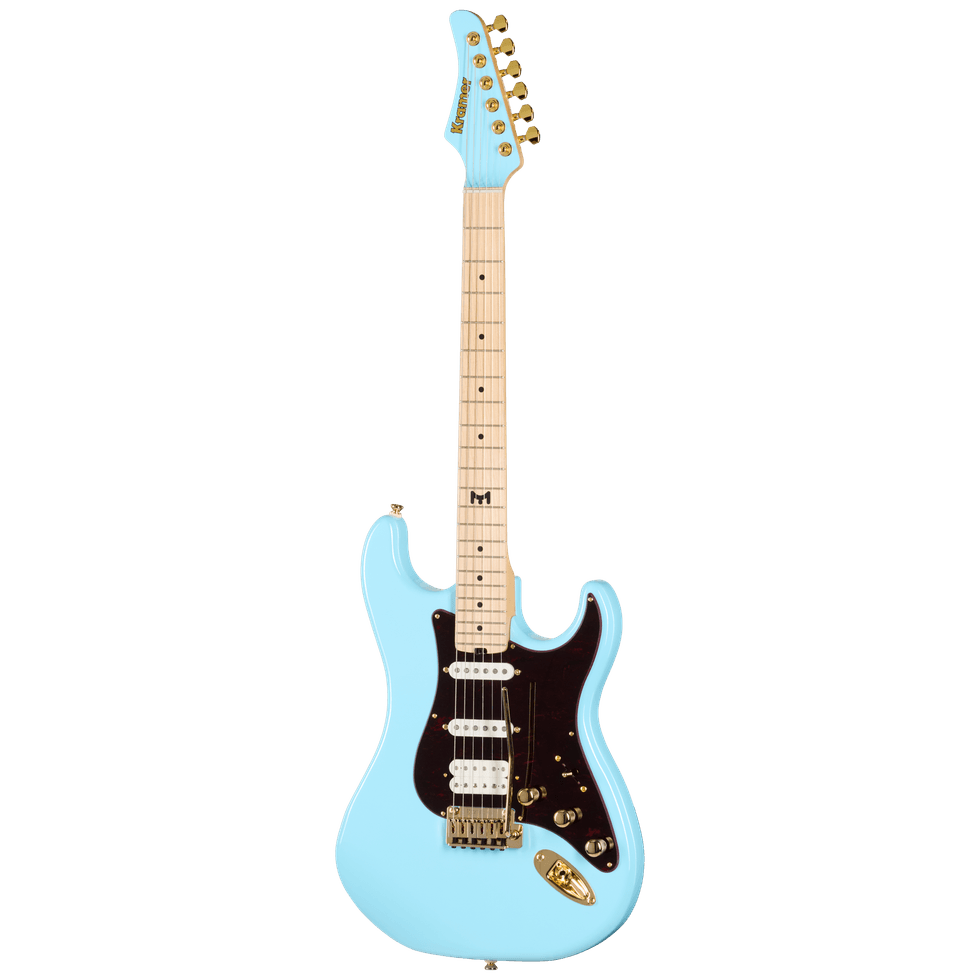
Finished in striking Splash Blue and designed to match Malina Moye’s explosive technique and genre-defying playing, the Pacer Deluxe blends stage-ready sophistication with the fast, responsive feel players expect from Kramer. Built for musicians who demand both versatility and precision, this guitar features a maple neck with skunk stripe, as well as DiMarzio® pickups, with a Virtual Vintage® Blues in the neck position, an Area 67™ in the middle, and a Super Distortion® in the bridge position. The pickups are selected using a five-way blade switch. A master volume and two tone controls (one for the middle pickup and one for the neck pickup) complete the controls, all of which are mounted in a tortoise shell-colored pickguard. It also rocks a Kramer modern two-point non-locking vibrato system, gold knurled knobs, and Kramer locking tuners. In an essential nod to Moye’s own distinctive playing approach, a left-handed version is available. A premium Kramer gig bag with a reproduction of Malina’s signature on the exterior to help keep it safe wherever you go.
Moye’s relationship with the guitar is as original as her sound. Known for playing upside down and left-handed, she has built a striking style that fuses rock, blues, soul, and funk into something instantly recognizable—technically fierce, emotionally charged, and unmistakably her own. Her musicianship places her in the same musical conversation as Eric Gales, Albert King, Elizabeth Cotten, and Jimi Hendrix, while her individuality sets her apart as a truly singular voice.
Whether headlining international tours, releasing boundary-pushing music or inspiring the next generation of players, Malina Moye continues to carve out her own lane in modern guitar culture—proving that true originality isn’t just heard, it’s felt. Her latest album, Dirty, captures that same intensity in recorded form. Blending gritty blues, high-voltage rock, and groove-heavy funk, the project showcases Moye at her most unapologetic and fully realized. The album reinforces what fans and fellow musicians already know: she is an artist who does not follow trends or expectations—she creates her own lane.
The launch of the Malina Moye Pacer Deluxe marks a meaningful milestone in Kramer history, with Moye becoming the brand’s first female signature artist—but its true significance is rooted in artistry, musicianship, and a career forged through talent, vision, and persistence.
Kramer’s Malina Moye Pacer Deluxe carries a street price of $1299. For more information visit kramerguitars.com.
Grez Guitars: Off to the Races
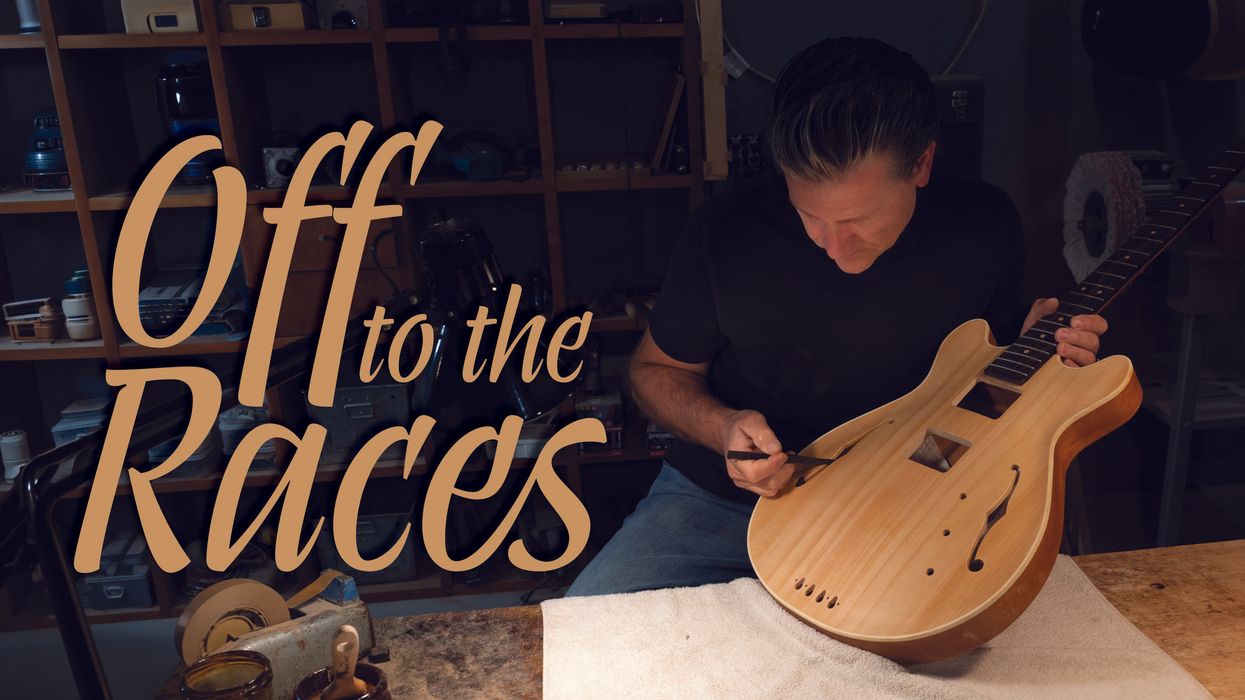
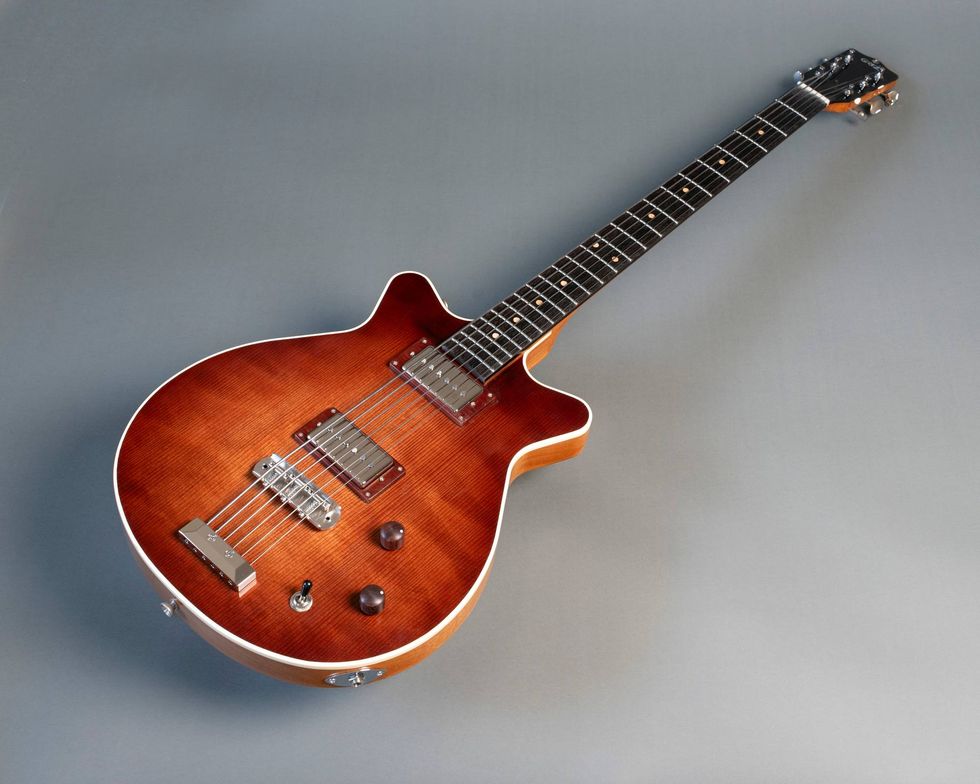
Jeff Tweedy, mastermind of legendary alt-rock act Wilco, is a total gear-head—always seeking out another guitar or amp or bass for his massive collection, seemingly hoping each strange and tantalizing toy sparks some form of inspiration. In January 2025, he opened up his treasure trove for an interview with Reverb, showcasing some of the boutique pieces that have captured his eye and ear. One obvious standout was a Grez Mendocino bass: a lightweight, semi-hollowbody that, with its sharp lipstick pickups, scans as a quirky tribute to the vintage Danelectro aesthetic. “I saw the instrument, [and] it looked austere and interesting,” he says in the video. “I listened to some clips of somebody playing one, and it sounded like something I didn’t have. It’s not like a Danelectro. It’s not like, really, anything.”
That’s basically the creative and business philosophy of Grez Guitars owner/luthier Barry Grzebik, who formed the small but surging company in 2009, operating out of a converted backyard horse barn in Petaluma, California. “I think most of these instruments are pretty versatile, but they’re not infinitely versatile,” he tells Premier Guitar, highlighting his compact line of 4-, 6-, and 12-strings. “I look at it less like ‘Who’s the right player for the instrument?’ A lot of people are. I look at it more like, ‘Who isn’t the right player?’ That’s a smaller group and more easily defined.” He points to the Tweedy-approved Mendocino: “If you’re playing slap-bass, super brash and bright with the treble cranked; if you’re looking for that crazy articulation and a super-fast vibe, these aren’t the instruments for you. Now, if you want something that blooms more interestingly and is a little fatter and richer-sounding, maybe if you’re deciding whether to put flats or rounds on it? [Give me] flat-wounds through a [Ampeg] B-15, and I’m just happy. Whatever that conjures in your mind tonally, that’s the vibe I want to embrace.”
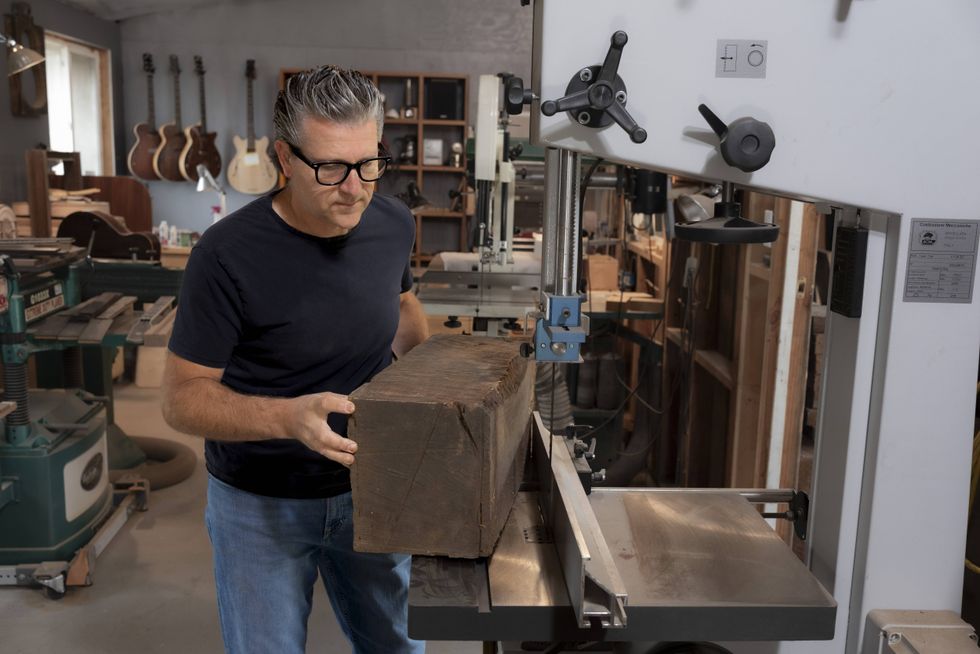
Grzebik never set out to build basses at Grez, having initially focused on guitars. Then again, he really couldn’t have pictured any of this organic rise—making his name as a luthier, spinning that name into a brand, getting online shout-outs from world-famous musicians—given that he spent most of his early career in the realm of electronics and pro audio. Early on, he dreamed of being a player—at least until he had a sobering epiphany of sorts.
“I can’t exactly put my finger on it, but I’ve always wanted to play guitar,” Grzebik says, looking back to his childhood. “The idea of being a musician was always fascinating to me, though I was never successful at doing it. But that doesn’t mean it’s not this thing you desire to do. I tried to play guitar as a young kid—maybe I was 8 or 9. My parents rented an acoustic guitar for me, and I went to a community center and took some group lessons. It didn’t stick, and I don’t even know why. And the guitar vanished because it was rented.”
He continues: “It cropped up again when I was 15 or 16—I got an electric guitar and started to learn to play. Then … while I was still in high school, I realized that I wasn’t really a guitar player. I love it, but it’s not for me. How should I put it? They say if you practice enough, you can become great at the guitar. And I know that when I practice, I become better. But I guess I’m also realistic about how much practice it takes me to get better versus someone else. As a kid, I’d run into other people who play guitar at parties and they’d just smoke me. I realized that, although I love it, it’s not what I’m meant to do—I should put my energy into places where I have more natural talent.”
“As a small custom builder, we’re kind of big, but we’re tiny in the grand scheme of things.”
That area happened to be design. “I was always a mechanical kid,” Grzebik says, recalling how his dad bought him his own toolbox back in the ’70s. “I was fixing my bike, then my buddy’s bike, eventually motorcycles—taking things apart and understanding them.” Those skills dovetailed with music due to his “weird fascination” with hi-fi. “Having a boombox was a new thing, having a stereo,” he says. “When I realized I wasn’t going to make any money playing guitar, I took an electronics class at a local junior college, and the lights just went on: ‘This is amazing. It’s just these parts? There’s not even that many kinds of parts? You put them in a certain order and it does these things?’ All of the sudden, the mystery was gone. It’s like when you learn how a magician does their magic trick. I thought, ‘I can be around guitar and music, but in a different way.’ I feel lucky that I figured that out really early.”
Grzebik experimented a lot—making his own guitar amp, crafting “little battery-powered preamps that you could put in your bass.” By the early ’90s, that obsession led him to work with audio company Apogee, initially designing products like equalizers, amplifiers, and compressors. “That was completely fascinating to me. I was obsessed with that—so much so that I completely stopped playing guitar for a while,” he recalls. “Eventually I was designing loudspeakers. As a junior engineer, you’re not really designing the whole product—the look, the feel, the idea—you’re just given this little thing. ‘Lay out this circuit board.’ ‘Design a power supply.’ ‘We need a heat sink that works better or fits in this spot.’ But as you work your way up the chain, you’re in charge of the whole thing and you’re setting the tone of how a product is going to look and feel and work. So I started to realize that I was a designer. It slowly became more and more the thing I loved to do.”
Around this time, a theme had clearly emerged: Grzebik was an adaptable worker and a creative thinker, willing to go where the road happened to lead. Soon enough, Apogee noticed his customer service skills and started sending him into the field, where he traveled all over the world to oversee installations for major events like the Oscars and the Grammys. “If you spent $100,000 or $200,000 for a sound system for your venue or touring rig, you might expect someone from the company to show up and hand-hold you through the installation—show you what it does, how to tune it,” he says. “That took me away from guitar, but it was so fascinating and exciting.”
“I look at it less like ‘Who’s the right player for the instrument?’ and more like, ‘Who isn’t the right player?’”
After a while, Grzebik realized he could do this kind of thing on his own: “Having been director of engineering for Apogee Sound for a long time, I had a few contacts, and people would call and hire me. I would work as a consultant, and I still do a little bit—designing recording studios here and there. But I realized after a few years that I kind of missed designing products.”
In 2008, he devised an acoustic guitar amp for a small startup, but when the economy tanked, the whole thing unraveled. There was a silver living, though. “That product forced me to drag the guitars I hadn’t used in a decade out of the closet,” he says. “And once they were out of the closet, I didn’t put them back. Then the idea started to creep in: ‘I could probably design a guitar. I know about guitars and woodworking and cabinetry and electronics and sound.’ I would have never thought, when I was in my 20s trying to become a product engineer, that I would be a guitar builder for a living. It didn’t even cross my mind at the time, but it just sort of morphed into it.”
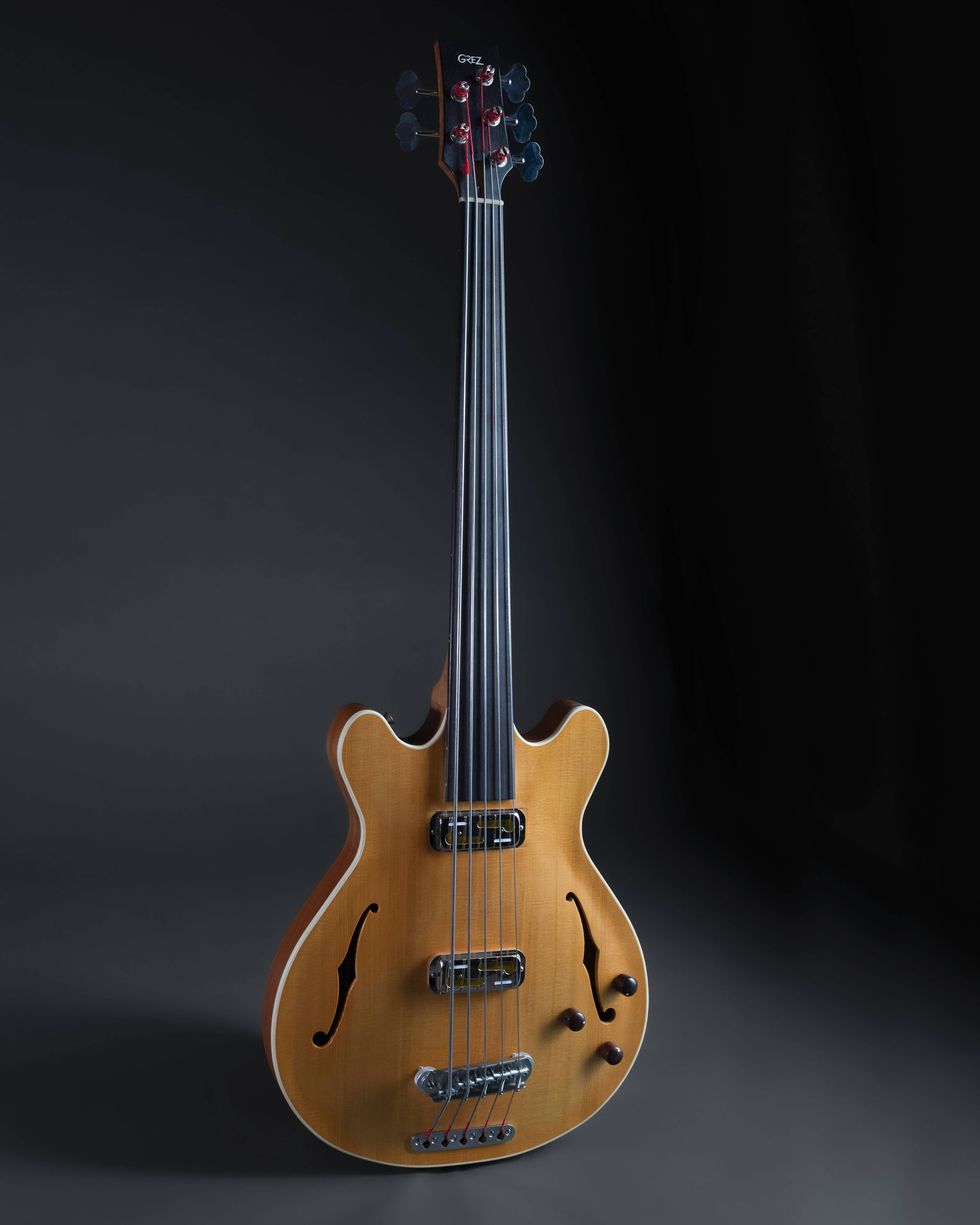
Flash forward to 2026, and Grez is one of the most reputable brands in the custom-guitar space, selling everything from Junior models to baritones, even a Mendocino Bass VI. The company produces somewhere around 100 instruments each year—about two per week—with 40 percent of sales going to dealers and 60 percent direct to customers, plus custom orders on request. “I have the ability to maybe do 150 in the facility I have, and then that’s it,” Grzebik notes. “And by ‘facility,’ what I really mean is ‘horse barn in the backyard.’ Once we get to about 150 a year, which is a place I slowly envision getting to, that’s it. We don’t make more than that. The goal isn’t necessarily to be giant. It’s just me and a few helpers, and we’re enjoying ourselves as best we can making a living. As a small custom builder, we’re kind of big, but we’re tiny in the grand scheme of things.”
“I’m trying to make racehorses that you go out and race.”
For their bass models, the ratio is way different: almost 90 percent direct. But Grzebik isn’t too analytical about that divergence—it’s all been “morphing” slowly, as he moved from semi-hollows and archtop hollowbody guitars into the occasional 4-string. “It was this tiny little growth curve [for bass],” he says. “I made one, and then I made another, and then a few more. It was a slow-motion kind of growth.” Given how labor-intensive the instruments are, he eventually settled into the staple Mendocino model—first as a guitar, then a baritone, then the Bass VI, then the short-scale bass. “Some of it sold well because there’s not a lot of what I’m doing out there,” he continues. “Admittedly, I make weird stuff. I’m not making copies of Fenders. The Mendocino short-scale bass is conceptually based on the Danelectro short-horn bass—it’s a nod to that at its core. It’s a super niche instrument, and you’re only going to sell so many. But as a tiny company, I don’t need to sell that many. I can make these weird things, and if I sell a dozen of this weird model and a dozen of that weird model, all of the sudden I’m making a living.”
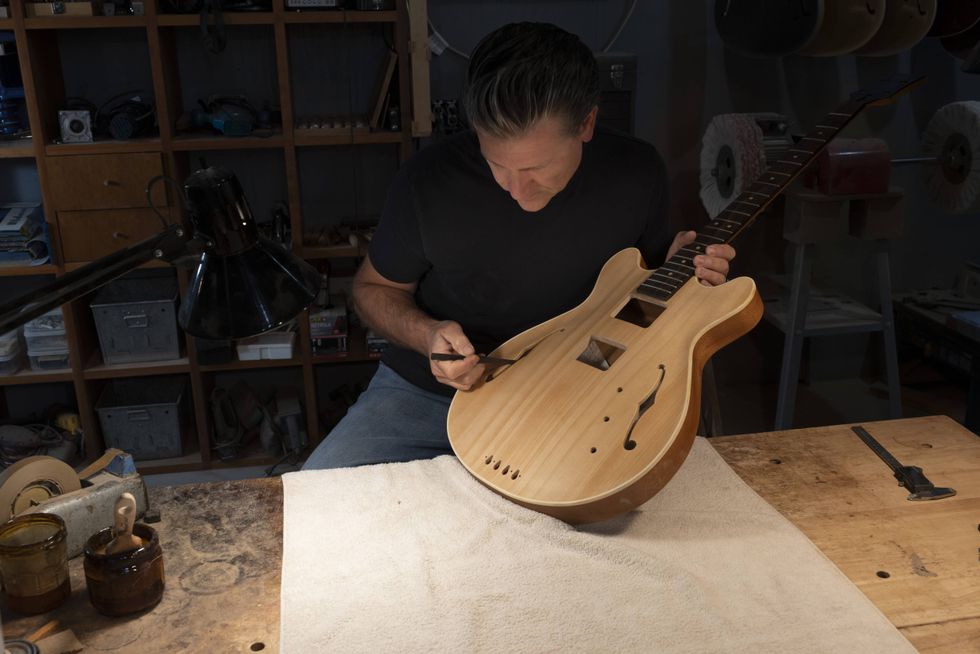
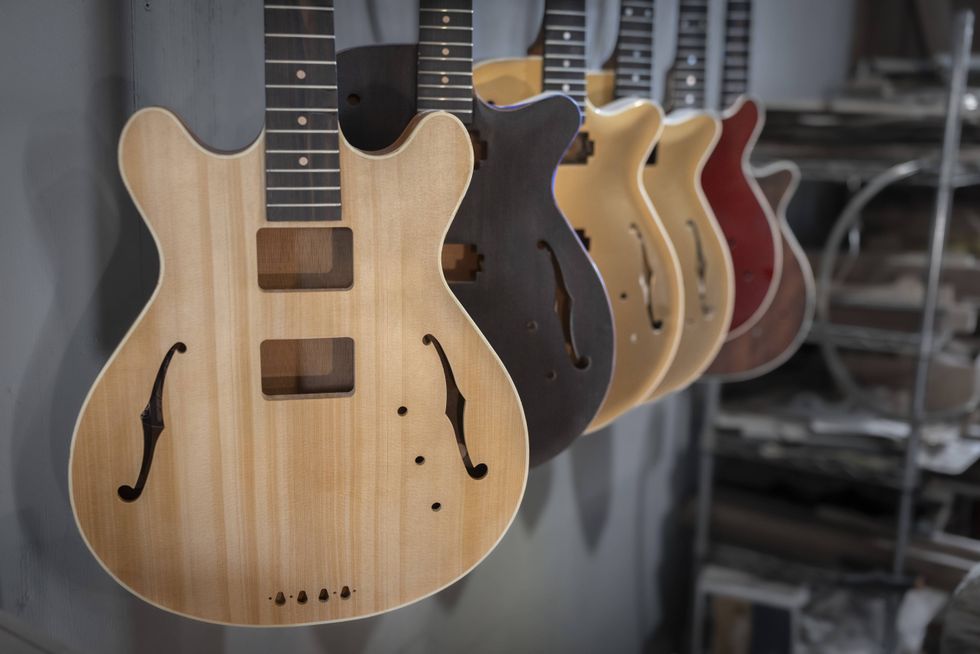
Part of that sustainability boils down to resourcefulness. Using as much reclaimed wood as possible, Grzebik maximizes every piece he has: “Because of my manufacturing background, I’m fairly good at keeping common materials. If I have a chunk of Honduran mahogany as a body blank, one piece in stock, that can be used for almost any model I make.” But it also comes back around to the uniqueness of his instruments, which continue to intrigue players like Tweedy, Ian Martin Allison, and Allman Betts Band bassist Justin Corgan. (The latter, Grzebik notes, recently hit the road with a Grez Grand Tour: a 16", semi-hollow double-cutaway model.)
“The people who are into bass, when they look up onstage and don’t quite know what the guy is playing, that really piques their interest,” Grzebik says. “They get a lot of people coming up post-show asking about the instrument. The reality is that most people don’t know Grez. When they look up there and see this thing, they’re asking about it all the time. I think [bassists], most of the time, are getting more attention than they’re used to.”
It all ties back to the Grez ethos: crafting eye-catching objects that are built to be played, not simply admired. “I’m not trying to make show ponies,” Grzebik says with a smile. “I’m trying to make racehorses that you go out and race.”
Remember when we thought Greta Van Fleet were breaking up? Well, they’re not – and they’ve just announced new music

Panic is over for Greta Van Fleet fans, as they’ve just announced that a new album is on the way despite break-up rumours flooding the internet earlier this year.
Back in May, GVF posted a cryptic social media video thanking their fans for a “wild ride”, featuring clips of the band throughout their 14-year run. Shortly after, the Michigan quartet calmed speculation with a studio clip showing the members working on new material.
The band then went on to release a new single titled Play Your Games, and even performed at a one-off intimate show in New York City. Now, Greta Van Fleet have announced their fourth album Palace For The People, landing on 9 October 2026, and have already shared a new single Saw You Stand. It will mark their first album since 2023’s Starcatcher.
According to a press release (via Louder), the record’s title was inspired by famous London music and sports venue Alexandra Palace (aka Ally Pally), which they headlined in 2022.
“A friend explained that the elaborate grandeur of this Victorian-era ‘palace’, originally named ‘The Palace Of The People’, was created as a gathering place for the public,” a statement on the album explains.
“Unlike most lavish buildings of the time, this one wasn’t created for the Monarchs nor the wealthy aristocrats of the day, but for everyone to ‘escape and wonder’, a truly modern concept for the time. Fast forward to 2026, Greta Van Fleet began to wonder: what would a palace for the people mean today? And how do we get there?”
Guitarist Jake Kiszka describes it as a “very modern record”, despite it still being rock ‘n’ roll at its core, while drummer Danny Wagner states, “the minute the four of us step into a room with the shared goal of creating, there is very little that can stop us.”
Listen to new single Saw You Stand below:
“I can’t tell you how many people have come up to me and said, ‘This is my best friend. We met through your music or at your show.’ We realised, the music is our palace!” adds bassist/keyboardist Sam Kiszka.
Josh Kiszka continues, “We love each other just as much as ever, if not more, because we’ve got to spend quality time together off of the road. We’ve grown closer, and we have more to say and share than ever.”
Palace For The People from Greta Van Fleet is available to pre-order now.
The post Remember when we thought Greta Van Fleet were breaking up? Well, they’re not – and they’ve just announced new music appeared first on Guitar.com | All Things Guitar.
Two of Eddie Van Halen’s Kramer guitars are up for auction – accompanied by his used cigarette butts

Two Kramer guitars that belonged to Eddie Van Halen have gone up for auction, with a unique additional offering: both come accompanied by used cigarette butts that are tucked under the strings on the headstocks.
The models up for grabs are a 1986 Zeke Clark Customised 5150 and 1987 Zeke Clark Customised 5150. Both are listed with a minimum bid of $50,000 each, and are being sold via Backstage Auctions.
The guitars have been “meticulously maintained” and put up for sale by Eddie’s lead guitar and amplifier technician, Randall ‘Zeke’ Clark, according to the auction website. Each one includes a signed letter of authenticity from Clark, who worked with Van Halen from 1985 to 1993, maintaining the band’s gear through the 5150, OU812, and For Unlawful Carnal Knowledge eras.
The 1986 model is the first he custom built for Eddie. It is described as in “raw, production-used condition” and is stamped with EV5150 on the rear back plate. It also features nine authentic guitar picks from the 5150 tour and, of course, retains the “stage-used cigarette”.
The lucky buyer will also receive a number of memorabilia, including an Ernie Ball EVH-branded leather guitar strap, three sets of vintage 5150-branded strings, a blue Van Halen-branded golf divot tool, an original fan-made EVH button, a Zeke Clark decal, a photo of Clark with the guitar, his personal business card, and more.
The instrument is housed in its original plush-lined hardshell case, described as “heavily weathered” and decorated with fifteen authentic backstage passes.
The 1987 version is in the same condition, and is also stamped with EV5150 on the rear back plate. This one comes with ten vintage white guitar picks, each printed with OU812 on one side and Eddie’s printed signature with 5150 on the other.
Other goodies included are: a notarised letter of provenance directly from and signed by Zeke Clark, two 8×10 colour photos of Zeke with the guitar, two full sets of strings, one incomplete set, and a guitar strap. It also has its original plush-lined hardshell accompanied by a rare 1988 Monsters of Rock Staff laminate.
Further Van Halen items are up for auction, including some as bizarre as a stage-used Frankendrill. Find out more in the video below:
To view all lots, head over to Backstage Auctions.
The post Two of Eddie Van Halen’s Kramer guitars are up for auction – accompanied by his used cigarette butts appeared first on Guitar.com | All Things Guitar.
“I wanted to hate it!”: Joe Bonamassa admits he was wrong about modelling amps

Joe Bonamassa has once again clarified his stance on amp modellers and the growing digital market, and feels that modellers may well replace tube amps in the future.
Despite Bonamassa previously questioning the coolness of digital gear, he has since spoken out on a flurry of platforms about his new-found love of all things digital. While he admits there are still aspects of traditional gear that cannot be emulated at this point – such as the pushing of air – he does feel that tonally, they’re on the mark.
Speaking on the No Cover Charge Podcast, he says, “The biggest revelation of them all, I still use two [Fender] High-Powered Tweed Twins, but they’re now Tone Master versions. I wanted to hate it! I know a lot of people who are like, ‘but in 2017, you said this…’ I’m like, ‘go fuck yourself.’
“I say a lot of things, okay? Have you ever been to a restaurant and you’re like, ‘the chicken parm is killer,’ and you’re trying to sell it to your friend, and then you go, ‘I’ll just have the caesar salad.’ I just wasn’t in the mood or I was wrong, and in this case I’m a little bit of both!”
He goes on to add, “The in-path, not the sound, the in-path of moving air into a microphone, they can’t do that yet. When you are about to break things like speakers, and you’re moving air, there’s a difference. So, I’m right about that, I was wrong about the fact that no modeller or digital anything will replace a tube version, I think they’re gonna get there and surpass.”
Bonamassa also recently spoke to MusicRadar about the Fender Tone Master range. First launched in 2019 at NAMM with two amp models that promised tubeless tube tone, the Fender Tone Master Pro multi-effects and floorboard modeller then followed in 2023 after a four-year period of research and development.
He said, “I still have my other tube amps behind me. It’s just that the [Fender ‘59] High-Powered Twin is now a Tone Master. When I first plugged into it, I realised this shit’s good. I wanted to dislike it, I really wanted to dislike it! But I couldn’t.
“My production manager, my sound tech, even my other guitar player Josh Smith – they were all telling me it sounds better and feels right. And I was like, ‘I know!’”
Check out the full No Cover Charge Podcast episode with Joe Bonamassa on YouTube below:
The post “I wanted to hate it!”: Joe Bonamassa admits he was wrong about modelling amps appeared first on Guitar.com | All Things Guitar.
Design and take home your own ’59 Les Paul Standard at the Gibson Garage Las Vegas, coming in 2027

Gibson has announced the opening of the fourth Gibson Garage location – this time in Las Vegas – following the success of similar brick-and-mortar retail stores in Nashville and London, and ahead of the opening of the upcoming Gibson Garage Miami in September 2026.
Set for its grand opening on 10 September 2026, Gibson Garage Las Vegas is situated at the Miracle Mile Shops shopping mall on the Las Vegas Strip, and is said to be Gibson’s “boldest expression yet of experiential retail, music culture and live performance”.
Occupying 9,000 square feet, the new Gibson Garage will house the “full family” of Gibson brands, including Epiphone, Kramer, MESA/Boogie, Maestro, KRK, Gibson Amps and more. This gear will sit in a “highly interactive environment created for musicians, collectors, artists, music fans, tourists, families and first-time players from around the world”.
Interactivity is one of the key selling points of the Gibson Garage as a concept, and visitors to the new Las Vegas location will be encouraged to pick up and play guitars including limited-edition and collector’s models.
Gibson says the new store has “soaring ceilings, dramatic architecture, expansive rooms and an immersive stage and sound environment” for live performances and events, all “built to match the scale, spectacle and spirit of Las Vegas.
 Credit: Gibson
Additionally, Gibson Garage Las Vegas will feature an Acoustic Murphy Lab Collection Room, offering visitors the chance to get up close with some of Gibson’s most astounding acoustic instruments.
The premises will also feature the first-ever Les Paul ‘59 Experience Room, an environment dedicated to celebrating the iconic 1959 Les Paul Standard, including a special area where visitors can design and build their own ‘59 Les Paul to take home.
“Las Vegas is one of the most exciting entertainment destinations in the world, and the Gibson Garage Las Vegas will be designed to meet that energy at full volume,” says Anne Rohosy, Interim CEO of Gibson.
“This will be much more than a place to buy a guitar – it will be a place to play, discover, perform, connect and experience the Gibson legacy in a way that can only happen in Las Vegas. Building on what we’ve created in Nashville, London and Miami, Gibson Garage Las Vegas will take experiential retail, artist culture and music to an entirely new level.”
“We’re thrilled to welcome Gibson Garage Las Vegas to Miracle Mile Shops,” adds Robert Buchanan, Vice President and General Manager of Miracle Mile Shops.
“Gibson is one of those brands that needs no introduction, and what they’re bringing to Las Vegas is more than a store. With live music, artists, history, and immersive experiences built into the space, Gibson Garage will give people a reason to visit Miracle Mile Shops just to be part of it. There couldn’t be a better city for Gibson Garage than Las Vegas, or a better location in Las Vegas than Miracle Mile Shops.”
Learn more at Gibson.
The post Design and take home your own ’59 Les Paul Standard at the Gibson Garage Las Vegas, coming in 2027 appeared first on Guitar.com | All Things Guitar.
What’s Inside: Fretboard Journal 60
We’ve been setting a high bar for ourselves for 21 years now, but Fretboard Journal 60 may just be our best issue yet. Included are features on actor/comedian/musician Christopher Guest, Brian Baker of Bad Religion, guitarist Andy Pitcher and so much more.
Here are some highlights found in this issue’s 128 keepsake pages.
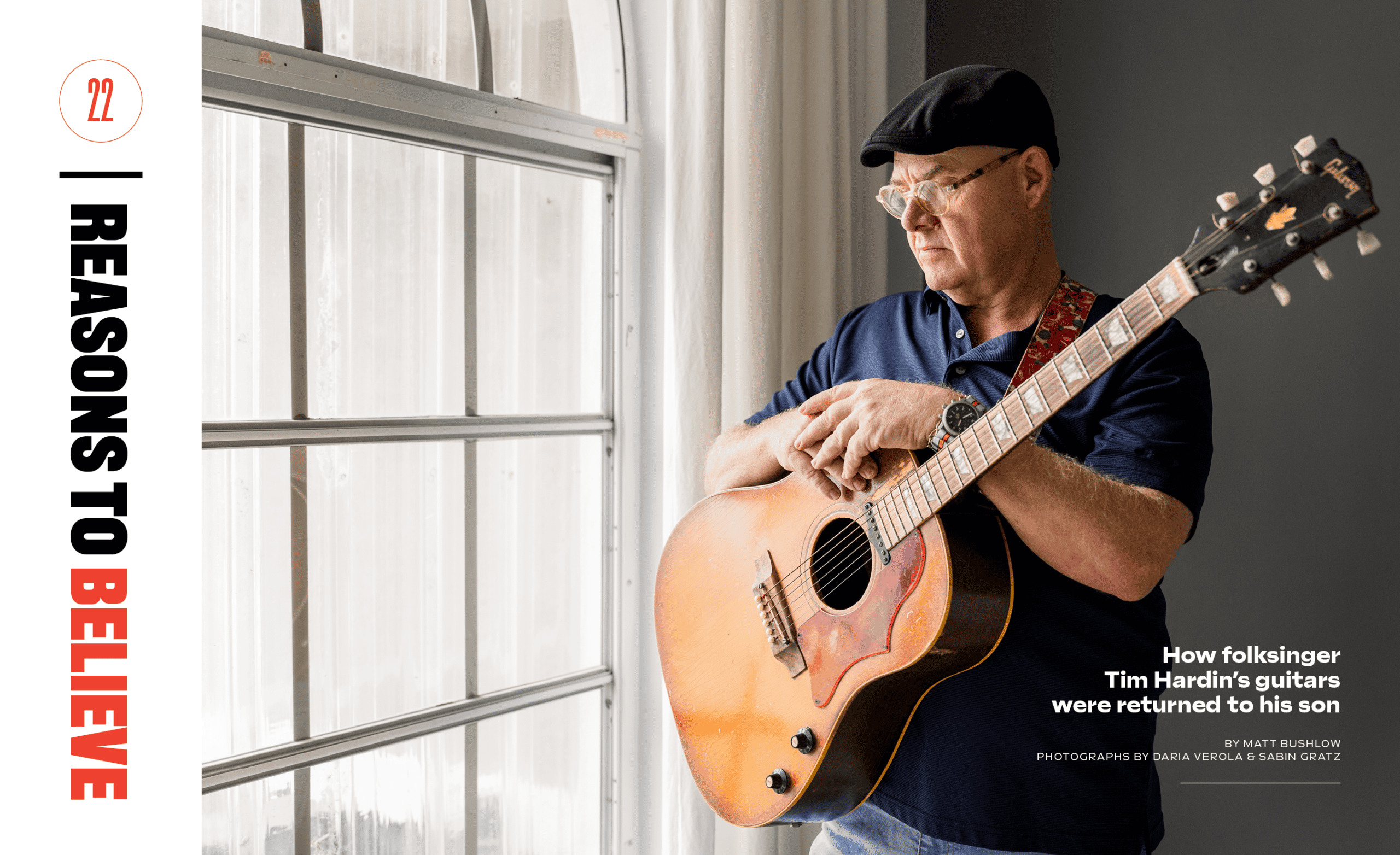
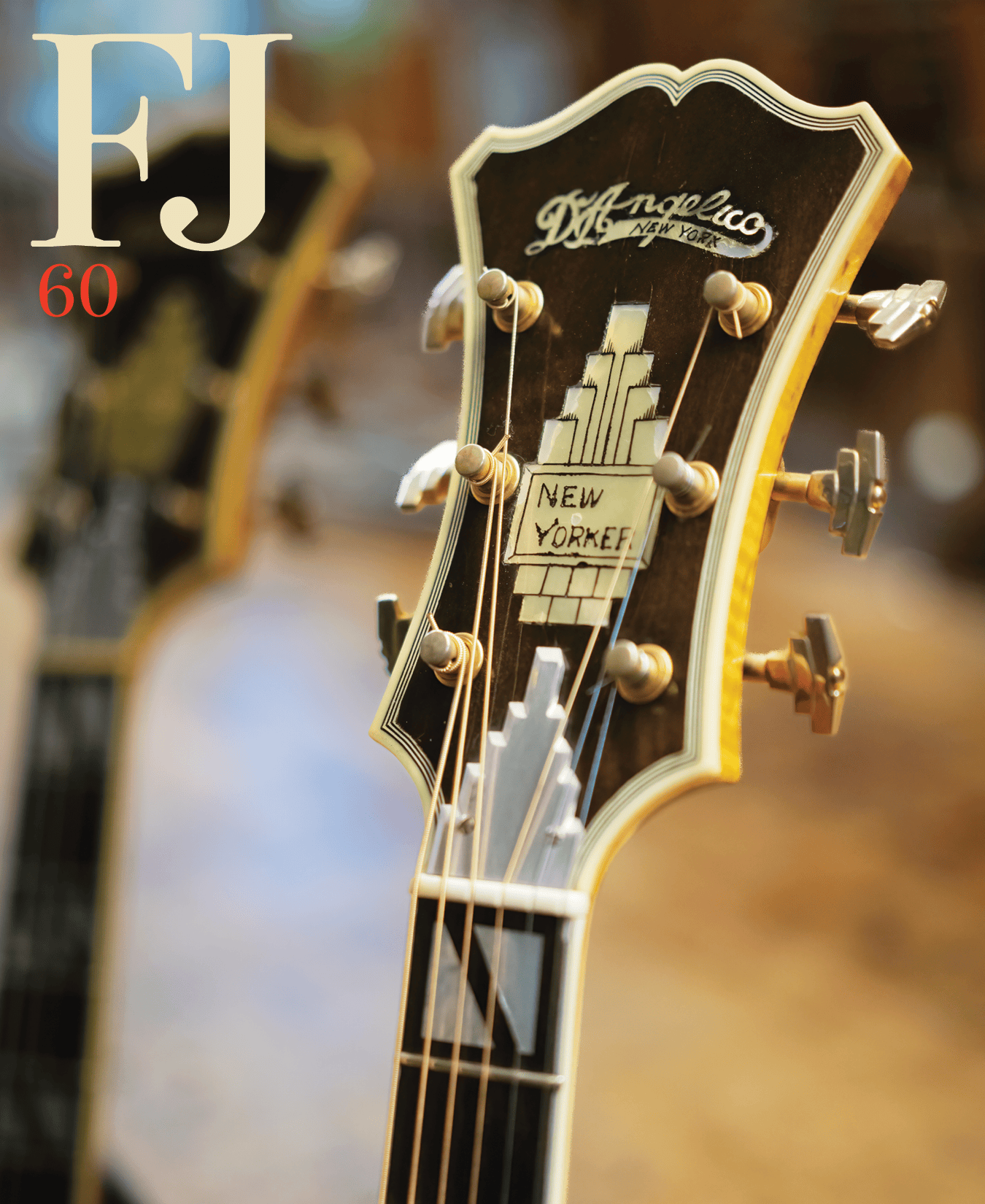
Matt Bushlow hears the story of Damion Hardin, son of 1960s folksinger Tim Hardin (“How Long Can We Hang On To a Dream”). Though his father passed away when he was just a teenager, Damion is busy honoring Tim’s legacy through his guitars, including a Gibson J-160, an unlabelled and utterly beguiling classical (pictured above), and an Ovation Balladeer.
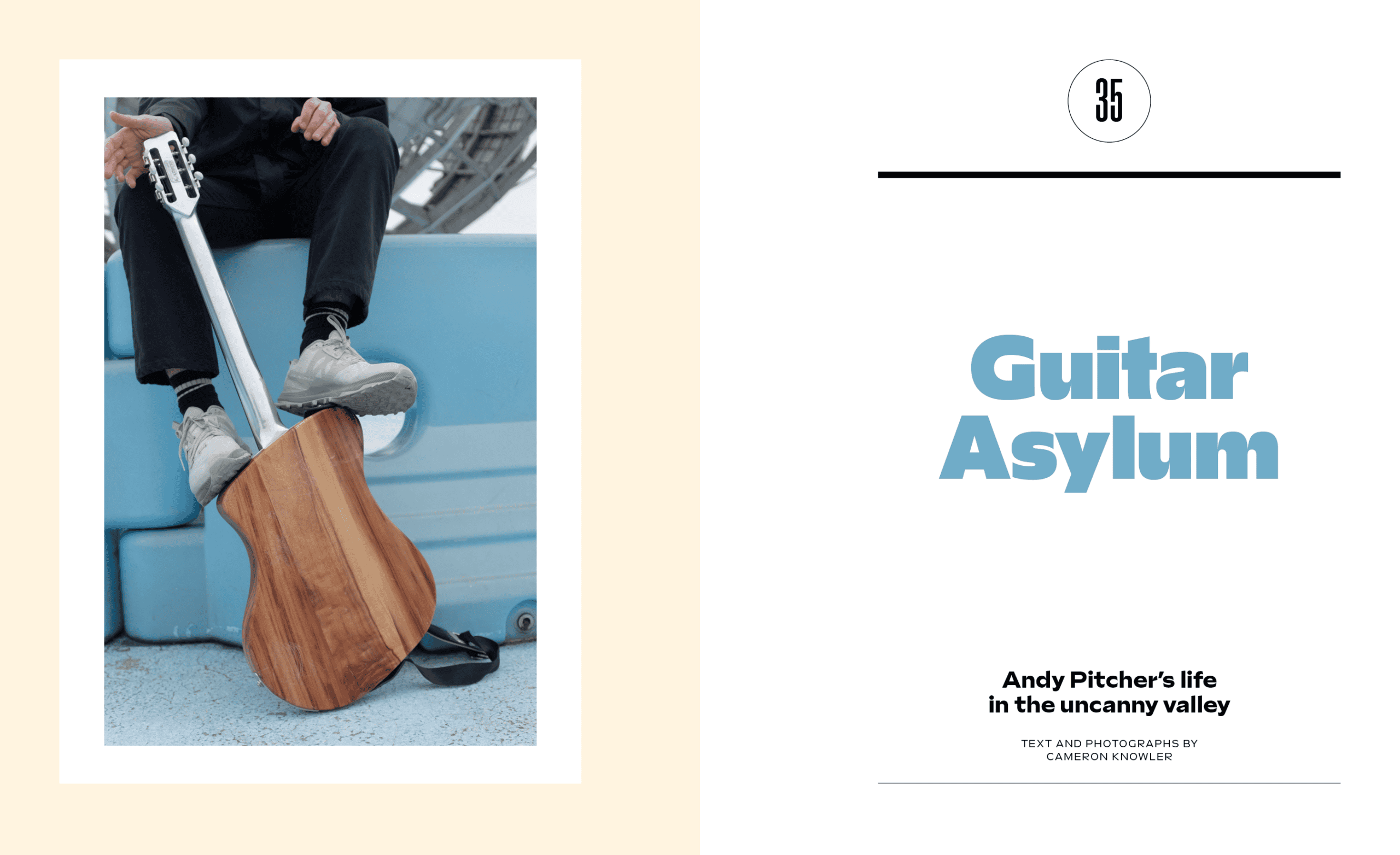
Experimental music is seldom sensitive, but Andy Pitcher is not your typical experimental guitarist. Cameron Knowler talks to the musician about his solo project, dot, an album that reflects on Pitcher’s first 30 years, loss and love. It’s a beautiful record and an equally beautiful conversation.
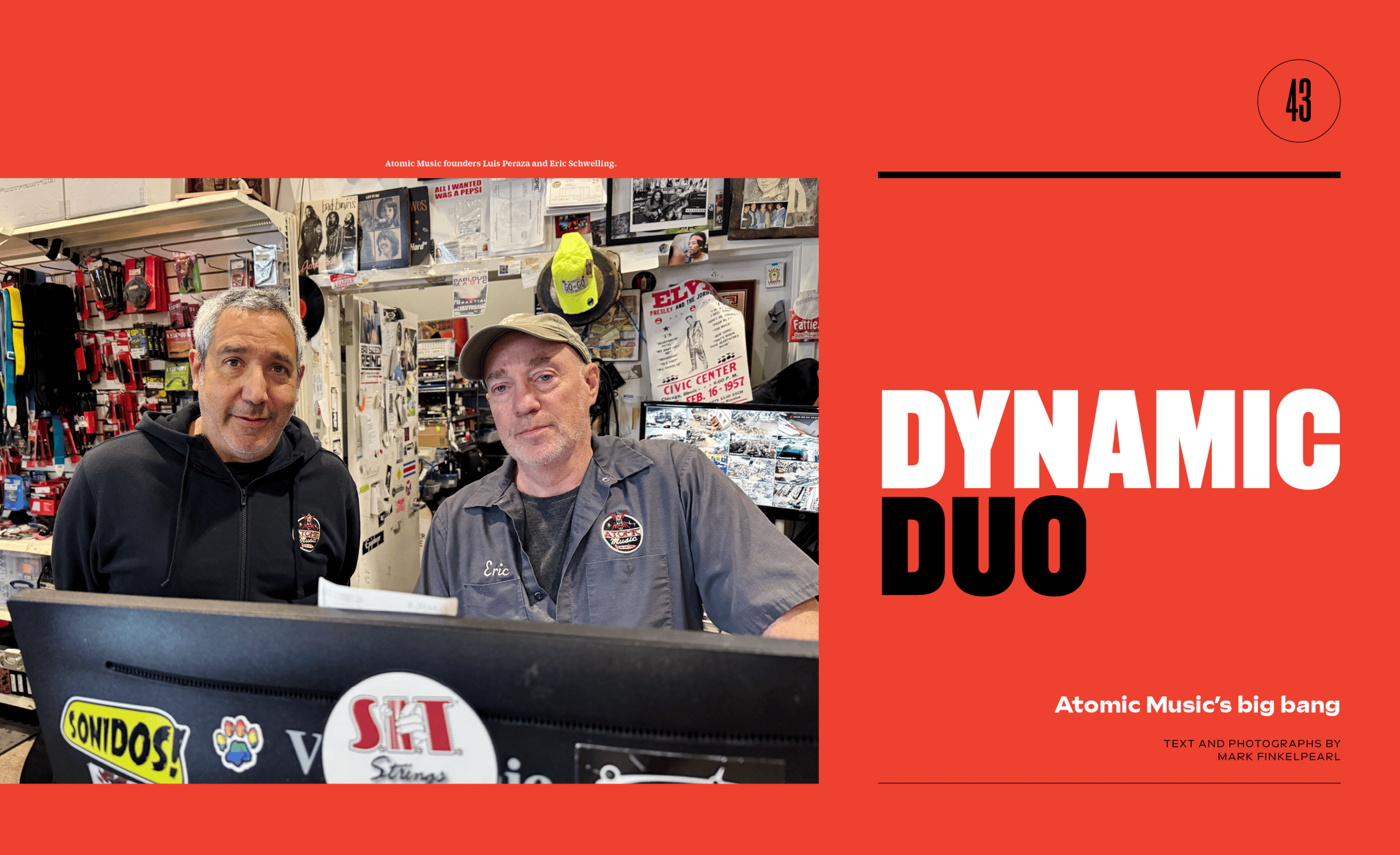
In a world of cookie-cutter guitar stores, Maryland’s Atomic Music stands out. For starters, it’s housed in a former Circuit City location inside a strip mall. More important is what’s inside: Thousands of pieces of rare and vintage gear lining the aisles that used to house Samsung TVs and laser printers. FJ contributor (and Atomic regular) Mark Finkelpearl talks to the store’s owners about its charming quirkiness, and massive inventory.
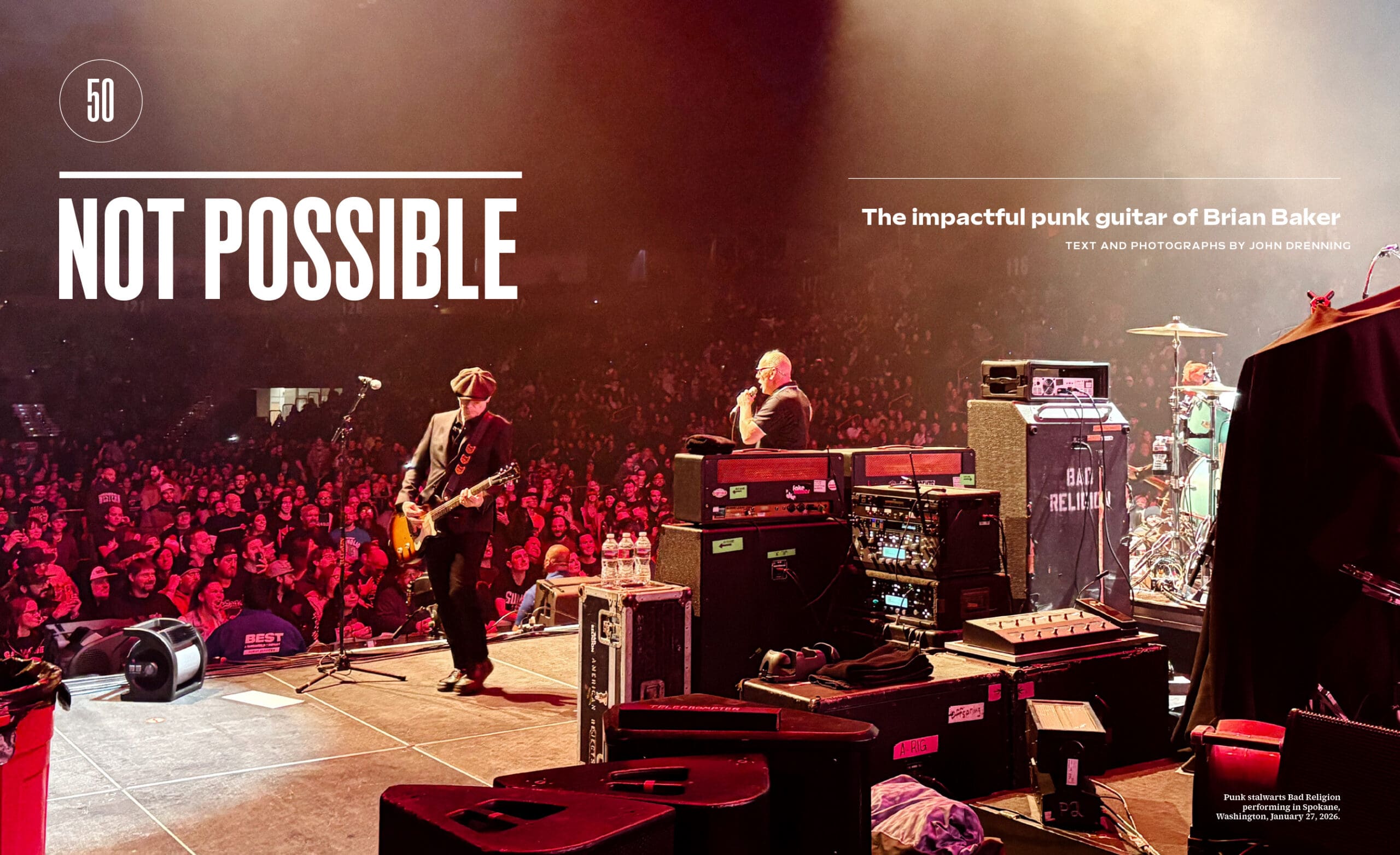
John Drenning sits down with one of punk’s true guitar icons, Bad Religion’s Brian Baker. Baker talks about his Les Paul Junior obsession, formative days in Minor Threat, Marshalls and more.
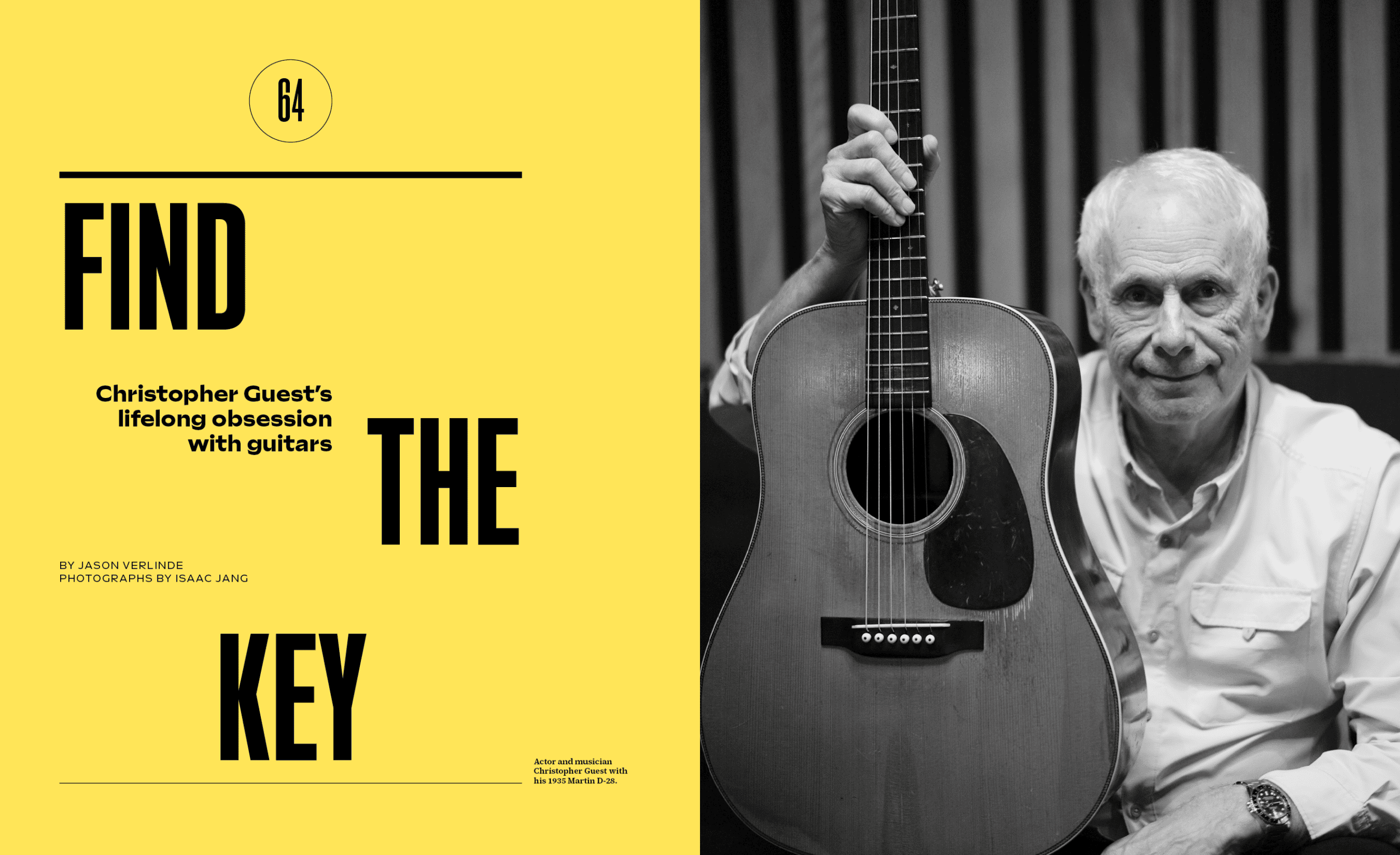
Fretboard Journal Publisher Jason Verlinde sits down with Christopher Guest, one of the funniest people in the world who also happens to be extremely serious about guitars. We talk Spinal Tap, his love for old Martins, his current gear obsessions and so much more.
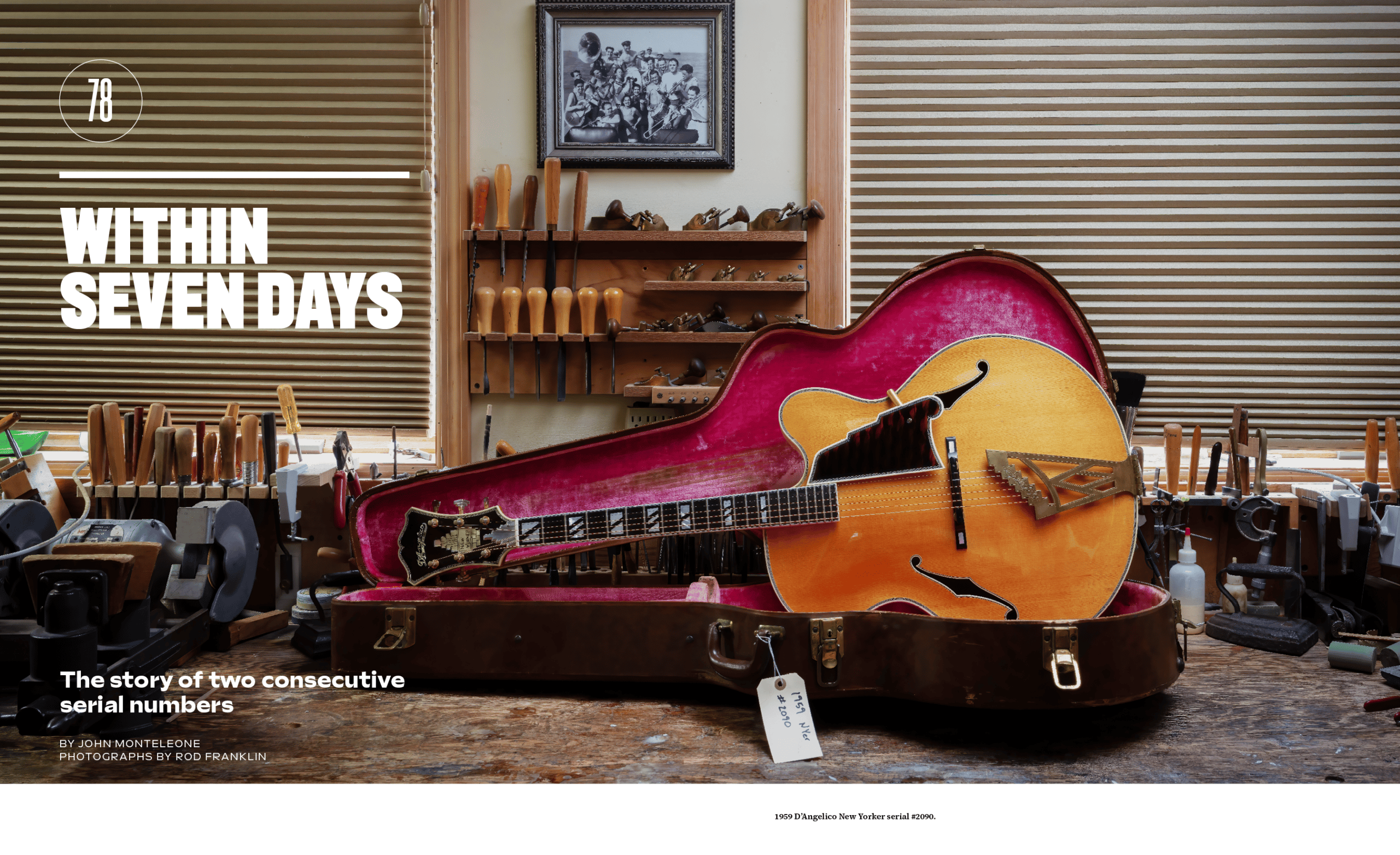
Famed archtop luthier John Montleone pens the never-before-heard story of two consecutive John D’Angelico instruments currently in his possession. D’Angelico’s #2090 and #2091 were both built in the late summer of 1959 and more than a little pedigree. In fact, 2091 was the first D’Angelico that Monteleone ever saw (at the ripe old age of 12). It’s a deep dive into instrument history and inspiration.

You may not have know Peter Nevins by name, but chances are you’ve seen this Portland, Oregon’s artist’s poster and album designs. A musician in his own right, Nevins has designed for Gillian Welch, Old Crow Medicine Show, John Prine and other Fretboard Journal favorites. Jamie Etherington talks to Nevins about his printmaking process, his old Gibson, influences and more. Guitarist Eric Skye captures the photos.
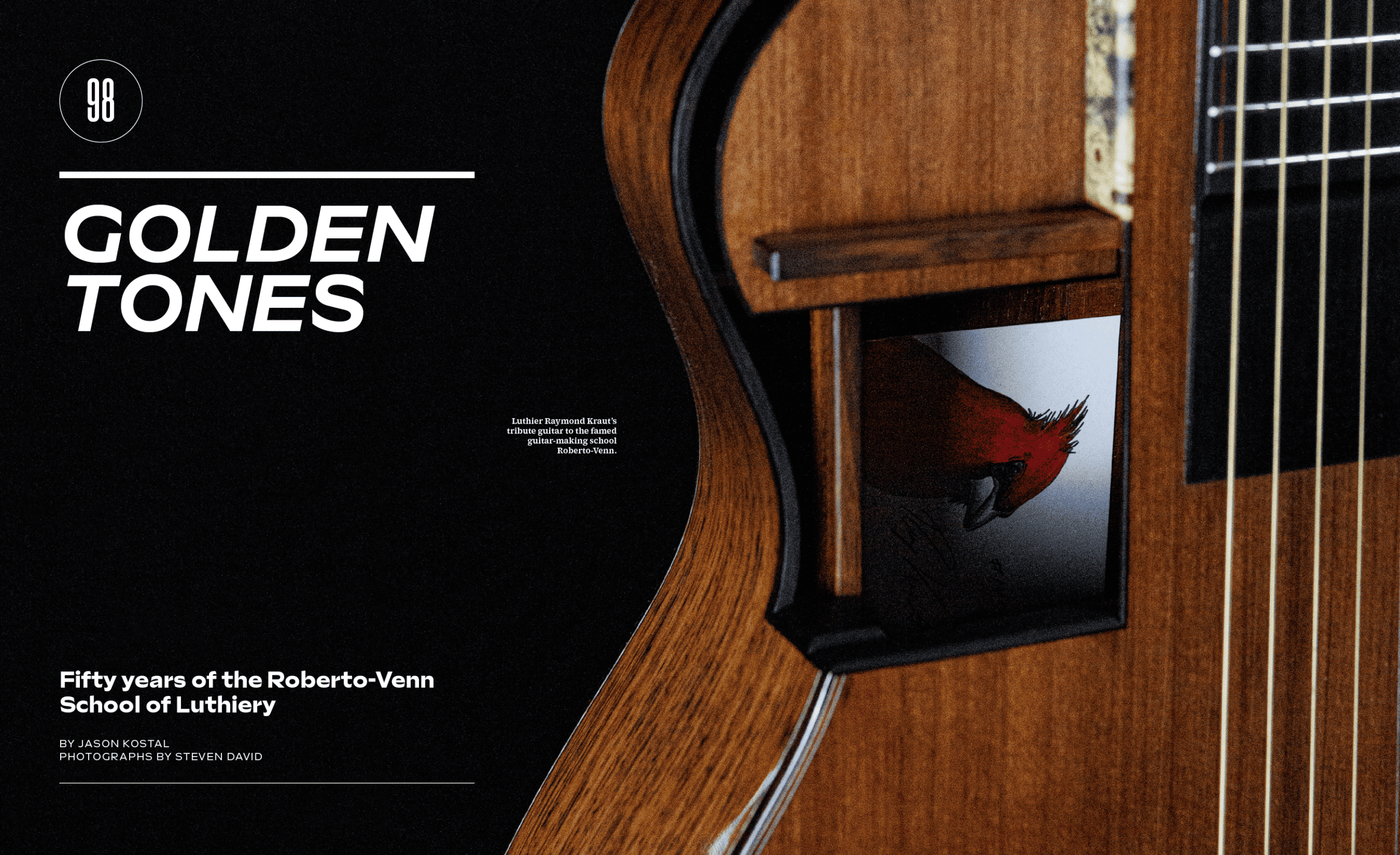
Roberto-Venn, the world’s most famous school for lutherie, recently celebrated their 50th anniversary through (what else?) a bunch of guitar builds. In this case, some of their most famous graduates of the Phoenix institution honored their alma mater with one-of-a-kind instruments. One of those grads, Jason Kostal, pens the story.
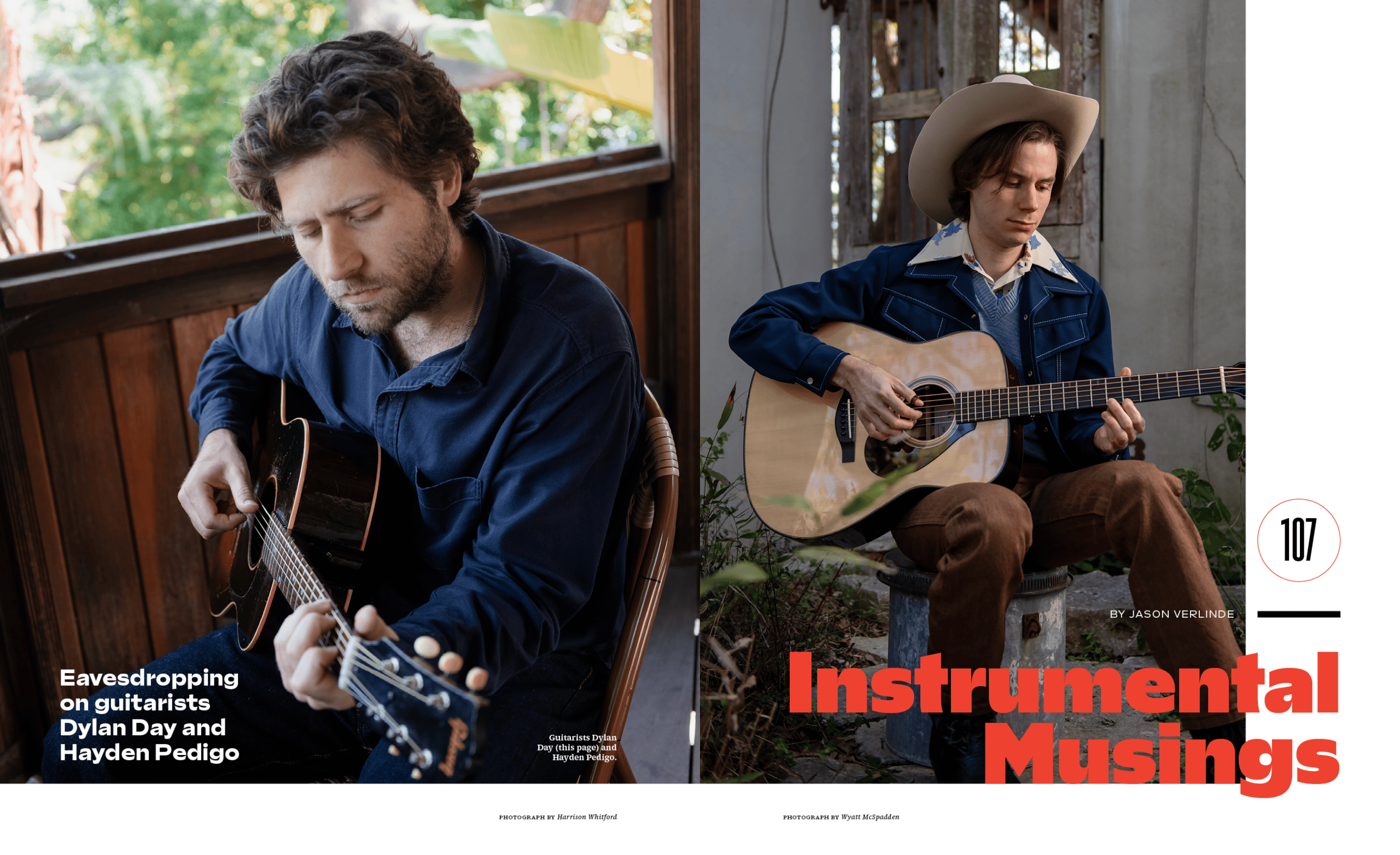
Dylan Day and Hayden Pedigo are two of the most creative acoustic guitarists on the scene today. Though they approach the instrument in vastly different ways, they also happen to be phone buddies. The Fretboard Journal crashes one of their ongoing conversations to talk guitar, taste, Genesis (the band and the book), and more.
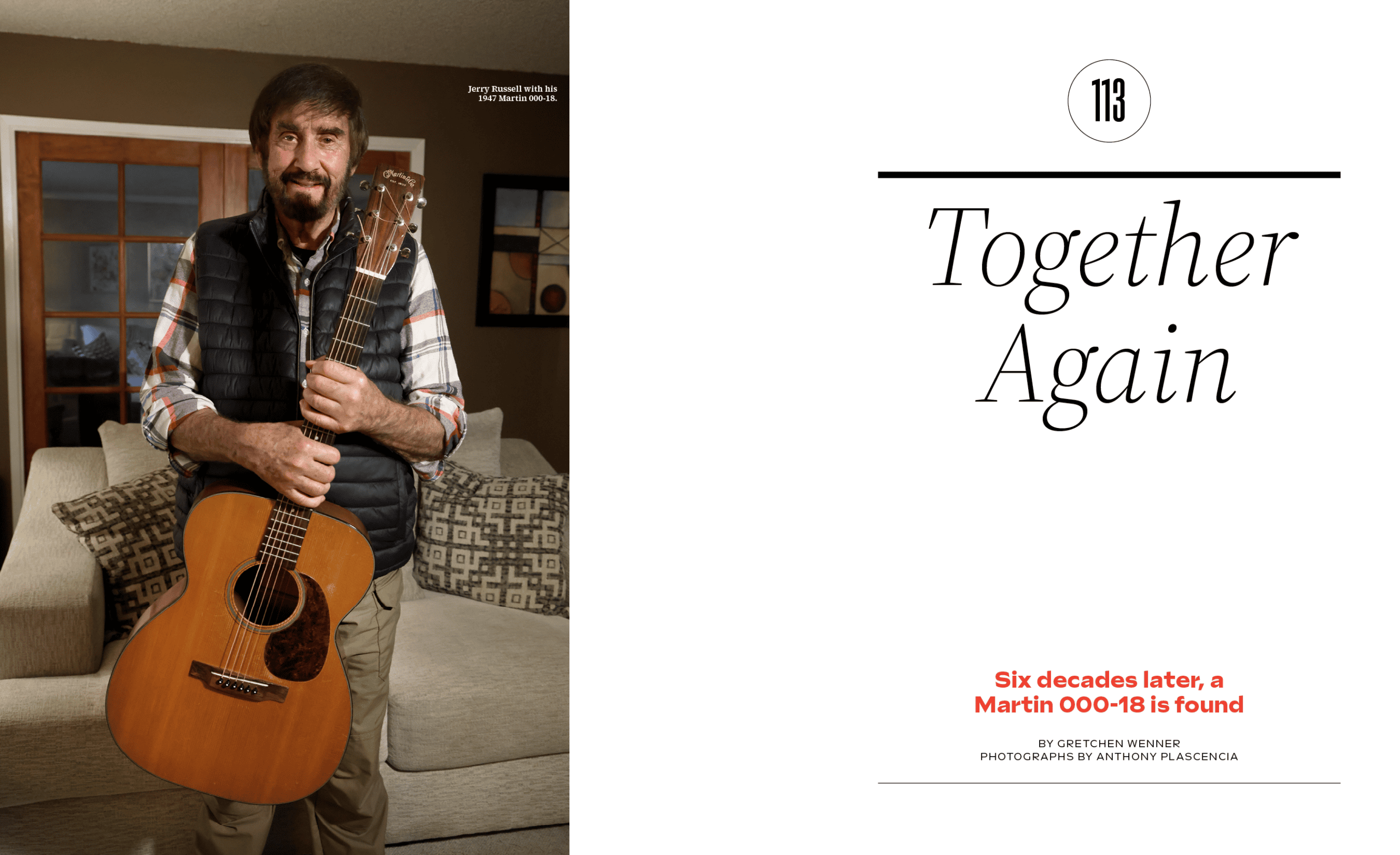
Plus: Apprenticing for Roger Sadowsky; reuniting with a lost Martin 000-18; Riverhorse on Big Tex; and so much more. Subscribe today to get this issue.
The post What’s Inside: Fretboard Journal 60 first appeared on Fretboard Journal.
“I put him above Ozzy”: This is metal’s greatest frontman, according to DevilDriver’s Dez Fafara
![[L-R] Ozzy Osbourne and Dez Fafara](https://guitar.com/wp-content/uploads/2026/08/Ozzy-Dez-hero@2000x1500.jpg)
Few names carry more weight in heavy metal than Ozzy Osbourne. But for DevilDriver and Coal Chamber vocalist Dez Fafara, there’s one frontman who sits even higher on the list: Pantera’s Phil Anselmo.
During an appearance on the Garza Podcast with Suicide Silence guitarist Chris Garza, Fafara spoke at length about Anselmo, calling him the greatest frontman metal has ever produced.
- READ MORE: “You never say never”: Zakk Wylde says new music with Pantera’s tribute lineup is possible
“Phillip – for me – I would say is the top frontman in the world, period, end of story,” Fafara says [via Ultimate Guitar]. “I love Ozzy, but I put him above Ozzy. That’s just cause…fuck, I don’t know, man. Plus, he’ll beat your fucking ass. He’s real. He’s a real fucking deal – Holyfield [referencing American boxer, Evander Holyfield].”
Fafara says Anselmo’s appeal goes far beyond his commanding stage presence, praising both his songwriting and Pantera’s enduring influence on heavy music.
“He’s an amazing frontman, amazing writer, and obviously one of the biggest bands in the world. Influenced everybody. I don’t think there’s anybody not influenced by Pantera. I wish I would have found him earlier, I would have got influenced vocally. But that just never happened.”
Elsewhere in the conversation, Fafara reveals how a chance meeting with Anselmo on Melrose Avenue eventually blossomed into a close friendship.
“I have a crazy story. When I was in Coal Chamber, I was walking down Melrose Ave. and Coal Chamber was just about to get signed, and I saw Phillip,” he says. “And I said, ‘Hey man, I love your shit. I’m listening to your shit.’ And he put his bags down, he’s like, ‘Cool, man.’ He signed something for me. I’m like, ‘One day, I’m going to tour with you.’ And he goes, ‘You know what, man? Bad ass. I hope you will.’”
Just a year later, that prediction came true.
“We pull up to a Pantera tour in my bus. Nobody’s on the bus but me. I hear the door knock and I answer it, and it’s Anselmo. And he goes, ‘Get your shit.’ I thought it was getting kicked off the tour.”
“I’m like, ‘OK.’ I got my bag and I go up on his bus. And he’s like, ‘This is my bunk, that’s your bunk below me. Throw your shit in – you’re living with me.’ And that’s how we became friends.”
Watch the full interview below.
The post “I put him above Ozzy”: This is metal’s greatest frontman, according to DevilDriver’s Dez Fafara appeared first on Guitar.com | All Things Guitar.
Tony Iommi’s final conversation with Ozzy Osbourne: “He said he wasn’t feeling great”

Even after years of watching Ozzy Osbourne battle health problems, Tony Iommi says the Black Sabbath frontman’s death still came as “a hell of a shock”.
Having formed Black Sabbath together in 1968, the pair spent nearly six decades as bandmates, collaborators and close friends, remaining in regular contact throughout their respective health struggles.
In a new interview with Rolling Stone, Iommi reflects on Black Sabbath’s emotional farewell show, the final text message he received from Osbourne, and why he still struggles to believe his longtime bandmate is really gone.
Looking back on Black Sabbath’s farewell performance, Iommi admits the show felt unlike anything the band had done before.
“On the night, it felt very strange for me because obviously we’d never been onstage with Ozzy in a throne before, sitting down,” says Iommi. “He was always jumping around, pulling faces, and making me and Geezer laugh. But on this occasion, I couldn’t see him because he’s in that throne at the front.”
With drummer Bill Ward returning to the fold for the first time in two decades, Iommi also spent much of the set positioned closer to the drum kit: “Bill wanted me to stand back by him just because he was unsure of some bits. And so I did.”
Watching the performance back has only made it more emotional. While he knew Osbourne’s health had been declining, Iommi says he “didn’t expect it to happen that quick.”
The guitarist also shared details of the final exchange the pair had before Osbourne’s passing.
“He texted me the night before, funny enough, and said he weren’t feeling great and so on. But obviously, most of our conversations to each other have been, ‘How are you feeling? How’s this? How’s that?’ And so it was just another conversation,” Iommi recalls. “I didn’t expect him to go overnight. Blimey. It was a hell of a shock, really.”
The two had remained close throughout their respective health battles, with Iommi recalling how they regularly checked in on one another over the years.
“We did stay in touch a lot. And he was going through so many different things and constantly in and out of hospital and having this done and that done. And again, he stood by me when I was diagnosed with cancer. He called me every day. So we’ve been supportive of each other. I do miss our conversations.”
Asked how he’s coped in the months since Osbourne’s death, Iommi admits the loss still hasn’t fully sunk in.
“It’s been really strange. I still don’t feel like he’s gone because when I look on YouTube or whatever, there’s something to do with Ozzy, and I see him again and again,” he says. “It’s almost like he’s still here. It’s really peculiar. Only, we were in touch so many times. That’s what I miss.”
Away from Black Sabbath, Iommi is preparing to release his first solo album in 21 years. From the Dark arrives on 23 October via BMG and features Norwegian vocalist Jørn Lande, Mercyful Fate bassist Becky Baldwin, and former Robbie Williams drummer Karl Brazil.
The post Tony Iommi’s final conversation with Ozzy Osbourne: “He said he wasn’t feeling great” appeared first on Guitar.com | All Things Guitar.
Richie Sambora says players should spend more time with their guitar than girls: “If you really look at a shape of a guitar, it’s really like a woman”

Richie Sambora has never been short on guitar wisdom, but his latest tip for beginners comes wrapped in an analogy you probably won’t hear from your local guitar teacher.
During a recent Q&A on his YouTube channel, the former Bon Jovi guitarist was asked what advice he’d offer aspiring players. His answer began with a reminder to spend as much time as possible with their instrument.
- READ MORE: Richie Sambora reveals he hired a private detective to track down his stolen Gibson Explorer
“Good listening habits. Try to have one in your hand as much as possible, maybe more than girls,” says Sambora. “Because if you really look at the shape of a guitar, it’s really like a woman, you know what I mean?”
It’s hardly the first time a guitarist has compared the six-string to the female body. Ironically, though, the traditional guitar shape has long been criticised by some players for being uncomfortable for women. That was one of the motivations behind St. Vincent’s signature Ernie Ball Music Man guitar, which she famously designed with room for “a breast – or two”, creating a body shape that better accommodates female players.
The design has since found a fan in Olivia Rodrigo, who used the guitar on her Guts world tour and later described it as “fucking cool looking”, saying: “It’s cut so that you can have boobs and play guitar, which is so awesome.”
Back on the subject of playing, Sambora rounded out his advice with a reminder not to overlook the basics.
“Just play. Learn the fundamentals first,” he says.
The guitarist also reflects on the musicians who shaped his own approach to the instrument, singling out Jimi Hendrix as his biggest inspiration.
“For me Jimi Hendrix was the epitome of improvisation. As far as I know, that was what I wanted,” Sambora says. “I listened to those records, especially the live ones like Band Of Gypsys over and over and over again. Then I moved on to Texas blues with Johnny Winter and the Allman Brothers. And then moved backwards to Buddy Guy, Muddy Waters, Albert King, BB King.”
The post Richie Sambora says players should spend more time with their guitar than girls: “If you really look at a shape of a guitar, it’s really like a woman” appeared first on Guitar.com | All Things Guitar.
New firmware update lets HeadRush users tap into a world of open-source guitar tone captures

Amp modelling and multi-effects specialist HeadRush has issued a major firmware update that might just change the game for users of its Prime, Core and Flex Prime floor-based processors.
The update means these three units now offer native support for Neural Amp Modeler (NAM), an open-source platform that lets users harness AI to capture and reproduce the sound of real guitar amps and gear, and direct integration with TONE3000, a free platform through which guitarists can share their tones.
With these changes, Prime, Core and Flex Prime users will see a transformation in how they experiment with tone creation, allowing them to tap into a vibrant global community of musicians and sound designers to explore a vast range of tone profiles. Crucially, they are able to do this with no computer, conversion or third-party software required.
The new NAM compatibility and TONE3000 integration is seamless, allowing guitarists to browse, download and play NAM captures directly from TONE3000 through HeadRush Cloud via their unit’s onboard touchscreen.
“Whether accessing a rare vintage amp captured overseas or a boutique pedal chain shared by a bedroom engineer, the path from discovery to performance is now instant,” HeadRush explains.
“With native NAM support and direct TONE3000 access built right into Prime, Core, and Flex Prime, we’re putting hundreds of thousands of community-created captures of iconic amps, boutique gear, and rare signal chains directly in musicians’ hands, with no computer required,” says Walter Skorupski, Senior Product Manager of HeadRush at inMusic.

“It’s the same open, community-powered spirit that’s reshaping modern guitar tone, now built directly into the rig.”
“I’m very proud of the level of quality that NAM offers. Seeing HeadRush affirm this by bringing it to their product line is a win for open-source technology in the music industry and, ultimately, the artists that industry serves,” adds Steve Atkinson, creator of Neural Amp Modeler.
“Less than two months after TONE3000 launched NAM A2, HeadRush’s entire multi-effects lineup has become the first to let you browse the full TONE3000 library directly from the device’s touchscreen,” says Stanley Vergilis, Co-Founder and CEO of TONE3000. “And with the Flex Prime available for just $499, making music is more accessible than ever.”
How do I download the new firmware update for my HeadRush Prime, Core or Flex Prime?
The easiest way to download the new firmware update is to do so directly via your unit’s onboard touchscreen. Simply open the main menu on your device and tap “Firmware Update”. After the download is complete, restart your device.
Alternatively, you can complete the firmware update using a USB connection to your computer. Just head to the HeadRush Downloads page and follow the instructions.
HeadRush’s flagship Prime unit is priced at $999, while the Core clocks in at $699, and the Flex Prime at $499.
What are people saying so far about the new HeadRush firmware update?
The new firmware update is significant, with some prominent guitar players and content creators saying it will change the world of digital amp modelling. YouTuber Xander Raymond Charles says in a new video: “I think HeadRush has just destroyed the amp modelling competition today.” Meanwhile, musician and engineer Glenn Fricker, of YouTube channel Spectre Sound Studios, says: “The entire amp sim industry was just obliterated by a free-to-use open source simulator.”
Learn more at HeadRush.
The post New firmware update lets HeadRush users tap into a world of open-source guitar tone captures appeared first on Guitar.com | All Things Guitar.
Why Tosin Abasi created the wildest nylon-string guitar ever: the Stage 7

The guitar industry can often feel slow to move. With the ubiquity of time-honoured designs like the Stratocaster and Les Paul – not to mention the percentage of the market dominated by close relatives of those two foundational guitars – substantial steps in innovation can feel few and far between. But if there’s one person hellbent on pushing the boundaries of guitar design, it’s Tosin Abasi.
 The Abasi Stage 7 on the Guitar.com Cover. Image: Rachel Billings for Guitar.com
The mastermind behind prog metal heavyweights Animals as Leaders and an extended-range virtuoso, there’s no more fitting poster boy for radical instrument design. And since forming Abasi Concepts in 2017, he’s been on the cutting edge.
Tosin Abasi’s career as a guitar designer has flourished over the past 10 years, from the development of the Abasi Concepts catalogue with thoughtfully designed and brilliantly ergonomic instruments like the flagship Larada and its double-cutaway sibling, the Ēmi, to his partnerships with some of the industry’s biggest brands.
He’s specifically shown an interest in collaborating with bigger brands to bring his unique take on guitar design to the masses. Ernie Ball Music Man had Abasi to thank for the Kaizen, one of the most exciting and unique shred guitars out there, and now it’s the turn of Yamaha-owned Cordoba.
 Image: Rachel Billings for Guitar.com
The world’s largest maker of nylon-stringed instruments has partnered with Abasi to create the Abasi Stage 7, a wildly imaginative seven-string nylon-string electric guitar that rips the rulebook for classical guitar design to shreds.
There’s plenty of Abasi Concepts DNA in the Stage 7 – which is a big part of why it’s unquestionably the most unique looking nylon-string on the market – but the form has function. It’s very probably the most ergonomic and comfortable classical guitar on the planet.
“If there’s a gap in the guitar space, this is a strong reason to create something there”
Pushing the boundaries
So why did one of the world’s foremost technical metal players decide to develop a nylon-string guitar? He had already dipped his toes into the classical world with Animals As Leaders, but he struggled to find a guitar that worked for him in a live setting. So he’d design his own.
“I’ve tried different acoustic-electrics for live shows, and there’s always this looming risk of feedback,” he explains. “We have a loud drummer, and there’s another guitar player playing electric. So my use of these nylons was always in a context that was not traditional. I realised that the more resonant the guitar was, the more feedback I’d get.”
Cordoba’s popular and impressive thinline hybrid nylon-string, the Stage, helped Abasi solve some issues. “If you turn down the contact mic on the body, you could get away with playing it pretty loud on stage without that feedback occurring,” he says.
 Image: Rachel Billings for Guitar.com
The vanilla Stage became a trusted touring ally, but this is Tosin Abasi we’re talking about. Abasi Concepts had already been prototyping a nylon-string of their own, and the cogs inevitably started turning.
“I said, ‘I wonder if Cordoba would be interested in collaborating on making something like this, but with some changes.’ We aligned on a co-branded, co-designed acoustic-electric that didn’t exist.”
Abasi’s touring experience factored into the new instrument, but he also had homebodies in mind. “We wanted to design this as a midpoint for the electric player who wants to get into nylon-string, playing in contexts that aren’t solo classical guitar, and likely does a lot of home recording,” he explains.
“In progressive metal, everyone is becoming their own recording engineer, and the ability to plug something in, as opposed to having to set up a bunch of mics and pres – we wanted it to sound great direct, straight out of the guitar.”
 Image: Rachel Billings for Guitar.com
Besides the Larada-inspired body shape, the wildest design element has to be the 24-fret fanned fingerboard. “What nylon-string guitar has 24 frets and seven-strings on it?” he laughs. Abasi has some words of reassurance for sceptical newcomers to fanned frets. “The actual string is happier,” he says. “The lowest strings benefit from that extra scaling… you get to add scale length so that the string is not floppy.” Meanwhile, a multi-scale length guitar retains the string tension of the higher strings as you’re used to. “The benefit is twofold: you retain the timbre of those treble strings, and you retain the tension that you’re used to.”
But Abasi also points to the ergonomic benefits of fanned frets: “Your elbow primarily stays still – it’s kind of alongside your torso – your hand naturally fans as it moves from the headstock towards the body of the guitar. This fanning motion is more in line with mechanically what’s happening in the first place.”
Also present on the Stage 7 is a cutaway on the lower bout, a stroke of design mastery present on all Abasi Concepts instruments, again rooted in Abasi’s personal preferences.
“Classical guitars don’t have this, but it helps for playing in a classical seated position,” he says. “It’s because most acoustic instruments don’t want to give up any volume, so the more body, the better… But because our instrument isn’t relying on the size of the cavity to produce its sound like a purely acoustic instrument, we were allowed to modify the body in a way that aided the ergonomics.”
“For a lot of guitar players, they see examples of nylon-string in a new context, and it puts a light bulb in their head”
A Match Made In Heaven
Nylon-string guitar and high-gain heavy metal music seem worlds apart on the surface, but both have roots in virtuosity, with technical chops a strong component of the appeal. Social media stars like Ichika Nito and Marcin have done a lot to bring virtuosic clean playing to the masses, while Polyphia’s Tim Henson has spearheaded nylon-string’s foray into the metal world, even launching his own more conventional Ibanez nylon sig. So is now the perfect time for the Abasi Stage 7?
“Tim did a great job of taking a nylon-string instrument and applying it to a completely unique context. Sometimes it just takes something for it to click for people,” Abasi says. “Animals as Leaders have had nylon-string guitars as far back as 2009… but for a lot of guitar players, they see examples of it in a new context, and it puts a light bulb in their head.”
 Image: Rachel Billings for Guitar.com
He continues: “A young player might be listening to classical guitar music, but doesn’t realise there’s a tonne of very advanced technique, and you’re allowed to play fast. Social media is exposure to the fact that classical guitar often incorporates really advanced technique.
“And so, if you’re a kid who’s into shred or progressive metal, you have an appetite for that complexity, and you see someone like Marcin playing complex stuff, you go, ‘Woah, this sounds really elegant and cool…’ It was always waiting to happen – that exposure has occurred at the right time.”
“Big brands often don’t have permission to really push the envelope. There’s hostility if they try to do new things”
Going It Alone
Abasi can push the boundaries of guitar design so regularly in no small part to Abasi Concepts, the brand he founded as much out of necessity as anything else.
“By the time I was playing eight-strings, it was kind of an underserved sector for guitar,” Abasi, who was an Ibanez signature artist at the time, recalls. “If you wanted pickups or a guitar in general, you had limited options. There were things I felt could make the eight-string easier to play that I wasn’t seeing occurring.”
After convincing the Japanese guitar giant to let him design his own original body shape, the Larada was born. But Abasi felt the wheels weren’t turning fast enough.
“Ibanez is a great company, but they’re a very large company… every single change took a very long period of time to implement,” he says. “I eventually felt I wanted to take my original design and expand it beyond just a single eight-string offering with Ibanez. That’s how Abasi Concepts was born.”
 Image: Rachel Billings for Guitar.com
In the nine years since, the brand has created a variety of different truly unique instruments, and that confidence at pushing the boundaries allowed him to come back to the mainstream world with Ernie Ball in 2022.
“It was the first time you could get something designed by me for under $1,500,” he reflects. “And it was exciting to be able to offer something for people who don’t have a lot of money to spend on really expensive guitars.”
Taking advantage of Music Man’s technological resources, Abasi was able to design a three-dimensional ergonomic instrument in a way that he might not have been able to on his own.
“They have an amazing engineering team and an amazing facility here in California,” he enthuses. “It’s incredible. They have robots and stuff!”
“Our whole thing is to make something distinct that solves a problem”
The Future Is Now
The common thread with all of Abasi’s creations is that they push things outside of the comfort zone that most guitar brands seem stuck in. Why do we have this tendency to play it safe?
“There isn’t a single answer,” he replies. “It just seems the case that guitar players are often a lot less open-minded when it comes to new guitar designs, and I think this is because most of our favourite music that was written on the guitar was written decades ago, and [instead of] creating new directions and blazing new trails, most people want to emulate their heroes.”
That discourages innovation in big manufacturers and legacy brands, he argues. “From the outside looking in, they often don’t have brand permission to really push the envelope. There’s hostility if they try to do new things. It feels almost like guitar players are a conservative, religious community.”
The Stage 7 is Abasi’s latest attempt to creatively challenge guitar orthodoxy – and an important business milestone as yet another successful partnership with a major brand. The next step, you’d expect, would be to scale up and expand even further, but Abasi is keen to keep things streamlined.
 Image: Rachel Billings for Guitar.com
“You ever go to a restaurant and the menu is enormous, and you’re like, ‘Wait, what?’ It’s similar to guitar gear,” he says. “A bunch of options sounds good on paper, but sometimes it’s more of a mental load. We’ve been very deliberate about what we offer.”
The Stage 7 feels deliberate and exciting in every way – an instrument that meets an un-met need and recontextualises the most traditional type of guitar in a way that makes it feel radically futuristic. It’s a textbook Abasi design, and one that comes from a clear mindset.
“If there’s a gap in the guitar space, this is a strong reason to create something there,” Tosin says. “Our whole thing is to make something distinct that solves a problem, and where you couldn’t simply choose another instrument for the same role.”
The Abasi Stage 7 is now available.
Words: Sam Roche
Photography: Rachel Billings
The post Why Tosin Abasi created the wildest nylon-string guitar ever: the Stage 7 appeared first on Guitar.com | All Things Guitar.
Totally Guitars Weekly Update July 31, 2026
July 31, 2026 Jerry Garcia was on my mind when the camera got to rolling, so a few of his melodies started today’s Update. We got another Ella Langley lesson from Nesh–Be Her, to go along with Choosin’ Texas from a few weeks back. We are wrapping up the Learn To Read Challenge with TG […]
The post Totally Guitars Weekly Update July 31, 2026 appeared first on On The Beat with Totally Guitars.
Luthier on Luthier: Paco Chorobo
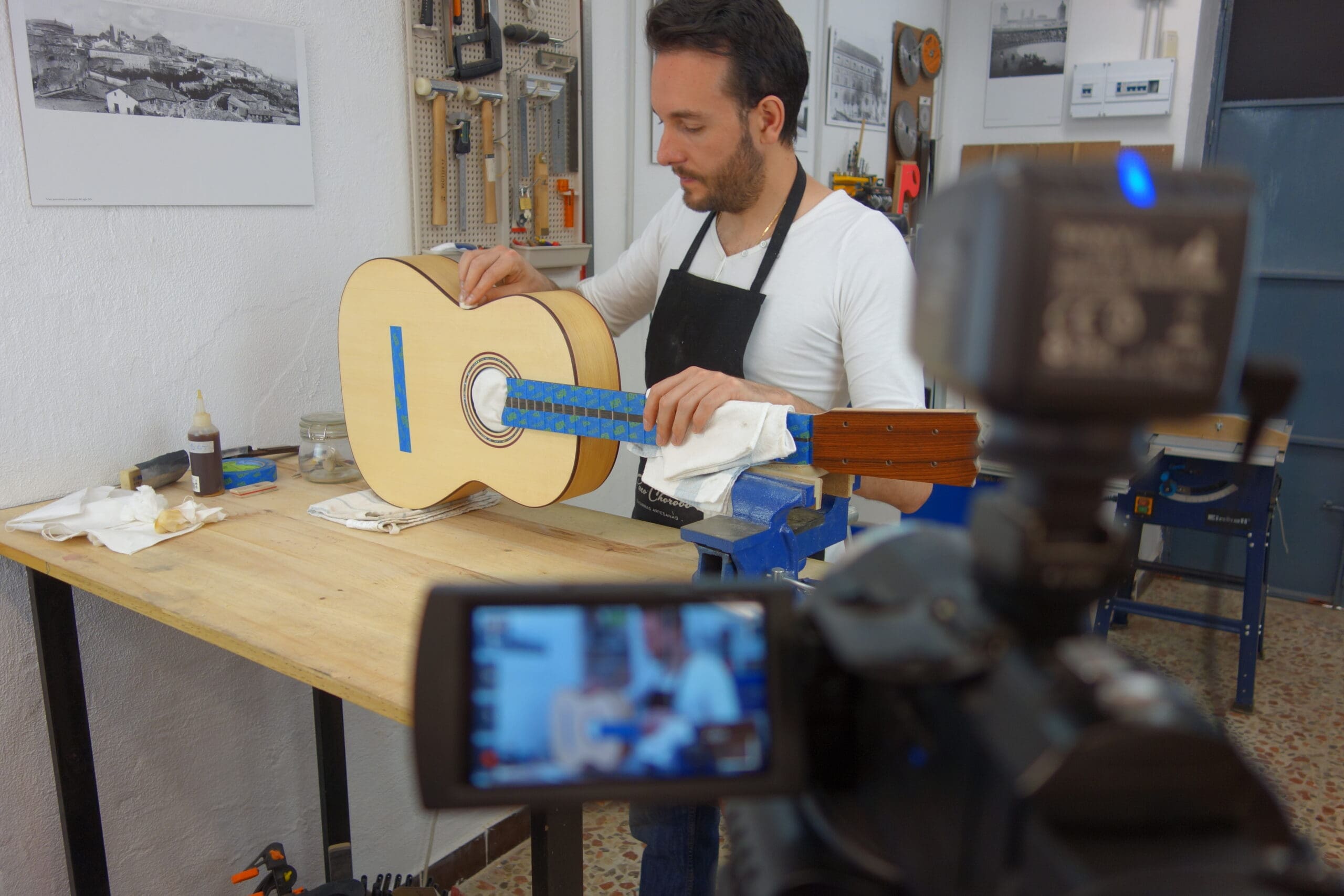
For episode 116, we’re joined by Spanish guitarmaker Paco Chorobo from Úbeda, Spain.
Paco shares his journey from telecommunications engineer to full-time luthier and discusses his approach to building both classical and flamenco guitars while blending traditional hand craftsmanship with modern technology. We also explore the cultural roots of flamenco guitars, the construction differences between flamenco and classical instruments, and his philosophy of building guitars around the individual player.
Link to Paco’s work: https://chorobo.com/home/
Luthier on Luthier is hosted by Michael Bashkin of Bashkin Guitars and brought to you by the Fretboard Journal. This episode is sponsored by the Looth Group, Dream Guitars and StewMac.
Want to support Luthier on Luthier? Join our Patreon to get access to exclusive photos and content from Michael and his builds.

The post Luthier on Luthier: Paco Chorobo first appeared on Fretboard Journal.
The Doom soundtrack is one of the greatest heavy metal compositions of all time. Next year, Mick Gordon will perform it live for the first time

It’s hard to dispute Mick Gordon’s Doom soundtrack as one of the greatest heavy metal compositions of all time. The Australian composer’s genius, crushing eight- and nine-string riffs offer the perfect sonic accompaniment to slaying hundreds upon hundreds of hellish demons and other grotesque creatures.
The soundtrack gave rise to such classics as Rip & Tear and Bfg Division, and gained such a cult status that Gordon was invited to compose the score for the game’s followup, Doom: Eternal, in 2020.
But surprisingly given its adoration by those at the intersection of heavy metal music and gaming, the Doom soundtrack has never been performed live in its entirety in the 10 years since the game’s release in 2016.
But that’s all set to change next year, when Mick Gordon will perform the Doom soundtrack for the first time ever in a headline set at the UK’s RADAR Festival alongside a full band and orchestra.
At RADAR 2027 Mick will bring the Doom soundtrack to the stage for the first time, featuring the DOOM Machine (his custom Doom instrument), with a full live band and an orchestra for good measure,” festival organisers say.
“This isn’t a DJ set, and it isn’t a tribute act. It’s the actual composer, the actual score – the riffs played properly loud in a room that can withstand all the ripping and tearing. “Mick has never performed this music live, like this. Until RADAR came calling.”
Next year’s RADAR Festival will take place at Manchester’s O2 Victoria Warehouse from 30 July to 1 August 2027, but there’s still this year’s edition to get through first. From today (31 July) through the weekend, the festival will see performances from Thy Art Is Murder, Skindred, Northlane, Animals as Leaders and so many more.
Learn more at RADAR Festival.
The post The Doom soundtrack is one of the greatest heavy metal compositions of all time. Next year, Mick Gordon will perform it live for the first time appeared first on Guitar.com | All Things Guitar.
“In their school they weren’t allowed to own a guitar”: Phil Collins explains the early differences between him and his Genesis bandmates

Phil Collins has been looking back on how he managed to join Genesis as their new drummer, and the early differences he noticed between himself and the rest of the band.
Collins had attended a drama school from the age of 14 where, as he says, he could get away with murder, while the other existing band members – Peter Gabriel, Tony Banks, and Mike Rutherford – that he joined in 1970 had all attended the private Charterhouse School in Surrey, UK.
Speaking to Prog about his journey into the lineup, he recalls, “It was just Tony, Peter and Mike. Mike’s always said that when Anthony Phillips, the unsung hero, left because he couldn’t take the stress, they thought that was the end of the band. But they carried on, and thought they could get a better drummer, I believe, than John Mayhew, who was on [second Genesis album] Trespass.
“I didn’t know all this background dynamic; I had just seen their name a lot in the back of Melody Maker. I knew Tony Stratton-Smith, their manager, since I was about 16 and he was managing The Creation.”
He continues, “I went down to the Marquee bar one night to see if he could put in a word for me. He said, ‘Oh, I’d love to, but I’m afraid they’re very fussy, these guys – you will have to audition.’ So I went along and here we are today! Yes, they were public school [an old term for an independent school] boys, and I was from the drama school where you could get away with murder.”
Collins shares, “In their school they weren’t allowed to own a guitar. At mine, I’d bring my records in and we’d play Sgt. Pepper... or Motown or The Byrds’ Younger Than Yesterday. The teacher would say, ‘Are you sure you can hear me talk at the same time as this music is on?’ We’d say, ‘Oh sure…’”
Genesis are releasing their 1974 album The Lamb Lies Down On Broadway in standalone 1-BR Blu-ray Audio for the first time on 28 August. You can pre-order it now via the Genesis website.
The post “In their school they weren’t allowed to own a guitar”: Phil Collins explains the early differences between him and his Genesis bandmates appeared first on Guitar.com | All Things Guitar.
“Seeing Brent in his casket was so difficult to wrap our heads around, and it makes you want to feel f**king alive”: Mastodon’s Brann Dailor on how the band dealt with the death of Brent Hinds

Mastodon’s Brann Dailor and Troy Sanders have been reflecting on the death of Brent Hinds, and how his sudden loss has changed their perspective on living and making things work as a band.
Hinds passed away due to a motorcycle accident at the age of 51 last year, shortly after his departure from the band. Earlier in the same year, Dailor also lost his mother. After a very difficult period of grief, the band are touring again (with more shows scheduled from September), and have a new album titled Marrow Deep landing on 28 August.
In a new interview with The Guardian, the pair look back on their somewhat hectic bond with Hinds, and how they found their desire to make more music after such a tumultuous time.
Dailor says, “If any of us did half the stuff that Brent pulled off, we’d all have been dead years ago. We’ve always been a hard-partying band, but for the last 10, 15 years, the three of us really settled down and were focusing more on our live show and being productive in the studio.
“He was still rocking, which was, for a lot of people from the outside looking in, the most admirable thing about him. But from the inside it’s not always that much fun.”
Dailor and Sanders decline to expand any further on why the band parted with Hinds. Their original statement claimed the decision was mutual, but some pretty scathing social media posts from Hinds regarding the other members suggested there were some inner tensions.
The one thing they can confirm? Hinds never punched Dailor in the face; a rumour which broke out after a public appearance he made with a black eye, just before the announcement. In fact, Dailor says Hinds sent him a text amid the media flurry saying he couldn’t believe the rumours.
Further into the interview, the pair reflect more deeply on the loss – not just the pain it caused them, but how it altered their perspective on living life to its fullest.
“I was devastated,” Dailor shares. “All the shit-talking that had happened – you reference the Instagram comment section shit – I didn’t think about any of that. We got 25 years of a deep relationship with this guy. I could tell who he was by the smell of his farts.
“When one of the integral members, one of your brothers, dies, it’s obviously a very painful thing to go through, but it also makes you question where you’re at. Seeing Brent in his casket was so difficult to wrap our heads around, and it makes you want to feel fucking alive. We’re still here, so we better get to it.”
Marrow Deep, the new album from Mastodon, is released on 28 August. You can pre-order it now.
The post “Seeing Brent in his casket was so difficult to wrap our heads around, and it makes you want to feel f**king alive”: Mastodon’s Brann Dailor on how the band dealt with the death of Brent Hinds appeared first on Guitar.com | All Things Guitar.
“I hate playing acoustic”: Why Tony Iommi is pushing himself outside his comfort zone on new solo album
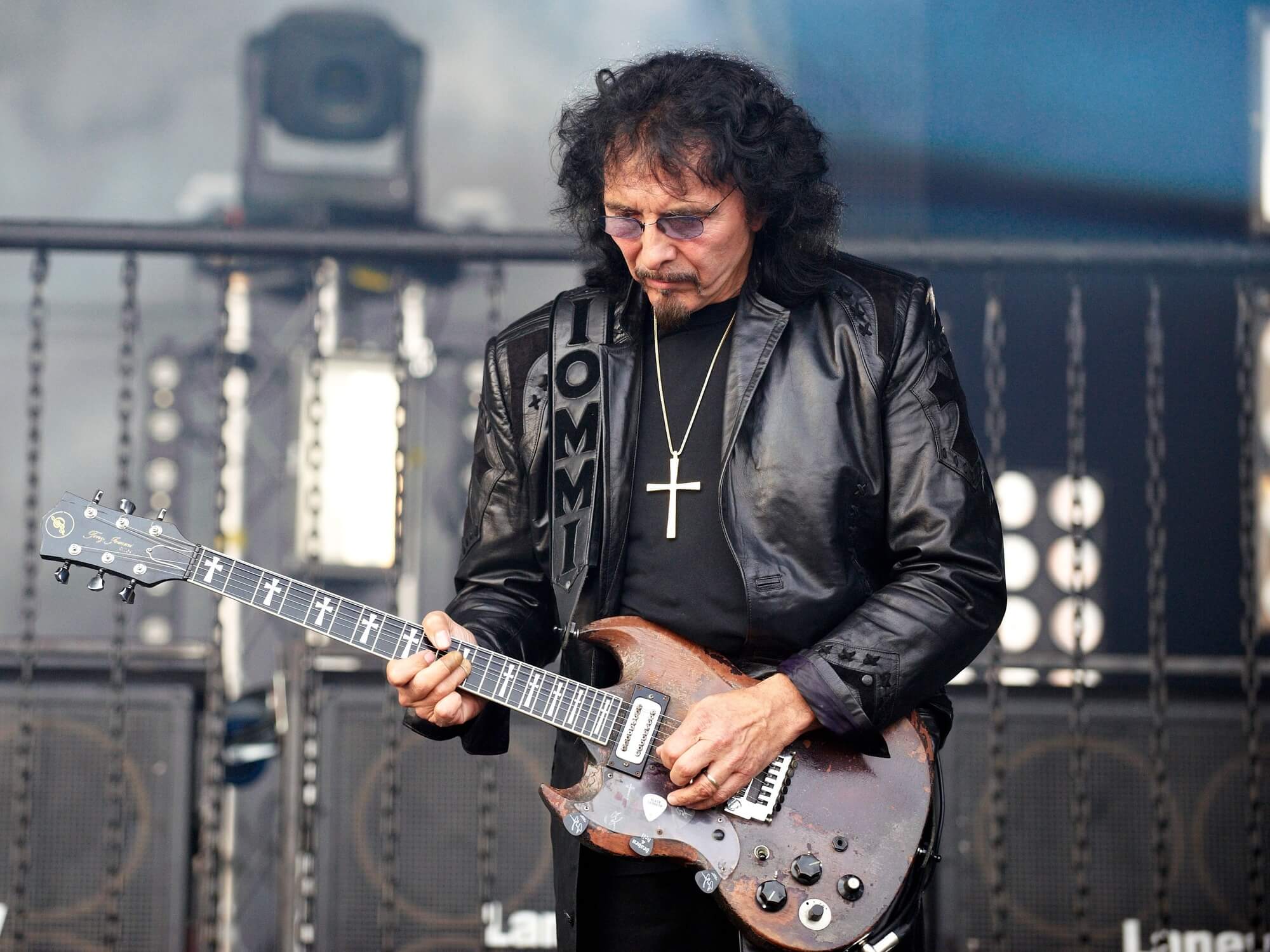
Tony Iommi has a confession to make: he hates playing acoustic guitar, and in fact, he feels he’s not very good at it.
Iommi announced his first solo album in over 20 years this week. Titled From The Dark, it is due to land on 23 October 2026 via BMG, and features Norwegian vocalist Jørn Lande, Mercyful Fate bassist Becky Baldwin, and former Robbie Williams drummer Karl Brazil. Iommi served as co-producer on the album alongside Mike Exeter.
Despite his admittance that acoustic really isn’t his thing, it gets a prominent spotlight on forthcoming track Legacy with a solo right in the middle. In a new interview with Rolling Stone, Iommi explains why he chose to explore outside of his comfort zone in this way.
“I did have a couple of acoustic things, but I’ve not used them. I thought I’d keep the album like it is. And not only that, it’s already quite long. We wouldn’t be able to fit them on,” he says.
“I like to do something you don’t really expect. And to be honest, I hate playing acoustic. I’m not very good at playing acoustic,” he confesses, before speaking directly on track Legacy, “On that bit, I just thought it would be nice and different.”
Iommi also discusses the album’s first single, World Alone. Asked if he has to push himself to write up-tempo songs like this single, he responds, “Not really. But I do remind myself [to write them]. When I heard [the rest of] what we’ve got I thought, ‘Well, we need to have some up-tempo tracks and a mid-tempo track just to balance off the album, really.”
Listen to World Alone below:
From The Dark is available to pre-order now.
The post “I hate playing acoustic”: Why Tony Iommi is pushing himself outside his comfort zone on new solo album appeared first on Guitar.com | All Things Guitar.
Gretsch Electromatic CVT Baritone review – long-scale downtuned heaviness from Gretsch hits the mark

A while ago I spoke to Gretsch EVP Jason Barnes about the revival of the Corvette, and, being the consummate professional that I am, I only let my personal musical tastes inform the direction of the interview towards the end of the chat. I mentioned that the double-cut, darkly-finished, and dual-humbucker’d Electromatic CVT seemed in part tailor-made for those who listen to a lot more Loathe and/or Electric Wizard than they do Bleachers and Taylor Swift, and Barnes was more than receptive. Despite Gretsch’s heritage skewing towards jazz and rockabilly, and modern usage skewing towards rock, indie and pop, Gretsch has been keeping a keen eye on those who have adopted its guitars – particularly its longer-scale offerings – for metal.
And there’s a lot to keep an eye on, in that regard – a few years back the Meshuggah fans of the world took notice of the downtuning potential of Gretsch’s dual (mini) humbucker Jet Baritone, and it got swept up in a new wave of metal – that G5260 was seen in the hands of both Loathe’s Erik Bickerstaffe and Sleep Token’s IV, both very different players with different musical aesthetics, but both driving a trend for innovative and ultra low-tuned modern metal.
So today we’re looking at the logical conclusion of those observations: a baritone version of the Corvette, launched with a pummelling demo from Loathe’s Erik Bickerstaffe. It’s the same rather mean shape as the newly-designed CVT, with the same full-range Twin Six humbuckers – but gone is the wraparound, replaced with a standard tune-o-matic-style two-piece bridge, placed a little further back in the body to compensate for the increased scale of 27 inches.
Gretsch obviously has a long history with long-scale guitars, but the CVT isn’t really drawing much of this heritage. The Electromatic Jet Baritone, launched on the same day as this guitar, is a lot closer to a pure modern-metallification of an old-school Gretsch formula – the Baritone Jet is a single-cut 29.75” guitar, like it’s more vintage-styled forebears. That’s just 0.25” off the same bridge-to-nut distance as a Fender Bass VI, and so opens up tunings below E1 (or suspension-bridge tension when in the more standard baritone register B-B).
The new CVT Baritone, on the other hand, is 27”, which will be far less alien to those used to playing on 25.5” necks, or even 24.75”. Given that the Corvette shape has had a more sporadic, chameleonic history since its launch decades ago, there aren’t really many expectations to smash here about what it’s meant to sound like – other than those brought by the name on the headstock. So the question remains:
 Image: Adam Gasson
Gretsch Electromatic CVT Baritone – what is it?
The baritone guitar has a long history outside of the heavy universe, and not every new long-scale launch is explicitly aimed at those who walk a more Iommic path. But the Baritone CVT absolutely is. Intentions and the noises made in demo videos may only matter so much, but, overall, the message sent by the guitar upon viewing it and/or its specsheet is that it’s built for metal. Downtuning is obviously a big thing across countless subgenres, but the aesthetics and specs do straddle the border between the classiness of Loathe’s whole gig and the more vintage-forward guitars of sludge and doom.
The finish is the first clue. The Baritone CVT exclusively comes in Bristol Fog – I presume that Gretsch does not mean the Bristol Fog that, on the afternoon of April 20th, rolls in all directions from Castle Park like an encroaching wall of aerosolised cannabinoids. Stoner associations aside, it’s still a dark, woodgrain-forward burst – no sparkle finishes or gold-trimmed vintage white for this launch.
The humbuckers are the next – the Twin Sixes are full-sized humbuckers, explicitly marketed as punchier and more full range than the mini-humbuckers, Broad’Trons and Filter’Trons you’ll find in many other Gretsches – these are far less likely to sound thin and underpowered through heavier gear.
The rest of the setup is essentially a minimalist dual-humbucker arrangement, with a master volume and tone. The wraparound of the standard-scale CVT is now a two-piece tune-o-matic style bridge, which is an unequivocally good change here – longer scale lengths require a lot more travel in the saddles for proper intonation, and I’ve also seen a couple of import wraparounds start to lean forward under higher tensions.
It’s been said that the CVT has more than a little Dunable Cyclops in its looks, with its two horns, long swooping pickguard and general ‘melted SG’ kind of look. The Cyclops and Dunables in general rely on a healthy amount of vintage cool being mixed in with their meaner, heavier looks – a combo that’s found particular footing in the post-, doom- and sludge-metal crowds. (A fun game at festivals like ArcTanGent is Dunable-spotting – drink every time you see one and you’ll be on the floor in no time). The Corvette shape is pretty perfect for achieving a similar visual feel, and so it’s good to see Gretsch work constructively with that aspect of the shape – metal doesn’t have to mean all pointy and satin black and glowing inverted crosses everywhere.
 Image: Adam Gasson
Gretsch Electromatic CVT Baritone – usability and sounds
Can Gretsch translate its baritone heritage to something that’s deserving of the above implications? Are the noisy Loathe demo video and the Dunable comparisons earned? The answer, pleasingly, is a resounding yes – in my view, players seeking sharper, more metalcore-indebted tones and the low-and-slow doom crowd will find a lot to like here.
Let’s start on playability. The neck is not really for shred – but it is a fairly medium C, a profile Gretsch calls “performance C”. On top we’ve got a real rosewood fretboard – now pretty common again on affordable guitars, but no less good to see – with a 12” radius. The profile is a pretty middleweight one, perhaps a little evocative of the slimmer side of a bound Les Paul neck. It’s made somewhat slower by the rather sticky poly finish (nothing a scotchbrite pad and some elbow grease won’t fix), but it’s by no means an unwieldy thing. The neck joint is also pretty sculpted – no big square neck plate here – meaning that up at the dusty end (likely for dissonant stabs mid-breakdown more so than melodic showing-off) it remains very playable.
Frets here are medium jumbo. In use they are, a bit like the neck profile, fairly anonymous – neither massive nor tiny. But they play cleanly and comfortably – zero buzz or grind to be found. It’s also good that they’re not actual jumbo wire – we’ll come to further down-tuning experiments in a bit, but for now it’s worth noting that at lower tension, really tall frets can mean it’s too easy to push strings out of tune as you press down.
Despite the extra length of the neck, the balance is fantastic. Neck dive is always a worry on baritones, but not here, as Gretsch has adjusted where the bridge sits, rather than just shunting all of the mass north of the neck joint. Playing sat or stood is very comfy – this bridge placement means the fretboard presents to your left hand fairly well when sat down, and the strap button being on the horn keeps everything at a good angle when stood up. The bridge is also in a nice and natural position for your right hand – its extra distance down the body makes staying in a palm-muting position easy.
A 27” scale is pretty comfy for a baritone, requiring only a little bit of adjustment if you’re used to standard scale stuff. I also find the stock strings – 14-68s – to be ideal. They’ve got a wound third (as they should have!), and their gauge is more than heavy enough to make tension quite substantial at standard baritone B-B. Bluesy three-semitone bends are out of the question in this register unless you’ve borrowed fingers from an olympic weightlifter – but fast death metal riffs are tight, responsive joy.
 Image: Adam Gasson
I also tune the guitar to where I normally hang out – drop F. This is, for a baritone less than 30” and with any strings other than Bass VI strings, quite a loose tuning – I’d say it’s similar in tension to tuning a Fender-scale instrument down to C with 11-52s. This transforms the playing experience quite a lot, from sleek, sharp and tight to loose and sludgy, but the CVT is up for the challenge: things stay relatively stable and articulate.
Importantly, at no point do I feel like strings are going to flop out of their saddles. A decent amount of neck pitch-back means there’s a lot of downward tension on the tune-o-matic-style bridge. It’s worth noting, however, that drop F is about as low as I’d take it with these strings – double drop C# would be a bit of a stretch without a much heavier gauge.
Helping with the articulation here are the Twin Six humbuckers, which work great in a heavy baritone context. Personally I find they’re voiced just right – full and deep through stacked meaty fuzzes, but still up for a bit of chugging when run into a tighter, more modern sound courtesy of the UAFX Anti.
For a cleaner tone, they’re perhaps a little boomy in full humbucker mode – but they can be split individually with push-pull pots. Their louder nature means that these tones are also quite hefty, but far better for cleans – as single-coils they more resemble P90s than they do spanky strat pickups, thanks to their strong output and midrange presence, but that’s no bad thing in my book.
The cleaner stuff may never really be the highlight or focus of a guitar like this, but the tones are by no means an afterthought – I had just as much fun making ambient and textural sounds on the CVT as I did trying to remember how to play At The Gates riffs. But for more traditional tic-tac/country baritone sounds, you might find yourself wanting a different set of pickups – the mid-forward nature of the Twin Sixes means it’s a little harder to get that spanky/scooped sound that, say, a set of Bass VI pickups do so well.
 Image: Adam Gasson
Gretsch Electromatic CVT Baritone – should I buy one?
For many fans of down-tuning this will be the sort of guitar they were hoping Gretsch would release – accessibly priced, the right look, the right pickups, and a scale length that strikes a balance between playability and still being, well, a baritone. And the guitar, in my time with it, made good on all of its promises. I think the only thing I wish Gretsch did here that it didn’t would be offer a few more finishes. No shade on Bristol Fog, really, but I’m curious how the CVT would look in a version of the Jet’s Imperial Stain.
And on the topic of that guitar, it’s hard to say that Gretsch compromised on scale length here when a 29.75” alternative has also been made available for almost the same price. If you are looking to really explore the depths of registers below E1, I would check out that guitar, and indeed my forthcoming review of it.
As it stands, though, this is the more balanced of the two options. There’s a long history of mid-priced baritone guitars being adopted into moddable djent/doom darlings of the aftermarket (after all, Bickerstaffe himself didn’t wait until Gretsch’s lineup included a more obviously metal instrument, he just tuned a vintage-voiced baritone down to drop Z and blasted away), but the Baritone CVT has clearly been made with a more “out of the box” approach – and it’s worked.
Gretsch Electromatic CVT Baritone – alternatives
Aside from the really obvious one – the Jet counterpart – 2026 has been awash with interesting baritone guitars. There’s the new Squier Paranormal Baritone Jaguar, and the new Fender Player Fusion Baritone Jaguar, both made with a similar audience to the new Gretsches in mind. The Squier Classic Vibe Custom Telecaster is another interesting and mid-priced option – although for metal you might want to also order some blade pickups…
Beyond these there’s a new Orangewood Baritone, Ed Sheeran has a signature Baritone (although to play that in a metal context you’ll probably want to get it re-finished from the off!), Dunable’s relatively affordable (compared to its custom shop) DE line has launched a baritone, and, if you want to throw off the last vestiges of a vintage aesthetic, Hils has launched a new mid-priced baritone headless guitar.
The post Gretsch Electromatic CVT Baritone review – long-scale downtuned heaviness from Gretsch hits the mark appeared first on Guitar.com | All Things Guitar.
Glen Hansard (1970-2026) on the Importance of Songwriting with Intention

Pages
