
Music is the universal language
“Glory to God in the highest heaven, and on earth peace to those on whom his favor rests.” - Luke 2:14
Norse Guitar Feeds
MONO x Teisco Reunite for New Vertigo Electric Guitar Cases
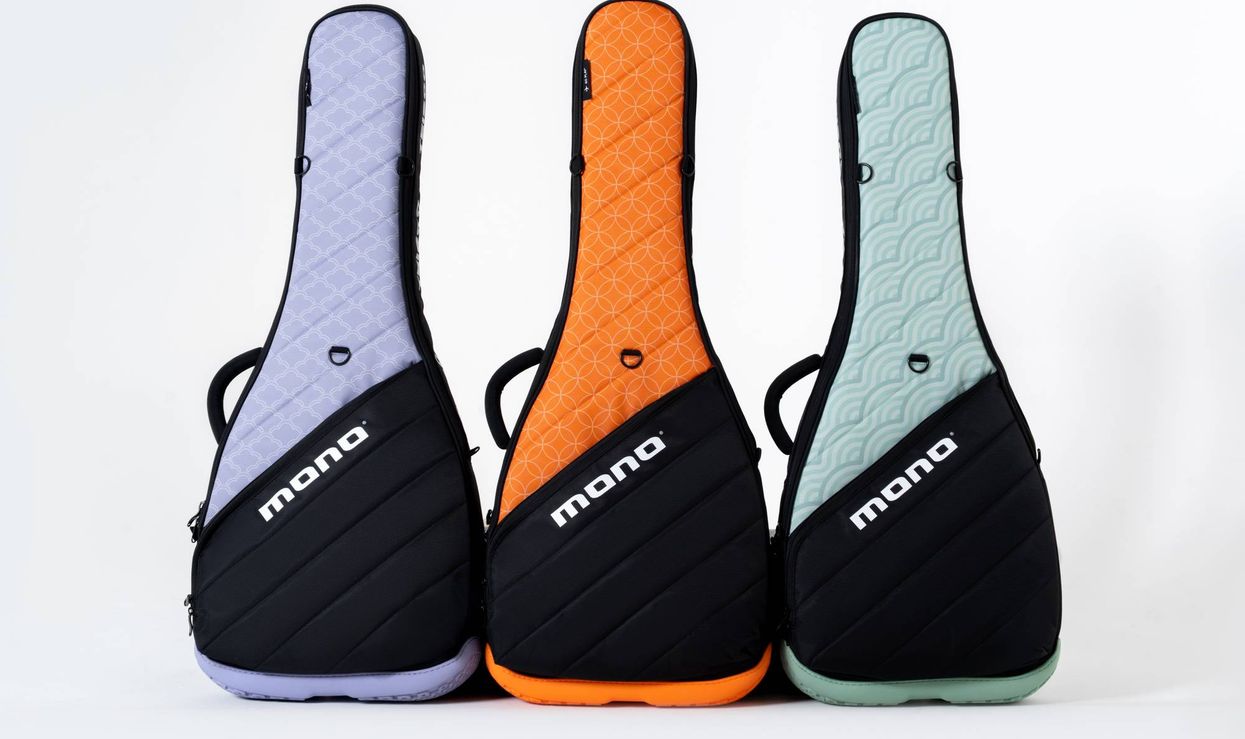
MONO has announced the company’s newest collaboration with Teisco, introducing fresh limited-edition colors on the Vertigo Electric Guitar Case.
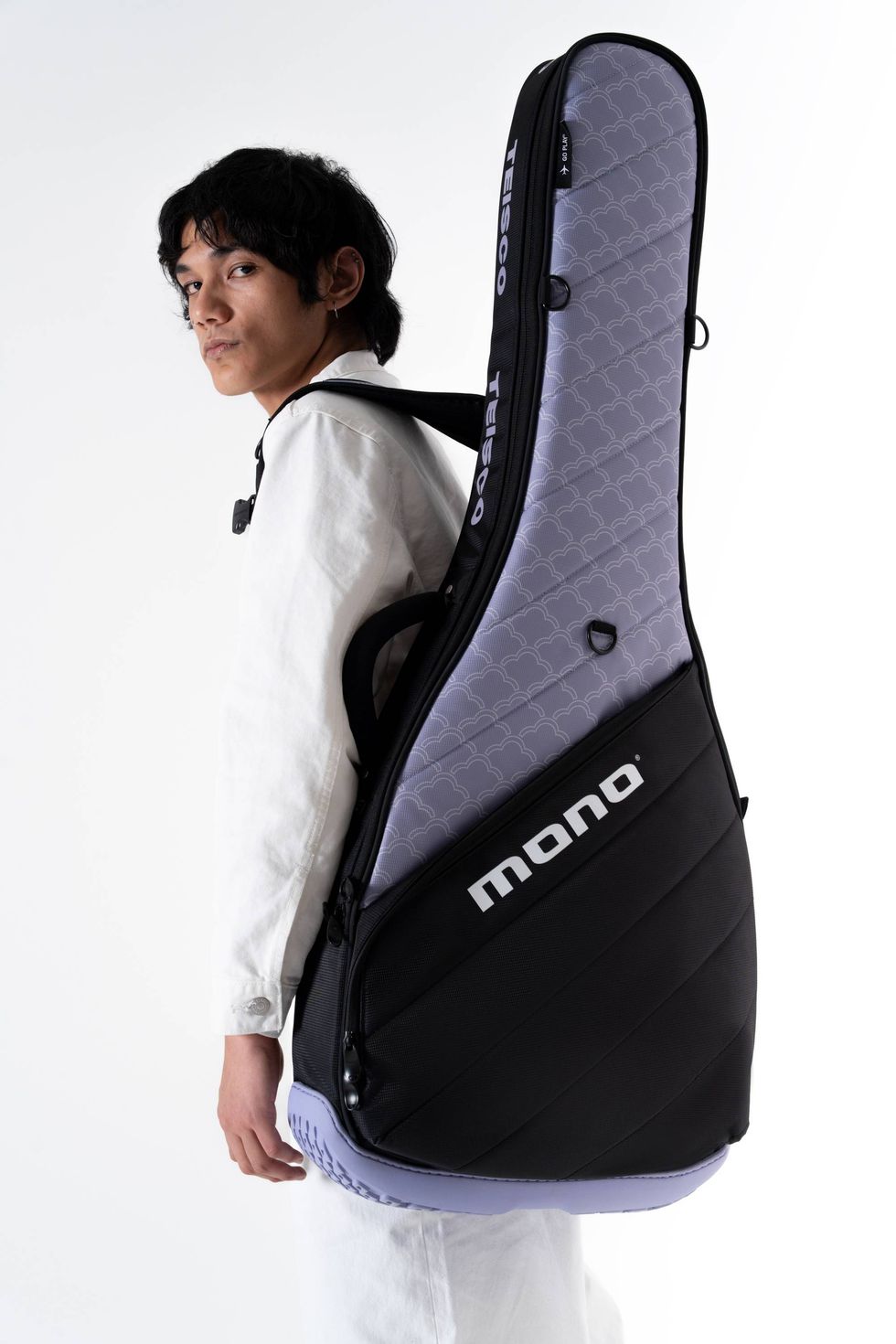
Inspired by the subtle beauty of Japanese design, the latest MONO x Teisco collection introduces three new colorways that pair muted pastel tones with geometric and flowing patterns.
The company describes the three eye-grabbing options: Orange is bold, energetic, and impossible to overlook. Inspired by the warmth of autumn, its interlocking pattern creates rhythm and structure, giving the impression of constant movement. Sage draws from the calmness of the natural world. Understated yet expressive, its flowing pattern evokes a sense of continuity, making it equally at home on the road, backstage, or in the studio. Lavender takes a softer, more contemplative approach, inspired by the quiet colors of the evening sky with an evocative cloud-like pattern.
To launch the new collection, MONO and Teisco have partnered with three artists whose creativity extends beyond their music into their personal style: LAYYI, Marco of Bellied Star, and Marian Carmel. Their creative identities make them the perfect artists to showcase the next evolution of the MONO x Teisco collaboration.

Built on MONO's award-winning Vertigo platform, the cases combine bold aesthetics with the premium protection trusted by musicians worldwide. Key features include:
- ● Available in Orange, Sage, and Lavender, each featuring a unique Japanese-inspired pattern.
- ● Patented Headlock Neck Suspension System securely supports the guitar neck and headstock, providing superior protection against drops and impacts.
- ● The Boot combines a custom-molded rubber outsole with an EVA insole to absorb unwanted impacts during transport.
- ● Top-loading design provides fast and convenient access, making it easy to take your instrument in and out.
- ● Smart Storage System features triple D-rings for seamless attachment of the Classic Tick Accessory Case 2.0 (sold separately), expanding storage capacity.
- ● Constructed to military specifications, with highly abrasion-resistant and weather-resistant materials. A water-resistant Sharkskin shell protects against the elements, while the plush interior lining safeguards delicate custom finishes.
The MONO x Teisco Vertigo Electric Guitar Cases carry a street price of $299.99. For more information, visit monocreators.com.
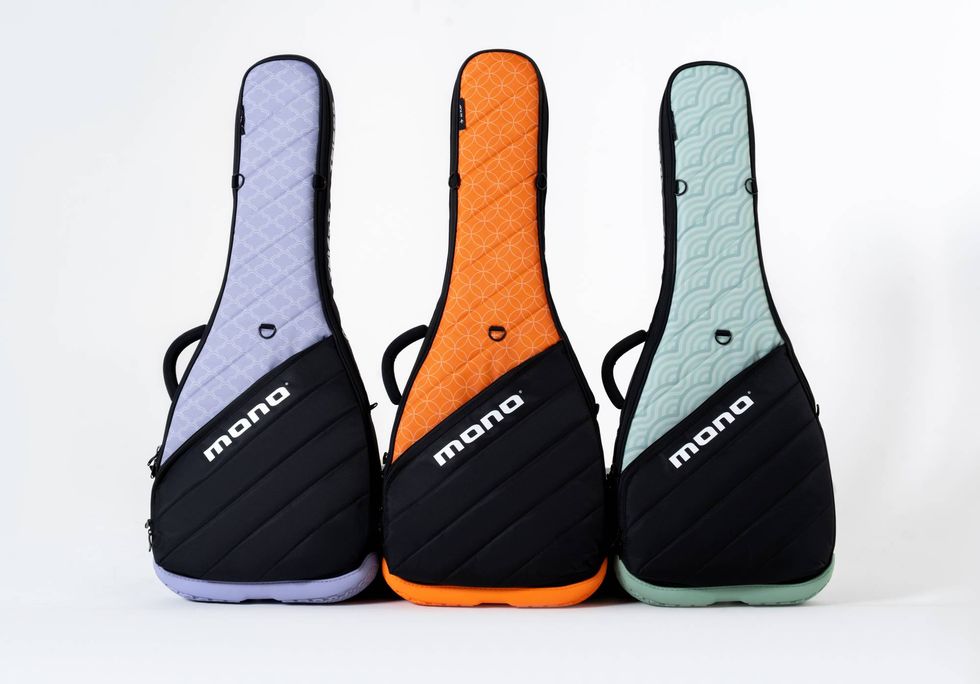
Vertigo Electric Guitar Case
MONO has announced the company’s newest collaboration with Teisco, introducing fresh limited-edition colors on the Vertigo Electric Guitar Case.
Wizard of Odd: Tending to Guitars Like Gardens
Alas, ’tis my favorite time of the year. As summer turns into fall, my hoodies come out, football season starts, and I harvest my little vegetable garden. I don’t take it too seriously, and mostly I just like to see what will grow. Basically, at its core, I enjoy taking care of things in general. Tending to a little garden is good therapy—if you know, you know. Now, I do get more serious with my tomatoes. See, one of my favorite routines is making a huge pot of spaghetti sauce (or gravy, depending on where you’re from). Man, we eat nothing but Italian dishes for about a month! I boil the tomatoes and grind them up with an awesome little tool and then let the juices reduce. Personally I like a little red cooking wine in my sauce, but all you have to do is season it to your taste. Simple, easy, and fresh!
I enjoy the whole process of choosing ingredients that I grow and simply letting the house soak with aromas from the simmering pot. I actually get happy when I see a “nice” tomato or a fine-lookin’ onion! Having everything at home and within reach contributes to my overall feeling of zen, and it’s one of my happy places.
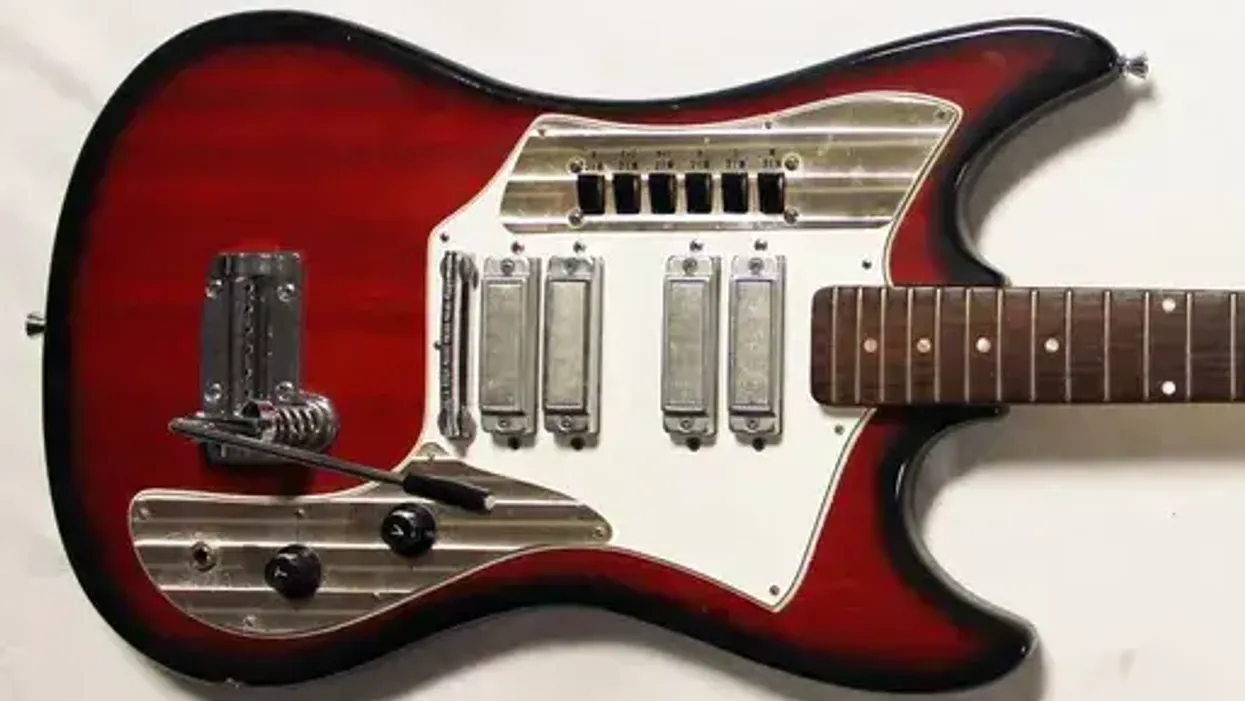
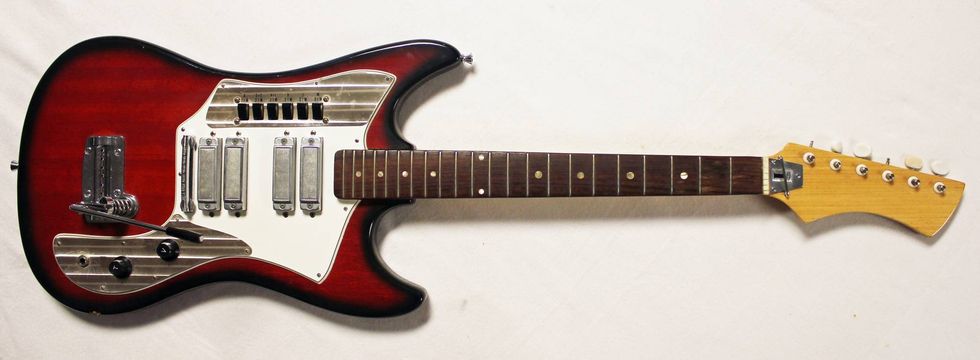
Normally I also have one or two guitar projects going every summer, too. This past summer I really struggled to build a few guitars (see last month’s article and my new puppies), but I was able to source some old parts and scrounge up what I have in my basement shop to basically restore this old Inter-Mark Cipher Valor. I like sourcing original parts to complete “husks,” which are like donors for parts. But I always feel kinda sad for these sacrificial guitars and have a need to make them whole again. Again, I enjoy tending to my guitars just like my garden—keeping everything happy and complete and content.
So as summer winds down, I want to write about my garden and my latest “project” guitar—more specifically, about gathering all the ingredients to make a guitar whole again. If you want to build a Fender- or Gibson-style guitar, there are all sorts of places to source parts, vintage or otherwise. But when you’re trying to rebuild a vintage oddball, you are gonna encounter some problems. It’s like with old car, motorcycle, or bicycle parts. So many obscure makers with proprietary parts—jeez, it can take a while to source those “ingredients.”
Take this 1960s Inter-Mark, for example. In Japan, these were made by a company called Shinko Gakki, which spent the post-war years making pianos and organs before eventually getting into acoustic—and then, in the mid-’60s, electric—guitars. They wound up going bankrupt shortly after. Shinko pickups? Copies of Italy’s Eko and Burns from the UK. Shinko used aluminum spun knobs. The truss rod cover also held the string guide. The pickup switching system was mostly based on Italian designs with push buttons and spring-loaded mechanisms. The tremolo units were also rough copies of Eko guitars. So how does one find parts?
For a while I was buying every Shinko-made guitar I could find, and I was able to finish off several guitars with original factory parts. See, all the above idiosyncrasies are primarily found on Shinko guitars, and you simply can’t buy an old Eko and part it out. Looks similar but not the same. This is why I cringe when I get questions about guitar parts. I have knobs that were only found on Shinko guitars, and they’re different from the Fujigen knobs. Even though both companies used spun aluminum, Shinko often used gold-plated knobs and Fujigen didn’t.
So now, at the end of the summer, I have my tomato sauce and another completed guitar. If you want to just jam on a guitar (which is what I mostly do), then go nuts. Or you can get into the weeds and try to make something whole again. Dig? It’s all about the sauce, brothers and sisters!
D’Addario Partners with Jacob Collier to Launch Specialty XS Strings and Vegan Strap
D’Addario, in collaboration with Taylor Guitars, announces the launch of the Jacob Collier Specialty XS Phosphor Bronze String Set, engineered specifically to support Collier’s custom 5-string acoustic guitars and signature symmetrical D-A-E-A-D tuning. Arriving alongside the new Jacob Collier Signature Vegan Strap, the release expands the ongoing partnership between D’Addario, Taylor Guitars, and one of modern music's most inventive multi instrumentalists.
To celebrate the launch, D’Addario has released an exclusive video interview exploring Collier’s creative process, his approach to reinterpreting traditional instruments, and the technical collaboration behind his custom gear.
“Instruments Are to Be Forever Reinterpreted”
Raised in a musical family in North London, Collier developed an early fascination with sound through experimentation across piano, drums, vocals, and guitar. Seeking a distinct creative voice, he routinely detuned and removed strings from traditional six string guitars, a process that eventually led to his signature five-string acoustic setup.
“An artist’s voice isn’t something you find; it’s already there, like the Michelangelo quote: 'Remove what's not the sculpture, and the sculpture was there all along,'" says Collier. “Trying to find my voice led me to fall in love with the five-string guitar. For me, it’s important that a string has a lot of life to it. D’Addario strings embody that—they are made with incredible care and attention to detail.”
“There is a miraculous tone and sublime feel to these D'Addario strings,” Collier adds. “This set was handpicked by Taylor's own Andy Powers to balance the tension, feel, and pitch accuracy of this symmetric 5-string tuning that forms the backbone of my custom Taylor guitar models.”
Product Specs & Availability
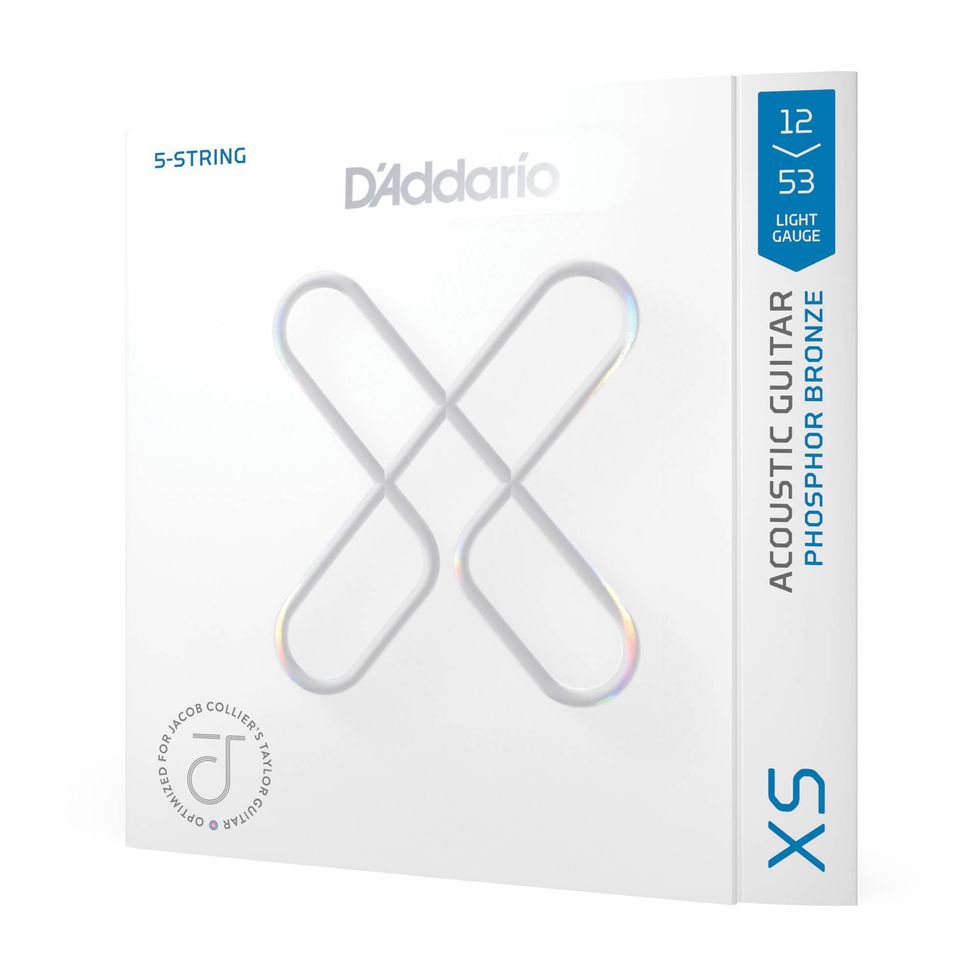
Jacob Collier Specialty XS Phosphor Bronze 5-String Set (12–53)
• Designed For: Taylor Jacob Collier GS Mini 5-String, Taylor Jacob Collier Academy 22e 5-String, and Taylor JCSM-5 Jacob Collier Signature 5-String • Gauges: Custom .012–.053 5-string configuration optimized for D-A-E-A-D tuning
• Technology: Ultra-thin XS film coating on wound strings with a unique polymer treatment on plain steel strings for maximum corrosion resistance and extended tone life
• Availability: Available globally via D’Addario authorized dealers and daddario.com
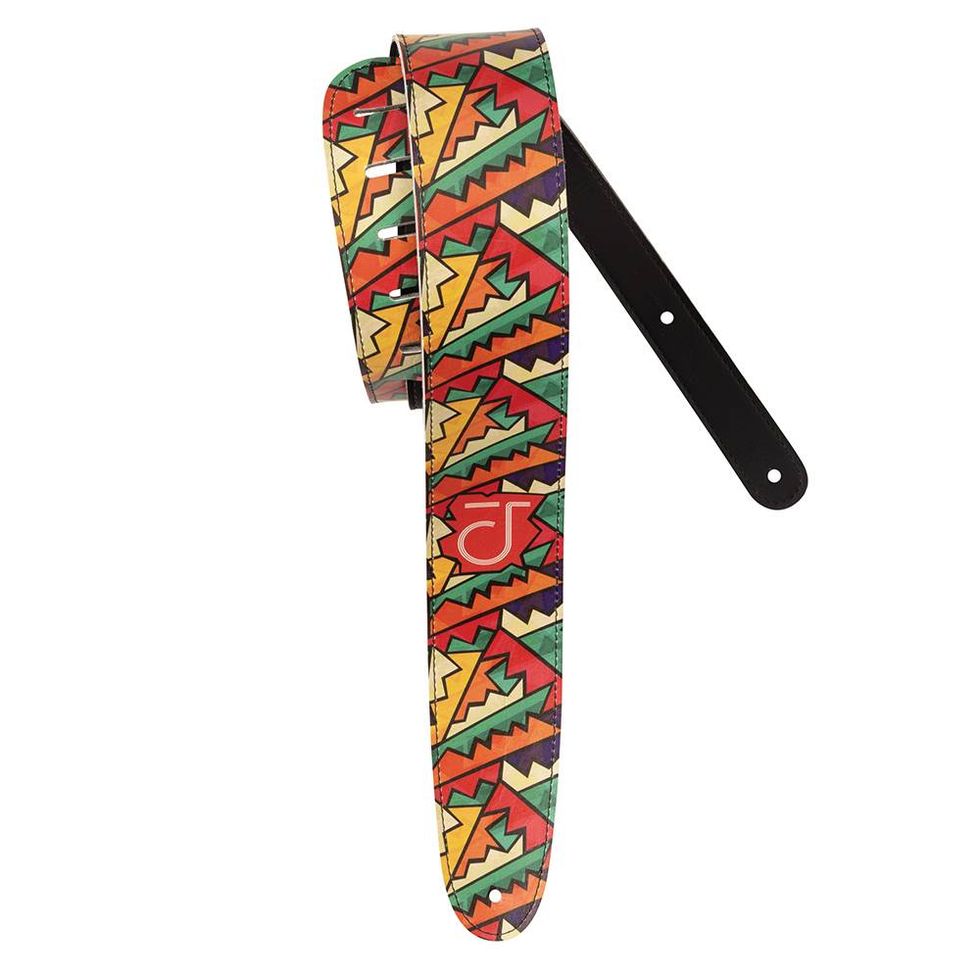
Jacob Collier Signature Vegan Strap
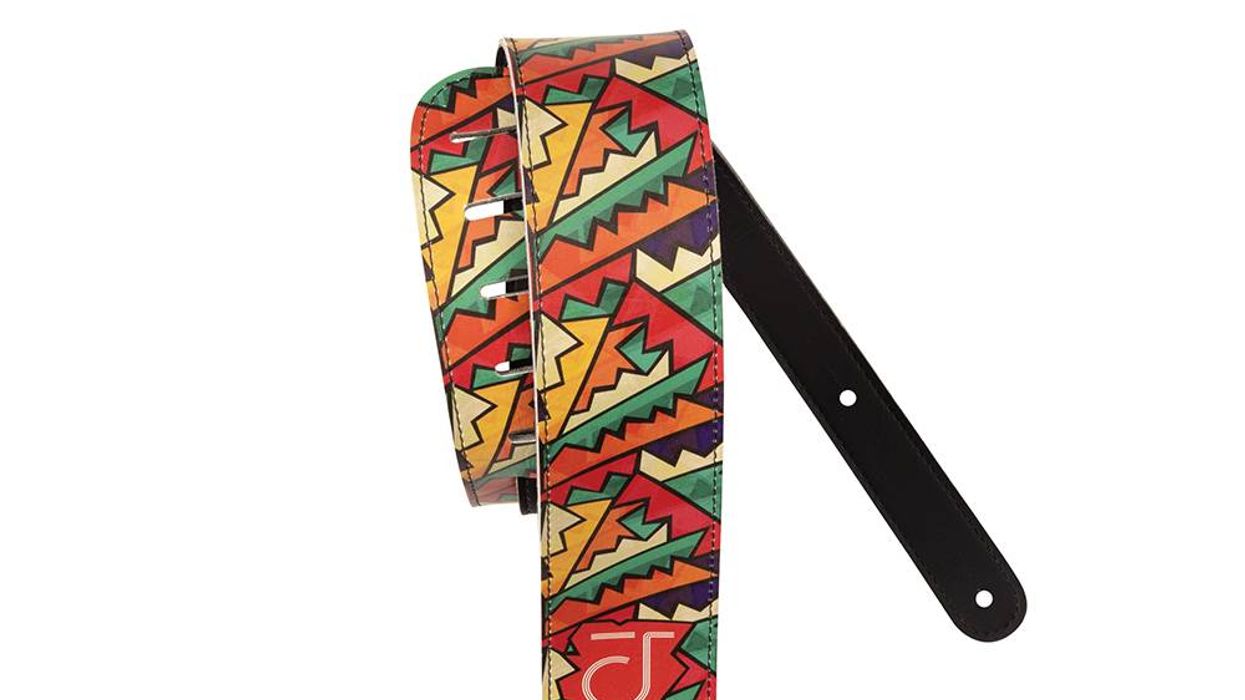
• Design: 2.5-inch printed vinyl featuring custom, vibrant geometric artwork reflecting Collier's colorful aesthetic
• Construction: Eco-conscious vegan strap designed for durability, comfort, and security
• Availability: Available globally via D’Addario authorized dealers and daddario.com
Explore the Launch
• Watch the Artist Spotlight Interview: https://ddar.io/collierinterview • Explore the Specialty XS 5-String Set: https://ddar.io/collier-xs • Explore the Signature Vegan Strap: https://ddar.io/collier-strap
What’s Next: Upcoming Giveaway & Educational Mini-Series
• Taylor x D’Addario Giveaway (Launching Soon): D’Addario will launch an exclusive sweepstakes featuring a massive prize bundle highlighted by the actual Taylor JCSM-5 5-String Acoustic played by Jacob Collier, along with specialty strings, the signature strap, and premium D’Addario accessories. Fans can bookmark daddario.com/pages/jacob-collier-taylor-giveaway to enter around the end of September.
• "Sounding It Out with Jacob Collier" Mini-Series (Launching Oct. 7): D’Addario will premiere a five-part video series on YouTube exploring the mechanics of the 5-string guitar, harmonic theory, rubato timing, and translating
piano concepts to guitar. Subscribe to D’Addario’s YouTube Channel to catch each weekly installment.
Slash Ft. Myles Kennedy and the Conspirators Release New Single “Flying Blind”
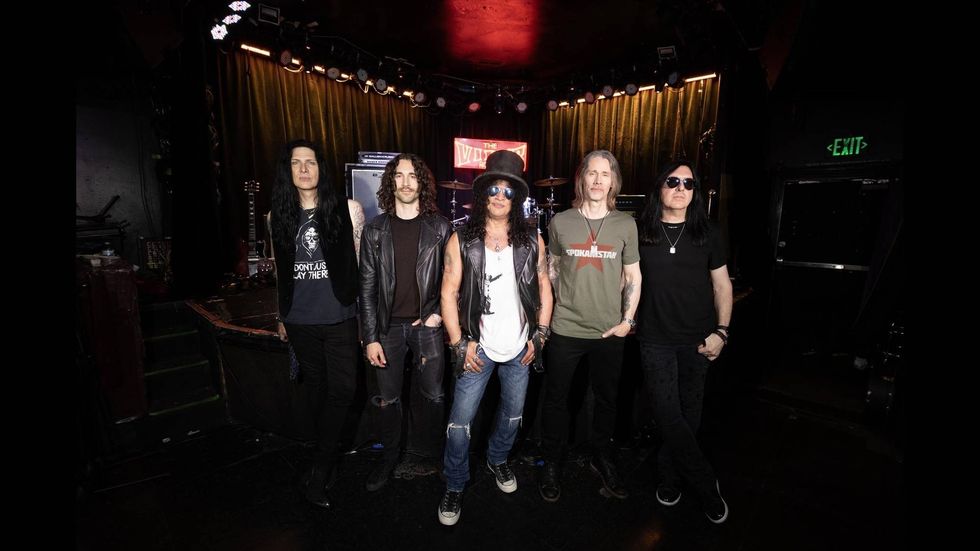
Fifteen years and five albums into one of modern rock’s most enduring collaborations, Slash Ft Myles Kennedy and the Conspirators, also known as SMKC, return today with the new single and official music video, “Flying Blind.” The anthemic track is the first taste of a powerful new chapter for the band and serves as the title track from its highly anticipated fifth studio album, Flying Blind, arriving worldwide Feb. 26, 2027, via Gibson Records.
Recorded largely live with longtime producer Michael “Elvis” Baskette at Studio Barbarosa in Florida, the 12-track album captures Slash on guitar and pedal steel, Myles Kennedy on vocals, Todd Kerns on bass, Brent Fitz on drums, and Frank Sidoris on rhythm guitar at their most immediate, instinctive, and tightly connected. The band completed the bulk of the record in approximately one week, often recording two songs a day with the musicians performing together in the same room.
“It’s a really fun, kind of spontaneous rock ’n’ roll record,” says Slash of Flying Blind. “It’s very straightforward and down-to-earth and raw.”
Listen to “Flying Blind,” out today across all digital platforms, and watch the music video, shot on location at The Viper Room in Los Angeles and directed by John Harvatine IV HERE. Pre-save, add and order the album Flying Blind HERE.
Created spontaneously during pre-production, “Flying Blind” began when Slash introduced a riff as the musicians were preparing to rehearse. The song developed quickly, combining SMKC’s unmistakable hard-rock drive with a soaring melody and immediate hook that ultimately made it the natural choice to introduce the album.
Slash explains, “Created in the studio while we were standing there in pre-production, a riff came to me and started developing. I had nothing of that song prior to those guys coming in, and then we started up a night of rehearsal and played that riff. It came together really quickly. As for it being the first single, you never know what the first single is going to be until you’ve recorded it. When I started thinking about it, ‘Flying Blind’ just seemed to have the right kind of melodic sensibilities and a hook to make it single material.”
For Myles Kennedy, the title track’s lyric examines the shortcuts people sometimes pursue in their search for fulfillment. “I really enjoyed putting a melody to this song,” Kennedy adds. “The way the chord progression starts in the beginning had a nice flow to it. The lyric is about how sometimes people try to take shortcuts and try to find the easy way to achieve happiness or enlightenment.”
SMKC have also announced the Flying Blind WORLD TOUR 2027, an extensive international run launching in Latin America in April before reaching North America on April 23 and continuing through the United Kingdom and Europe. The North American tour includes two nights at The Wiltern in Los Angeles, as well as performances at New York City’s Beacon Theatre, Nashville’s Ryman Auditorium, Boston’s Citizens House of Blues, Denver’s Fillmore Auditorium, and other landmark venues. Fans can sign up now for early access to tickets at laylo.com/slash/m/flyingblindworldtour2027. Tickets go on sale to the general public Oct. 9 at slashonline.com/tour.
In celebration of the release of Flying Blind, SMKC have partnered with Fandiem to launch a special charitable sweepstakes giving fans the chance to win a once-in-a-lifetime trip to Wales to meet Slash backstage at Cardiff Castle. Benefiting the American Foundation for Suicide Prevention (AFSP) and the National Alliance on Mental Illness (NAMI), the campaign offers one winner and a guest round-trip travel to Cardiff, a three-night hotel stay, tickets on Slash’s guestlist for his performance at Cardiff Castle, backstage access to meet Slash, front-of-house viewing, access to pre- show soundcheck, a Slash merch pack, a South Wales sightseeing tour, and a pre-show dinner.
Fans can donate now and enter for a chance to win at www.fandiem.com/slash and take part in this exclusive experience while helping raise funds for two organizations dedicated to mental health and suicide prevention.
SMKC continue to work the same way they did at the beginning: get into a room, play, and see what happens. That philosophy drives Flying Blind, the band’s first full-length studio album since 2022’s acclaimed 4. Some of its songs developed from Slash’s demos and musical fragments, while others were created spontaneously with the musicians playing together in a room.
Slash brought the initial material to Kennedy, who added vocal melodies and lyrics before the songs were developed into full-band arrangements with bassist Todd Kerns, drummer Brent Fitz, and rhythm guitarist Frank Sidoris.
“He’s an incredible riff writer,” Kennedy says of Slash. “He also comes up with simple chord progressions that are very compelling for melodies. It works, and it’s timeless.”
Unlike previous SMKC albums, whose riffs and arrangements sometimes evolved through nightly soundchecks and extended touring, much of Flying Blind came together in concentrated bursts between the members’ other projects. Slash developed the material while touring with Guns N’ Roses, recording his acclaimed blues album Orgy of the Damned, and launching the S.E.R.P.E.N.T. Festival. Kennedy began working on the songs during a break from Alter Bridge and while creating his third solo album. “Our schedule is tight, and you have to abide by it or everything else starts to get affected,” he says. “Now it’s just a given that you’re always creating. It’s a muscle thing. The creative part of your brain doesn’t have time to atrophy, and you just keep going.”
The band reconvened with Baskette, who previously produced SMKC’s World on Fire in 2014 and Living the Dream in 2018, at his Studio Barbarosa in Florida. Staying together throughout the sessions allowed the musical and personal chemistry at the center of the band to become an essential part of the recording.
Going into the sessions, Slash gave Baskette two clear instructions: keep the recording as live as possible, and do not overwork the performances afterward. “He really adhered to that,” Slash says. “It worked out great.” The arrangements were largely in place before recording began, but remained open enough to accommodate spontaneous ideas in the studio. With the musicians performing simultaneously, the band retained as much of the natural interplay and energy of each complete performance as possible. Kennedy recorded his vocals several months later and describes the finished album as a high point in SMKC’s recording history. “Out of all the records, the sounds and performances on Flying Blind are my favorite. It’s very present. It’s right there,” he says.
Across its 12 tracks, Flying Blind explores a broad range of sounds without abandoning the band’s direct, hard-rock foundation. “Good Time Girl” combines a talk box hook with a pronounced country twang influenced by pioneering guitarist Jimmy Bryant and steel guitarist Speedy West, while “Sweet Kill” delivers brash, riff-driven rock that Slash calls “probably the most ’80s thing I’ve done in a while.”
“One of Your Kind” moves with a down-tuned churn, while sharp, punk-influenced chords drive “Here in Babylon.” “Thrill Seeker” is built around a dizzying descending riff that remains deep in the pocket, and “Rev My Heart” is a classic rock ’n’ roll rave-up anchored by an unforgettable progression and a lyric inspired by the night Kennedy first met his future wife. The instrumental “Living the Dream” continues an SMKC tradition, giving Slash room to improvise and placing his unmistakable guitar playing at the forefront. “I’ve done one of these instrumentals on every Conspirators record except Apocalyptic Love,” Slash says. “It’s fun to have something that I can open up and improvise on, where I don’t have any specific guidelines or guardrails. It’s nice to do a new one every record, so that live you don’t have to do the same one all the time.”
One of the album’s most significant departures is “Looking for a Miracle,” the first song Slash has written on pedal steel and the first to feature a recorded pedal steel solo from the guitarist. Slash developed the original musical idea on pedal steel before adapting it for guitar, so the full band could rehearse the song. He then returned to the pedal steel during the recording sessions and worked out the solo at Studio Barbarosa. “I love pedal steel,” Slash says. “It’s one of these instruments that is so unbelievable in what you can do with it. So it’s become a thing for me. But it is a commitment. It’s a pretty complex instrument.”
Kennedy and the rest of the band have watched Slash’s relationship with the instrument develop over time. “For a long time, we would go and rehearse for tours or do pre-production, and then we’d leave, and Slash would stay at his studio and practice to all hours on mastering pedal steel.”
The album concludes with “Stem the Flow,” a sweeping final statement centered on disillusionment with institutions and systems once believed to be unbreakable. Hard-hitting, spontaneous, and wide- ranging, Flying Blind captures SMKC sounding as loose, raw, and locked-in as ever.
The roots of SMKC stretch back to Slash’s star-studded, self-titled 2010 solo album, on which Kennedy appeared as one of several guest vocalists. The musical and personal connection that followed quickly developed into a permanent band. “I got into working with the Conspirators as a happy accident from doing that first solo album,” Slash says. “I established a relationship with these guys on a musical and personal level that I wasn’t about to give up when Guns restarted.”
What began without a long-term plan has grown into a 15-year partnership, five studio albums, and numerous world tours. “It blows my mind that 15 years has moved this fast,” Kennedy says. “It’s been the blink of an eye. But as they say, time flies when you’re having fun, and we have a lot of fun. It’s a pinch-me kind of thing.”
Fifteen years after forming, Slash Ft. Myles Kennedy and the Conspirators continue to refine their sound while carrying the torch for immediate, unvarnished rock ’n’ roll. For Slash, the force behind Flying Blind and SMKC remains the pure pleasure of playing music. “When we started, we didn’t have anything,” Slash says. “We weren’t setting out to conquer the world. It was just for the pure pleasure of it. So now, we get together and play, we have a really good time, and then we go out and tour and do it again the next time.” Slash laughs. “As long as there’s electricity, we’ll keep plugging in.”
Following is the track listing for Flying Blind:
- 1. “Avarice and Greed”
- 2. “Good Time Girl”
- 3. “Thrill Seeker”
- 4. “One of Your Kind”
- 5. “Flying Blind”
- 6. “Looking for a Miracle”
- 7. “Sweet Kill”
- 8. “Won’t Be Long”
- 9. “Living the Dream”
- 10. “(Don’t) Thread the Needle”
- 11. “Rev My Heart”
- 12. “Stem the Flow”
Slash Ft. Myles Kennedy and the Conspirators are:
- Slash guitar and pedal steel Myles Kennedy vocals Todd Kerns bass and vocals Brent Fitz drums Frank Sidoris rhythm guitar
Catch SMKC on the Flying Blind WORLD TOUR 2027:
- DATE CITY VENUE LATIN AMERICAN DATES Fri April 2 Santiago, Chile Teatro Caupolican Sun April 4 Mendoza, Argentina Arena Maipú Tue April 6 Córdoba, Argentina Plaza de la Música +Wed April 7 Buenos Aires, Argentina Movistar Arena Sat April 10 Florianópolis, Brazil Arena Opus Sun April 11 Curitiba, Brazil Live Curitiba Tue April 13 Rio de Janeiro, Brazil Fundição Progresso Wed April 14 São Paulo, Brazil Espaço Unimed NORTH AMERICAN DATES Fri April 23 Reno, NV Grand Theatre at The Grand Sierra Resort Sat April 24 Rohnert Park, CA Graton Resort & Casino Mon April 26 Los Angeles, CA The Wiltern Tue April 27 Los Angeles, CA The Wiltern Thu April 29 Del Mar, CA The Sound Sat May 1 Albuquerque, NM Route 66 Casino Sun May 2 Denver, CO Fillmore Auditorium Tue May 4 Kansas City, MO The Midland Theatre Wed May 5 Des Moines, IA Val Air Ballroom Fri May 7 Windsor, ON Caesars Windsor Sat May 8 Niagara Falls, ON OLG Stage at Fallsview Casino Mon May 10 Boston, MA Citizens House of Blues Wed May 12 New York, NY Beacon Theatre Mon May 17 Nashville, TN Ryman Auditorium Wed May 19 St. Louis, MO The Factory +Fri May 21 Norman, OK Riverwind Casino +Sat May 22 Tulsa, OK Hard Rock Hotel & Casino UK AND EUROPEAN DATES Mon June 7 Munich, Germany Zenith Wed June 9 Warsaw, Poland Letnia Scena Progresji
- Thu June 10 Nickelsdorf, Austria Nova Rock Festival Sat June 12 Milan, Italy Carroponte Sun June 13 Rome, Italy Rock In Roma Thu June 17 Vitoria-Gasteiz, Spain Azkena Rock Festival +Wed June 23 Stockholm, Sweden Grona Lund Mon June 28 Dusseldorf, Germany Mitsubishi Electric Halle Wed June 30 Cardiff, UK Cardiff Castle Thu July 1 Scarborough, UK Scarborough Open Air Theatre Sat July 3 Dublin, Ireland Trinity College Sun July 4 Belfast, UK Custom House Square Tue July 6 Halifax, UK Piece Hall Wed July 7 London, UK Eventim Apollo Fri July 9 Weert, Netherlands Bospop Sun July 11 Vizovice, Czech Republic Masters of Rock Mon July 12 Zagreb, Croatia SRC Salata Wed July 14 Budapest, Hungary Budapest Park Fri July 16 Belgrade, Serbia Luka Beograd Sun July 18 Athens, Greece Lycabettus Theatre Thu July 22 Istanbul, Turkey Bonus Parkorman Sun July 25 Plovdiv, Bulgaria Hills Of Rock Mon July 26 Ghimbav, Romania Rockstadt Extreme Festival
- Festival date +On-sale TBD
Stompboxtober 2026 is here! Enter for your chance to win all month long!

Don't Miss your chance to win!
Polyphia Releases Hypnotic New Single “With Eyes to See”
Today, the genre-defying instrumental rock innovators Polyphia release the hypnotic new track “With Eyes To See” with an accompanying music video. This is the third single off their highly anticipated fifth full-length studio album Be Not Afraid out October 23rd with Rise Records.
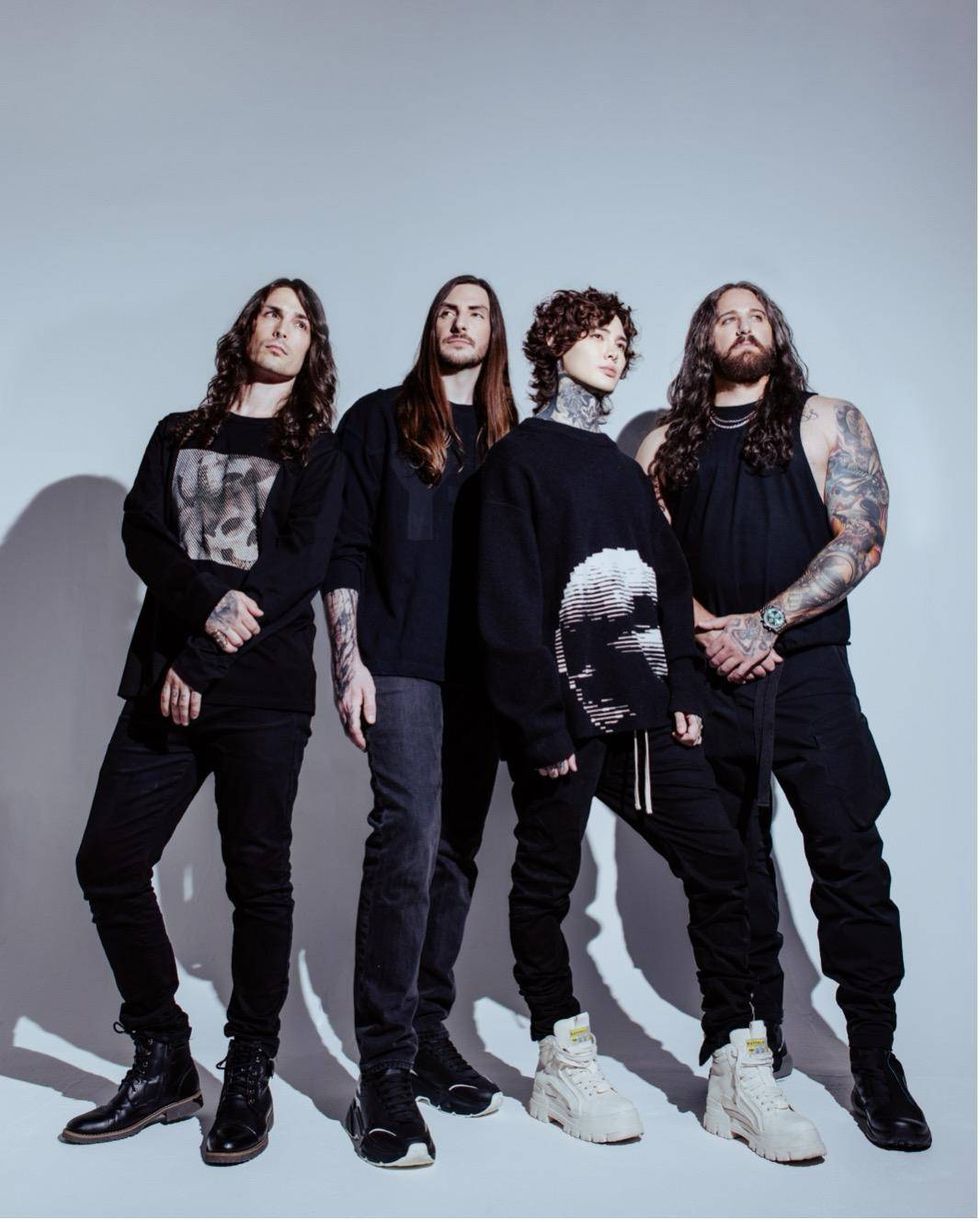
The accompanying music video mirrors the track's hypnotic pull, layering mesmerizing visuals with flashes of a world turned inside out. It’s interwoven with glimpses of redacted Epstein files and world destruction, grounding the video's dreamlike unraveling in something unsettlingly real.
Earlier this year, Polyphia teased their new chapter with the release of their first single in over four years, “Can You Feel It” pushing boundaries in ways the band never has before with a hybrid of metal and dance music. Following, they released “Power In The Blood” with a music video filmed at the São Francisco da Penitência Church in Rio de Janeiro, Brazil. The powerful visuals from each release lay the foundation for what’s to come off the new record.
Throughout 2024 and 2025, Polyphia worked together in various locations in Miami, Los Angeles and Dallas alongside co-producer RJ Pasin and guitar phenom Spiro Dussias. Guitarist Tim Henson took a different approach to composition, initially singing lines aloud and then translating them onto guitar, creating a process that encouraged the entire band to build on each other’s ideas in real time. More than anything, the sessions were defined by how much fun they were having creating music together. By the time the album was finished, they had reached a point where they could let go of any expectations about what would happen next and simply enjoy what they had created together.
The collective thread together a three-dimensional offering of otherworldly metal, future-facing prog, and pulsating house sealed tightly with carefully curated samples, inventive beat-craft, and the guitar eloquence that Tim and Scott remain renowned for. This time around, the instrumental push-and-pull invokes the polarity of the ultimate extremes: good and evil.
When speaking on the album Henson adds, “The album takes you through the extremes of two different worlds / moods: one being very uplifting and triumphant, the other being spine-chilling and terrifying. There are moments on the record that legitimately scare me when I listen to them.”
Polyphia will be on tour this fall in the UK and Europe, before heading out on the North American leg of their World Tour in early 2027.RJ Pasin will still support every date worldwide. North American shows will feature Ladrones, with select dates including Intervals. Perturbator will join all UK and European dates, which remain unchanged for Nov/Dec 2026.
A full list of show dates can be found below. For more information and to purchase tickets visit Polyphia.com .
- North America Tour Dates 2027 w/ Ladrones & RJ Pasin:
- w/ Intervals
- # No Ladrones
- February 5 - Phoenix, AZ - Arizona Financial Theatre
- February 6 - Las Vegas, NV - House of Blues
- February 9 - Los Angeles, CA - Hollywood Palladium
- February 10 - San Diego, CA – SOMA #
- February 11 - Anaheim, CA - House of Blues
- February 14 - San Francisco, CA - The Masonic
- February 17 - Seattle, WA - Paramount Theatre
- February 19 - Salt Lake City, UT - The Depot
- February 20 - Denver, CO - The Fillmore Auditorium
- February 23 - Minneapolis, MN - Uptown Theater
- February 24 - Milwaukee, WI - Landmark Credit Union Live
- February 25 - Chicago, IL - Aragon Ballroom
- February 26 - Indianapolis, IN - Egyptian Room at Old National Centre
- February 27 - Detroit, MI - The Fillmore Detroit
- March 2 - Toronto, ON - Great Canadian Toronto *
- March 3 - Montreal, QC – L’Olympia *
- March 5 - Philadelphia, PA - The Fillmore Philadelphia
- March 6 - Brooklyn, NY - Brooklyn Paramount
- March 7 - Boston, MA - MGM Music Hall at Fenway
- March 9 - Washington, DC - Echostage
- March 10- Raleigh, NC - The Ritz
- March 12 - Charlotte, NC - The Fillmore Charlotte
- March 13- Orlando, FL - Hard Rock Live
- March 14 - St. Petersburg, FL - Jannus Live
- March 16 - Atlanta, GA - Coca-Cola Roxy
- March 17- Birmingham, AL - Avondale Brewing Company
- March 18 - Nashville, TN - The Truth
- March 20 - Dallas, TX - South Side Ballroom
- Europe/UK Tour Dates w/ Perturbator & RJ Pasin:
- Nov 18 – Zurich, CH – Halle 622
- Nov 19 – Lyon, FR – Le Radiant
- Nov 20 – Toulouse, FR – Interference
- Nov 22 – Barcelona, ES – Razzmatazz
- Nov 23 – Madrid, ES – Sala La Riviera
- Nov 25 – Milan, IT – Alcatraz
- Nov 27 – Munich, DE – Zenith
- Nov 28 – Prague, CZ – SaSaZu
- Nov 29 – Warsaw, PL – Progresja
- Nov 30 – Leipzig, DE – Haus Auensee
- Dec 2 – Hamburg, DE – Docks
- Dec 4 – Copenhagen, DK – Amager Bio
- Dec 5 – Berlin, DE – Tempodrom
- Dec 6 – Oberhausen, DE – Turbinenhalle
- Dec 7 – Brussels, BE – Ancienne Belgique
- Dec 8 – Amsterdam, NL – AFAS Live
- Dec 9 – Paris, FR – Zenith Paris
- Dec 11 – Birmingham, UK – 02 Academy Birmingham
- Dec 12 – Manchester, UK – Manchester Academy
- Dec 15 – Leeds, UK – O2 Academy Leeds
- Dec 16 – London, UK – O2 Academy Brixton
“F**k you! I wanna talk to Gates!”: A drunk Van Halen fan once got so angry trying to build a fan site he rang up Microsoft and demanded to speak to Bill Gates
![Eddie Van Halen [main], Bill Gates [inset]](https://guitar.com/wp-content/uploads/2026/10/Van-Halen-Bill-Gates@2000x1500.jpg)
Ahh, technology. When it works it’s wonderful. But when it fails… Is there anything more annoying in the world?
If you’ve ever tried to build a website in the days pre-Wix, Squarespace and other all-in-one website builders you’ll attest to how much technology can have a tendency to ‘not play ball’.
A particularly devoted Van Halen fan once discovered this for himself while trying to create a fan website for the band, and became so frustrated with Microsoft’s FrontPage service that he ended up calling Microsoft, and ultimately demanding to speak to the head honcho, Bill Gates.
In a story told by Microsoft veteran Raymond Chen speaking to The Register, the Van Halen fan – apparently getting progressively more drunk as the call wore on – vented his frustration with FrontPage, a now-discontinued web editor that let users create websites without having to write code.
“Man, was this person lit,” Chen says his colleague reported upon answering the call. “The sound of ice clinking in a glass was readily apparent, and as the call went on, the customer got more and more drunk.”
The caller apparently even ended up shouting: “You’re not even a real f**king fan of Van Halen!” before, at his wits end with the software, demanding to speak to none other than Microsoft CEO Bill Gates. “F**k you! I wanna talk to Gates!” He apparently said.
We’re highly doubtful the fan was ever transferred to Microsoft’s commander-in-chief, and have no idea if he was ever able to make the site work. But it’s a funny story nonetheless.
In other Van Halen news, David Lee Roth and Alex Van Halen appeared at a recent event together and touched on their famously tumultuous relationship over the years. “There should be a star in front of three different clubs in Hollywood where we practiced Brazilian Jiu Jitsu over the setlist!” Roth said.
The post “F**k you! I wanna talk to Gates!”: A drunk Van Halen fan once got so angry trying to build a fan site he rang up Microsoft and demanded to speak to Bill Gates appeared first on Guitar.com | All Things Guitar.
Strymon Unveils La Brea Analog Tape Drive
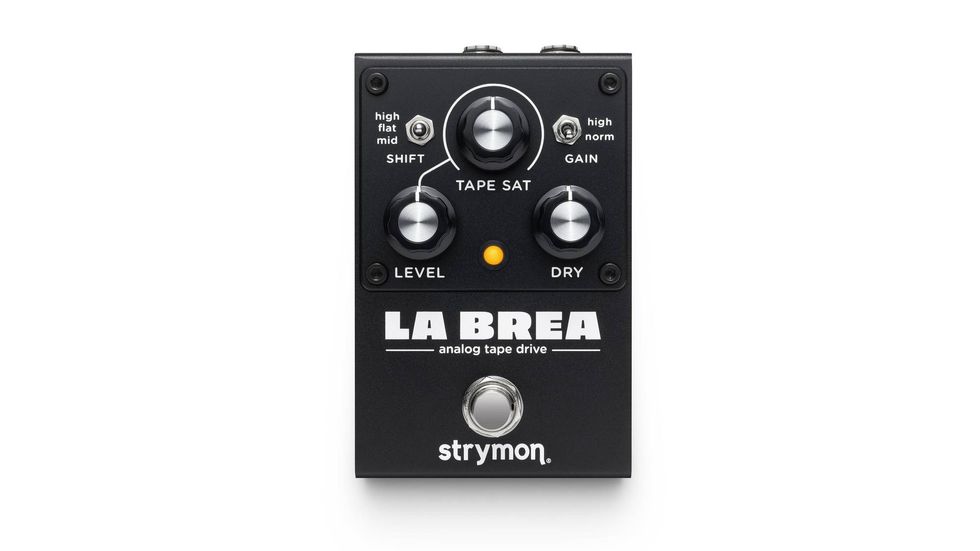
Strymon Engineering has introduced a new analog tape drive pedal called La Brea.
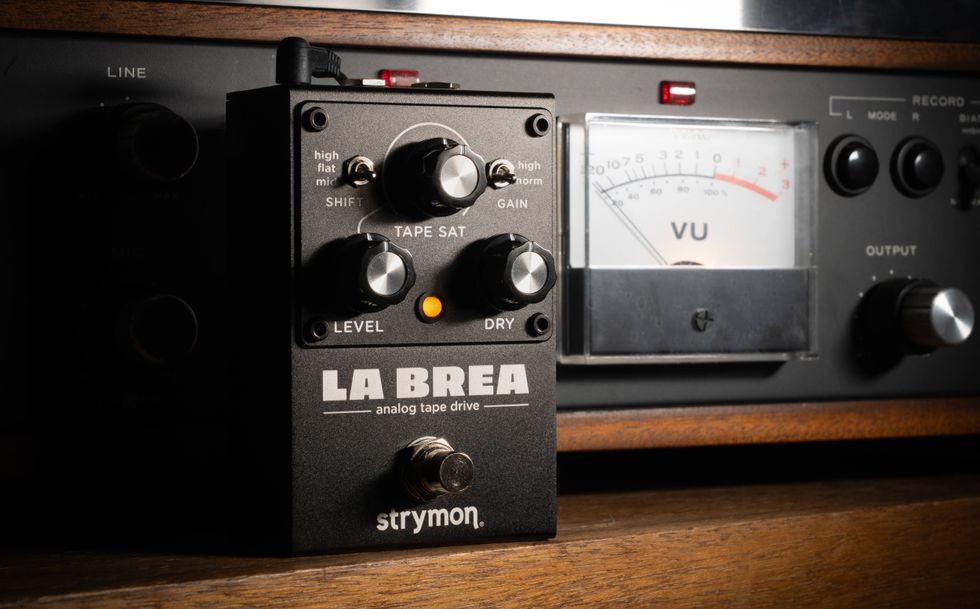
Incorporating multiple stages of analog gain using techniques learned from studying vintage tape machines, La Brea delivers a wide range of saturation from a simple interface. The pedal never sounds harsh even at extreme settings, and piling on the gain just makes things fatter and more saturated without getting crispy or painful to listen to, just like a real mastering tape deck.
Initially inspired by the white paper that co-founder Pete Celi wrote on the development of Strymon’s iconic Deco pedal, analog engineer Josh Forbes aimed for true tape behavior in a fully analog design.
In addition to the tape saturation side, La Brea also features a fully discrete dry path, giving the pedal two distinct personalities that players can use to craft personal sounds. The dry path always stays in phase with the saturated output, meaning you can add a little or a lot with no comb filtering or other artifacts. The discrete operation also means that it can be used as a pure clean boost, or a clean boost that allows you add saturation (as much or as little as desired) to fatten up single notes and chords.
As tape has a tendency to saturate high frequencies first as the gain increases (making them less prevalent), La Brea also features a three-position Shift switch that allows the player to add some of those high frequencies back in to the output. One position concentrates on adding high frequencies only, and the other adds upper midrange frequencies to the high boost to help notes poke though the mix. It’s a powerful tool that can help wake up dark humbuckers, add bite to older strings or make setting up a rig even easier.
“It’s crazy to think that Josh read Pete’s whitepaper on the making of Deco over twelve years ago, which was before he even worked here”, said CEO and chief analog guru Gregg Stock. “He’s been thinking about how to recreate tape behavior purely in the analog domain ever since, so it’s great that we now have the Series A line of analog pedals to showcase these great ideas our guys come up with. La Brea is a drive pedal with a unique voice and response, so it fits really well with the other pedals in Series A.”
“It’s quickly become the favorite drive pedal for a bunch of people at the office”, said Sean Halley, Strymon’s marketing guy. “The fact that it’s based on tape means that it never gets harsh, never gets strident, and mates really well with all different types of amplifiers. I’ve had one on my gigging board since the beginning of the year in disguise, so I’m excited to take the tape off and finally let people see what it is!”
La Brea carries a street price of $199 US. For more information visit Strymon.net.
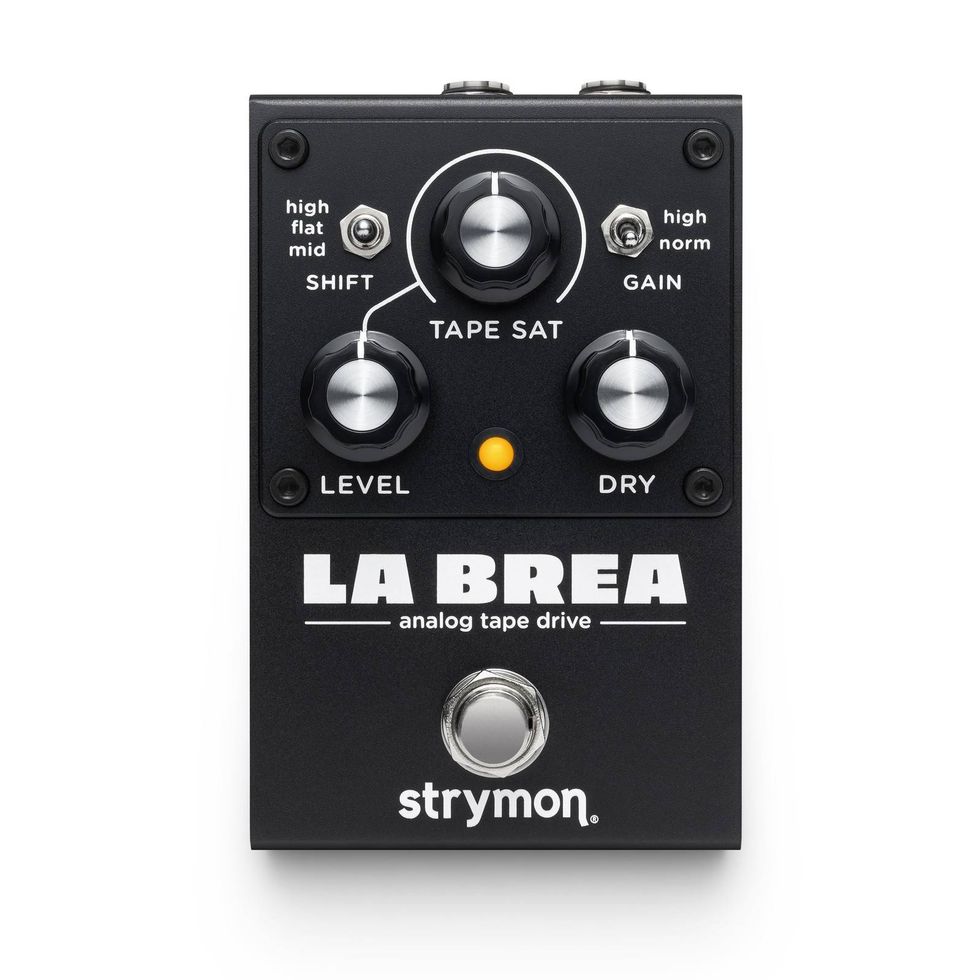
La Brea
Strymon Engineering (www.strymon.net), has introduced a new analog tape drive pedal called La Brea.
Greta Van Fleet Announce 'Into the Beginning' 2027 North American and European Tour

GRAMMY Award-winning rock and roll band Greta Van Fleet announce their 2027 North American and European headline tour today. Promoted by Live Nation, the 59-city Into The Beginning Tour kicks off Wednesday, February 3 in Savannah, GA at Enmarket Arena and makes stops in Chicago, Brooklyn, Detroit, Dallas-Fort Worth, Berlin, Milan, Amsterdam, Paris, London, Toronto and more before wrapping back in their home state of Michigan on Saturday, July 31 at Grand Rapids’ Acrisure Amphitheater. Special guests Arc De Soleil, The Kooks, and Portugal. The Man will join as support on select North American dates. VIP Packages are available for North American dates only.
GENERAL ONSALE BEGINS FRIDAY, OCTOBER 9 AT 10AM LOCAL FOR EUROPEAN DATES AND THURSDAY, OCTOBER 15 AT 10AM LOCAL FOR NORTH AMERICAN DATES
ALL TICKETS WILL BE SOLD AT FACE VALUE PLUS FEES THROUGH PRIMARY TICKET SELLERS. NO PLATINUM TICKETS WILL BE SOLD. FANS ARE ENCOURAGED TO SIGN UP FOR PRE-SALES THROUGH GRETAVANFLEET.COM
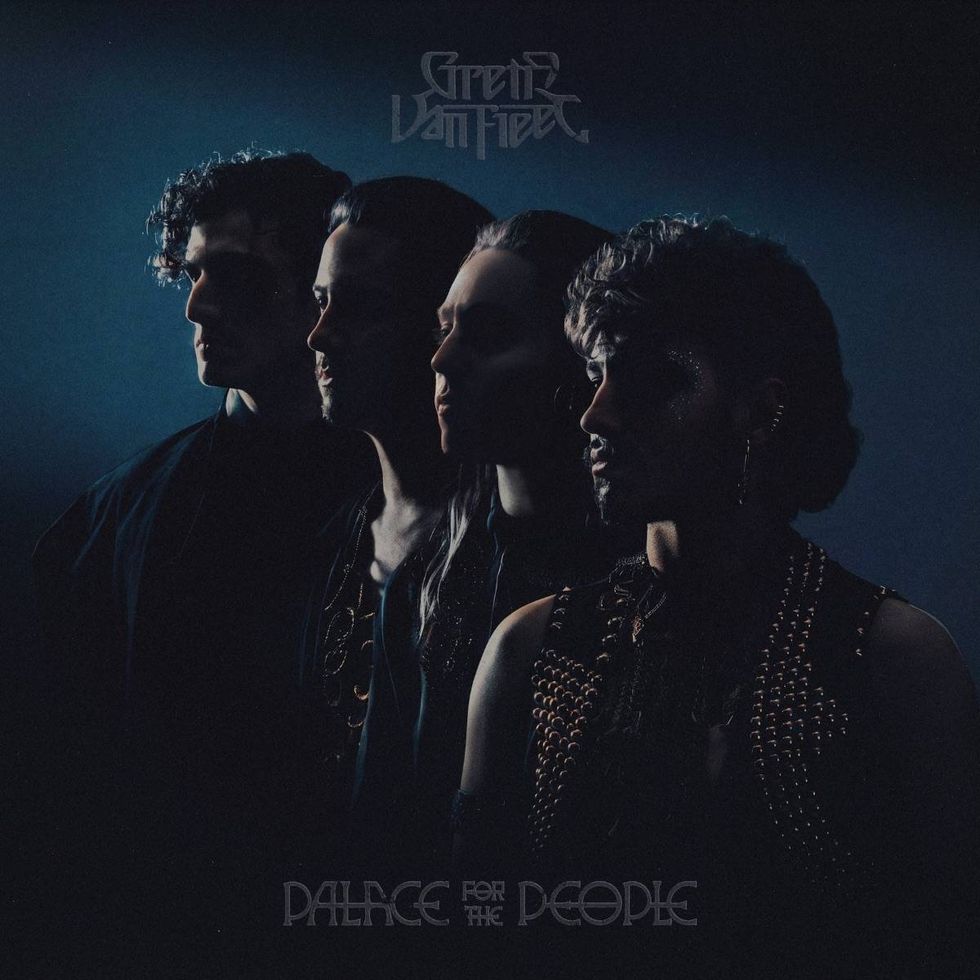
NEW ALBUM “Palace for the People” OUT FRIDAY, OCTOBER 9 – PRE-SAVE HERE
PRE-SAVE/ADD “Palace for the People” (ALBUM)
- Into the Beginning
- Tear It Down
- Heart and the Beat
- Boughten Bliss
- Field of Stars
- Play Your Games
- Dreams You Hold
- Lost in the Golden
- Touch Again
- Saw You Stand
- Heya
- Call My Own
- Born into This
TICKETS – NORTH AMERICA: Tickets to the Into The Beginning Tour will be available starting with a Fan Presale (details below) beginning on Tuesday, October 13 at 9am local time. Additional presales will run throughout the week ahead of the general on-sale beginning on Thursday, October 15 at 10am local time on GretaVanFleet.com .
FAN PRESALE: Fans can sign up now for the Greta Van Fleet Fan Presale at GretaVanFleet.com .
RESERVED BY SPOTIFY: Greta Van Fleet’s Reserved by Spotify tickets may be available to eligible North American Spotify Premium subscribers through Ticketmaster. These fans will be notified by Spotify via email and app notification, and will have the opportunity to purchase up to two tickets during the Reserved presale.
TICKETS – EUROPE: Tickets to the Into The Beginning Tour will be available starting with a Fan Presale on Wednesday, October 7 at 10am local time. Fans can sign up now for the Greta Van Fleet Fan Presale at GretaVanFleet.com. Additional presales will run throughout the week ahead of the general on-sale beginning Friday, October 9 at 10am local time on GretaVanFleet.com .
Ticket prices have been priced in advance by the tour and won't change during the presale or onsale (no platinum tickets). All tickets will be sold at face value plus fees through primary ticket sellers. Fans are encouraged to sign up for the Fan Presale through Gretavanfleet.com for first access to tour tickets.
Today’s news follows the release of the band’s latest single “Tear It Down” from their forthcoming fourth studio album, Palace for the People, which arrives Friday, October 9 via Republic Records. Pre-order/pre-save the album HERE . “Tear It Down” follows lead tracks “Play Your Games” and “Saw You Stand,” which the band performed on Jimmy Kimmel Live!, and offers another look behind the curtain of their majestic new album.
On Palace for the People, Greta Van Fleet continue to explore themes of humanity, connection, resilience, and transcendence—building a body of work that feels both deeply personal and universally resonant. They’ve made a mysterious, monumental, and cataclysmic body of work, painting a sonic tableau out of powerhouse vocals, earth-rupturing riffs, and stunning solos. This is expressive, ethereal, and energetic rock and roll music delivered with apropos symphonic grace, revelrous excess, dynamics, and the glory of a collective who refuse to be boxed in musically, thematically, or spiritually. It’s also the brilliance of a bloodline committed to tape. They have taken another massive creative leap, building a new place for listeners to congregate and determining the tone for rock’s future in the process.
Prior to the Into The Beginning Tour and in celebration of the forthcoming album, Greta Van Fleet will perform an intimate under-play residency next month at Nashville’s The Basement East on the first three Saturdays in October. For more information go to: GretaVanFleet.com .
Since emerging from Frankenmuth, Michigan, Greta Van Fleet have become one of rock and roll’s defining voices of their generation. Across multiple platinum-selling releases and sold-out arena tours spanning the globe, the GRAMMY award-winning band has consistently challenged expectations while forging a sound entirely their own. Palace for the People represents the band’s boldest artistic statement yet.
2027 TOUR DATES:
- Wed, Feb 3 – Savannah, GA – Enmarket Arena *
- Fri, Feb 5 – Tampa, FL – Benchmark International Arena *
- Sat, Feb 6 – Jacksonville, FL – VyStar Veterans Memorial Arena
- Tue, Feb 9 – Atlanta, GA – State Farm Arena *
- Wed, Feb 10 – Nashville, TN – Bridgestone Arena *
- Fri, Feb 12 – Rosemont, IL – Allstate Arena *
- Sat, Feb 13 – Omaha, NE – CHI Health Center *
- Mon, Feb 15 – Minneapolis, MN – Target Center *
- Wed, Feb 17 – Green Bay, WI – Resch Center *
- Fri, Feb 19 – Louisville, KY – KFC Yum! Center *
- Sat, Feb 20 – Pittsburgh, PA – PPG Paints Arena *
- Tue, Mar 2 – Detroit, MI – Little Caesars Arena ^
- Wed, Mar 3 – Cleveland, OH – Rocket Arena ^
- Fri, Mar 5 – Boston, MA – TD Garden ^
- Sat, Mar 6 – Albany, NY – MVP Arena ^
- Mon, Mar 8 – Brooklyn, NY – Barclays Center ^
- Wed, Mar 10 – Philadelphia, PA – Xfinity Mobile Arena ^
- Fri, Mar 12 – Charlotte, NC – Spectrum Center ^
- Sat, Mar 13 – Knoxville, TN – Food City Center ^
- Mon, Mar 15 – Fort Worth, TX – Dickies Arena ^
- Tue, Mar 16 – Tulsa, OK – BOK Center ^
- Fri, Mar 19 – Anaheim, CA – Honda Center #
- Sat, Mar 20 – Phoenix, AZ – Mortgage Matchup Center #
- Mon, Mar 22 – Reno, NV – Reno Events Center #
- Wed, Mar 24 – Seattle, WA – Climate Pledge Arena #
- Thu, Mar 25 – Portland, OR – Moda Center #
- Sat, Mar 27 – Boise, ID – ExtraMile Arena (BSU) #
- Mon, Mar 29 – Salt Lake City, UT – Delta Center #
- Tue, Mar 30 – Denver, CO – Ball Arena #
- Sat, May 15 – Munich, DE – Olympiahalle ‡
- Sun, May 16 – Milan, IT – Unipol Forum ‡
- Tue, May 18 – Hamburg, DE – Barclays Arena ‡
- Wed, May 19 – Copenhagen, DK – Royal Arena ‡
- Fri, May 21 – Berlin, DE –Uber Arena ‡
- Sat, May 22 – Czech Republic Prague – O2 Arena ‡
- Mon, May 24 Amsterdam, NL – Ziggo Dome ‡
- Tue, May 25 – Brussels, BE – Forest National ‡
- Thu, May 27 – Paris, FR – Adidas Arena ‡
- Fri, May 28 – London, UK – O2 Arena ‡
- Sun, May 30 – Birmingham, UK – Utilita Arena ‡
- Tue, Jun 01 – Manchester, UK – Co-op Live ‡
- Wed, Jun 02 – Glasgow, UK – OVO Hydro ‡
- Fri, Jun 04 – Dublin, IE – 3Arena ‡
- Mon, Jul 5 – Vancouver, BC – Rogers Arena +
- Wed, Jul 7 – Edmonton, AB – Rogers Place +
- Thu, Jul 8 – Calgary, AB – Scotiabank Saddledome +
- Sat, Jul 10 – Winnipeg, MB – Canada Life Centre +
- Tue, Jul 13 – Kansas City, MO – T-Mobile Center +
- Wed, Jul 14 – St. Louis, MO – Chaifetz Arena +
- Fri, Jul 16 – Columbus, OH – Nationwide Arena +
- Sat, Jul 17 – Noblesville, IN – Ruoff Music Center +
- Tue, Jul 20 – Raleigh, NC – Lenovo Center °
- Wed, Jul 21 – Columbia, MD – Merriweather Post Pavilion °
- Fri, Jul 23 – Hershey, PA – Giant Center °
- Sat, Jul 24 – Uncasville, CT – Mohegan Sun Arena °
- Mon, Jul 26 – Gilford, NH – BankNH Pavilion °
- Wed, Jul 28 – Laval, QC – Place Bell °
- Thu, Jul 29 – Toronto, ON – RBC Amphitheatre °
- Sat, Jul 31 – Grand Rapids, MI – Acrisure Amphitheater °
- Arc De Soleil and Edgehill ^ The Kooks and Luna Li # The Kooks and Sana Sana Musica ‡ Larkin Poe + Portugal. The Man and Sun Room ° Portugal. The Man and Friko
Greta Van Fleet are
- Josh Kiszka — Vocals
- Jake Kiszka — Guitar
- Sam Kiszka — Bass, Keys
- Danny Wagner — Drums
Chibson pokes fun at the state of the guitar industry with new Cease & Desist knobs

Chibson USA is hardly a company known for taking things seriously. In fact, the brand exists to poke fun at the weird and mockable that exists throughout the guitar world.
Some of its parody releases have included the Cease & Desist pedal – which celebrated Mickey Mouse’s entry into the public domain – the Humbuckle, a humbucker-inspired belt buckle that actually made it to market, and the Chibson Drive, a Google-inspired overdrive pedal made in collaboration with Acorn Amps, designed for the “data-driven results musicians dream of having”.
Indeed, “cease and desist” is a term a little too familiar in the guitar industry, with some of its biggest players often pursuing legal action to stop competitors making guitars which they believe infringe upon its intellectual property.
Gibson, for example – the company after which Chibson is humorously named – has a long history of using legal avenues to protect its trademarks and intellectual property. After a long and bitter legal battle, just yesterday, it was announced that Dean’s parent company must pay Gibson $4 million in legal fees following a trademark loss. Also recently, Gibson issued a cease and desist to Donald Trump-backed Trump Guitars, saying it had infringed upon the classic Les Paul body shape design.
And a wordmap of most-used terms in the guitar world this year wouldn’t be complete without “cease and desist” front and centre in massive letters, amid an ongoing legal campaign from Fender to reclaim the Stratocaster body shape and stop other builders from making instruments that resemble it. So far, PRS, Yamaha, Thomann, Amazon, LsL Instruments and more have received cease and desist letters from Fender.
Yep, the guitar industry has been a whirlwind in 2026, so what could be better than a little comic relief from Chibson?
Originally conceived for Chibson’s social media pages, the new Cease & Desist knobs were thought up to “celebrate this new lawsuit era”. And they’re now a reality, available in a 3-pack of knobs to customise your guitar.
“If anything can be learned from lawsuits of the past, it’s that guitarists love a little frisky controversy and now with the release of Chibson’s Cease & Desist knobs, guitarists can support their favorite illegal guitar manufacturer while making a bold statement!” Chibson says.
In a not so subtle nod to Spinal Tap, the knobs have also been designed to go to 11. “These are one louder!” Chibson says, reference the iconic line from Nigel Tufnel.
Chibson’s Cease & Desist knobs are available to order now, priced at £16. Learn more at Chibson.
The post Chibson pokes fun at the state of the guitar industry with new Cease & Desist knobs appeared first on Guitar.com | All Things Guitar.
Harmony Standard Series Comet with Tremolo review: “This is a cool guitar that allows you to do your thing without trying to look like anybody else”

$1,899/£1,899, harmony.co
Since its renaissance in 2018, the Harmony Guitars brand has earned a reputation for intriguing, retro-coded instruments that aim to offer a different personality to a crowded and often conservative guitar buying scene.
While the brand has mainly concentrated on modernised tweaks of its original solidbody guitars over its first decade of rebirth, it’s arguably the esoteric semi-hollow designs – beloved by the likes of Dan Auerbach, Jack White, Courtney Barnett, and many others – that people associate with the brand.
Therefore, it made all the sense in the world when Harmony then introduced the H72-inspired Comet in 2021 (the brand also launched a full H72 reissue later that year, but that was made in Asia rather than Kalamazoo, Michigan), and very nice it was too. Now, however, the Comet is getting an overdue bit of wobble, courtesy of a Göldo LT1 tremolo – can it make a good guitar even better?
 Image: Adam Gasson
What is it?
The Comet is a double cutaway semi-hollow electric guitar – think of it as an inflatable SG with twin f-holes. With the exception of the rosewood fretboard the whole guitar body is made from genuine mahogany. So far, so traditional.
We have a cheeky 25” scale which sits nicely between the Gibson and Fender standards and makes for a guitar that balances well and feels comfortable across the player’s body. The neck has a gentle C carve, a 1 11/16” nut width and a 12” fretboard radius.
As with previous Harmony models, the electronics offered are also very retro-flavoured: a pair of custom gold foil humbuckers with single master cupcake knobbed volume and tone controls and a three-way selector switch which is set to the rear of the control array. Hidden in the volume control is a push-pull coil tap giving the player access to slinky single-coil content, which is very welcome.
The main attraction to this model, however, is the Göldo LT-1 vibrato (which Harmony insists on calling a tremolo) system. Göldo originally developed the Les Trem vibrato for its sister brand, Duesenberg, but in recent years the unit has become a popular aftermarket alternative to the mighty Bigsby for Gibson-accented instruments, while also seeing OEM use on a variety of other guitars, most notably Eastman’s Romeo and Juliet electrics. Needless to say, we’re expecting emotive wobbles rather than full dive-bombs here.
Finally, we have a sturdy MONO Vertigo gig bag (MONO and Harmony are both part of the same parent company) which will get you where you need to go and keep the guitar safe and sound.
 Image: Adam Gasson
Build quality & usability
Given that it’s almost unheard of to see a USA-made instrument hitting the market without a “2” at the start of its four-figure price tag these days, we could reasonably expect to see some compromises in fit and finish in one coming in at $100 under that bar. However, the quality of the build here is impressive – it’s clean, tidy and well-sorted throughout. It must be said that alone is a huge improvement on many of the original Harmony guitars churned out in the 1960s.
Despite the retro stylings, this does feel like a modern instrument – sleek, immediate and responsive. It is noticeably comfortable. The nitrocellulose finish is well applied, though the Midnight blue finish is definitely a choice. I would have expected something several shades closer to black for ‘Midnight’ personally, it’s all rather royal to my eyes, but that’s all down to personal taste.
Now, if you are expecting Bigsby-like action from the Göldo LT-1 system, you may be in for a surprise. While the Bigsby has a firmer response, the Göldo feels a lot more like the sort of floating vibrato more commonly found on Fender offsets.
Plenty will enjoy how it responds to the slightest touch, though I found it rather too easy to move accidentally – especially given how close the mechanism is to the bridge. Still, if you’re looking for something that allows for a lighter touch, it certainly does that.
What it also does, regrettably, is get in the way of the controls. The bar and the spring are right in the way of the volume control, so it’s much harder than you’d like to adjust on the fly, and it makes activating the coil-split downright fiddly.
 Image: Adam Gasson
Sounds
Let’s be real here – no one really knows what a gold foil pickup is supposed to sound like. Yes, we’ve seen them all over the place in recent years – although that fervour seems to be dying down a little now – but the fact that so many USA catalogue guitars and Japanese oddities came with starkly differing versions of these pickups has muddied the waters in terms of what to expect from a guitar toting these retro beauties.
Quite whether these pickups are ‘real’ gold foils then, is rather academic. What we have here are two very capable humbuckers with gold foil covers, which offer a pleasing variety of semi-hollow tones.
The neck pickup is warm and velvety with a smooth jazz voice. Smacking it around a bit with a Bigfoot Engineering King Fuzz reveals dark delights, and a quick flick of the tone knob gets us well into chaotic fuzz territory with added beeps and octaves.
The bridge pickup is snappy enough to get the point across. This is not a 335, but it does still growl when you dig in, even when clean. Slipping a Thorpy Bunker into the equation reveals enough aggression for retro-flavoured grunge and blues–rock at best, but it’s extremely unlikely that our cloven-hoofed brethren will be looking at this guitar to get their thrills.
Popping the push-pull volume knob gives me a voice that is closer to a Tele than a Strat – it’s up to you to decide whether that is what you’re looking for. It’s a useful enough sound within a full band mix, but it doesn’t carry like the full-fat humbuckers when it’s soloing time.
The vibrato system does work well in practice, and thanks to the locking tuners the whole experience is very solid no matter how irresponsible you get with that awkwardly placed bar.
 Image: Adam Gasson
Should I buy one?
Are you looking for someone outside the norm that still delivers in both sonics and build quality? Are you sick of sunbursts and Cadillac-inspired finishes? Fancy some vibrato action but in a guitar that can easily be converted to a stop tail if you like? How about a modern take on a design that goes back to the 1960s? Well, the Harmony Comet with Tremolo will give you all of this in a comfortable and engaging instrument.
This is a cool guitar – and let’s not pretend that isn’t important – one that allows you to do your thing without trying to look like anybody else. And as Wallace Stevens reminds us: “Things as they are, are changed upon the blue guitar.”
Alternatives
Looking for a bright blue semi on a budget? The non-trem Comet ($/£1,799) is a very good guitar without many of the usability issues the retro-fit trem has added. The Chinese-made Epiphone Emperor Swingster ($/£799) in Delta Blue Metallic features retro styling, a Bigsby and a pair of Retrobucker pickups. Eastman Guitars offer the strongest direct competition to the Comet with the Romeo LA ($1,979/£1,769). This Chinese-made guitar has build that can go toe to toe with most US makers, and even sports the same LT-1 trem. Feeling flush? The Duesenberg Starplayer TV Phonic model gives you semi-hollow maple construction, gold foil pickups and an own-brand version of the LT-1, while gently relieving you of $4,599
Editor’s note: Guitar.com and Harmony Guitars are both owned by the Caldecott Music Group.
The post Harmony Standard Series Comet with Tremolo review: “This is a cool guitar that allows you to do your thing without trying to look like anybody else” appeared first on Guitar.com | All Things Guitar.
IK Multimedia Releases TONEX 2 Player
Reverend Guitars Unveils New Standard Series
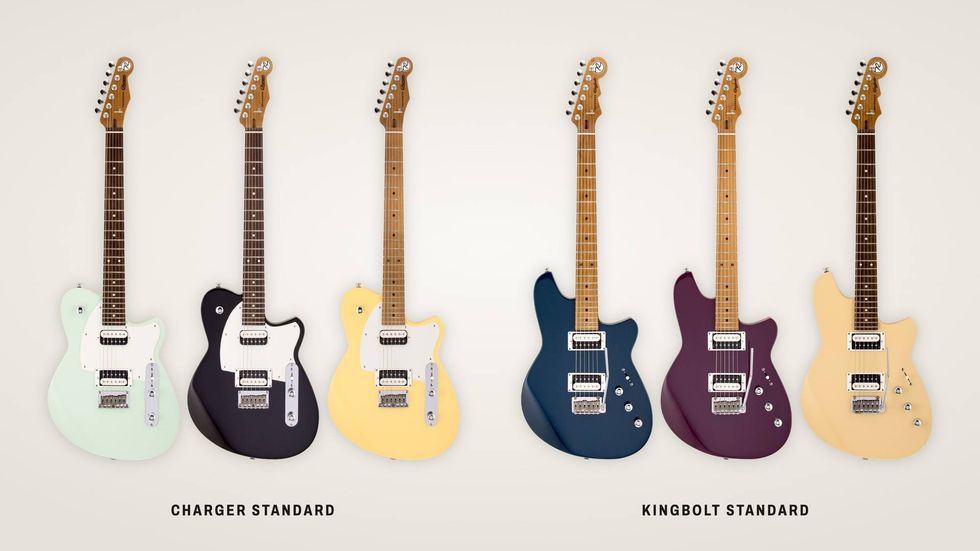
Reverend has introduced the brand new Standard Series of electric guitars, featuring clean lines and retro-modern style, loaded with no-nonsense high-performance appointments.
The new series includes two models: the Charger Standard has a string-through-body bridge, while the Kingbolt Standard features a BS184 tremolo bridge. Both the Charger Standard and Kingbolt Standard feature Reverend HCM humbuckers, delivering plenty of raw horsepower and versatility.
HCM Pickups are based on Reverend’s classic HA5 Humbuckers, with the pickup cover removed and the alnico magnets replaced with a Medium Ceramic magnet. The result is a medium-high output humbucker with enhanced punch, sustain and harmonics, designed for those who seek raw rock tone, but want sweet cleans when you back off the volume knob and/or right-hand attack. The HCM Bridge pickup is wound with 43 gauge wire and measures 13K ohms. The HCM Neck pickup is wound with 42 gauge wire and measures 7.5K ohms.
Both models include Reverend’s classic Bass Contour Control knob along with volume and tone controls – simple yet highly flexible electronics suited to just about any musical style. Each model features a roasted maple neck with 25 ½” scale length, medium oval neck profile and 12” radius for smooth playability. The dual action truss rod is accessible at the headstock, for ease of adjustment and reliability. Both models have stainless steel saddles for sustain and punch, and Reverend Pin-Lock tuners.
The Reverend Charger Standard is available in Midnight Black, Powder Yellow and Iconic Blue and carries a $999 street price. The Reverend Kingbolt Standard is available in Tide Blue, Sandstone and Purple Punch colors and carries a $1099 street price. For more information visit reverendguitars.com.
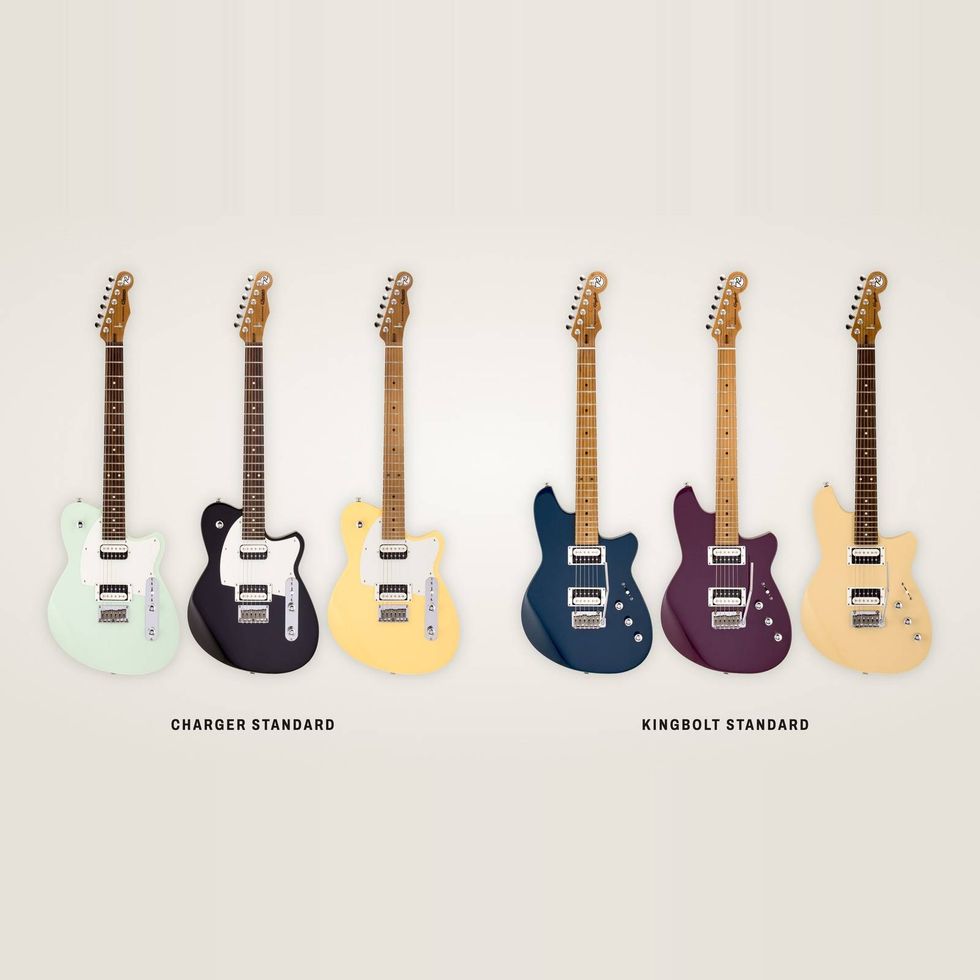
Standard Series
Reverend has introduced the brand new Standard Series of electric guitars, featuring clean lines and retro-modern style, loaded with no-nonsense high-performance appointments.
Working It Out
“If only I could make them understand just how much their business would benefit by letting me contribute to the ambiance of their establishment.”
In the beginning anyway, you figure that’s what the owner or manager wants to hear and on the surface you’d be right. The problem is – they’ve heard it all before and reality vs promises is something they’ve experienced, most likely more than a few times. There are other strategies of course and none is better than having someone already employed by the establishment vouch for your talent, experience and ability. There is also the idea that offering an appearance or two without charge might be enough to keep the door open. But that is dangerous in many ways and will be the subject of another blog entry in the near future.
As the years and then decades pass those rejections begin to be more tolerable, at least from a more practical point of view, i.e., there are always more places to play. Timing can be hugely important. More than once I’ve gotten a gig by being the first one who walked through the door at a moment in time when an establishment has decided to add or resume live music but of course that is pure luck.
This outlook can only be attained based on long-term experiences, good and bad. Back in the early 1970s I was camping with some friends at a campground in Acadia National Park in Maine. A middle-aged guy was in the campsite next to us and when he heard the guitar music coming from next door he walked over. Turns out he was a professional musician, a drummer who had worked with some pretty well-known groups over the years, both on the road and in the studio. We asked him how he ended up at a secluded campsite in northern Maine. He basically mumbled something about needing a break from his busy schedule and after playing some gigs in Boston he just got in his car and headed north with no set plans about how long his break would be.
This we found a bit strange. If he could easily get gigs whenever he wanted, why the heck wasn’t he back at it? Basically, he said, I just couldn’t face another session or gig playing with some young group who had neither the drive nor the temperament (or talent) to move away from the lightweight pop music.
Well, said I with all the confidence and ignorance of youth, you would never catch ME playing music I hated even if there was serious money involved.
Mr. Drummer just shook his head and I detected more than a little disdain as he said: “Well…OK… I remember saying just about the very same thing thirty years ago when I decided to try breaking into that tight circle of so-called “professional” musicians. I wish you luck maintaining that lofty goal. Really, I do! Because the fact is, ‘luck’ isn’t as random as you might think.”
With that, Mr. Drummer got up from his chair and began heading back to his campsite. We shook our heads and proclaimed – he’s just jaded. It’s so sad that he seems to have totally lost touch with the reason he started playing in the first place. In retrospect I’m pretty sure he was hoping to hook up with some young hippie-ish girl who took the “Make Love, not WAR!” moto literally and would gladly jump into his sleeping bag. That’s what numerous magazine articles of the time had pretty much confirmed, right?! But alas, all the hippie chicks around that campfire were spoken for and frankly had no interest in some cynical middle-aged dude who may have looked alarmingly like their father.
But I’ve never forgotten what he said and over the many years since that evening his words made more and more sense. Or as Mr. Dylan put it so well: “I was so much older then, I’m younger than that now.” These days a rejection doesn’t put me in a state of minor depression for a few days or longer. The let-down is always there, make no mistake, but I handle it much, much better than I did in my youth. All it really took was confidence that a rejection was not personal. I’ve learned that a hard ‘no’ may very well involve private decisions or situations the owner or manager may be dealing with and have no explanation. In fact, that truth is almost always lurking close to the front of my brain, especially when the establishment is brand new or has undergone a complete personality change with new management. It’s likely that unrealistic promises won’t help you land that gig and if you do, the owner expects a full house from the first gig and onward, which in a totally seasonal area like Cape Cod is virtually impossible. So, who takes the blame for that? I’m guessing you can guess.
As some reading this know, I had a dream gig for a bit over 13 years. Just about every Sunday over those years I played at the (old) Daily Brew café, only a 15-minute drive from my home. Because I was playing in a very small space inside there was no need to haul heavy amps or a PA system. I expanded my set-up a bit during summer and early fall when I played outside on the back deck but it was still a relatively simple exercise. The owner gave me free reign in terms of the music I played and I was keenly aware that volume control was very important. I had to accept the fact that it was definitely NOT a concert and for much of the time my function was not much more than helping fill in the gaps in conversation.
This proved to be an excellent opportunity to take a step or two back and try to make my ego accept and understand the reality of the necessities and requirements of being a professional musician on the local level. I learned a few things over those years that served me well. If there was just one person who was actually listening intently I would make believe that person was my only audience and I owed that person my best possible performance. Another important lesson: It was quite likely there were others listening but not responding until they walked past me to the door and said something to the effect of – Nice set! I really enjoyed your music!
See! said my ego. See!! You DID accomplish what you set out to do. You added something positive to the ambiance and there WERE people who understood why I sat there week after week, year after year. So I just keep plugging away, chasing down rumors of new playing opportunities and leveraging gigs I do play by asking the people hiring me to please recommend me to others.
Never, ever take a steady gig for granted. Treat every chance to put your music in front of people as something very special, something that very few people get to experience.
Peace & good music,
Gene
ESP’s Ryan Dominguez: Crafted by Fate

Ryan Dominguez’s path to becoming ESP USA’s shop manager, master painter, product/color developer, and, now, Director of USA Manufacturing Operations, was cast by fate. It was his last year of high school, and he knew he wanted to do something with art as a career. He floated the idea of becoming an animator, but everyone kept telling him there was no money in art. Little by little, he began feeling lost. “I didn’t really know where I wanted to go in life,” Dominguez tells PG. “One day I was walking home through the alleyway where my friends and I used to do alleyway things. In the gutter there was this brochure for Guitar Craft Academy, and I read through it and thought, ‘That’s a pretty cool way to blend art and music.’”
Dominguez went home and talked it over with his grandparents, who were willing to let him give it a shot. “It honestly could have been clown college, as long as it led to work,” he jokes. “They were cool with whatever direction I decided to go in.” It paid off. About two weeks after graduating Guitar Craft Academy, Dominguez landed a job at ESP as a tech. He has since spent most of his adult life with the company, clocking in around 20 years collectively so far.
ESP, short for Electronic Sound Product, was formed in Tokyo in 1975 as a repair shop and replacement parts maker. They later built guitars for the Japanese market under the ESP and Navigator brand names. By 1983, ESP parts were available in the U.S. market. The company’s ascent coincided with the rise of the Sunset Strip metal scene in the ’80s, where bands tried to out-glam one another through heavy makeup, bold fashion, and big hair. ESP seemed to perfectly match that aesthetic, creating guitars with exciting graphics and unusual body shapes.
The turning point for ESP happened in the mid-’80s when George Lynch was on tour with Dokken in Tokyo. He had a very specific idea for a guitar build and heard that ESP made fully custom instruments, so he set up a meeting. At first, they discussed specs for a neck that Lynch wanted them to make, but over the course of a few hours, they collectively designed Lynch’s “Kamikaze” guitar. That instrument, which features vivid military-themed graphics and a reverse headstock, would become ESP’s first signature model. Lynch’s equally famous “Tiger” guitar would also be released by ESP as part of its Signature Series. The unforgettable visuals of “Kamikaze” and “Tiger” quickly made ESP a household name among guitarists.
“[W]e know what people expect when they see ‘ESP’ on a headstock. We always want ESP USA to live up to that legacy.”
The timing of Lynch’s signature models coincided with ESP’s move to New York City, where they operated out of a loft on 19th Street, before moving to Manhattan's then-famous music row on 48th Street in 1989. After landing in the Big Apple, ESP started making guitars for NYC-based artists like Vernon Reid, Page Hamilton, and Bruce Kulick. Then the company made the move west in 1993, relocating its U.S. headquarters to Sunset Boulevard in Hollywood, California. That was the place to be for metal at the time, and ESP quickly became a major player—for decades since, ESP’s artist roster has been a who’s who of metal guitarists. In addition to Lynch’s guitars, ESP has crafted many of the genre’s most distinct instruments—including Kirk Hammett’s “The Mummy,” “Ouija,” and “White Zombie,” James Hetfield’s “Snakebyte” and “Truckster,” and Akira Takasaki’s “Random Star,” to name a few. In 1996, ESP introduced their affordable—and highly popular—LTD line, which helped put their guitars into the hands of budget-conscious players.
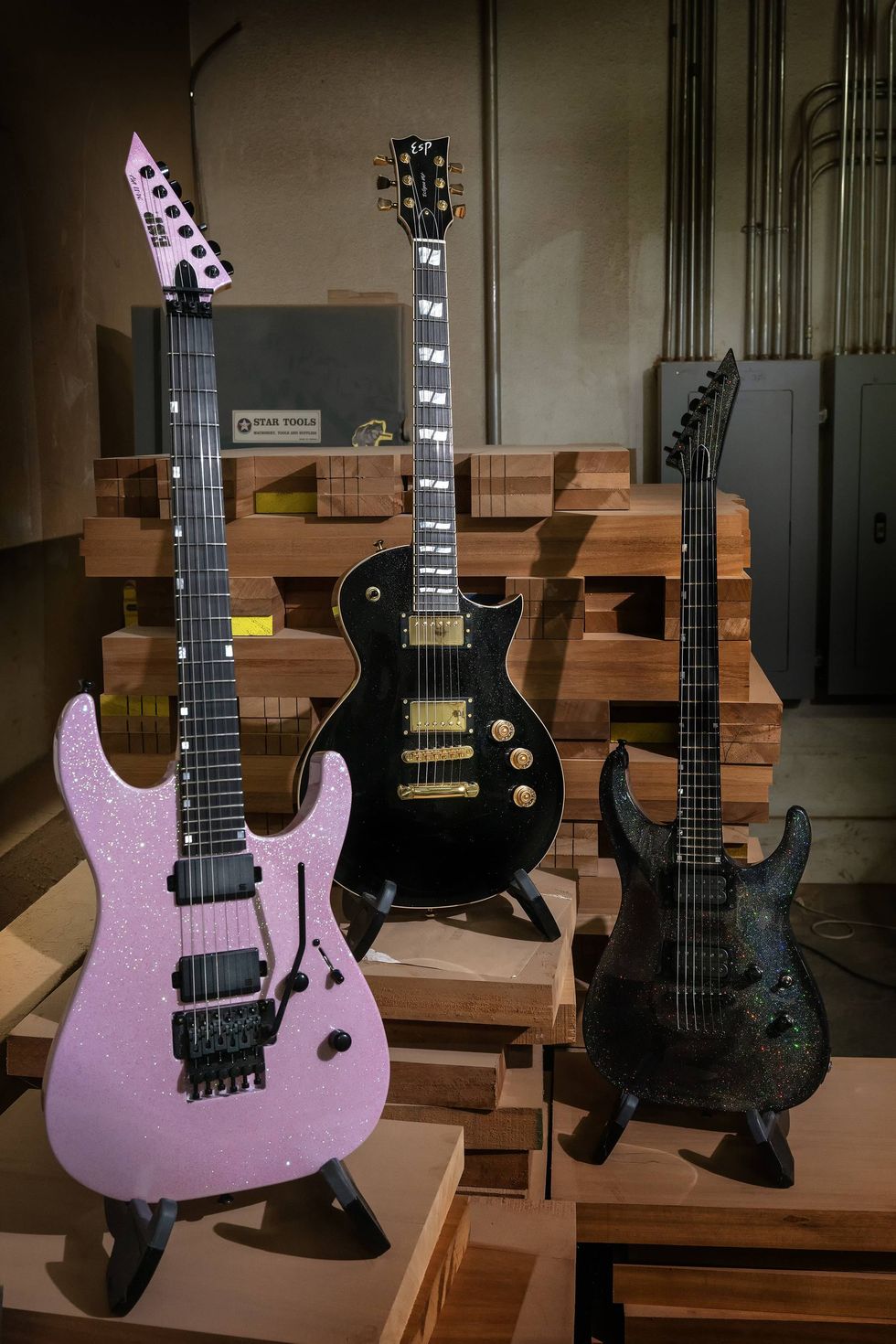
ESP’s unique designs are a perfect match for Dominguez’s creative and musical inclinations. Since he was young, the self-taught artist has always had a sketchbook and pencils in hand. “I used to love opening up a skateboard magazine or a surfing magazine or a music magazine, and drawing something from the pages—especially if it was a Reef girl,” he says. Dominguez also played guitar as a kid, starting on a 3/4-scale acoustic his mom got him when he was around nine. She also signed him up for guitar lessons, but he admits that he “didn't really take it too seriously.” In fact, in one of his lessons, Dominguez had stopped paying attention to the teacher and instead used his pick to carve an anarchy sign into the back of his acoustic guitar. “I’m pretty sure that was the last lesson my mom took me to,” he chuckles.
By around 8th grade, he wanted to pick up the guitar again. He asked for an electric for Christmas and, this time around, started taking it seriously, even forming a pop-punk band with some friends. “I think every kid that has a guitar kind of dreams of being some sort of a rock star, or at least for being able to play or write a song or something,” he says. “I entertained the idea. I was probably a little bit of an emo kid in high school and thought I could write songs and play the acoustic, that sort of thing. But it was never really something that I tried to actively pursue.”
“Sometimes I feel like a kid who snuck into a candy store that someone forgot to lock up for the night.”
Instead, Dominguez entered the world of guitar building. When he first joined ESP in 2004, he started off doing set-ups before eventually moving on to the repair department. After about a year and a half, he left the job and moved to Arizona to attend the Roberto-Venn School of Luthiery, aiming to explore the acoustic side of guitar building. Roberto-Venn also had a month-long course on guitar repairs, and Dominguez was interested in learning how to do heavier repairs, like neck resets. “My original intention was to be a builder. I had gone to Roberto-Venn to kind of expand on that,” he says. “And when I graduated, I had a little bit of money left over from the student loans, so I bought a bunch of tools to go out and build some guitars in my garage and go down that path.”
During that time, Dominguez also took on work painting cabinets for a company in Arizona. This proved to be beneficial, as he developed a considerable amount of his painting technique over the approximately two years he was employed there. Unfortunately, once the recession hit, everyone got laid off.
Dominguez called his old boss Todd Binder—now president of ESP—to see if he could get his job back. “That was on a Friday in August, 2008—I packed up my little car that weekend and started on Monday,” he says. “When they decided to open the USA Shop in 2013, they knew I had experience painting and asked if I wanted to try it out [there]. I said ‘no,’ but then Todd called me out and said, ‘Well, you know, sometimes we just gotta step up and do what’s asked.’
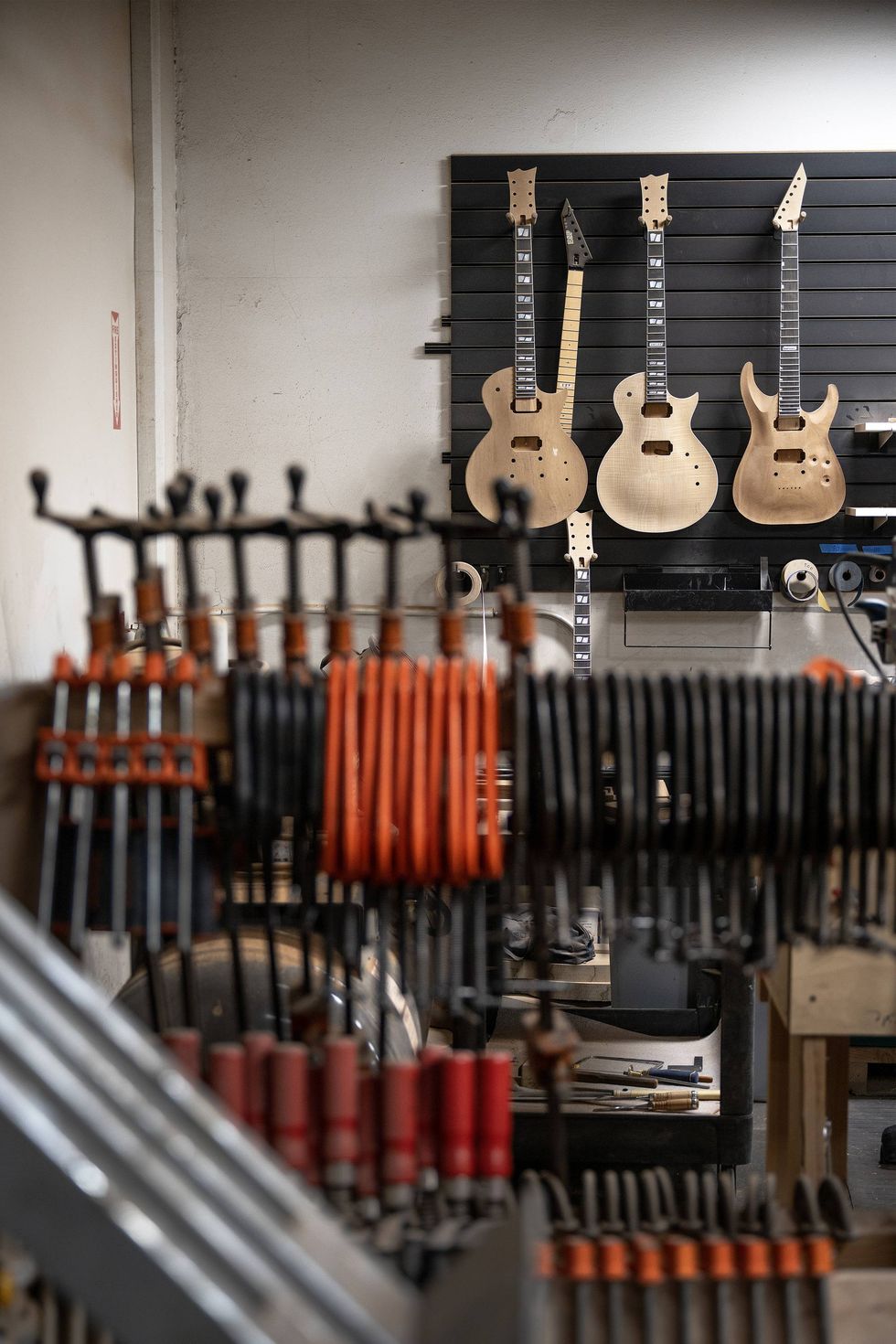
“When I first moved over to the USA Shop, I was doing a little bit of everything,” he continues. “Everyone was—woodworking, assembling, building, painting. My role within USA has changed quite a bit over the years. I’ve shifted mostly from doing paint stuff to managing the shop, working with the woodworkers on processes. ‘How can we make this faster?’ ‘What kind of pain points are you guys seeing out there?’ A lot of it entails what we’re going to be offering on the year as far as products and finishes: working with suppliers to find unique woods to be able to use for limited-edition builds; coming up with all the limited-edition models that we’re going to be offering; and a lot of managerial, sitting-behind-the-computer stuff, too, like creating SKUs and entering things into the system—part numbers, all that stuff.”
Typically, Dominguez goes through about three to four guitars a day—the sweet spot where he can still keep a close eye on quality control. “We don’t build as fast as some shops do, but we know what people expect when they see ‘ESP’ on a headstock,” he says. “We always want ESP USA to live up to that legacy.”
ESP USA and ESP’s Japanese Custom Shop, Original Series, and Signature Series are the elite tier of the company’s brands. (There's also an LTD version of the Signature Series.) Each serves a different purpose but shares the common goal: delivering the absolute best ESP products. “There’s definitely been a collaboration going on between USA and Japan. If I have a question like, ‘Hey, how’d you do this finish?,’ or ‘What’s your process for doing the side of the headstock?,’ they’re more than willing to work with us on any questions that we have. They’ll show us different processes and procedures, different ways of doing things,” he says. “They’ve come to me as well with, ‘How do you get this finish?,’ and, ‘What's your technique for this?’
“I just want to be clear that all of our custom guitars and artist Signature Series guitars from ESP are built at the ESP Custom Shop in Japan, not at the USA Shop,” he adds, hoping to clarify some common confusion. ESP USA isn’t like the ESP Custom Shop in the sense that you can customize every single detail of a build like body shapes or unique graphic designs. Rather, it’s a ”select shop” where you can personalize some aspects by choosing from a curated list of shapes, tops, finish types, and pickups. However, ESP’s Custom Shop won’t take every single request thrown at them. “Have they ever turned down a request?,” Dominguez says. “Yes, but probably not because they couldn’t do it. They have super high standards and won’t put the ESP logo on just anything. At the USA Shop, I can’t recall turning down a request. We try to be as accommodating as possible, and I do like a good challenge.”
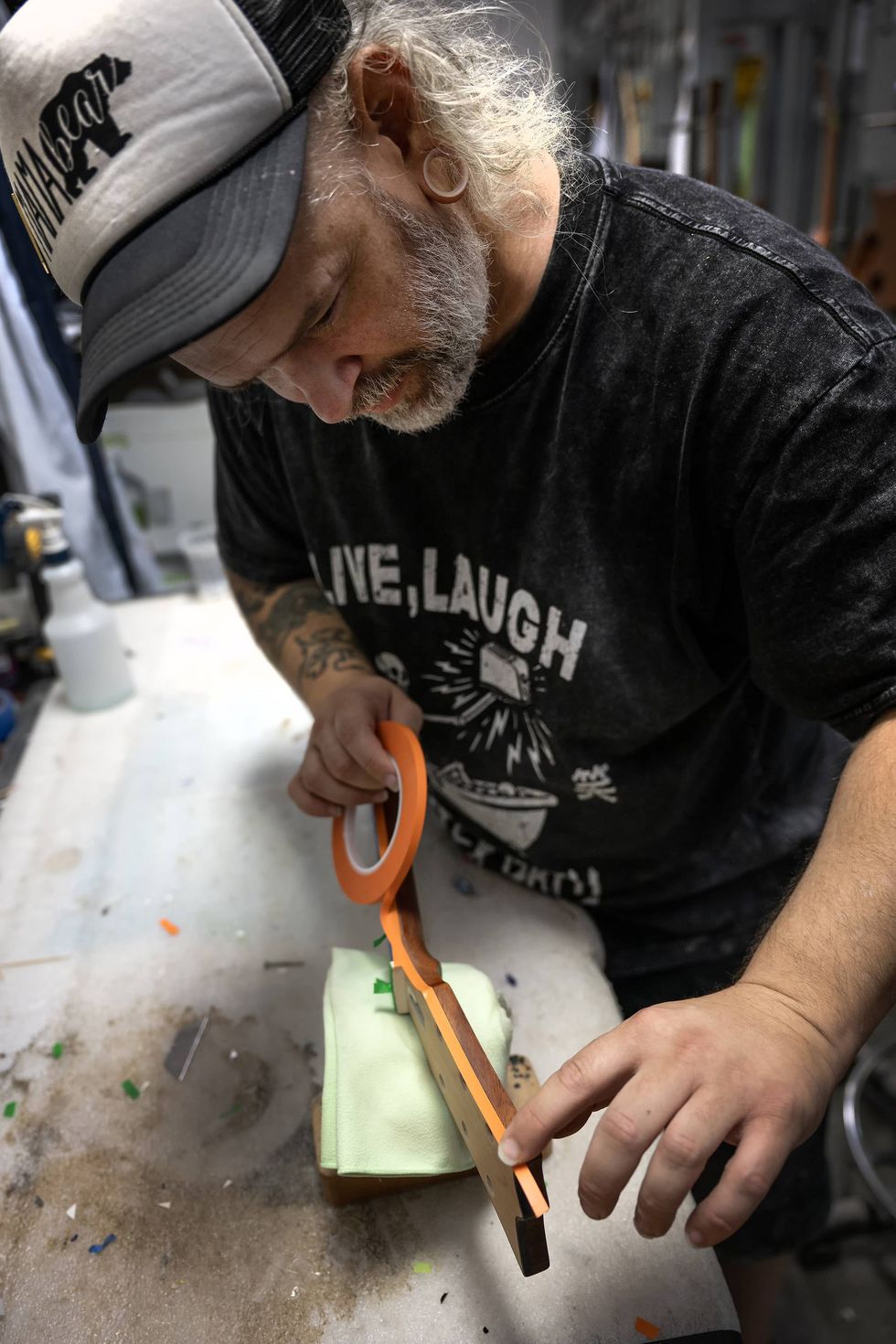
One perk of Dominguez’s job at ESP is the amount of free rein he’s afforded with his artistic explorations. “Sometimes I feel like a kid who snuck into a candy store that someone forgot to lock up for the night,” he admits. “I almost feel guilty about the amount of creative freedom I have. Almost. I’d like to think that I’ve been with ESP long enough to understand the company’s design philosophy, aesthetic standards, and, most importantly, what our players expect from the brand. I think that’s what has given me some confidence and relieved a lot of the guilt in the freedom I have to experiment. That, and failures. I’ve failed enough times behind the scenes to realize that another idea will come … sometimes when you least expect it. Sometimes it even wakes you up at 3 AM.”
Dominguez’s Instagram handle, @spongebrick, encapsulates everything about his work ethic and desire to build ESP guitars to the highest standards possible. “What Spongebrick, the person, represents, I’d like to think, is tenacity and dedication to a craft,” he explains. “It would have been really easy to throw in the towel for a dust-free environment and some air conditioning at a place where the stakes don't feel as high. Building guitars with ‘ESP’ on them—and the expectations people have as a result—can be constant high pressure.”
But, he continues, “there’s that little voice that’s constantly nagging me to be better—and to not blow that tiny mistake completely out of proportion until I can see it again the next day to realize it’s actually okay. That voice wouldn’t let me walk away. If I did, it would nag me about that, too.”
Skid Row's Scotti Hill and StewMac Create New Hooligan Boost Pedal Kit
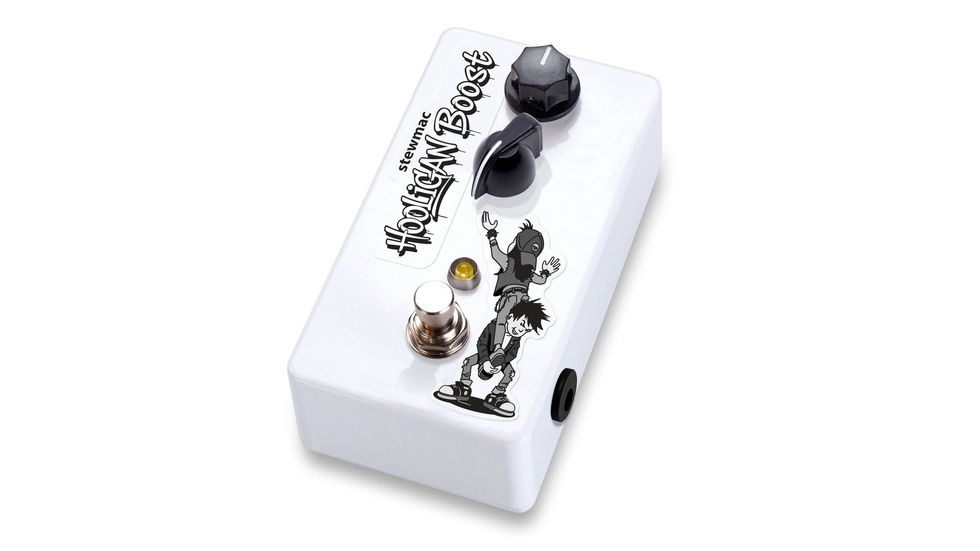
StewMac has teamed up with Scotti Hill, lead guitarist of rock band Skid Row, to introduce the Hooligan Boost Pedal Kit—a DIY guitar effects pedal designed with Hill's own approach to guitar tone in mind.
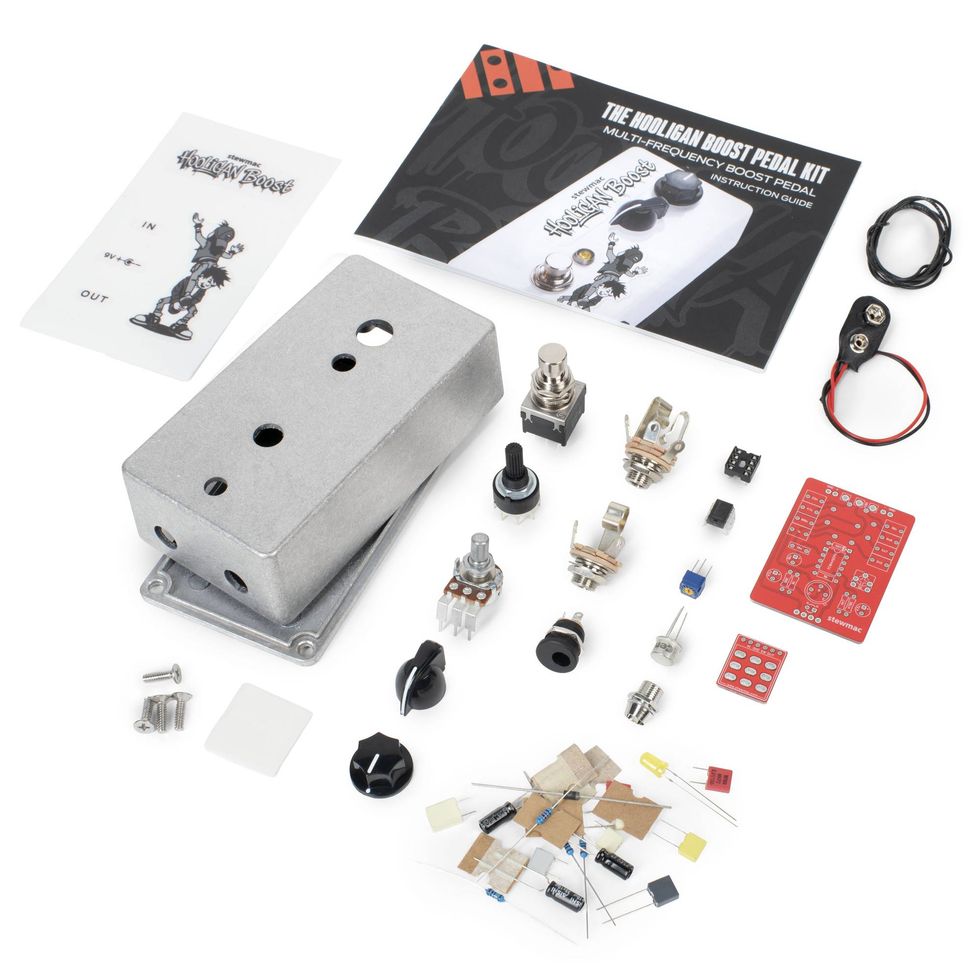
Inspired by the classic Dallas Rangemaster circuit, Hill and StewMac spent over a year creating the Hooligan, dialing in just the right components and selecting an enclosure that would be easy to use and not take up too much room on your pedal board. An eight-position Range selector allows players to move through different frequency ranges, while the Volume control can take the sound anywhere from clean boost to full-on overdrive. Hill's preferred starting point is positioned at 11 o’clock on the range switch, which provides a balanced foundation for exploring the pedal's range.
The Hooligan Boost is versatile enough to be used as a volume boost for solos, or an always-on pedal to define your core guitar tone.
See the demo video here:
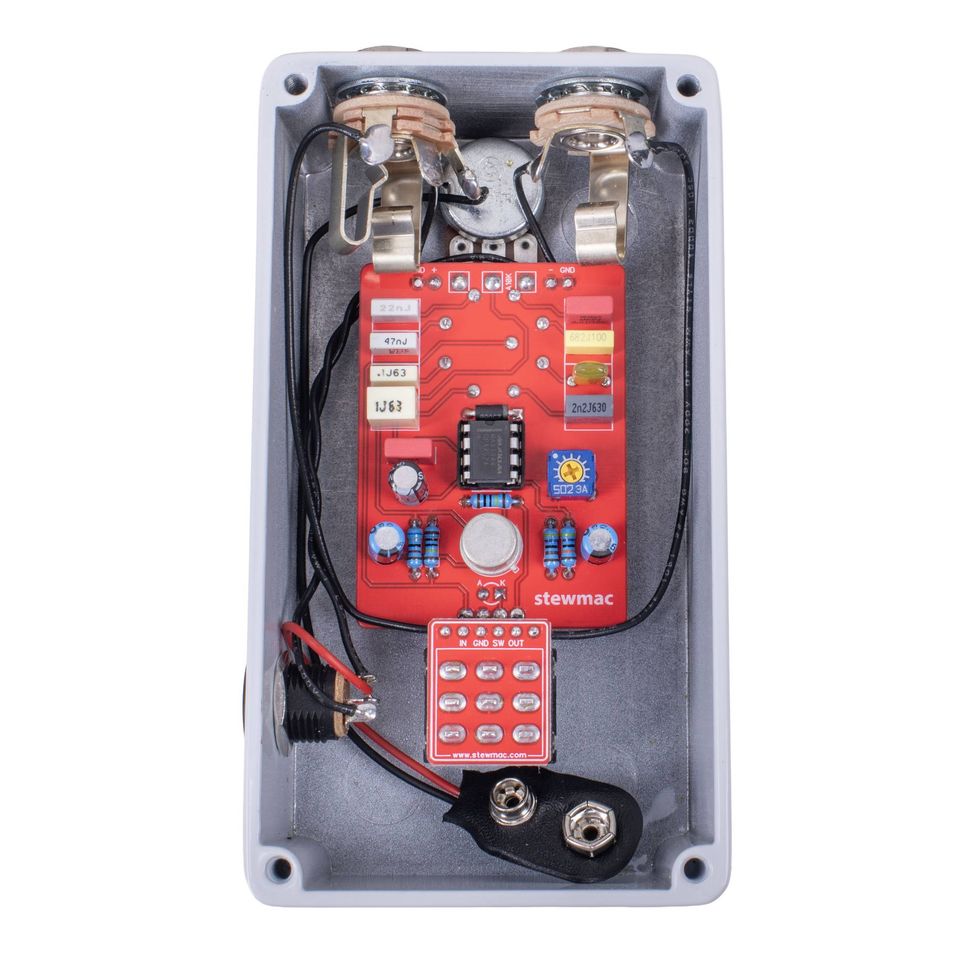
Key features include:
- Classic boost circuit inspired by the legendary Dallas Rangemaster.
- Eight-position Range control lets you tailor the boost's cutoff frequency to your amp. Go from bright, cutting boost to full-frequency boost with plenty of low end.
- Volume knob controls overall output level, ranging from clean treble boost to full frequency overdrive.
- Powered by a 9-volt power supply with a 2.1mm negative-center barrel, available separately.
- Step-by-step instructions written for the first time builder.
- Top quality, high tolerance components from resistors to switches. Road-worthy, rugged metal enclosure with all holes pre-drilled.
- Available in either bare or powder coated white finish.
- 9-volt operation – can use battery or external DC power supply
- Input and output jacks are rear mounted for easy cable routing
- Custom printed labels
- True bypass switching
The collaboration brings together two sides of Hill's career: his decades of experience chasing the right guitar tone on stage and his love for building his own pedals. The result is a versatile boost pedal that puts a reimagined classic circuit into the hands of guitarists and DIY builders.
"I've been searching for the ‘perfect’ tone since I first picked up a guitar," says Hill. "It’s elusive. Lots of ideas would come and go, but I kept coming back to boosts again and again. So, when StewMac and I started bouncing around ideas for a pedal kit, I knew we should start with a REALLY good boost pedal."
The pedal's personality extends beyond its circuit. The Hooligan's artwork draws inspiration from Hill and his friends as young troublemakers—a nod to the rebellious spirit and rock 'n' roll attitude that have followed him throughout his career. "Back when we were young, we definitely got into our share of mischief," says Hill. "So, Hooligan seemed like the right fit."
The collaboration also has a personal connection for Hill. Before working with StewMac on the Hooligan, he had already built one of the company's pedal kits himself. "I wanted to be sure we came up with something that was not only practical, but not too complicated to build," Hill says. "I thought it would be a great way to get people started in pedal building. In fact, a StewMac kit was what got me started in pedal building!"
The Hooligan Boost Pedal Kit is designed to give builders the experience of assembling their own effects pedal while ending up with a practical piece of gear that belongs on a working guitarist's pedalboard. The Hooligan combines the hands-on satisfaction of a DIY project with the versatility of a pedal designed by a professional touring and recording guitarist. Whether it's being used to push an amp into breakup, add bite and presence, or simply become an always-on part of a player's rig, the Hooligan is built around one of Hill's most enduring lessons: good tone starts with finding what works for you.
The Hooligan Boost Pedal Kit includes everything needed to build the pedal electronics and enclosure, along with Scotti Hill-inspired artwork and a detailed StewMac instruction guide.
The Hooligan Boost Pedal Kit is available from StewMac for a street price of $109.99. For more information, visit StewMac.com.
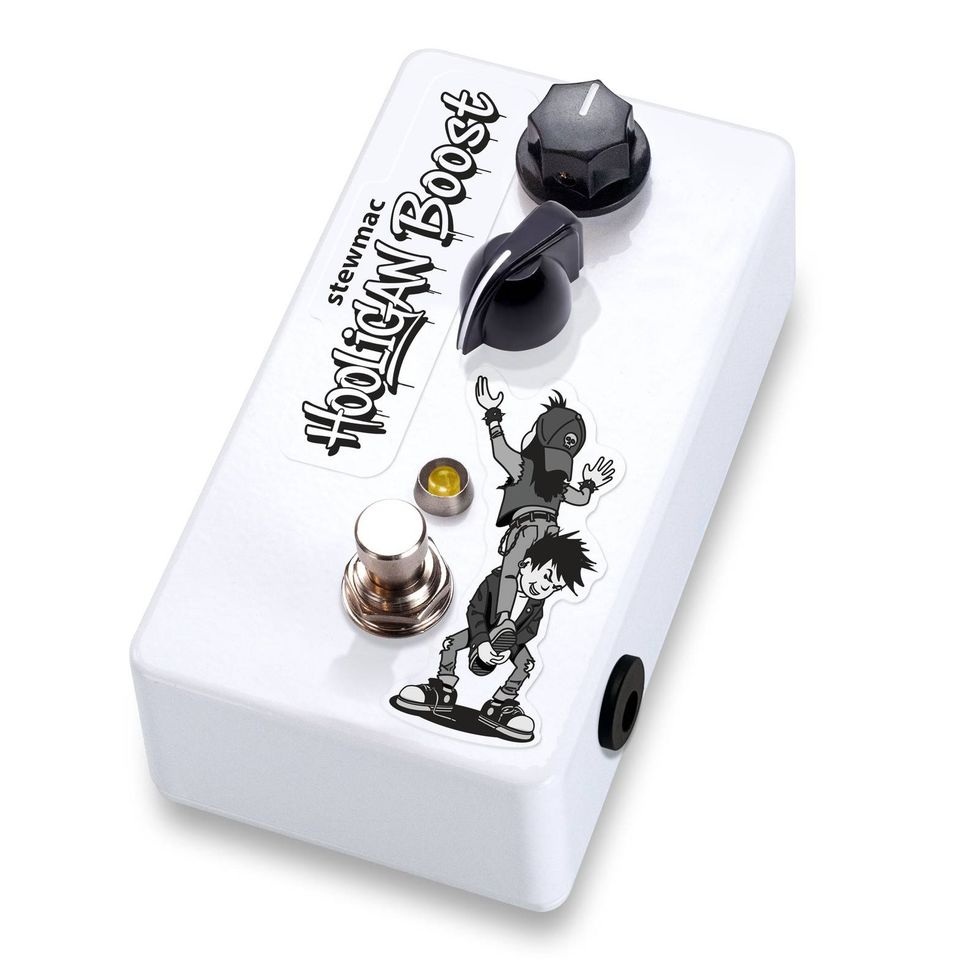
Hooligan Boost Pedal Kit
StewMac has teamed up with Scotti Hill, lead guitarist of rock band Skid Row, to introduce the Hooligan Boost Pedal Kit—a DIY guitar effects pedal designed with Hill's own approach to guitar tone in mind.
Stompboxtober 2026 Day#1: Line 6

Stompboxtober Is back for 2026! Come back every day during October for your chance to WIN your new favorite effects pedal or accessory. Today's featured pedal is form Line 6. Enter to win the DL4 MkII!
Stompboxtober 2026 - Win Pedals All Month Long!
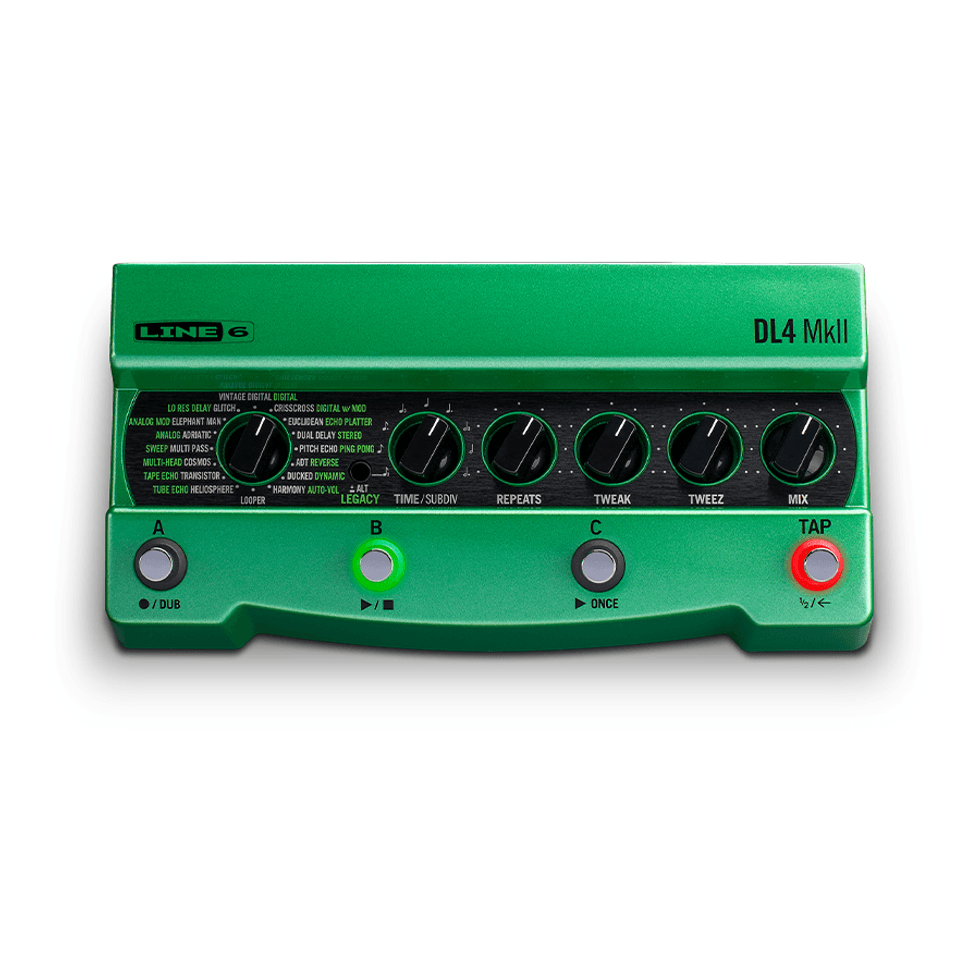
DL4 MkII
The DL4TM Delay Modeler has remained one of the most widely used delay pedals in the world for more than two decades. The DL4 MkII includes all the sounds and features of the original, while introducing new sounds and features. The 15 new MkII delays were drawn from our HX® family of amp and effects processors and the 4-Switch and 1-Switch looper types offer up to 240 seconds of record time (expandable to several hours using an optional microSD card). There's an XLR microphone input, MIDI In and Out/Thru connectors, heavy duty footswitches, three bypass options, and a jack for connecting an optional expression pedal or two footswitches. The DL4 MkII is also smaller and lighter than the original, making it an even more appealing choice for modern musicians.
Dean parent company must pay Gibson $4 million in legal fees after trademark loss
![Headstock of a Dean guitar [main image], and the headstock of a Gibson guitar [inset]](https://guitar.com/wp-content/uploads/2025/09/Dean-Gibson-new-hero@2000x1500.jpg)
Dean’s parent company Armadillo has been ordered to pay over $4 million of Gibson’s legal fees, after its loss in the dispute over infringing body shapes.
Earlier this year, the final result of the retrial between Gibson and Armadillo was declared. The second jury broadly agreed with the first, finding that Armadillo had infringed on a number of Gibson’s body shapes, and that Gibson was overall the prevailing party. However, it was not a total victory for Gibson, as its ES shape was ruled to be generic.
But, despite that one trademark decision, the rest of the ruling was still very much levelled at Dean and Armadillo. This march ruling declared that Armadillo must foot a $170,000 bill for at least some of Gibson’s legal fees, with the judge further stating that “all costs of court spent or incurred in this cause are adjudged against Armadillo”. This figure was unclear at the time, but following recent filings from Gibson, it has now been calculated as a total of $4,046,444.05: $235,417.92 in litigation costs, and $3,811,026.13 in attorney’s fees. Armadillo has until next Friday (9 October) to pay.
The $4 million payout comes just months after Armadillo declared bankruptcy, something the current company leader Pamela Keris-Rubinson blamed on extensive alleged fraud by her son, former CEO and president of Armadillo Evan Rubinson. In a bankruptcy filing made in June, Pamela Keris-Rubinson alleged that Evan’s appointment as company leader (following the death of CEO Elliott Rubinson) saw a previously successful Armadillo Enterprises start to decline severely. The rest of the bankruptcy filing revealed that Armadillo holds assets within the range of $1 million and $10 million – but owes $50 million in liabilities.
This fraught financial position wasn’t helped by the initial result from its spar with Gibson – even before the retrial, Dean was ordered to stop selling some of its most popular designs back in 2022. The disruption to the business was somewhat felt by customers – sharper, non-infringing Vengeance models were announced in 2021, but would not make it into stores for another two years. Dean has also recently entered into a legal conflict with the estate of Dimebag Darrell, who have also launched a new guitar brand in collaboration with Dean’s namesake, Dean Zelinsky.
Overall the recent filing is, of course, not good news for an already embattled Dean and Armadillo. Given the disparity between the company’s assets and its liabilities, an order to pay another $4 million in legal fees makes its future even more uncertain.
The post Dean parent company must pay Gibson $4 million in legal fees after trademark loss appeared first on Guitar.com | All Things Guitar.
“I thought it went better with the guitar!”: Johnny Marr reveals he chose his famous hairstyle to compliment this specific guitar

Johnny Marr is known for his distinctive look as much as his guitar playing in The Smiths and as a solo artist, but it was no accident.
As he explains in a new interview with LIFEJACKET on YouTube, the Mancunian legend recalls how his distinctive mod-crop hairstyle was inspired by the “Beatle who never made it”, Stuart Sutcliffe, and how he chose his look to complement a specific guitar in his arsenal.
That guitar was, of course, his famous Jetglo-finished 1982 Rickenbacker 330, bought at a Manchester guitar shop in ‘83 and used extensively across the Smiths’ self-titled debut album and on tour.
“One of my heroes at the time was Stuart Sutcliffe,” he recalls. “I thought, ‘I really wanna look like Stu Sutcliffe.’ V-neck jumper, white polo neck, Ray-Bans. The shop I worked in, we were the first ones to sell the Wayfarers when they came back. So, I was like, ‘I’m having those.’
He continues: “The Smiths had the quiffs, the ‘ 50s thing. But because I was into Stu Sutcliffe, he combed his hair down and did the Beatle cut. So that’s where that came from. He looked even better when he combed his hair down.”
Marr remembers the first time he showed up to a Smiths photo shoot rocking his new look. “The rest of the band were like, ‘What have you done?’ I just rocked up and I had the bowl cut then. I thought it went better with the guitar.
“I knew I was gonna get a Rickenbacker, so the bowl thing and the Rickenbacker. All of these obsessive little details came into play.”
Everyone’s influenced by someone, of course, and the Smiths quickly noticed following their rapid success that their fans were beginning to adopt their look themselves.
“The fans all dressed like different members of the band, which is kinda cool,” Marr continues. “So when you rocked up at Bangor University or Loughborough or somewhere like that, there’d be a bunch of kids outside, and you’d be like, ‘Okay, there’s Andy, there’s Johnny.’
“We’d look out the window of the bus and there’d be these kids dressed like us. And because we were kids ourselves, it’s kind of a bit of a buzz up there. Because you’re building a culture. You’re missing a trick if you think a band is just about the music. If you look at Fontaines D.C. now, they’ve got such a strong look. You’re always drawing from someone, it’s never entirely original.”
Marr’s ‘82 Jetglo Rickenbacker 330 found a new home last month, selling for a respectable £358,400 during a Christie’s auction which saw the Smiths guitarist sell off a bunch of guitars and other items from his personal collection.
The auction – which took place on 17 September and brought in £3,649,280 in total – also saw the sale of Marr’s Cherry Red 1960 Gibson ES-355, which sold for over £200,000, and the 1971 Martin D-28 acoustic used on Rusholme Ruffians, What She Said and Meat is Murder, which brought in £128,000.
The post “I thought it went better with the guitar!”: Johnny Marr reveals he chose his famous hairstyle to compliment this specific guitar appeared first on Guitar.com | All Things Guitar.
Five reasons why you need to try the new Spark Pedal

Ad feature with Positive Grid
Positive Grid’s Spark smart amp has been one of the most revolutionary new guitar products of the last decade. With its great sound and ease of use, it has completely changed what people expect from home practice amps, while the range has expanded to ensure that no matter what musical situation you might find yourself in, the Spark can help you sound great with minimal fuss.
The latest addition to the range is the Spark Pedal, and it might be the most versatile and useful Spark product yet. With its compact pedal-based form factor, it has the potential to be a wonderfully useful bridge between home, stage and studio. These are our top five reasons why you need to give the Spark Pedal a try next time you’re in a guitar store.

Its sounds and usability are as good as ever
The reason that so many guitar players have been charmed by the Spark ecosystem is how remarkably easy it is to build your own sounds, with rugged and clear multifunction knobs that make it easy to dial in sounds in a heartbeat.
But that’s only part of it – the benchmark-setting companion smartphone app that controls all of the complicated stuff, you can easily build your signal chain in moments, hearing them in real time on the device. And what good sounds they are too – with 33 high-quality amp models and 43 effects using the same HD Tone engine as the Spark 2, you can run the gamut of all the classic amps and effects you’d ever need – and they all sound remarkably faithful and organic, whether running through a PA or headphones.
It’s truly a Spark for any situation
While the original Spark was designed for relatively quiet home practice and recording, the various other models in the range have expanded the offering to cover any scenario – from full-on live performances and busking to bedroom headphone jamming. The Spark Pedal however, manages to be everything in one.
Of course, if you want to play at home, you can either plug into the headphone jack and enjoy impressive sounds in cans, or you can run it into your PC speakers or a powered cab. If you’re recording? Well the built-in USB-C recording interface makes going direct a doddle, but there’s more. For gigging guitarists, the Spark Pedal might be the most versatile box yet – you can choose to run it direct into a powered cab or PA live, or you could bypass the amp models and use the onboard effects going into a traditional amp. Indeed, the Spark Pedal plays nicely at the end of your existing pedalboard, with stereo outs, an expression pedal jack, and even MIDI control to ensure that you can program any element of your performance to go off without a hitch.
And with a built-in 60-second looper, the Spark Pedal is the perfect companion for solo guitarists looking to build their song from the ground up. And with simple and easy to understand controls for the looper built right into the Pedal’s three footswitches, you won’t have any trouble when it comes to overdubs and syncing your playing up just right.

You don’t have to worry about powering it
If you’re trying to run light at a gig, or you’re performing at a location where plentiful supplies of power sockets are not forthcoming (and we’ve all been there) the Spark Pedal takes the stress out of your set-up. With its built-in rechargeable battery that offers up to 7 hours of playing time, you don’t need to fumble around looking for a power outlet – simply turn it on, plug it in, and you’re ready to rock.
You can find your tone in a heartbeat
One of the most exciting features about the whole Spark ecosystem is how easy and fun it is to find the tone you’re looking for. Thanks to the busy folks on Positive Grid’s ToneCloud platform, there are now over 100,000 different user-created presets that you can search through, often ones aimed at nailing the tone of a specific song or artist. If you’re playing covers, this is an absolute godsend, and means that you can be as flexible in your set as your songbook allows. In addition to the onboard presets, if you don’t want to use something someone else has made, Spark AI’s Text to Tone feature lets the computer do the hard work, building a totally new tone from your prompt.

It’s built for the road
The build quality and smart physical design of the Spark amps has always been a huge strength, and the Spark Pedal takes this and makes it even more useful. With its compact form factor, you can easily fit it in the pocket of a gigbag, but with a metal chassis and rugged metal footswitches, you don’t have to worry about it getting damaged. What’s more, a rubbery neoprene shell and rubber feet mean that you don’t have to worry about it moving around on stage too much either.
Another reassuring thing about the Spark Pedal’s design is its stripped down control layout. There’s no LCD screen to worry about treading on here – with the deep editing done via the app, what’s on the pedal is designed for those moments where you need to make quick changes on the fly, and you can do those without worrying about how it’s going to mess up your sound if you get it wrong.
With versatility, connectivity, portability and durability the Spark Pedal would be great anyway, but add all that to the great tones and ease of use that we’re already used to from Positive Grid, and you have a gigging guitarist’s new best friend.
Find out more about the Spark Pedal at Positive Grid.
The post Five reasons why you need to try the new Spark Pedal appeared first on Guitar.com | All Things Guitar.
Pages
