
Music is the universal language
“Glory to God in the highest heaven, and on earth peace to those on whom his favor rests.” - Luke 2:14
Norse Guitar Feeds
“I’ve got CDs and cassettes full of them – I just can’t get away from it”: Tony Iommi has a massive stockpile of unheard riffs

At 78 years old, Black Sabbath legend and heavy metal pioneer Tony Iommi is showing no signs of slowing down. A year on from the death of his Sabbath bandmate and longtime friend Ozzy Osbourne, the guitarist is gearing up to release his first solo album in 21 years, From the Dark, next month.
He’s the man behind some of the most influential and enduring riffs in the history of heavy metal – think Paranoid, Iron Man and War Pigs – so it stands to reason that Tony Iommi is sitting on a treasure trove of never-before-heard guitar parts just waiting for the right song or context.
As he explains in a new interview with Classic Rock, he is indeed sitting on a pile of currently unused riffs and guitar ideas, and explains how creating music is just part of his DNA.
“I’ve got CDs and cassettes full of them, thinking that if I ever get stuck I can go back and get one. But I rarely do,” he explains. “Though saying that, I’ll probably never come up with another riff.”
Iommi continues: “The thing is, I don’t have to do this. It’s not about the money, because we don’t need the money. But this [gestures towards the studio], this is what I do. I just can’t get away from it. I have things I want to say.”
Quite how many riff ideas he’s sitting on is anyone’s guess, but we’re sure to hear a bunch of them when his new album From the Dark drops on 23 October. In fact, we’re even set to be treated to a little Iommi acoustic playing…
In July, the guitarist detailed his decision to incorporate some acoustic guitar playing on the new album, and how it ultimately boiled down to wanting to push himself outside of his comfort zone.
“I like to do something you don’t really expect. And to be honest, I hate playing acoustic. I’m not very good at playing acoustic,” he confessed, before speaking directly on the track which features acoustic guitar, Legacy: “On that bit, I just thought it would be nice and different.”
The album will also feature a guest appearance from Brian May, although Iommi wanted the Queen legend to feature even more.
“I said to him, ‘Play on some other tracks,’ but he went, ‘Oh no, it’s your album,’” Iommi recalled recently. “That’s the relationship we’ve had with each other for all these years. We’ve played a lot together. He is a great friend.”
From the Dark arrives 23 October via BMG. Listen to its lead single World Alone below:
The post “I’ve got CDs and cassettes full of them – I just can’t get away from it”: Tony Iommi has a massive stockpile of unheard riffs appeared first on Guitar.com | All Things Guitar.
Noel Gallagher reveals the “best bit of advice I’ve ever been given” from Johnny Marr about buying guitars
![[L-R] Noel Gallagher and Johnny Marr](https://guitar.com/wp-content/uploads/2023/10/Noel-Gallagher-Johnny-Marr@2000x1500.jpg)
According to Noel Gallagher, Johnny Marr is somewhat of a Guitar Guru. Simply touching a guitar owned by the ex-Smiths guitarist is enough to inspire Gallagher – which is pretty helpful, considering Marr has gifted Gallagher a few guitars over the years (including a Gibson Les Paul that was also owned by The Who’s Pete Townshend). However, after over 30 years of soaking up Marr’s guidance, the Oasis axeman is finally sharing the ultimate advice Marr has ever given him.
Ahead of Marr auctioning off some of vast collection of gear, the guitarist is hosting a public exhibition in collaboration with Christie’s London. To celebrate the opening of Marr’s Guitars: The Johnny Marr Collection, Marr and Gallagher had a walk around reflecting on their history. In Gallagher’s eyes, the second time they hung out was when he realised Marr was somewhat of a genius.
- READ MORE: Unexpected gear used by Frank Zappa
The revelation came after the pair had perused the selection in a Doncaster guitar shop. On the day, Marr had experimented with a guitar with nine pickups, before handing it back to an employee and telling Gallagher “let’s go”. The two friends then went to a sandwich shop, and that’s when Marr shared some life-changing guitar advice. “This is the best bit of advice I’ve ever been given,” Gallagher says. “He buys a sandwich, and he says, ‘I’ve got to go and eat before I think about buying this guitar.’”
Marr’s logic? “You should never buy a guitar with an empty stomach,” Gallagher recalls.
Alongside his belief that a full stomach is the key to guitar clarity, Marr also believes that the Les Paul is the “ultimate guitar”. Back in the 90s, Gallagher wasn’t so sold on a Les Paul – but Marr’s firm stance was enough to sway him to give a Les Paul another shot. “After about a week, I was like, I fucking love these guitars,” he recalls.
“He texted me and said, ‘I’m even standing different, because [a Les Paul] changes your gait, your attitude, and everything,’” Marr adds.
Marr is so committed to the Les Paul that he has famously gifted at least two Les Pauls to Gallagher over the years, including a 1960 Gibson Les Paul and a black 1978 Gibson Les Paul Custom. One of his Les Paul gifts even made its way onto the cover of Oasis’ 1994 debut single, Supersonic. In fact, a number of Marr’s gifted guitars feature on the cover, including a Rickenbacker 330 Jetglo.
“I remember that you’ve always been a bit gung-ho with your guitars,” Gallagher tells Marr. “I remember the day that when Oasis was recording Definitely Maybe for the first time, and you sent down some guitars… because [the band only had] one guitar each…”
At the time, it left the Oasis brother feeling starstruck. “I remember looking at it on the floor, thinking, ‘That cannot be the fucking the Smiths guitar…’” Gallagher laughs. “I was thinking ‘what if somebody stands on it… [because we were all] rat ass at four in the morning.’”
Christie’s London Marr’s Guitars: The Johnny Marr Collection is running until 17 September. Marr’s new album The Age Of Everything is also out 2 October.
The post Noel Gallagher reveals the “best bit of advice I’ve ever been given” from Johnny Marr about buying guitars appeared first on Guitar.com | All Things Guitar.
“We will vigorously defend what we believe is a meritless lawsuit”: Mastodon respond to legal action from Brent Hinds’ estate

Last week, news broke that the estate of late Mastodon guitarist Brent Hinds was suing his former bandmates, over the unauthorised use of his likeness on the cover of their latest album, as well as other alleged infractions.
The filing – made at the Fulton County Court in Atlanta, Georgia and reported by the Atlanta Journal-Constitution – claims Hinds’ likeness was used on the cover for Marrow Deep – released 28 August – without permission, and that the buyout of Hinds’ interests in the band was never finalised prior to his tragic death in August 2025.
The lawsuit alleges that the band “selected and placed a recognisable image of Brent on the album cover of Marrow Deep and disseminated that cover to advertise, market, distribute and sell physical albums, digital downloads and streams, merchandise and related goods or services.”
Now, Hinds’ former Mastodon bandmates – guitarist Bill Kelliher, bassist Troy Sanders and drummer Brann Dailor – have responded in a brief post on Instagram.
They write: “Sadly, a private business dispute with the estate of our dear departed friend Bren Hinds was made public. We strongly deny allegations of ill intent on our part and intend to vigorously defend what we believe is a meritless lawsuit.
“We don’t intend to speak publicly on this going forward, as we feel this wouldn’t honour Brent’s memory or the legacy of his musical gifts.”
It was announced that Brent Hinds had left Mastodon in March last year. He was a founding member of the band in 2000.
The split appeared to be mutual at the time, but in the months following, the guitarist made some thorny comments about his former bandmates, calling them a “shit band with horrible humans”.
Despite the seemingly fractured relationship in the months prior to his death, Hinds’ former bandmates have been remembering their time with him lately fondly.
“He was a man scorned. He said some hurtful things, but I know he didn’t mean it,” said drummer Brann Dailor in a recent interview.
“I was always hopeful that he was going to call me at some point and be like: ‘Dude, I’m done being a ding-dong. Can I come back? I have a riff…’ We were 100% sure he would’ve done that.”
Just a year on, the death of Brent Hinds still affects the members of Mastodon profoundly.
“It isn’t easy to talk about Brent, he was our family, someone we all loved wholeheartedly. He was a wild man, our wild man and that came with some challenges,” the band wrote in July.
“Both things are true and we aren’t interested in chasing one truth over the other. Losing him has meant sitting with a type of grief we never expected. No more hugs, no more high fives, no more disagreements, no more making up. That part has been hard, it’s real.”
The post “We will vigorously defend what we believe is a meritless lawsuit”: Mastodon respond to legal action from Brent Hinds’ estate appeared first on Guitar.com | All Things Guitar.
“It’s about having a space that’s big enough to tell 132 years of stories” Gibson’s Mark Agnesi on why Miami’s new Gibson Garage is its biggest yet

Mark Agnesi has got used to answering the same question about Gibson’s latest Garage location: why Miami? The first of Gibson’s popular and innovative “retail experience” locations was in the brand’s home town of Nashville, the second jumped across the pond to London, reimagining the existing Gibson artist space in the centre of one of Europe’s biggest cities.
Most people might have expected the next Garage then, to build on that theme – a New York, Paris, Tokyo… Instead, they opted for a prime spot in the most bohemian part of one of America’s most fun towns. So, why Miami?
“Why Miami? I don’t know if people realise that there’s this whole other part of the world that listens to music in Spanish, and Miami is the hub for all of that music, all of those bands, all of those artists,” Gibson’s Director of Brand Experience explains.
“It’s also a huge port of call for everyone coming in from South America. It’s one of those cities that a lot of people come to. And because of that we’ve had strong relations in Miami forever, so it made a lot of sense for us to put some roots down there as well.”
 Inside the Gibson Garage Miami, including the custom-finished guitars created for launch (Image: Gibson)
Go Big
The Miami Garage is also a different proposition to the previous two spaces that Gibson has inhabited – both in vibe and scale. The location, which is smack bang in the middle of Miami’s artsy Wynwood neighborhood, is double the size of the other Garages, and is a much more bespoke offering than the other two.
“It’s the first time that I wasn’t handed a space to design it,” Agnesi explains. “This time we purposefully went out and started looking at spaces, and I got to take the learnings from the first two and really build out what I think the experience should be for Garages moving forward.”
For example, the Miami Garage’s ironic previous life as a parking garage helped create a focal point for the space that Agnesi feels elevates things above what Gibson has been able to do previously.
 The exterior of Gibson Garage Miami is as striking as its interior (Image: Gibson)
“The performance space is really the star of the show in Miami,” Agnesi enthuses. “You know, I’m in the ground floor of a parking garage, so there’s no columns anywhere screwing up the interior. Like in Nashville, we have all these great things, but if you’re not in the right spot, you start getting blocked out by columns. Miami is this big space that we can put 400 people in, and everyone’s got unobstructed views of the stage.
“That was the first thing I fell in love with when I walked in there. And as a result the whole Garage really does revolve around the stage, the other areas just open up like a book around it – just like our open-book headstock, man. And the extra space, because we have several different brands, you can have a shop for each one.
“But then you can bring people together, and do these cool things that you really can’t typically do, like bring major artists through to play on stage in the middle of the afternoon, or have Marty Schwartz giving guitar lessons to people and letting kids jump up on stage with him. It’s about having a space that’s big enough to tell 132 years of stories.”
 A mural outside the Gibson Garage Miami by street artist Nate Dee (Image: Gibson)
Art Rock
Wynwood is famous around the world as an epicentre of art – the area is home to dozens of galleries and the legendary Wynwood Walls project made the area a wonderfully realised canvas for street art.
Given the location, it was a natural fit for the Miami Garage to expand on the celebration of visual art that began with the London location – the Gibson Gallery. This photographic celebration of Gibson’s impact on music history is a small part of the London Garage, but it’s a large and permanent exhibit in Miami.
 A Kramer mural inside the Gibson Garage Miami by street artist Solano (Image: Gibson)
“Just like to be able to walk in, even as a non-player who doesn’t quite understand the brand, and to look up at the walls and literally see the entire history of the last 100 years of recorded music on the wall,” Agnesi reflects. “It starts to click with people.”
The opportunity to bring some of Wynwood’s famous arts culture into the Miami Garage was also something that Agnesi couldn’t resist.
“You’re like ground zero for street art culture,” he reflects. “So we had an actual Wynwood street artist come in and do this massive mural for us in the Kramers section. So actually in the space, there is legit Miami street art. I believe each Garage has to feel like the city that they’re in, and in Miami it’s spectacular.”
 Each of Gibson’s brands gets their own bespoke area at the Miami Garage (Image: Gibson)
Factory Record
The Gibson Garage locations have been celebrated for the way they bring the brand and its various sub-brands into the real world, and allow those who have never been to the Gibson factory in Nashville to experience a little of what it’s like. For Agnesi, it’s an ongoing process, but one where the passion for Gibson and guitars drives the whole endeavour.
“Because we love this stuff, man,” he explains. “No matter what, the one thing we all have in common is that we all love this stuff. And anytime you can be in a room with a tonne of guitars, it’s the best feeling in the world.
“But it’s easy to put a tonne of stuff in the room. What we really want to try and do is curate it correctly and artfully so that when people walk in, I want you to feel like you walked into the chocolate factory. I’m still always trying to get there, to give you the Willy Wonka experience. But we’re getting closer with each Garage, and sooner or later we’ll get it.”
“I think it’s really important that all roads – whether it’s product or marketing, storytelling or ad campaigns, our history – all of this stuff converges inside that space. If you’re really into it and you’re a fan of it, there’s this place that you can walk in and really be in the middle of everything that’s happening with Gibson.”
 The performance space is the heart of the Miami Garage, and can hold up to 400 people (Image: Gibson)
Broad Church
Everything is an increasingly broad concept at Gibson. While the brand focused on getting the classic stuff right when it emerged from bankruptcy in 2019, the last few years has seen the family of brands branch out to target a much broader audience than it had for a long time – but for Agnesi that’s part of the Gibson DNA.
“We were talking about the Gibson Gallery. You know there’s a picture of Bill Monroe with his Gibson mandolin in there, practically inventing bluegrass. Then there’s “Mother” Maybelle Carter and the Carter family, they pretty much invented country. But then over here there’s BB King and Albert King, and over there there’s Slash and Jimmy Page, and over here is John Lee Hooker and Jimi Hendrix, and over here is Bob Dylan and Woody Guthrie. Gibson really has been across all stringed instruments, across all genres of music since the dawn of recorded music. It’s all there, we are that diverse.
“So yeah, we had to get the core right first, but then you can start going places. We just released baritones a couple weeks ago. Baritones are back – it’s so cool! We can reach this whole other segment that we weren’t reaching before. We’re doing more stuff with Floyd Roses for people that want that stuff. We’ve got new pickup ranges and higher output pickups and all these different things. And the stuff that Epiphone is doing. I don’t even know if I can talk about some of the crazy new Epiphone stuff that’s coming… but it’s mind blowing how far it’s come in the last five six years.”
 The Gibson Garage Miami is the first US Garage to feature a permanent Gibson Gallery display (Image: Gibson)
Hand in hand with the evolution has been the Garages, each one a multi-year project of increasing scope and ambition. And before he’s even finished with the Miami Garage, the brand announced that the next one would arrive sometime in 2027 on the Las Vegas Strip. Agnesi is clearly still focused on the Wynwood project, but the scope of the Vegas Garage is clearly something that has him very excited.
“I feel like Nashville and London are like churches to the brand, right?” Agnesi explains. “Miami is like a cathedral. Las Vegas is the Vatican. Las Vegas is on a totally different level. Las Vegas is a complex on the Vegas Strip, complete with architecture. The Gibson Garages have always just looked like whatever the building that we got the lease in looked like. This is the first time we really identify architecturally what the brand looks like.
“And now we’re going to be out on the Las Vegas Strip, with LED screens playing content out over Las Vegas, 24 hours a day. Las Vegas is a whole other thing. We’ll get into Las Vegas next year. I’m stoked about Miami right now. I’ve got too much to think about!”
 Bespoke Gibson merch and custom-finished guitars are exclusive to the Miami Garage (Image Gibson)
The post “It’s about having a space that’s big enough to tell 132 years of stories” Gibson’s Mark Agnesi on why Miami’s new Gibson Garage is its biggest yet appeared first on Guitar.com | All Things Guitar.
It’s Guitar Month at Sweetwater – and a bunch of Positive Grid gear has been discounted

[Editor’s note: These are Sweetwater deals, and are US-focused. If you’re outside the US, you’ll be shown similar deals.]
Right now, Sweetwater is celebrating Guitar Month – which means plenty of guitar discounts and offers galore. Amidst all the dazzling deals, Positive Grid, in particular, has slashed prices across a wide range of products. We’re talking amps, wireless guitar systems and headphones… and, because we’re oh-so nice, we’ve even made things a little easier for you and cherry-picked the best deals. You can thank us later.
If you’re after something a little more portable, the Spark Mini – AKA one of the greatest practice amps ever –has also had a price drop of $50. That means you can grab this weenie combo amp for just $199. That’s under $200 for over 30 different amp types, effects tones, and a surprisingly huge sound despite its small two by two inch scale and 10-watts of power.
There’s also savings on the Steve Vai edition of the Spark Mini – which is unsurprisingly named the Spark Mini Vai, of course. We considered this to be a perfect compact amp for shredders in particular, awarding it 9/10 in 2024. It’s got all the perks of the Spark Mini with the added bonus of Vai-approved sounds pre-loaded onto it, meaning its a tad pricier than the standard edition. Though, only $15 more, meaning it’s just $215 than its usual $269 pricepoint. Not too shabby.
If you’re after something a little bigger, the Spark Cab is also on sale. The 140-watt cabinet comes with a 10-inch woofer and two high-frequency dome tweeters, plus full audio spectrum (45-20,000 Hz) frequency response – and it’s currently $53 off, costing just $296.
For the clumsy axemen our there, Positive Grid’s Spark LINK might be your saving grace. Removing cables from the chaos, we gave this wireless guitar system an 8/10 in 2024, deeming it a “remarkably simple and effective solution”. And, if you’re keen to ditch the wires, you can get the Spark LINK for $119 instead of its usual $149 – a $30 saving.
Sweetwater has also thrown some very exciting bundle deals thrown into the mix, too. For example, you can get the Spark LINK wireless guitar system with the Spark NEO Core headphones. While it’s a somewhat ironic pairing, considering the Bluetooth NEO Core headphones pride themselves on also having a wired option to hear your tones directly plugged into your instrument, we can’t complain seeing the deal. Purchased separately both items would cost $218 – but, bundled, you’ll save $19 and only have to pay $199.
There’s also a great saving of $52.99 if you’re after a portable performance bundle. This comprehensive kit boasts a Spark LIVE 150-watt 4-channel Combo Amp and PA System, as well as a Spark Control X footswitch, the Spark LINK, and even rechargable batteries for the Spark LIVE- and it can all be yours for 849, rather than its individual total of 901.99.
To explore further Positive Grid deals and more, head to Sweetwater.
The post It’s Guitar Month at Sweetwater – and a bunch of Positive Grid gear has been discounted appeared first on Guitar.com | All Things Guitar.
Fender Vintera III Late ’50s Telecaster review: “this guitar has really surprised me”

$1,249/£1,069, fender.com
It’s been 75 years since Leo Fender came up with what many still believe is his crowning achievement – the Telecaster. In the seven decades and change since, the Tele has proved itself to be a remarkable chameleon of a guitar, finding a sonic home in every genre you can imagine.
Part of what makes it such a consistent success is the genius simplicity of its design. It’s effectively a plank of wood with some pickups on it, and that makes it endlessly adaptable in a way that more involved instruments cannot so easily manage.
The simplicity of a Tele also means that it’s quite easy to dismiss how tricky it can be to get one right. Yes, any idiot with a drill and a guitar kit can put together a functioning and usable T-type guitar, but a good one is its own sort of magic.
Which makes this new Vintera III Late 50s Telecaster such an interesting proposition – is it really $400 better than the impressive Player II Tele? Or more than twice as good as a Squier Classic Vibe? Or is it trying to be something a little different and more specific than both?
 Image: Adam Gasson
What is it?
There’s a very strong argument to be made that there was not a whole hell of a lot wrong with the Vintera II guitars that were launched just a few short years ago, and while other guitars in this range may have been redressing historic blindspots with Fender’s vintage-focussed Mexico-made line, you can never accuse the Big F of neglecting or shirking its Strats and Teles.
That being said, the 50s-style Telecaster that was offered in the Vintera II was very much focused on the earliest models – to the extent that it was actually called a Nocaster, in reference to the transition period between the first Broadcaster guitars and their rebrand as Telecasters where the guitar briefly had no model name on the headstock.
That meant blackguards and sunbursts, so it’s interesting that the Vintera III range here takes inspiration more from the guitars that came out towards the end of the decade, as the transition to the more interesting (and colourful) 60s began. In basic terms, that means that in addition to the unavoidable Butterscotch, we also get the much more exciting options of Sherwood Green Metallic and this rather fetching Dakota Red. All three finish options come with a one-piece maple neck and a single-ply white pickguard.
Elsewhere, it’s very much a classic Tele – the Butterscotch option comes with the welcome return of ash to the range, while the other two are both alder. You get a vintage-style ashtray bridge complete with three uncompensated steel barrel saddles, a pair of the new Vintage-Style Late ’50s Pickups and the usual two knobs and a three-way control layout.
It shouldn’t be worth noting that for your $1,249 you do actually get a gig bag here – unlike most of the other guitars in Fender’s Mexico-made ranges – but as usual it’s not one you’re going to be wanting to entrust your guitar’s safety to. Despite Fender calling it a “Deluxe Gig Bag”, it feels about as deluxe as the toilet paper in a dive bar – presumably the non-Deluxe version would just be a piece of string tied to a trash bag?
 Image: Adam Gasson
Build quality and playability
Whatever people might think about Fender as a business at the moment, there’s no avoiding the fact that when it comes to making guitars – especially at the more affordable end of the market – it really does know what it’s doing.
You can argue about whether a twelve hundred dollar Mexican Telecaster can even be classed as the “affordable end” of anyone’s market any more, but it doesn’t change the fact that this is a very impressive and well-sorted instrument straight out of the box.
The guitar hits bang in the weight sweet spot at exactly 7lbs, and close inspection reveals a very well put-together instrument. The Dakota Red finish is expertly applied to the body, the single-ply pickguard is expertly cut and attached, while the neck pocket is a snug and reassuring fit without any movement or worrying gaps. Granted, it’s pretty hard to get a Telecaster wrong, such is the simplicity of its construction, but it’s not easy to do it well either – and this ticks all the boxes.
Fender claims this Tele comes with a Late ’50s Soft V-shaped profile, and while you can feel a little bit of the V in the shoulder, you almost have to be looking for it – it’s not really noticeably that different from a generic C-shape. Maybe that’s a good thing in the grand scheme of things, but if you read the description and were expecting something that feels properly old-school, you may want to brace yourself for disappointment.
The neck itself is nicely finished with a tinted gloss poly – it’s not too sticky out of the gate, and adds a nice caramel tint to the maple, though there is a bit of overspray on the bone nut. Speaking of that, my initial inspection led me to wonder if those slots had been cut too narrowly – it’s a very tight fit. In practice, however, the strings move through the slots without any sticking points – though I’m not sure if that would still be the case if you upped the gauge from the supplied .009s.
The neck is straight and true, with no truss rod adjustment needed out of the box, and with intonation rock solid all the way up – that’s good news, because being a vintage-style guitar, we’d have to pop the neck off to adjust the damn thing. The split-post vintage-style tuners are smooth and responsive, and keep things in check without any fuss.
The action is about as low as you can get away with on a guitar like this, and it makes for a very slinky player. The 21 vintage tall frets are shiny and well dressed, and as has become the norm for Mexican Fender guitars, the fingerboard edges are nicely rolled to make for a very comfortable player.
There are people who will tell you that bending a string with a 7.25” radius is some sort of impossible labour of the kind that Hercules would have turned tail and run from. Despite this, and no doubt in part because of the well-done fretwork and low action, two- and three-fret bends can be executed without any hassle, and we don’t really get any hint of choking out until we’re troubling the very top of the fretboard – and there’s no money up there anyway.
 Image: Adam Gasson
Sounds
You know what you’re in for with a vintage-style Telecaster, but before we get into the weeds of how this guitar sounds, a note about those saddles. The vintage-style three-barrel steel arrangement here might be vintage-accurate, but there’s a very good reason why so many players opt for brass instead of steel because it does temper the inherent high-end nature of the sound somewhat. Here, however, it’s the full-unvarnished spanky Telecaster experience – for good or for ill.
The bridge pickup is lively, piercing and unapologetically treble-forward, while you get a woollier and jazzy tonality in the neck, with the in-between sound offering a gently massaged take on the bridge pickup’s ferocity.
In practice, that means that you get wonderfully percussive, snappy responsiveness on the bridge pickup when running into a clean Deluxe Reverb, for example, or a wonderfully bratty and unapologetic piercing Pixies snarl when you lay on some gain.
The flipside of that is that the bass response is perhaps a little lacking. It does a lovely job of giving you that slightly woolly Seeker-esque crunch when you run it into a cooking Marshall Plexi, but if you’re looking for a fat-bottomed full-on distortion… this is still a vintage-voiced Telecaster.
And while that might be good for a great many things, the Vintage-Style Late ’50s pickups are designed to sound like, well, late 50s Telecaster pickups. That means they run the gamut from pristine country cleans to throaty 60s rock… and while they have plenty of utility beyond that definition, of course, these are impressively true to vintage Teles I’ve played in both their response and their overall character – limitations and all.
 Image: Adam Gasson
Should I buy one?
I’ll end this with something of a confession: I’ve never really got on with traditional Teles. I think they look fantastic, I think they sound incredible in the hands of other people, and I absolutely think the Tele is probably the most important electric guitar ever made.
That being said, the only Teles I’ve ever really bonded with have been Deluxes, Customs or Cabronitas… for whatever reason, the classic configuration never really inspired me.
And yet spending a few weeks with this Vintera III has really surprised me – even outside of my play testing, I’ve found myself being drawn to pick it up more often than not, and have had an absolute blast while doing so.
Maybe that would have happened anyway, but I can’t help but think that the inherent quality of this instrument has managed to pull me in – it’s fantastic to play, accessibly lightweight, and has pickups that sound impressively and authentically like a vintage Tele. If it were mine, I’d probably chuck a set of compensated brass saddles on there to take the edge off some of the ice-pick sonic qualities, but that’s more personal preference than anything. This might not be the cheapest Tele around, but it’s one of the best.
Alternatives
If you want a Tele-style guitar that’s a little less on the vintage end of the spectrum, the Player II Modified Tele ($1,049/£939) brings Noiseless pickups and more modern player-focused appointments, while the regular Player II Telecaster (from $849/£769) is a really great guitar for the money with rolled board edges and some quality (if more generic-sounding) pickups. Some finish options also offer chambered bodies. If for, ahem, some reason, you wanted a T-type guitar that doesn’t say Fender anywhere on the headstock, there are some solid options in this price point. Chief amongst them is the Reverend Pete Anderson Eastsider T ($1,299/£999), though for something a little different, you should definitely check out the PRS SE NF 53 ($1,049).
The post Fender Vintera III Late ’50s Telecaster review: “this guitar has really surprised me” appeared first on Guitar.com | All Things Guitar.
Avantone Pro introduces GTR-100 Amp For Guitar Modelers
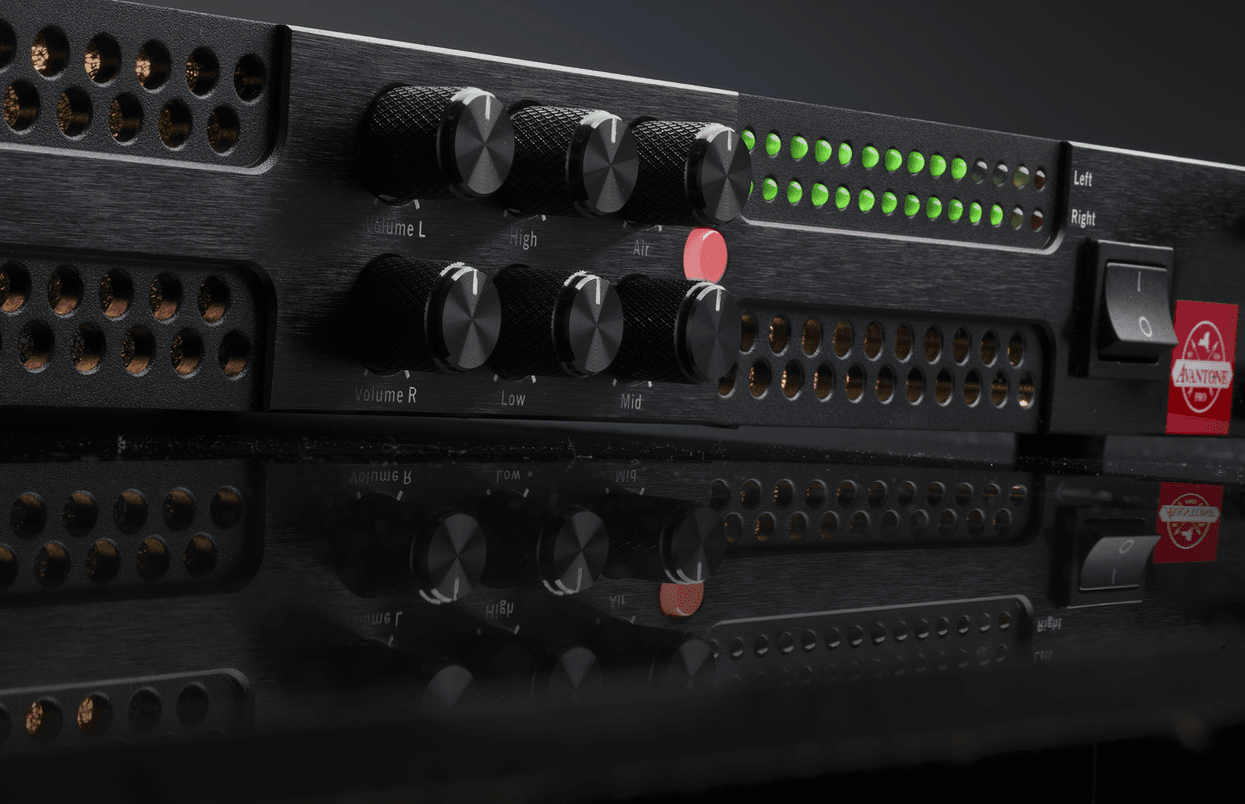
Avantone Pro has launched the GTR-100, a two-channel Class A/B power amplifier engineered specifically for guitarists using modern amp modelers and effects processors. Designed to faithfully translate carefully crafted tones from guitar modelers to the stage, the GTR-100 delivers high-headroom, transparent amplification without the coloration, weight, or maintenance demands of traditional tube rigs.
At the core of the GTR-100 is a solid-state Class A/B topology that delivers clean amplification that preserves the integrity of modeler-based tones while providing substantial output power — up to 140 watts per channel (4 Ω) or 245 watts in bridged mono mode (8 Ω). Switchable Line and Inst (instrument) inputs ensure optimal impedance matching whether connecting directly to a modeler, pedalboard, or standalone stompbox.
“The GTR-100 was designed for players who have fully embraced modern modeling platforms but still need reliable, high-performance stage amplification,” says Avantone Pro’s Seth Berman. “It delivers the power and clarity required for live performance while maintaining the exact tonal characteristics users have dialed in.”
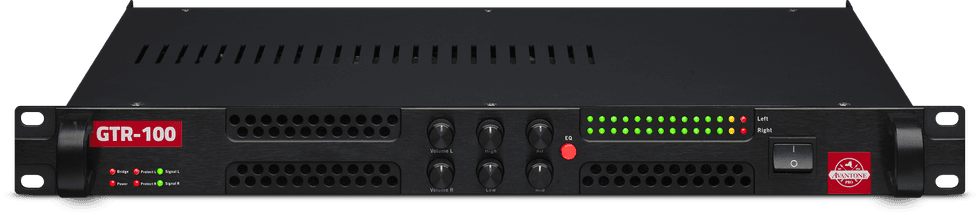
The GTR-100 is built to integrate seamlessly into contemporary guitar rigs. Its stereo inputs and outputs allow players to bring stereo effects like delays and modulation into live performance environments. A switchable 4-band EQ provides precise tonal shaping to adapt to varying venues, while independent channel Volume controls offer granular output balancing.
For direct connectivity, the GTR-100 includes XLR THRU outputs with optional analog Cab Sim (cabinet simulation), enabling users to send a polished, mix-ready signal directly to front-of-house systems or recording devices — eliminating the need for microphone placement on speaker cabinets. A comprehensive 14-stage input/output metering system provides clear visual feedback for gain staging and signal integrity.
Housed in a compact and lightweight 1U rackmount chassis, the GTR-100 is engineered for durability and portability. Reinforced metal handles extend beyond the front panel controls, helping protect knobs and switches during transport. Rear-mounted rack rails simplify cable management in touring rigs, while a low-noise cooling fan ensures reliable thermal performance without introducing unwanted noise.

Additional protection circuitry is indicated via front-panel LEDs, alerting users to conditions that could potentially impact the amplifier or connected speakers — providing peace of mind in demanding live environments.
Key features include:
• Two-channel Class A/B power amplifier optimized for guitar modelers
• 100W per channel @ 8 Ω / 140W per channel @ 4 Ω / 245W bridged mono @ 8 Ω
• Switchable Line/Inst inputs for flexible connectivity
• Stereo operation with independent channel Volume controls
• Switchable 4-band EQ for venue-specific tone shaping
• XLR THRU outputs with optional analog Cab Sim
• 14-stage input/output metering for precise level monitoring
• Lightweight, rugged 1U rackmount design
• Low-noise cooling fan and protection indicator system
The Avantone Pro GTR-100 carries a street price of $599.00. For more information visit: https://avantonepro.com/en/products/gtr-100
Supercool Pedals Spritz! Saturator Review
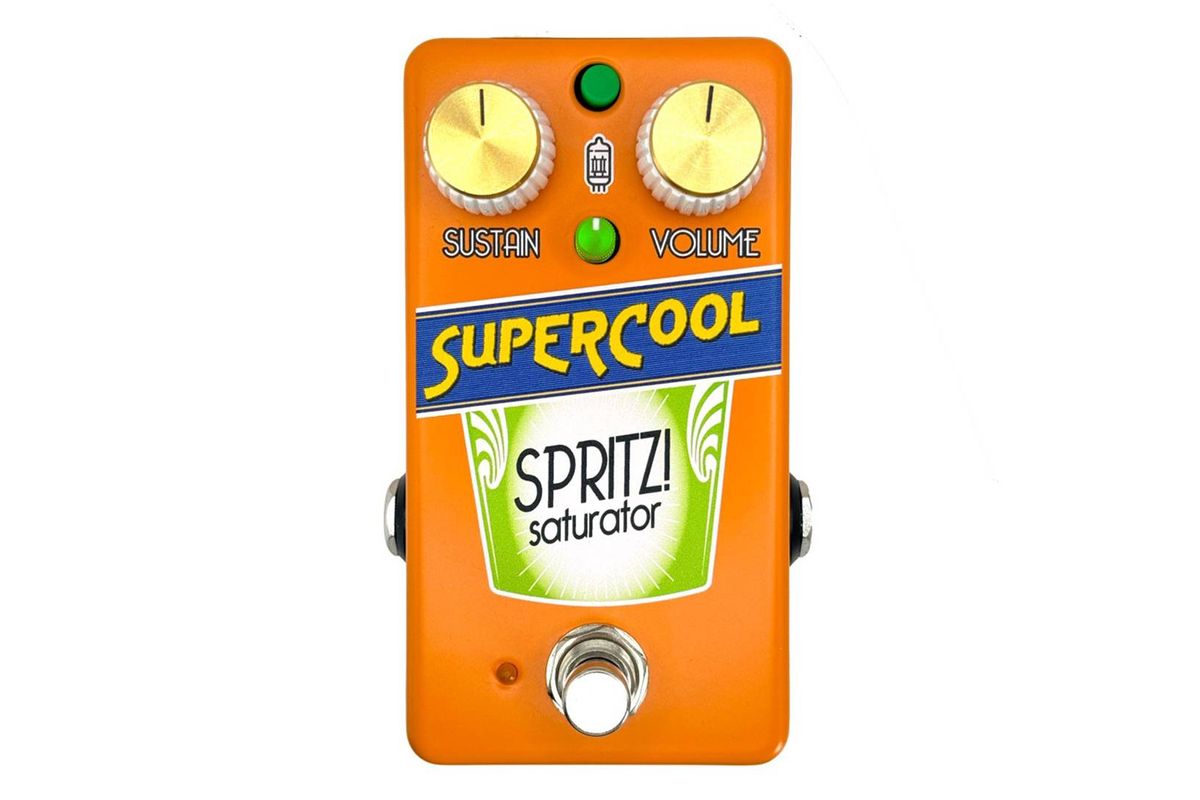
Supercool Pedals, based in Peterborough, Ontario, released the original Spritz compressor, a simple 2-knob pedal, back in 2022. Earlier this year, builder Jamie Muir overhauled that design and released the Spritz! Saturator, adding a “tube simulation” overdrive circuit with its own discrete controls in addition to the familiar dual-knob setup. Like its titular drink on a hot summer afternoon, the Spritz! Saturator is a refreshing, invigorating treat.
Drink Up
The Spritz! Saturator follows the Caffeine Boost and original Spritz as Supercool’s third pedal with art inspired by a delicious Italian beverage, and the company’s now-signature aesthetic cheek is a fun jolt to have on your board (and might give you a hankering for an icy aperitif). With two main knobs in the vein of the Ross Compressor and MXR Dyna Comp, the Spritz! keeps operation simple. But the added “tube simulation” feature, a simple JFET circuit activated by a small button perched atop the pedal’s face and tweaked with a mini knob between the two big guns, brings enhanced functionality to a familiar effect.
When the tube simulation circuit is engaged, its small control knob is illuminated, but manipulating the knob itself is a bit tricky given its location and size; I sometimes found myself wishing for a bigger knob, and a separate footswitch to kick on the saturation for lead or heavier moments.
Puttin’ on the Spritz
I liked the Spritz! Saturator on guitar, but I loved it on bass. With a Jazz-style bass through a Peavey solid-state head and Traynor 2x15 cab, the Spritz! popped my signal open like an oyster, trading a ruddy, dull exterior for a juicy, meaty interior. What I appreciated most was the presence it brought via the saturator’s full-frequency boost, which has a gentle peak in the midrange. It coated my signal in a pleasant, just-thick-enough layer of grit, and spring-loaded my bass lines. With the sustain and volume knobs at noon, each note had just a bit of extra bounce and shape.
On 6-string, I delighted in applying the Spritz! to classic power- and jangle-pop riffs, which rang out more sweetly and evenly for having the Spritz! in the mix. Compression isn’t in my usual pedal rotation, but messing with the Spritz! made me wonder why; it was great fun to tear through Tom Petty and the Heartbreakers and Records songs with the squeeze and light gain sugarcoating everything. If I’d had a 12-string Rickenbacker on hand, I might never have gotten around to writing this review.
The onboard dirt from the tube simulation circuit was right up my alley. It felt pleasantly tweed-like in the sense that when it’s dimed, it sags and threatens to collapse in a way that feels wonderful under the fingers in addition to sounding great. The one knock I can muster against the Spritz! is that it could use a bit more output power. Depending on your rig and where you place the pedal, you might find unity level anywhere between noon and 3 o’clock on the volume knob. But that quality also primes it for end-of-chain usage, where it can level out unruly pedals, smooth out muddy EQs, and just generally tighten up your tone.
The Verdict
Supercool’s updated Spritz! is an instantly useful piece of kit for any rig or instrument. It covers a broad range of compression applications, and sounds swell no matter how you set it. The tube simulation function is a welcome bit of extended usability and produces a lovely growl at many settings. Compression will never be the sexiest effect on your board, but if you need a rock-solid, easy-to-use compressor that injects instant pro tone into your chain, Spritz! is a competitive option.
Smoothing Planes, Which is Better? The Stanley No.3 or the Stanley No.4, Revisited
In 2012, a follower of my blog sent me a question, which size smoothing plane do I like best, the No. 3 or No.4? My answer was the No.3, and if you want to read what else I had to say about those planes, click here to read the post, which has had a good number of hits over this past month.
If I were to get asked that question today, I would answer with one word, “Neither!”
I really enjoyed using those old planes, but as I worked with more visually stunning tonewood, I discovered that I couldn’t really get those planes to step up and create a smoother surface. No matter how I sharpened and tweaked the irons, or flattened the bottoms of those planes, I was always a little disappointed with the results. By the beginning of 2020, I decided to make a change. I purchased a Lie-Nielsen (L-N) No. 62 low angle plane.

Once I sharpened up the iron on that plane and used it on some righteous East Indian rosewood, I knew my time using bevel down hand planes was done. I sold every bevel down plane I owned, I mean every plane, including a Stanley No.5 type 6 that was once owned by my maternal grandfather. The only two bevel down planes I kept were a vintage No.40 scrub plane and an Ibex violin plane.
I ended up buying a toothed iron and several extra irons for the L-N to experiment with cutting angles, all of which I still use for different planing situations, and I bought a Lee Valley Veritas Small Bevel-Up smooth plane. That small bevel up plane is a workhorse for me, with a toothed iron in it I use it for thinning down guitar backs and sides, and with a 55 degree angle on an extra iron its a great smoothing plane for Sitka spruce tops.
A L-N no.9 1/2 and a Violin maker’s plane round out my working planes.
If I were to go back to making furniture and other bits that are based upon squares and rectangles, I would willing spend the time and money to purchase a L-N No.7 1/2 jointer for jointing long boards.
Bevel down planes work well for me.
You should use what works best for you.
Now get out to the shop and make something!
My eBay Listing - Veritas Saw Set, Mint in Original Box
I am selling a mint in box Veritas Saw Set on eBay, item number 267783405719.
Veritas Saw Set, Mint in Open Box with original packaging. It is in the original factory box, looks like the tool was never used, there are no marks, dings, dents or other sign of wear, all parts show original factory finish with factory oil on moving parts. Box shows no signs of damage from shipping or storage, tool still has its original packaging. This saw set is like new.


Podcast 562: Nate Mercereau
On today’s episode, guest host Ryan Richter sits down with multi-instrumentalist, composer, and producer Nate Mercereau.
Renowned for pushing the boundaries of stringed instruments, Nate continues to redefine what it means to play and compose with the guitar as the centerpiece.
In this conversation, Ryan and Nate dive into the making of Mercereau’s compelling new album, Fantastic Thoughts. They discuss the creative philosophy, gear setups, and spontaneous moments of inspiration that shaped the record, giving listeners an insider’s look into Nate’s unique artistic process.

We are brought to you by Peghead Nation: https://www.pegheadnation.com
(Get your first month free or $20 off any annual subscription with the promo code FRETBOARD at checkout).
Mike & Mike’s Guitar Bar: https://mmguitarbar.com
Above photo: Alyssa Mercereau


The post Podcast 562: Nate Mercereau first appeared on Fretboard Journal.
Carl Martin Introduces the CM Acoustic 300-Watt Amplifier
Carl Martin has unveiled the CM Acoustic, a 300-watt full-range amplifier developed for acoustic performers who need studio-quality clarity at stage volume. Developed and assembled in Denmark, it is designed to reproduce the natural character of acoustic instruments and vocals rather than impose the coloration of a traditional combo amplifier.

At the core of the CM Acoustic are two custom-designed 6.5-inch Carl Martin SU65147CM full-range drivers. The system preserves pick attack, harmonic separation and low-end definition as volume rises, delivering the controlled projection and clean headroom of a compact professional PA while retaining the immediacy and straightforward operation of a dedicated instrument amplifier.
Two independent channels make the CM Acoustic a self-contained performance solution for singer-songwriters and acoustic duos. The instrument channel provides gain, three-band EQ with a sweepable midrange from 220 Hz to 5.1 kHz, limiter, EQ bypass, reverb and volume. A balanced XLR microphone input with +48V phantom power handles vocals, while an AUX input, balanced XLR output, effects loop, reverb-mute footswitch connection and 35 mm pole mount support professional stage, studio and small-venue setups.
CM Acoustic highlights include:
- 300 watts of clean, dynamic headroom for acoustic instruments and vocals
- Two custom-designed 6.5-inch SU65147CM full-range drivers
- Two independent channels for instrument and microphone
- Balanced XLR microphone input with +48V phantom power
- Three-band instrument EQ with sweepable 220 Hz-5.1 kHz midrange
- Limiter, EQ bypass, reverb and dedicated channel controls
- Balanced XLR output, AUX input, effects loop and reverb-mute connection
- Developed and assembled in Denmark with warm wooden side panels
The Carl Martin CM Acoustic carries a street price of $1,299. For more information visit carlmartin.com.
String maker Stringjoy launches its first capo – what’s different?

Guitar string purveyor Stringjoy has entered into the world of capos with its first offering, the Sweetspot.
Boasting a precision dial for variable tension control – perfect for a range of guitars and neck widths – the Sweetspot also features a single-hand-friendly quick-release design, soft silicone contact points to protect strings and finish, and a heavy-duty case metal build for long-terms durability.
Sweetspot by both name and nature, the capo is said to be the “best of both worlds” for guitarists seeking the convenience of a spring-loaded trigger capo and the adjustability of a screw-on, adjustable tension capo.
“Guitarists have always had to choose between a quick-change capo that’s fast but imprecise, or a screw-adjustable one that’s precise but slow and clumsy,” says Scott Marquart of Stringjoy. “We didn’t think that tradeoff made sense, so we set out to bring something to market that didn’t exist yet.
“The Sweetspot features a tension-adjustment control you won’t find on other trigger capos that allows you to dial in the exact tension you need for your guitar in seconds, then pop it on and off one-handed mid-song without missing a beat.
“No buzz, no tuning issues, no compromise, and at a price point that means you’re not paying a premium for something that, in our opinion, simply works like it should. It’s the capo we always wished existed, and now it’s ours to share.”
The Sweetspot is available in Silver or Black, and is priced at $24.99.
Learn more at Stringjoy.
The post String maker Stringjoy launches its first capo – what’s different? appeared first on Guitar.com | All Things Guitar.
“Whenever we weren’t shooting, we’d be jamming”: Alex Winter says he and Keanu Reeves would play bass together while filming Bill & Ted’s Excellent Adventure
![[L-R] Keanu Reeves and Alex Winter](https://guitar.com/wp-content/uploads/2026/09/Keanu-Reeves-Alex-Winter@2000x1500.jpg)
Alex Winter has shared how he and co-star Keanu Reeves would kill time on the set of Bill & Ted’s Excellent Adventure. The 61-year-old film star and documentarian explains in an interview with The Guardian how he and Reeves would jam together.
Fielding questions submitted by members of the public, one fan asks Winter how fun it is to work with Reeves and what they got up to between scenes.
- READ MORE: Unexpected gear used by Frank Zappa
The fan asks: “Which Keanu Reeves was the most fun to work with: in Waiting for Godot on Broadway; as Ted ‘Theodore’ Logan to your Bill S Preston, Esq in Bill & Ted; or as mutant Ortiz the Dog Boy when you directed him in Freaked? And following Waiting for Godot, what wildly inappropriate classic should Bill & Ted tackle next?”
Winter responds: “I just love performing with Keanu. The funny thing is we both play bass, so all through the first Bill & Ted, whenever we weren’t shooting, we’d be jamming.
“Keanu and I both have theatre backgrounds and have studied Shakespeare, so I’d like to do some Shakespeare, maybe something like Measure for Measure. There’s a few that we’ve discussed. I’m not sure if we’ll get there, but who knows? Never say never.”
Winter’s musical background goes a step further than jamming with his co-stars, as the film star also directed a documentary on legendary musician Frank Zappa in 2020.
The documentary took Winter five years to make. Summarising Zappa in an interview with Vanity Fair, Winter said: “Here was this radical, long-haired freak, but also a patriarchal, macho, relatively conservative Italian dad….
“Now that he’s gone, and we live in such a politically fraught world, I see fans try to take ownership of Zappa. The far-left take ownership, the libertarians take ownership, and I think he was all of it and none.
“He was, though, rabidly anti-Bush and anti-Reagan. He maintained a powerful anti-authoritarian, anti-fascist streak, and pro-citizens rights. It carried through his whole life.”
The post “Whenever we weren’t shooting, we’d be jamming”: Alex Winter says he and Keanu Reeves would play bass together while filming Bill & Ted’s Excellent Adventure appeared first on Guitar.com | All Things Guitar.
The estate of Brent Hinds is reportedly suing Mastodon

After Mastodon recently gave an interview to Classic Rock speaking of their fond memories of late bandmate and guitarist Brent Hinds – who died in a motorcycle accident last year – it’s come to light that Hinds’ estate has filed a lawsuit against the band.
The filing, made at the Fulton County Court in Georgia against Mastodon members Troy Sanders, Bill Kelliher and Brann Dailor, cites a number of complaints, including the unauthorised use of Hinds’ likeness on the cover of their latest album Marrow Deep, that Hinds continued to have owned interest in merchandise, and that the buyout of said interests was never finalised before his death.
Hinds’ estate also alleges that the surviving members of Mastodon made claims about Hinds’ substance abuse. The complaint is made regarding private information allegedly being made public after Hinds’ death.
According to the Atlanta Journal-Constitution, Hinds estate alleges that the band “selected and placed a recognisable image of Brent on the album cover of Marrow Deep and disseminated that cover to advertise, market, distribute and sell physical albums, digital downloads and streams, merchandise and related goods or services.”
Brent Hinds was a founding member of Mastodon from the band’s formation in 2000 until his death in August 2025. It was announced that he’d departed the band earlier last year.
While the split appeared mutual at the time, Hinds later made harsh comments about his former bandmates, calling them a “shit band with horrible humans”.
It’s unclear what will happen with the new lawsuit, but Hinds’ former bandmates have been remembering their time with the guitarist fondly as of late.
“He was a man scorned,” said drummer Brann Dailor recently. “He said some hurtful things, but I know he didn’t mean it.
“I was always hopeful that he was going to call me at some point and be like: ‘Dude, I’m done being a ding-dong. Can I come back? I have a riff…’ We were 100% sure he would’ve done that.”
The post The estate of Brent Hinds is reportedly suing Mastodon appeared first on Guitar.com | All Things Guitar.
Robert Fripp and Toyah’s lockdown Sunday Lunch series was such a sensation they’re making a movie about it – here’s an update on its progress
![[L-R] Robert Fripp and Toyah Willcox](https://guitar.com/wp-content/uploads/2026/09/Toyah-Fripp-hero-new@2000x1500.jpg)
Toyah Willcox has shared an update on the long-awaited documentary on her and husband Robert Fripp’s Sunday Lunch lockdown sessions. Speaking at Rewind South to eonmusic, Toyah confirmed that a documentary crew had been filming the pair’s project.
Toyah and Fripp went viral during the Covid-19 lockdowns with covers of hit songs performed from their kitchen. Now, some years after the lockdowns ended, they’re still going, most recently offering up a rendition of The Rolling Stones’ Jumpin’ Jack Flash and the ZZ Top track, Gimme All Your Lovin’.
On the new documentary, Toyah said: “We shot a lot of stuff. We were shooting a documentary for a company in New Zealand.”
But a clear release date is out of the question, with Toyah adding: “I don’t know. They’ve got to make the movie first. They’ve got the footage.”
The film has been in the making since 2023 and that’s not all for the viral sensation. Toyah confirmed her album, Future Dreaming, will be released next April. She said: “My singles start in January. And then I have three singles: January, February, March, and then the album’s out in April.”
King Crimson guitarist Fripp will feature on two of the tracks, with the album produced by Andy Brooke. Toyah said: “He’s [Fripp] on two tracks. It’s been produced by a wonderful producer called Andy Brooke, who’s produced most magnificent arrangements. I’m very excited about it.”
Last year, Robert Fripp suffered a heart attack while travelling to Italy to attend one of his Guitar Craft courses. Ever one to look at the funny side of things, the guitarist later told the story of how hospital staff shaved his balls, for reasons still unknown to him to this day…
“I was in A&E, they hooked me up to a monitor, and the next step was this dear man turned up and shaved my balls,” Fripp recalled. “I thought, ‘Well, if this is something to do with my heart, why is he shaving my balls?’”
The post Robert Fripp and Toyah’s lockdown Sunday Lunch series was such a sensation they’re making a movie about it – here’s an update on its progress appeared first on Guitar.com | All Things Guitar.
Vox VFZ-1 Fuzz Review

In design and engineering terms, a vintage fuzz is a comparatively basic thing. And most of the earliest vintage fuzzes evolved from common ancestry. But as we’ve discovered in the intervening years, even small differences in a simple design can mean profound shifts in performance and personality.
The first Tone Bender, the MK I, for instance, was a close relative of the Maestro FZ-1 (of “Satisfaction” fame.) The MK II was a more potent evolution—made most famous, probably, by Jimmy Page. But in between those releases, the Tone Bender took an interesting turn. The MK 1.5, as it’s now known, simplified by shedding a transistor. The change didn’t last long, but it proved to be an enduring platform, because the Tone Bender MK 1.5 is essentially a sibling of the Fuzz Face, Vox Distortion Booster, and the Italy-made Vox Tone Bender—which, collectively, could be the most recorded fuzzes of the 1960s. This design is also the foundation of the new Vox VFZ-1. Where the original MK 1.5 used germanium transistors, the VFZ-1 employs a pair of more stable silicon transistors. But it also adds bass and treble cut controls, as well as a switchable crunch mode (which works, more or less, just like turning your guitar volume down.) It’s a versatile circuit that reveals how flexible the MK 1.5 is as a fuzz foundation. It also reaffirms, in many cool ways, how those little changes can add up to real differences.
Silicon Cornerstone
Germanium versions of the Tone Bender MK 1.5 and Fuzz Face are rightly revered for their dynamic range and drive characteristics. But silicon Fuzz Face variants are very cool in their own ways. Jimi Hendrix and David Gilmour sold about seven gazillion records on the strength of silicon Fuzz Face tones, after all. That sound is recognizably the foundation of the Vox VFZ-1’s voice. At its core, it’s meaty and assertive in the high-mid range, with a growly, contoured low-mid accent. It sounds great with single-coils, and spectacular with humbuckers, which tame its spikier tendencies and shine a light on its capacity to meld sheer mass and throaty grit. Imagine a bellowing Orson Wells as a guitar/fuzz combo and you wouldn’t be far off. Its responsiveness to guitar volume and tone attenuation and touch dynamics is impressive, too. It may not be in a germanium Fuzz Face’s class in this regard, but you can definitely summon sparkly low-gain to near-clean tones via these techniques.
Range Rover
The VFZ-1’s utility is enhanced by the simple tone cut and bass cut controls, and both can be transformative depending on your aims. I had the most fun removing as much top end as possible with the tone cut, and letting the bass flow freely via a full-counterclockwise bass cut setting. The sounds produced at these settings don’t quite have Big Muff weight, but they’re close. In fact, if I was casting a fuzz for a desert drone rock role but needed a new twist on the theme, I would be thrilled to use this VFZ-1 setting with a humbucker to achieve that aim. You can still summon detail and shading with the guitar volume and tone controls in this setup, but the results are more guttural and less buzzy than you’d expect from a Tone Bender or silicon Fuzz Face.
The Verdict
Burly, blazing, scuzzy, and smooth, the Vox VFZ-1 is a genuinely exciting alternative to both the silicon Fuzz Face and Tone Bender-type circuits. Indeed, it can play those roles, but can also step well out of type. It’s sturdy and stylish, and at just less than $149 offers impressive flexibility at a price that aligns with much less versatile vintage-style fuzzes.

VFZ-1 Fuzz
Fuzz Guitar Pedal with Volume, Fuzz, Tone Cut, Bass Cut, and Crunch/Fuzz Controls
“John Lydon was alright – we got on quite well. It’s just that Sid Vicious was such a dick”: Roger Taylor recalls the first time Queen met the Sex Pistols

Queen drummer Roger Taylor has reflected on the infamous tense encounter that occurred with the Sex Pistols when the two bands were recording at the same studio in 1977.
At the time, Queen were working on what became News Of The World, while the Pistols were laying down their debut album, Nevermind The Bollocks…, when the two forces came into contact at Wessex Sound Studios.
Speaking to Classic Rock, Taylor says, “I really loved the Pistols album. It was [made with a] great producer, mate of mine, Chris Thomas. Because we were in the same studio for a while in 1976-77, somewhere around there. They were doing their first album, and it was dreadful at first until Chris came in and made a great record.”
Sid Vicious interrupted Queen’s session to taunt frontman Freddie Mercury over a comment he’d made in an NME interview about his love of ballet. Reports from other Queen insiders also recall the Pistols’ John Lydon crawling into their space on all fours.
“Sid put his head in the studio and said: ‘Hello, Freddie, are we bringing ballet to the masses?’ And Freddie said something like: ‘Oh, Mister Ferocious, we’re doing our best here…’” He goes on to add, “John [Lydon] was alright, actually. He was quite a character. We got on quite well. It’s just that Sid Vicious was such a dick.”
Earlier this year, Taylor and Queen guitarist Brian May spoke to Uncut about their own experience of recording a debut album, and the high-stakes that surrounded the experience: “We were ludicrously compliant on the first album because we were terrified that it was going to be our only chance to record,” said May.
“That’s the big difference between Queen and Queen II, the second album is the sound of us starting to get the sound we wanted,” added Taylor.
The post “John Lydon was alright – we got on quite well. It’s just that Sid Vicious was such a dick”: Roger Taylor recalls the first time Queen met the Sex Pistols appeared first on Guitar.com | All Things Guitar.
“He said some hurtful things, but I know he didn’t mean it”: Brann Dailor reflects on Mastodon’s public fallout with late guitarist Brent Hinds

Last year, the metal world was rocked when it was announced that Mastodon founding guitarist Brent Hinds had died in a motorcycle accident.
The guitarist had departed the longstanding Atlanta metal outfit earlier in 2025, and while the decision was described as mutual at the time, the split later became somewhat acrimonious. Three months after his exit, Brent Hinds described his former bandmates as a “shit band with horrible humans”.
But despite the harsh words uttered during the heat of the split, Hinds’ former bandmates – guitarist Bill Kelliher, bassist Troy Sanders and drummer Brann Dailor – hold nothing but respect and fond memories for the 24 years they shared together as one of the top bands in the metal scene.
- READ MORE: Want to test the prototype from Guitar Center’s new in-house guitar brand? Here’s how you can
In an interview in the latest print issue of Classic Rock, drummer Brann Dailor reflects on the years they spent together, and the circumstances surrounding Brent Hinds’ departure from the band.
“There’s 25 years of living with this guy,” he says. “When you have this otherworldly bond, this really deep emotional place together through music, it’s an elevated relationship. But when we did the Ashes of Leviathan tour, I could finally see that it had run its course with him. We needed some kind of change, because it was dragging everybody down.
“It became really hard to get Brent to commit to anything. He just wanted to go do his own thing, ride his motorcycle and be a free spirit.”
Dailor continues, reflecting on the thorny words said by Hinds about his former bandmates: “He was a man scorned. He said some hurtful things, but I know he didn’t mean it.
“I was always hopeful that he was going to call me at some point and be like: ‘Dude, I’m done being a ding-dong. Can I come back? I have a riff…’ We were 100% sure he would’ve done that.”
Just a year on, the death of Brent Hinds still affects the members of Mastodon profoundly.
“It isn’t easy to talk about Brent, he was our family, someone we all loved wholeheartedly. He was a wild man, our wild man and that came with some challenges,” the band wrote in July.
“Both things are true and we aren’t interested in chasing one truth over the other. Losing him has meant sitting with a type of grief we never expected. No more hugs, no more high fives, no more disagreements, no more making up. That part has been hard, it’s real.”
“I thought there’d be that turnaround where we’d meet, apologise, hug and say, ‘I love you.’ I didn’t know when, but I knew it would happen. And I was fucking wrong,” added Troy Sanders.
Since Hinds’ death last year, Mastodon have taken on two new members: Nick Jonhston on lead guitar, and keyboardist João Nogueira.
Last month saw the release of the band’s ninth studio album and first without Brent Hinds, Marrow Deep. The band have a string of US tour dates planned for the rest of the year to promote the album, alongside Deafheaven and Alcest.
For a full list of dates, head to MastodonRocks.com.
The post “He said some hurtful things, but I know he didn’t mean it”: Brann Dailor reflects on Mastodon’s public fallout with late guitarist Brent Hinds appeared first on Guitar.com | All Things Guitar.
The 10 best pedal compressors for guitarists in 2026
Compression! It’s one of the most misunderstood and underrated guitar effects. If you’re looking for your next dedicated compression pedal, you’re in the right place – let’s explore some great options for squishing your sound.
For electric guitar, some kind of compression somewhere along the chain is quite important – the raw, completely unaltered signal from a guitar’s pickup is quite uneven, with a big transient at the start, and a quick falloff as the note dies. Compression of all kinds, whether it’s from your amp’s front end, a dirt pedal or a dedicated compressor, evens out your volume and makes for a more pleasing playing (and listening!) experience.
Here we’re looking at dedicated compression pedals, which let you add sustain and even out dynamics without introducing extra distortion, unless you want to – overloading a compressor pedal can be its own kind of saturated fun. But the core use-case for compression is to gain some more control over your dynamics without having to sound like you’re suddenly in Slayer. Compression is at the backbone of many of the best guitar tones out there – from the punchy, ‘quacky’ country sound of a compressed Telecaster, to the sparklingly clean and articulate solos of David Gilmour, and a whole lot else besides.
A dedicated compressor pedal can be an excellent addition to your sound, particularly if you want to sculpt a quality clean tone. But there are a lot out there, ranging from the premium studio-grade compressor workstations for your board, to simple two-knob affairs that won’t break the bank. Let’s dive in.
At a glance:
- Keeley Electronics Compressor Plus
- Universal Audio UAFX 1176
- Empress Effects Guitar Compressor MKII
- Warm Audio Pedal76
- Origin Effects Cali76 FET
- JHS Pedals 3 Series Compressor
- Xotic SP Compressor Mini
- Boss CS-3
- MXR Dyna Comp
- TC Electronic Hypergravity
- Why you can trust Guitar.com
Keeley Electronics Compressor Plus
The undisputed standard for modern pedalboard compression. Evolving from Robert Keeley’s legendary two-knob design, the Plus features a blend control for parallel compression and a specialized attack/release switch optimized for either single-coils or humbuckers. It effortlessly retains your core tone while adding sweet, musical sustain and evening out your dynamics. It’s arguably the most versatile “always-on” compressor for everyday players.
Universal Audio UAFX 1176
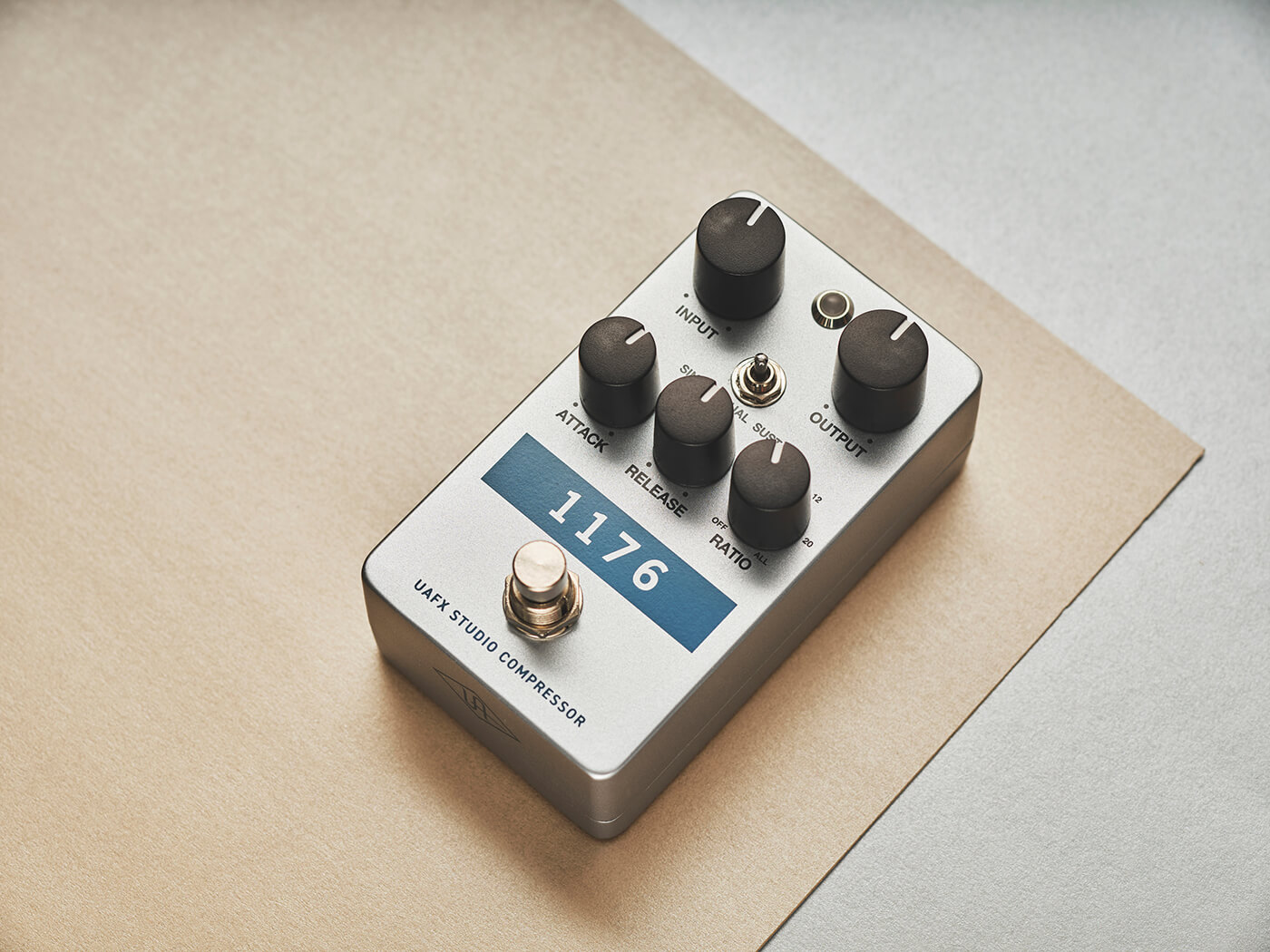
Universal Audio managed to cram the exact algorithms of their legendary studio hardware into a compact stompbox. This pedal delivers authentic 1176 FET compression with switchable Single, Dual, and Sustain modes—giving you everything from subtle dynamic control to iconic Led Zeppelin-style squish. If you want uncompromising, studio-grade digital emulation of a legendary rackmount unit without dropping thousands of dollars, this is the benchmark.
Empress Effects Guitar Compressor MKII
This all-analog FET compressor brings recording console flexibility to your feet. It boasts independent Attack and Release knobs, a sidechain high-pass filter to keep bass frequencies from triggering the compression, and a handy “tilt” EQ knob. The standout feature is the vibrant LED metering strip, letting you see exactly how much gain reduction you’re applying.
Warm Audio Pedal76
Warm Audio built its reputation on cloning classic studio gear, and the Pedal76 brings an all-analog, true-to-spec 1176 circuit directly to your pedalboard. Featuring custom USA-made CineMag transformers, this pedal delivers rich, vintage FET character and lightning-fast attack times. It is undeniably large and requires serious board space, but it rewards you with authentic analogue warmth and punch that digital emulations struggle to fully replicate.
Origin Effects Cali76 FET
Widely considered the ultimate boutique compressor, the Cali76 is an ultra-premium, studio-grade FET compressor packed into a brushed-steel enclosure. It captures the distinct sound of an 1176 with zero digital processing. The inclusion of a dedicated Dry knob allows for seamless parallel compression, giving you massive sustain without killing your pick attack. It’s premium appointments don’t come cheap, though…
JHS Pedals 3 Series Compressor
Part of JHS’s budget-friendly 3 Series, this no-nonsense compressor offers just three knobs (Volume, Attack, Sustain) and a Bright switch to add top-end sparkle back into your signal. Despite the stark white enclosure and incredibly approachable price point, it’s built in the USA and delivers smooth, transparent dynamic control that rivals pedals double its price.
Xotic SP Compressor Mini
Don’t let the dinky footprint fool you – this tiny pedal houses a premium Ross-style circuit that punches way above its weight class. It features an external blend knob for quick parallel compression and a three-way toggle for High, Mid, or Low compression strength. Internal dip switches offer even deeper tweaking for attack and release.
Boss CS-3
A rugged, reliable workhorse that has graced thousands of professional pedalboards for decades. Unlike transparent modern compressors, the CS-3 is notoriously “squishy,” heavily coloring your tone and providing near-infinite sustain for searing solos or snappy country chicken-picking. It also comes with the added benefit of being housed in the Boss compact enclosure, and therefore will probably outlast several civilisations.
MXR Dyna Comp
The original red box that helped define the sound of modern country, funk, and 80s pop. With just two knobs, it’s easy dial in and hard to make sound band. The Dyna Comp is not transparent; it produces a very distinct, percussive “pop” on the attack and significantly alters your EQ, making it work great as a bit of a of a preamp boost as well as just a pure compressor.
TC Electronic Hypergravity
A highly advanced digital multiband compressor built on the MD3 algorithm from TC’s flagship studio System 6000. Because it compresses high, mid, and low frequencies independently, it yields incredibly transparent, even results without choking your tone. The real magic lies in the TonePrint app, which allows you to beam custom presets from pro artists directly to the pedal or deep-dive into the parameters yourself. It’s also eminently affordable, and sports a pretty compact enclosure given its extensive featureset.
Why You Can Trust Us
Every year, Guitar.com reviews a huge variety of new products – from the biggest launches to cool boutique effects – and our expert guitar reviewers have decades of collective experience, having played everything from Gibson ’59 Les Pauls to the cheapest Squiers.
That means that when you click on a Guitar.com buyer’s guide, you’re getting the benefit of all that experience to help you make the best buying decision for you. What’s more, every guide written on Guitar.com was put together by a guitar obsessive just like you. You can trust that every product recommended in those guides is something that we’d be happy to have in our own rigs.
The post The 10 best pedal compressors for guitarists in 2026 appeared first on Guitar.com | All Things Guitar.
Pages
