
Music is the universal language
“Glory to God in the highest heaven, and on earth peace to those on whom his favor rests.” - Luke 2:14
Norse Guitar Feeds
Reverend Guitars Unveils New Standard Series
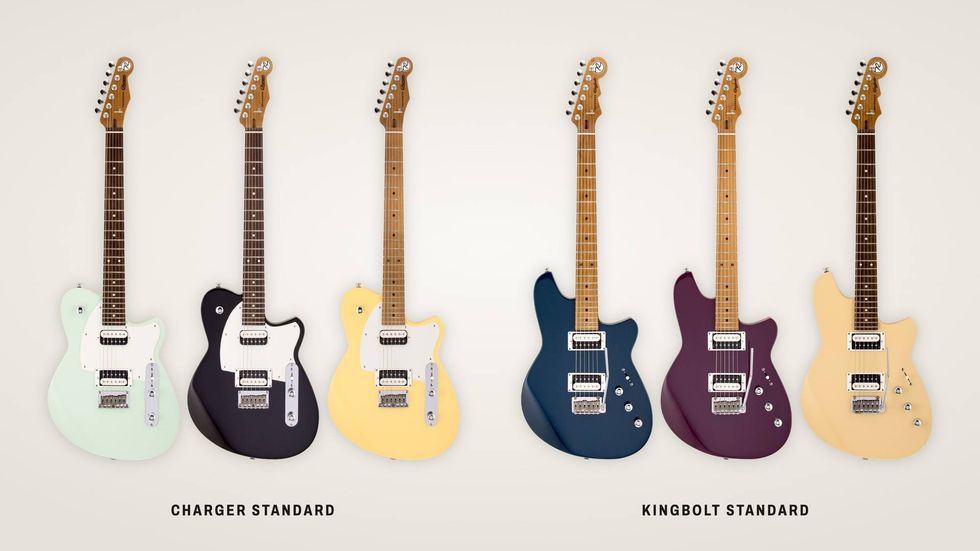
Reverend has introduced the brand new Standard Series of electric guitars, featuring clean lines and retro-modern style, loaded with no-nonsense high-performance appointments.
The new series includes two models: the Charger Standard has a string-through-body bridge, while the Kingbolt Standard features a BS184 tremolo bridge. Both the Charger Standard and Kingbolt Standard feature Reverend HCM humbuckers, delivering plenty of raw horsepower and versatility.
HCM Pickups are based on Reverend’s classic HA5 Humbuckers, with the pickup cover removed and the alnico magnets replaced with a Medium Ceramic magnet. The result is a medium-high output humbucker with enhanced punch, sustain and harmonics, designed for those who seek raw rock tone, but want sweet cleans when you back off the volume knob and/or right-hand attack. The HCM Bridge pickup is wound with 43 gauge wire and measures 13K ohms. The HCM Neck pickup is wound with 42 gauge wire and measures 7.5K ohms.
Both models include Reverend’s classic Bass Contour Control knob along with volume and tone controls – simple yet highly flexible electronics suited to just about any musical style. Each model features a roasted maple neck with 25 ½” scale length, medium oval neck profile and 12” radius for smooth playability. The dual action truss rod is accessible at the headstock, for ease of adjustment and reliability. Both models have stainless steel saddles for sustain and punch, and Reverend Pin-Lock tuners.
The Reverend Charger Standard is available in Midnight Black, Powder Yellow and Iconic Blue and carries a $999 street price. The Reverend Kingbolt Standard is available in Tide Blue, Sandstone and Purple Punch colors and carries a $1099 street price. For more information visit reverendguitars.com.
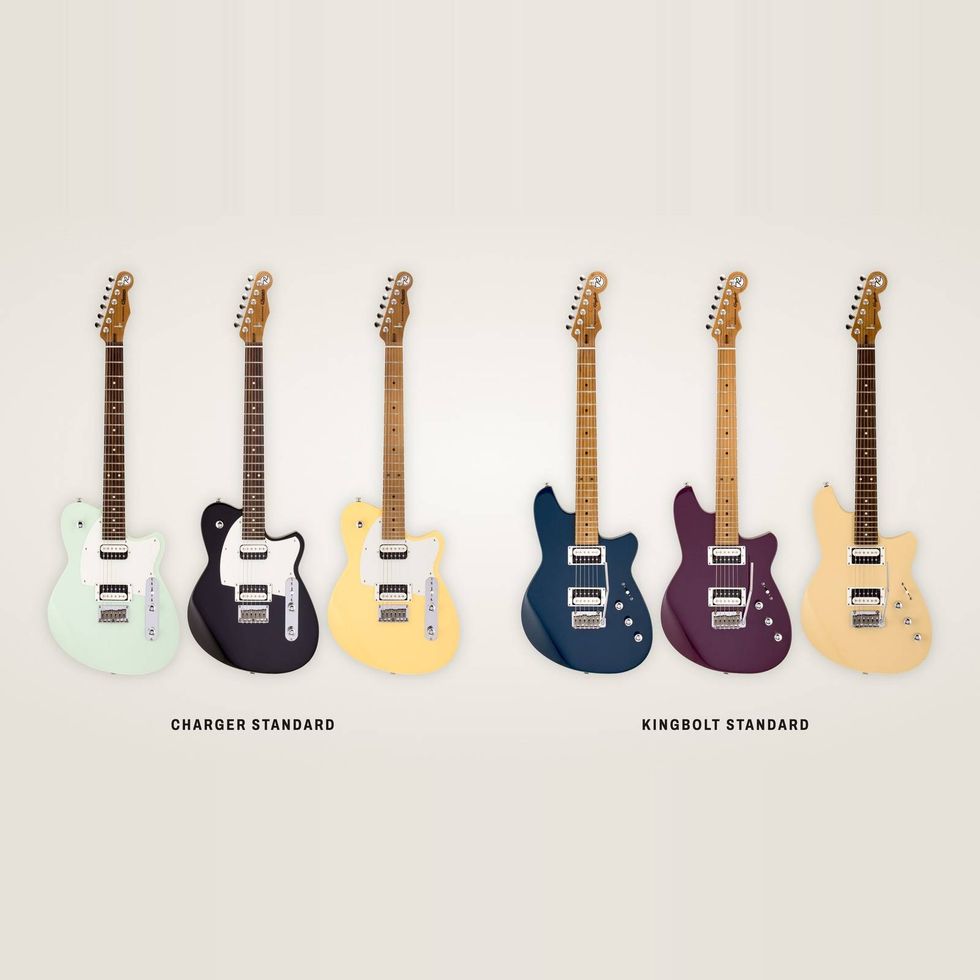
Standard Series
Reverend has introduced the brand new Standard Series of electric guitars, featuring clean lines and retro-modern style, loaded with no-nonsense high-performance appointments.
Working It Out
“If only I could make them understand just how much their business would benefit by letting me contribute to the ambiance of their establishment.”
In the beginning anyway, you figure that’s what the owner or manager wants to hear and on the surface you’d be right. The problem is – they’ve heard it all before and reality vs promises is something they’ve experienced, most likely more than a few times. There are other strategies of course and none is better than having someone already employed by the establishment vouch for your talent, experience and ability. There is also the idea that offering an appearance or two without charge might be enough to keep the door open. But that is dangerous in many ways and will be the subject of another blog entry in the near future.
As the years and then decades pass those rejections begin to be more tolerable, at least from a more practical point of view, i.e., there are always more places to play. Timing can be hugely important. More than once I’ve gotten a gig by being the first one who walked through the door at a moment in time when an establishment has decided to add or resume live music but of course that is pure luck.
This outlook can only be attained based on long-term experiences, good and bad. Back in the early 1970s I was camping with some friends at a campground in Acadia National Park in Maine. A middle-aged guy was in the campsite next to us and when he heard the guitar music coming from next door he walked over. Turns out he was a professional musician, a drummer who had worked with some pretty well-known groups over the years, both on the road and in the studio. We asked him how he ended up at a secluded campsite in northern Maine. He basically mumbled something about needing a break from his busy schedule and after playing some gigs in Boston he just got in his car and headed north with no set plans about how long his break would be.
This we found a bit strange. If he could easily get gigs whenever he wanted, why the heck wasn’t he back at it? Basically, he said, I just couldn’t face another session or gig playing with some young group who had neither the drive nor the temperament (or talent) to move away from the lightweight pop music.
Well, said I with all the confidence and ignorance of youth, you would never catch ME playing music I hated even if there was serious money involved.
Mr. Drummer just shook his head and I detected more than a little disdain as he said: “Well…OK… I remember saying just about the very same thing thirty years ago when I decided to try breaking into that tight circle of so-called “professional” musicians. I wish you luck maintaining that lofty goal. Really, I do! Because the fact is, ‘luck’ isn’t as random as you might think.”
With that, Mr. Drummer got up from his chair and began heading back to his campsite. We shook our heads and proclaimed – he’s just jaded. It’s so sad that he seems to have totally lost touch with the reason he started playing in the first place. In retrospect I’m pretty sure he was hoping to hook up with some young hippie-ish girl who took the “Make Love, not WAR!” moto literally and would gladly jump into his sleeping bag. That’s what numerous magazine articles of the time had pretty much confirmed, right?! But alas, all the hippie chicks around that campfire were spoken for and frankly had no interest in some cynical middle-aged dude who may have looked alarmingly like their father.
But I’ve never forgotten what he said and over the many years since that evening his words made more and more sense. Or as Mr. Dylan put it so well: “I was so much older then, I’m younger than that now.” These days a rejection doesn’t put me in a state of minor depression for a few days or longer. The let-down is always there, make no mistake, but I handle it much, much better than I did in my youth. All it really took was confidence that a rejection was not personal. I’ve learned that a hard ‘no’ may very well involve private decisions or situations the owner or manager may be dealing with and have no explanation. In fact, that truth is almost always lurking close to the front of my brain, especially when the establishment is brand new or has undergone a complete personality change with new management. It’s likely that unrealistic promises won’t help you land that gig and if you do, the owner expects a full house from the first gig and onward, which in a totally seasonal area like Cape Cod is virtually impossible. So, who takes the blame for that? I’m guessing you can guess.
As some reading this know, I had a dream gig for a bit over 13 years. Just about every Sunday over those years I played at the (old) Daily Brew café, only a 15-minute drive from my home. Because I was playing in a very small space inside there was no need to haul heavy amps or a PA system. I expanded my set-up a bit during summer and early fall when I played outside on the back deck but it was still a relatively simple exercise. The owner gave me free reign in terms of the music I played and I was keenly aware that volume control was very important. I had to accept the fact that it was definitely NOT a concert and for much of the time my function was not much more than helping fill in the gaps in conversation.
This proved to be an excellent opportunity to take a step or two back and try to make my ego accept and understand the reality of the necessities and requirements of being a professional musician on the local level. I learned a few things over those years that served me well. If there was just one person who was actually listening intently I would make believe that person was my only audience and I owed that person my best possible performance. Another important lesson: It was quite likely there were others listening but not responding until they walked past me to the door and said something to the effect of – Nice set! I really enjoyed your music!
See! said my ego. See!! You DID accomplish what you set out to do. You added something positive to the ambiance and there WERE people who understood why I sat there week after week, year after year. So I just keep plugging away, chasing down rumors of new playing opportunities and leveraging gigs I do play by asking the people hiring me to please recommend me to others.
Never, ever take a steady gig for granted. Treat every chance to put your music in front of people as something very special, something that very few people get to experience.
Peace & good music,
Gene
ESP’s Ryan Dominguez: Crafted by Fate
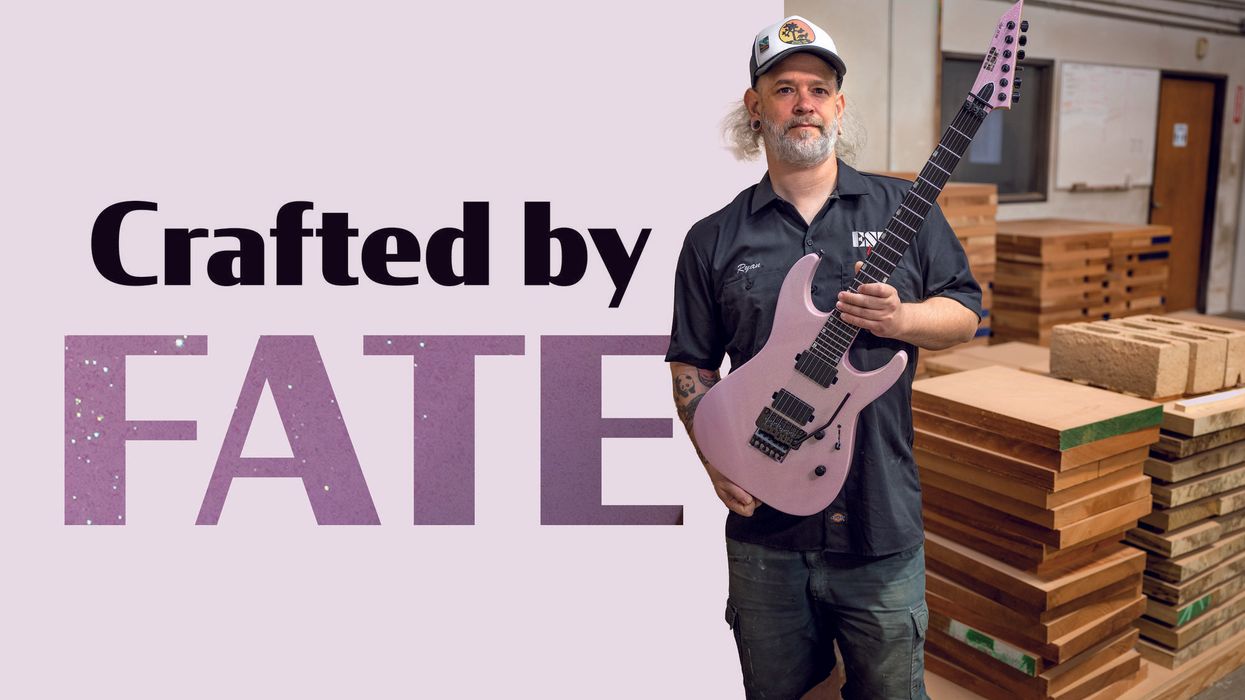
Ryan Dominguez’s path to becoming ESP USA’s shop manager, master painter, product/color developer, and, now, Director of USA Manufacturing Operations, was cast by fate. It was his last year of high school, and he knew he wanted to do something with art as a career. He floated the idea of becoming an animator, but everyone kept telling him there was no money in art. Little by little, he began feeling lost. “I didn’t really know where I wanted to go in life,” Dominguez tells PG. “One day I was walking home through the alleyway where my friends and I used to do alleyway things. In the gutter there was this brochure for Guitar Craft Academy, and I read through it and thought, ‘That’s a pretty cool way to blend art and music.’”
Dominguez went home and talked it over with his grandparents, who were willing to let him give it a shot. “It honestly could have been clown college, as long as it led to work,” he jokes. “They were cool with whatever direction I decided to go in.” It paid off. About two weeks after graduating Guitar Craft Academy, Dominguez landed a job at ESP as a tech. He has since spent most of his adult life with the company, clocking in around 20 years collectively so far.
ESP, short for Electronic Sound Product, was formed in Tokyo in 1975 as a repair shop and replacement parts maker. They later built guitars for the Japanese market under the ESP and Navigator brand names. By 1983, ESP parts were available in the U.S. market. The company’s ascent coincided with the rise of the Sunset Strip metal scene in the ’80s, where bands tried to out-glam one another through heavy makeup, bold fashion, and big hair. ESP seemed to perfectly match that aesthetic, creating guitars with exciting graphics and unusual body shapes.
The turning point for ESP happened in the mid-’80s when George Lynch was on tour with Dokken in Tokyo. He had a very specific idea for a guitar build and heard that ESP made fully custom instruments, so he set up a meeting. At first, they discussed specs for a neck that Lynch wanted them to make, but over the course of a few hours, they collectively designed Lynch’s “Kamikaze” guitar. That instrument, which features vivid military-themed graphics and a reverse headstock, would become ESP’s first signature model. Lynch’s equally famous “Tiger” guitar would also be released by ESP as part of its Signature Series. The unforgettable visuals of “Kamikaze” and “Tiger” quickly made ESP a household name among guitarists.
“[W]e know what people expect when they see ‘ESP’ on a headstock. We always want ESP USA to live up to that legacy.”
The timing of Lynch’s signature models coincided with ESP’s move to New York City, where they operated out of a loft on 19th Street, before moving to Manhattan's then-famous music row on 48th Street in 1989. After landing in the Big Apple, ESP started making guitars for NYC-based artists like Vernon Reid, Page Hamilton, and Bruce Kulick. Then the company made the move west in 1993, relocating its U.S. headquarters to Sunset Boulevard in Hollywood, California. That was the place to be for metal at the time, and ESP quickly became a major player—for decades since, ESP’s artist roster has been a who’s who of metal guitarists. In addition to Lynch’s guitars, ESP has crafted many of the genre’s most distinct instruments—including Kirk Hammett’s “The Mummy,” “Ouija,” and “White Zombie,” James Hetfield’s “Snakebyte” and “Truckster,” and Akira Takasaki’s “Random Star,” to name a few. In 1996, ESP introduced their affordable—and highly popular—LTD line, which helped put their guitars into the hands of budget-conscious players.
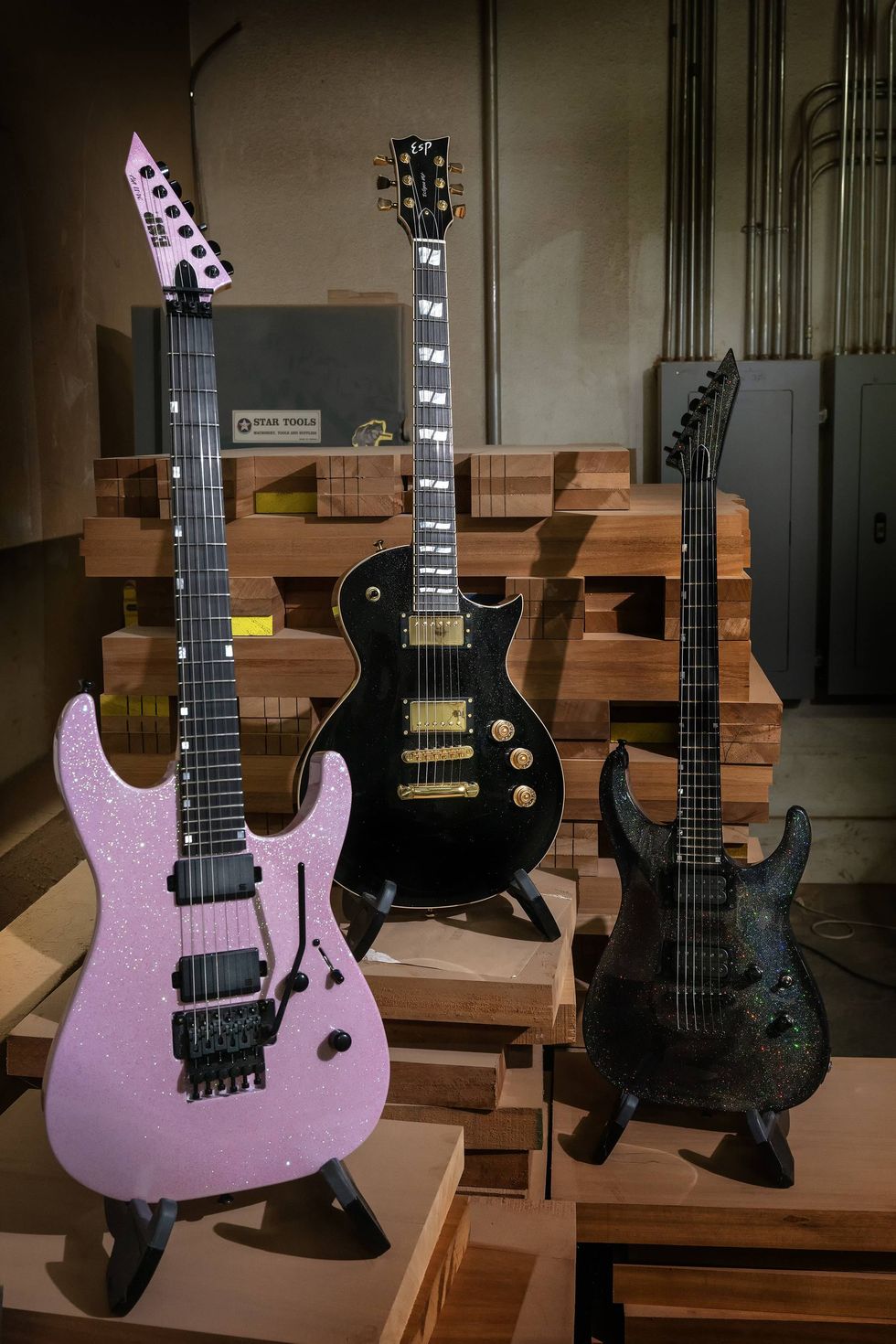
ESP’s unique designs are a perfect match for Dominguez’s creative and musical inclinations. Since he was young, the self-taught artist has always had a sketchbook and pencils in hand. “I used to love opening up a skateboard magazine or a surfing magazine or a music magazine, and drawing something from the pages—especially if it was a Reef girl,” he says. Dominguez also played guitar as a kid, starting on a 3/4-scale acoustic his mom got him when he was around nine. She also signed him up for guitar lessons, but he admits that he “didn't really take it too seriously.” In fact, in one of his lessons, Dominguez had stopped paying attention to the teacher and instead used his pick to carve an anarchy sign into the back of his acoustic guitar. “I’m pretty sure that was the last lesson my mom took me to,” he chuckles.
By around 8th grade, he wanted to pick up the guitar again. He asked for an electric for Christmas and, this time around, started taking it seriously, even forming a pop-punk band with some friends. “I think every kid that has a guitar kind of dreams of being some sort of a rock star, or at least for being able to play or write a song or something,” he says. “I entertained the idea. I was probably a little bit of an emo kid in high school and thought I could write songs and play the acoustic, that sort of thing. But it was never really something that I tried to actively pursue.”
“Sometimes I feel like a kid who snuck into a candy store that someone forgot to lock up for the night.”
Instead, Dominguez entered the world of guitar building. When he first joined ESP in 2004, he started off doing set-ups before eventually moving on to the repair department. After about a year and a half, he left the job and moved to Arizona to attend the Roberto-Venn School of Luthiery, aiming to explore the acoustic side of guitar building. Roberto-Venn also had a month-long course on guitar repairs, and Dominguez was interested in learning how to do heavier repairs, like neck resets. “My original intention was to be a builder. I had gone to Roberto-Venn to kind of expand on that,” he says. “And when I graduated, I had a little bit of money left over from the student loans, so I bought a bunch of tools to go out and build some guitars in my garage and go down that path.”
During that time, Dominguez also took on work painting cabinets for a company in Arizona. This proved to be beneficial, as he developed a considerable amount of his painting technique over the approximately two years he was employed there. Unfortunately, once the recession hit, everyone got laid off.
Dominguez called his old boss Todd Binder—now president of ESP—to see if he could get his job back. “That was on a Friday in August, 2008—I packed up my little car that weekend and started on Monday,” he says. “When they decided to open the USA Shop in 2013, they knew I had experience painting and asked if I wanted to try it out [there]. I said ‘no,’ but then Todd called me out and said, ‘Well, you know, sometimes we just gotta step up and do what’s asked.’
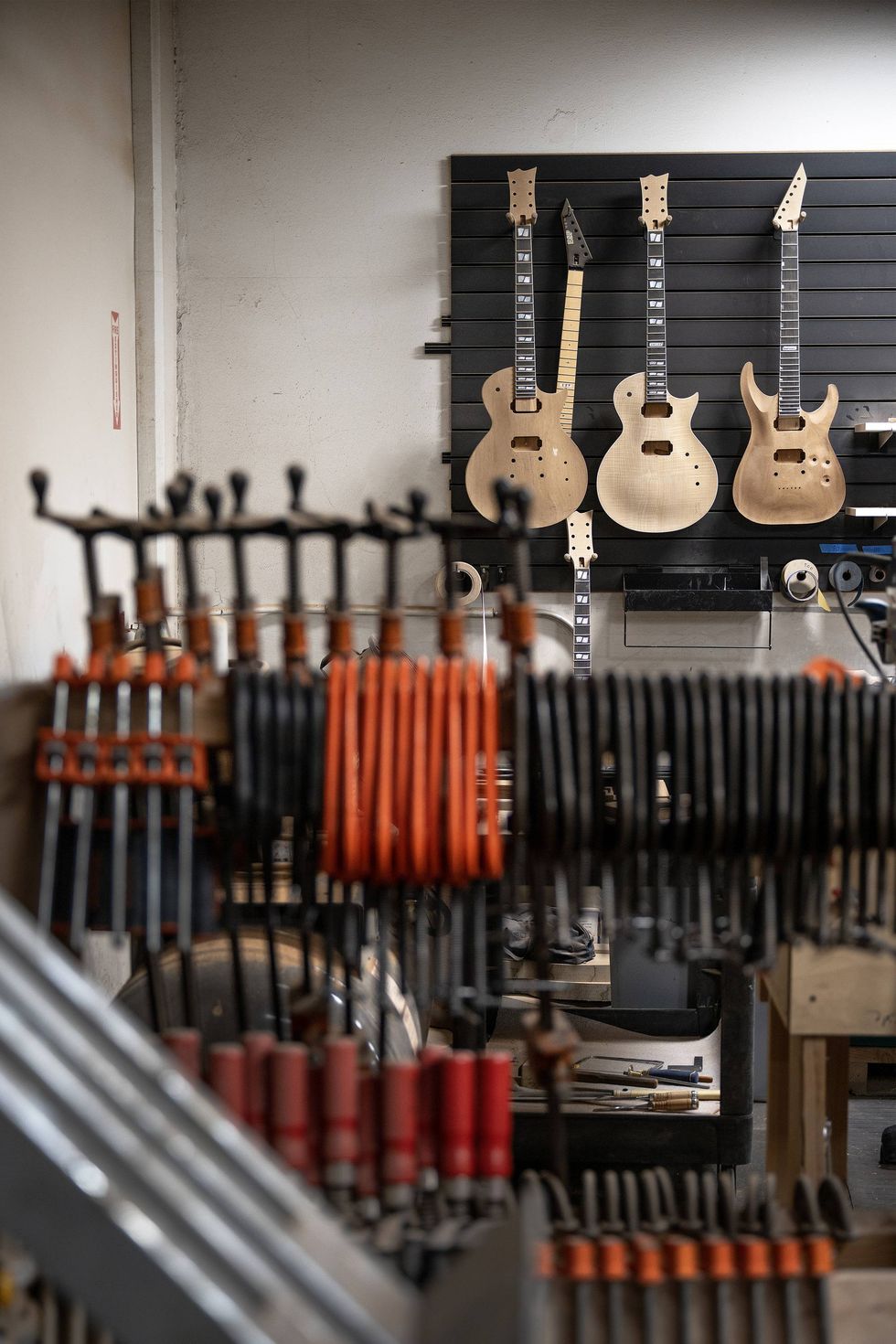
“When I first moved over to the USA Shop, I was doing a little bit of everything,” he continues. “Everyone was—woodworking, assembling, building, painting. My role within USA has changed quite a bit over the years. I’ve shifted mostly from doing paint stuff to managing the shop, working with the woodworkers on processes. ‘How can we make this faster?’ ‘What kind of pain points are you guys seeing out there?’ A lot of it entails what we’re going to be offering on the year as far as products and finishes: working with suppliers to find unique woods to be able to use for limited-edition builds; coming up with all the limited-edition models that we’re going to be offering; and a lot of managerial, sitting-behind-the-computer stuff, too, like creating SKUs and entering things into the system—part numbers, all that stuff.”
Typically, Dominguez goes through about three to four guitars a day—the sweet spot where he can still keep a close eye on quality control. “We don’t build as fast as some shops do, but we know what people expect when they see ‘ESP’ on a headstock,” he says. “We always want ESP USA to live up to that legacy.”
ESP USA and ESP’s Japanese Custom Shop, Original Series, and Signature Series are the elite tier of the company’s brands. (There's also an LTD version of the Signature Series.) Each serves a different purpose but shares the common goal: delivering the absolute best ESP products. “There’s definitely been a collaboration going on between USA and Japan. If I have a question like, ‘Hey, how’d you do this finish?,’ or ‘What’s your process for doing the side of the headstock?,’ they’re more than willing to work with us on any questions that we have. They’ll show us different processes and procedures, different ways of doing things,” he says. “They’ve come to me as well with, ‘How do you get this finish?,’ and, ‘What's your technique for this?’
“I just want to be clear that all of our custom guitars and artist Signature Series guitars from ESP are built at the ESP Custom Shop in Japan, not at the USA Shop,” he adds, hoping to clarify some common confusion. ESP USA isn’t like the ESP Custom Shop in the sense that you can customize every single detail of a build like body shapes or unique graphic designs. Rather, it’s a ”select shop” where you can personalize some aspects by choosing from a curated list of shapes, tops, finish types, and pickups. However, ESP’s Custom Shop won’t take every single request thrown at them. “Have they ever turned down a request?,” Dominguez says. “Yes, but probably not because they couldn’t do it. They have super high standards and won’t put the ESP logo on just anything. At the USA Shop, I can’t recall turning down a request. We try to be as accommodating as possible, and I do like a good challenge.”
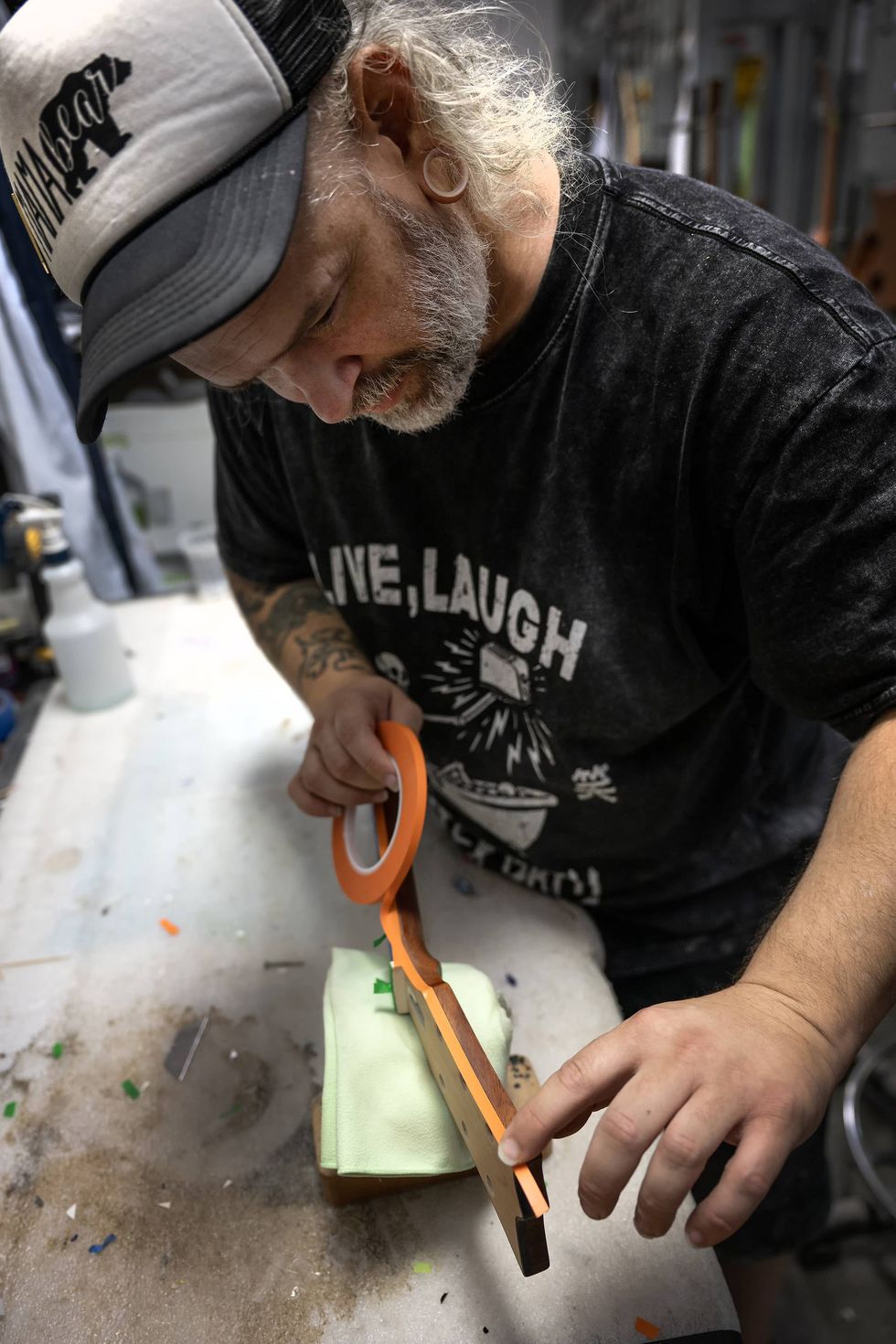
One perk of Dominguez’s job at ESP is the amount of free rein he’s afforded with his artistic explorations. “Sometimes I feel like a kid who snuck into a candy store that someone forgot to lock up for the night,” he admits. “I almost feel guilty about the amount of creative freedom I have. Almost. I’d like to think that I’ve been with ESP long enough to understand the company’s design philosophy, aesthetic standards, and, most importantly, what our players expect from the brand. I think that’s what has given me some confidence and relieved a lot of the guilt in the freedom I have to experiment. That, and failures. I’ve failed enough times behind the scenes to realize that another idea will come … sometimes when you least expect it. Sometimes it even wakes you up at 3 AM.”
Dominguez’s Instagram handle, @spongebrick, encapsulates everything about his work ethic and desire to build ESP guitars to the highest standards possible. “What Spongebrick, the person, represents, I’d like to think, is tenacity and dedication to a craft,” he explains. “It would have been really easy to throw in the towel for a dust-free environment and some air conditioning at a place where the stakes don't feel as high. Building guitars with ‘ESP’ on them—and the expectations people have as a result—can be constant high pressure.”
But, he continues, “there’s that little voice that’s constantly nagging me to be better—and to not blow that tiny mistake completely out of proportion until I can see it again the next day to realize it’s actually okay. That voice wouldn’t let me walk away. If I did, it would nag me about that, too.”
Skid Row's Scotti Hill and StewMac Create New Hooligan Boost Pedal Kit
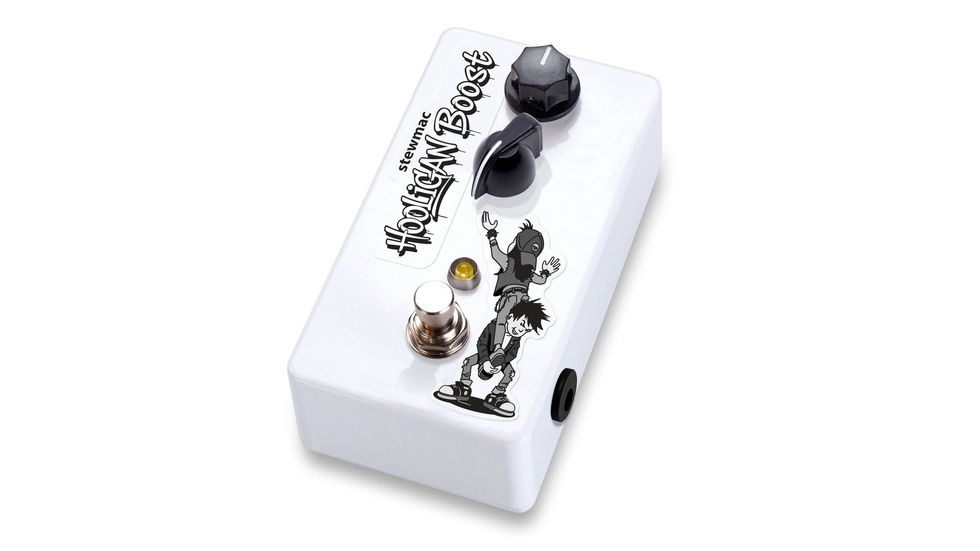
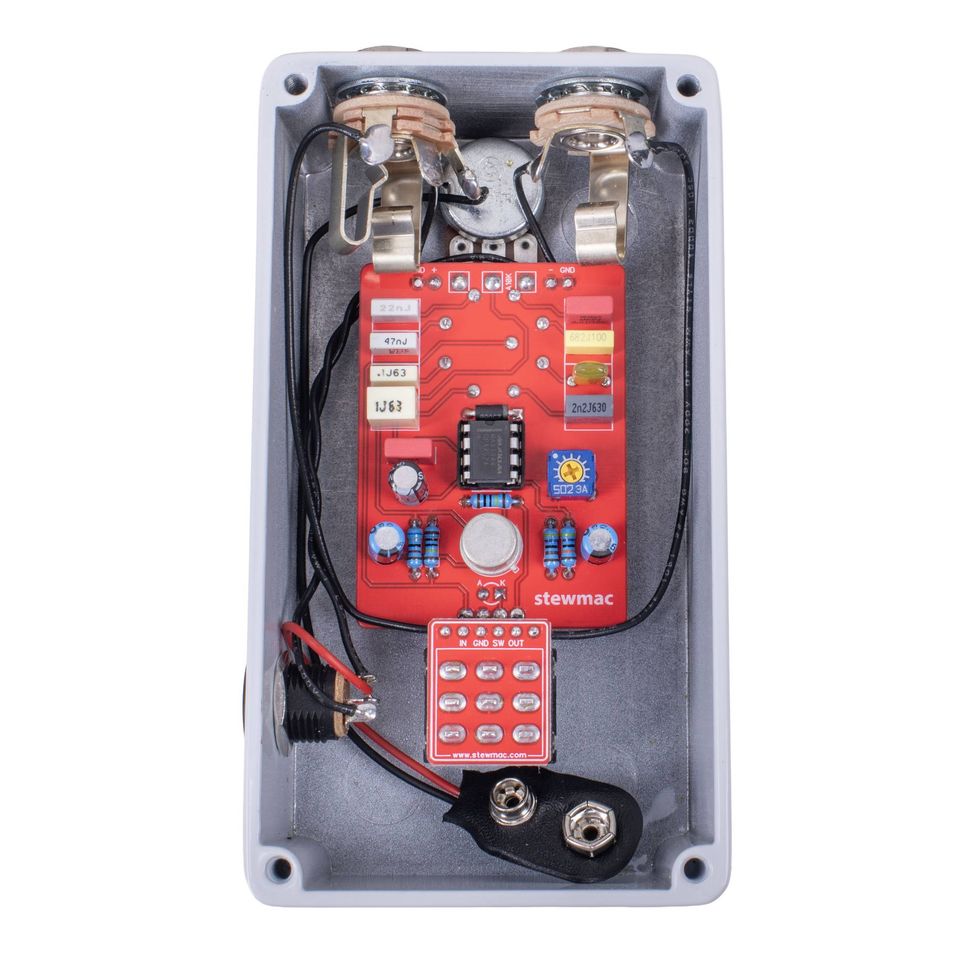
StewMac has teamed up with Scotti Hill, lead guitarist of rock band Skid Row, to introduce the Hooligan Boost Pedal Kit—a DIY guitar effects pedal designed with Hill's own approach to guitar tone in mind.
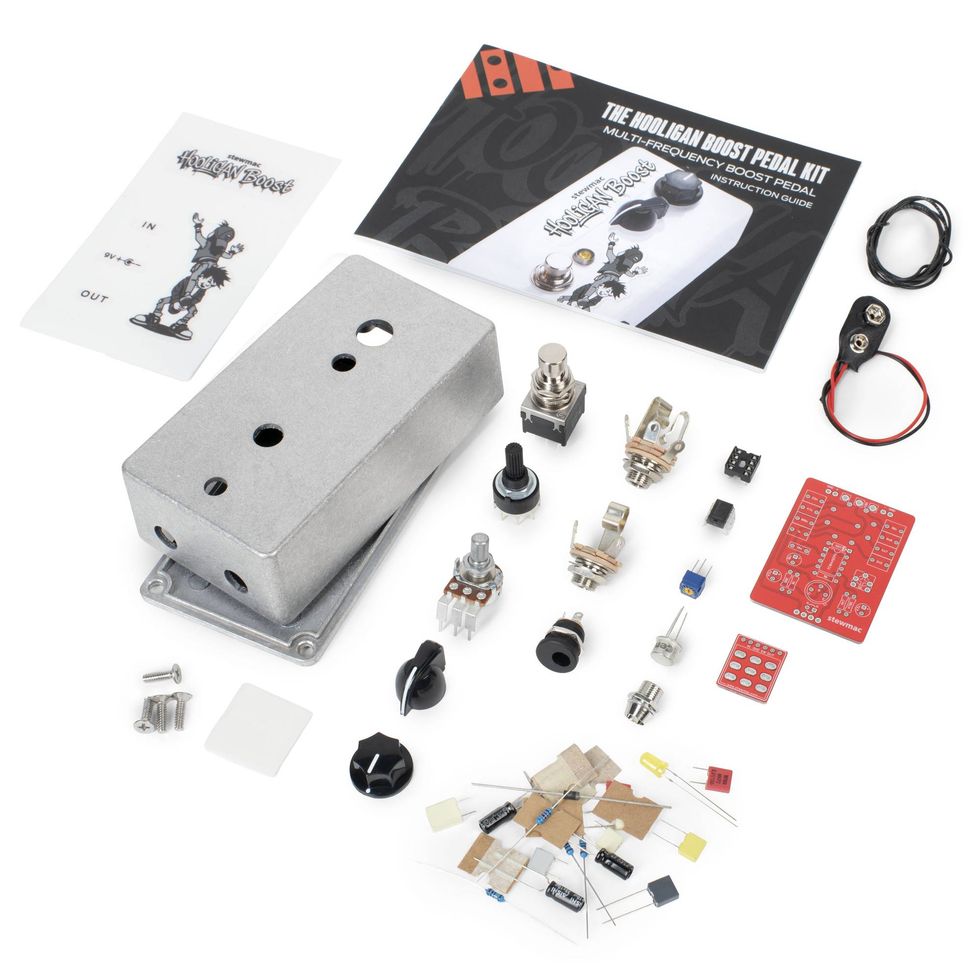
Inspired by the classic Dallas Rangemaster circuit, Hill and StewMac spent over a year creating the Hooligan, dialing in just the right components and selecting an enclosure that would be easy to use and not take up too much room on your pedal board. An eight-position Range selector allows players to move through different frequency ranges, while the Volume control can take the sound anywhere from clean boost to full-on overdrive. Hill's preferred starting point is positioned at 11 o’clock on the range switch, which provides a balanced foundation for exploring the pedal's range.
The Hooligan Boost is versatile enough to be used as a volume boost for solos, or an always-on pedal to define your core guitar tone.
See the demo video here:
Key features include:
- Classic boost circuit inspired by the legendary Dallas Rangemaster.
- Eight-position Range control lets you tailor the boost's cutoff frequency to your amp. Go from bright, cutting boost to full-frequency boost with plenty of low end.
- Volume knob controls overall output level, ranging from clean treble boost to full frequency overdrive.
- Powered by a 9-volt power supply with a 2.1mm negative-center barrel, available separately.
- Step-by-step instructions written for the first time builder.
- Top quality, high tolerance components from resistors to switches. Road-worthy, rugged metal enclosure with all holes pre-drilled.
- Available in either bare or powder coated white finish.
- 9-volt operation – can use battery or external DC power supply
- Input and output jacks are rear mounted for easy cable routing
- Custom printed labels
- True bypass switching
The collaboration brings together two sides of Hill's career: his decades of experience chasing the right guitar tone on stage and his love for building his own pedals. The result is a versatile boost pedal that puts a reimagined classic circuit into the hands of guitarists and DIY builders.
"I've been searching for the ‘perfect’ tone since I first picked up a guitar," says Hill. "It’s elusive. Lots of ideas would come and go, but I kept coming back to boosts again and again. So, when StewMac and I started bouncing around ideas for a pedal kit, I knew we should start with a REALLY good boost pedal."
The pedal's personality extends beyond its circuit. The Hooligan's artwork draws inspiration from Hill and his friends as young troublemakers—a nod to the rebellious spirit and rock 'n' roll attitude that have followed him throughout his career. "Back when we were young, we definitely got into our share of mischief," says Hill. "So, Hooligan seemed like the right fit."
The collaboration also has a personal connection for Hill. Before working with StewMac on the Hooligan, he had already built one of the company's pedal kits himself. "I wanted to be sure we came up with something that was not only practical, but not too complicated to build," Hill says. "I thought it would be a great way to get people started in pedal building. In fact, a StewMac kit was what got me started in pedal building!"
The Hooligan Boost Pedal Kit is designed to give builders the experience of assembling their own effects pedal while ending up with a practical piece of gear that belongs on a working guitarist's pedalboard. The Hooligan combines the hands-on satisfaction of a DIY project with the versatility of a pedal designed by a professional touring and recording guitarist. Whether it's being used to push an amp into breakup, add bite and presence, or simply become an always-on part of a player's rig, the Hooligan is built around one of Hill's most enduring lessons: good tone starts with finding what works for you.
The Hooligan Boost Pedal Kit includes everything needed to build the pedal electronics and enclosure, along with Scotti Hill-inspired artwork and a detailed StewMac instruction guide.
The Hooligan Boost Pedal Kit is available from StewMac for a street price of $109.99. For more information, visit StewMac.com.
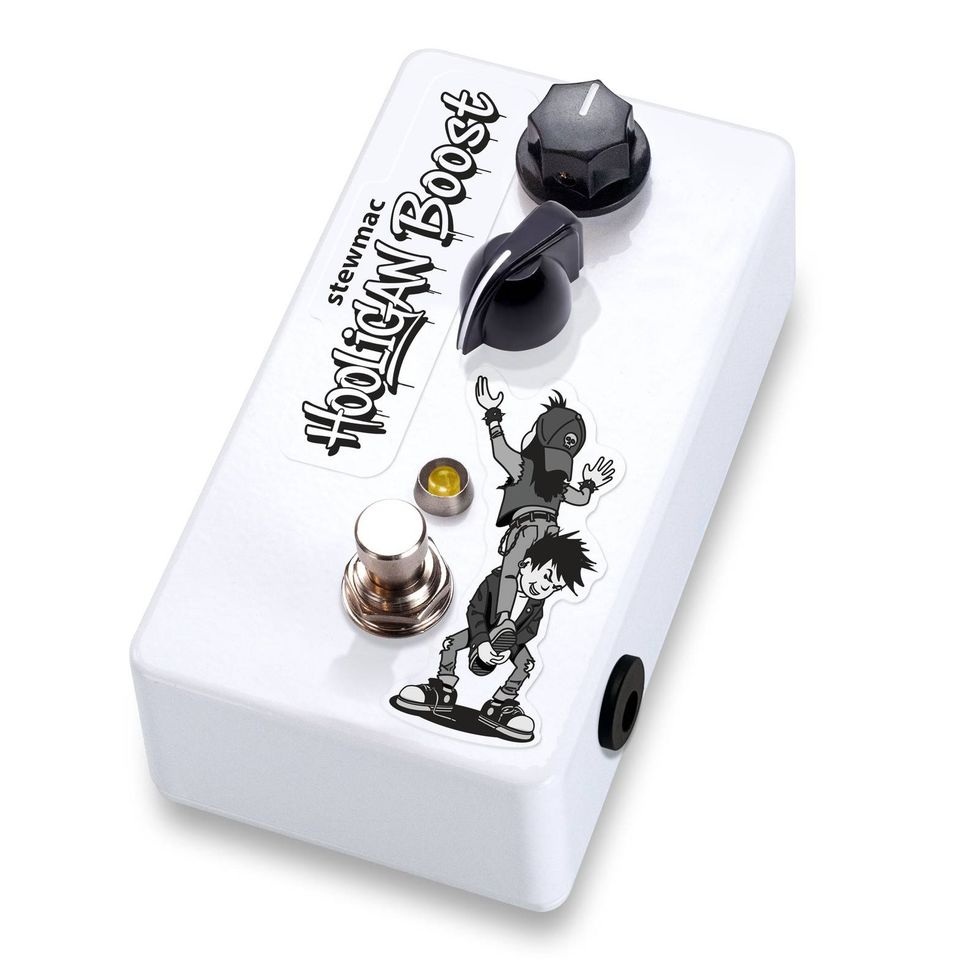
Hooligan Boost Pedal Kit
StewMac has teamed up with Scotti Hill, lead guitarist of rock band Skid Row, to introduce the Hooligan Boost Pedal Kit—a DIY guitar effects pedal designed with Hill's own approach to guitar tone in mind.
Stompboxtober 2026 Day#1: Line 6

Stompboxtober Is back for 2026! Come back every day during October for your chance to WIN your new favorite effects pedal or accessory. Today's featured pedal is form Line 6. Enter to win the DL4 MkII!
Stompboxtober 2026 - Win Pedals All Month Long!
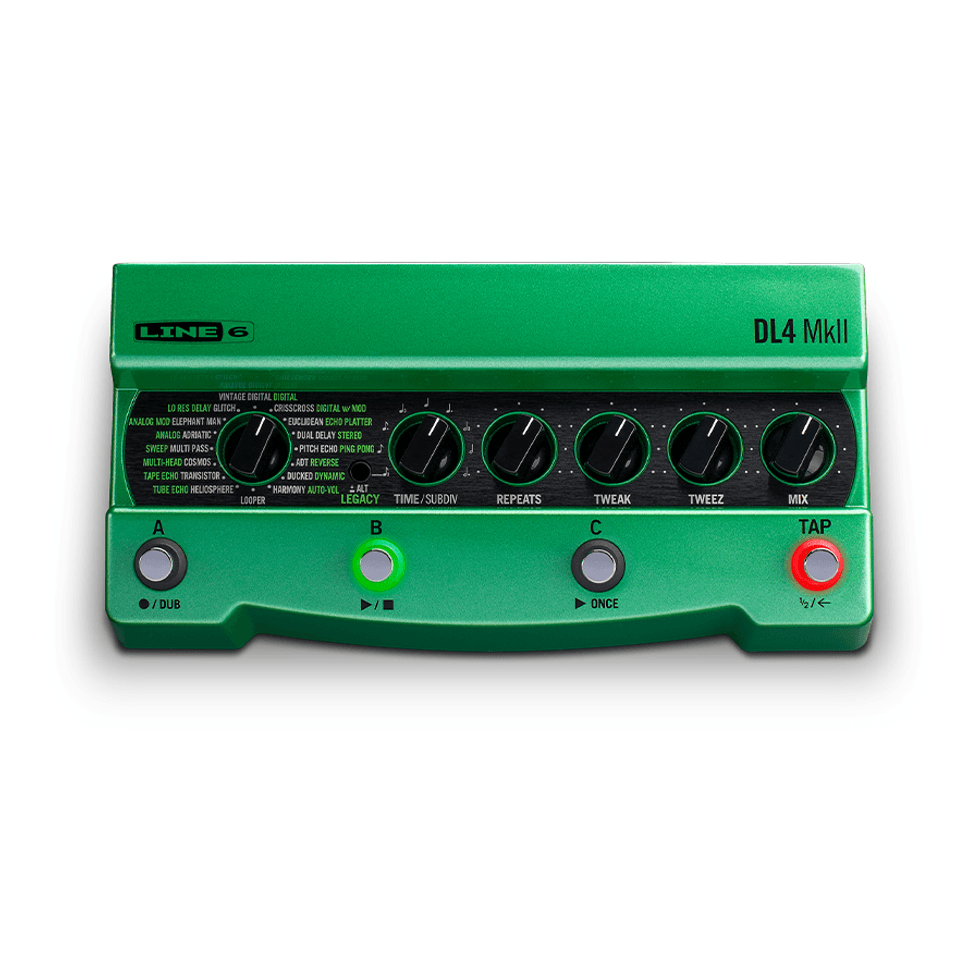
DL4 MkII
The DL4TM Delay Modeler has remained one of the most widely used delay pedals in the world for more than two decades. The DL4 MkII includes all the sounds and features of the original, while introducing new sounds and features. The 15 new MkII delays were drawn from our HX® family of amp and effects processors and the 4-Switch and 1-Switch looper types offer up to 240 seconds of record time (expandable to several hours using an optional microSD card). There's an XLR microphone input, MIDI In and Out/Thru connectors, heavy duty footswitches, three bypass options, and a jack for connecting an optional expression pedal or two footswitches. The DL4 MkII is also smaller and lighter than the original, making it an even more appealing choice for modern musicians.
Dean parent company must pay Gibson $4 million in legal fees after trademark loss
![Headstock of a Dean guitar [main image], and the headstock of a Gibson guitar [inset]](https://guitar.com/wp-content/uploads/2025/09/Dean-Gibson-new-hero@2000x1500.jpg)
Dean’s parent company Armadillo has been ordered to pay over $4 million of Gibson’s legal fees, after its loss in the dispute over infringing body shapes.
Earlier this year, the final result of the retrial between Gibson and Armadillo was declared. The second jury broadly agreed with the first, finding that Armadillo had infringed on a number of Gibson’s body shapes, and that Gibson was overall the prevailing party. However, it was not a total victory for Gibson, as its ES shape was ruled to be generic.
But, despite that one trademark decision, the rest of the ruling was still very much levelled at Dean and Armadillo. This march ruling declared that Armadillo must foot a $170,000 bill for at least some of Gibson’s legal fees, with the judge further stating that “all costs of court spent or incurred in this cause are adjudged against Armadillo”. This figure was unclear at the time, but following recent filings from Gibson, it has now been calculated as a total of $4,046,444.05: $235,417.92 in litigation costs, and $3,811,026.13 in attorney’s fees. Armadillo has until next Friday (9 October) to pay.
The $4 million payout comes just months after Armadillo declared bankruptcy, something the current company leader Pamela Keris-Rubinson blamed on extensive alleged fraud by her son, former CEO and president of Armadillo Evan Rubinson. In a bankruptcy filing made in June, Pamela Keris-Rubinson alleged that Evan’s appointment as company leader (following the death of CEO Elliott Rubinson) saw a previously successful Armadillo Enterprises start to decline severely. The rest of the bankruptcy filing revealed that Armadillo holds assets within the range of $1 million and $10 million – but owes $50 million in liabilities.
This fraught financial position wasn’t helped by the initial result from its spar with Gibson – even before the retrial, Dean was ordered to stop selling some of its most popular designs back in 2022. The disruption to the business was somewhat felt by customers – sharper, non-infringing Vengeance models were announced in 2021, but would not make it into stores for another two years. Dean has also recently entered into a legal conflict with the estate of Dimebag Darrell, who have also launched a new guitar brand in collaboration with Dean’s namesake, Dean Zelinsky.
Overall the recent filing is, of course, not good news for an already embattled Dean and Armadillo. Given the disparity between the company’s assets and its liabilities, an order to pay another $4 million in legal fees makes its future even more uncertain.
The post Dean parent company must pay Gibson $4 million in legal fees after trademark loss appeared first on Guitar.com | All Things Guitar.
“I thought it went better with the guitar!”: Johnny Marr reveals he chose his famous hairstyle to compliment this specific guitar

Johnny Marr is known for his distinctive look as much as his guitar playing in The Smiths and as a solo artist, but it was no accident.
As he explains in a new interview with LIFEJACKET on YouTube, the Mancunian legend recalls how his distinctive mod-crop hairstyle was inspired by the “Beatle who never made it”, Stuart Sutcliffe, and how he chose his look to complement a specific guitar in his arsenal.
That guitar was, of course, his famous Jetglo-finished 1982 Rickenbacker 330, bought at a Manchester guitar shop in ‘83 and used extensively across the Smiths’ self-titled debut album and on tour.
“One of my heroes at the time was Stuart Sutcliffe,” he recalls. “I thought, ‘I really wanna look like Stu Sutcliffe.’ V-neck jumper, white polo neck, Ray-Bans. The shop I worked in, we were the first ones to sell the Wayfarers when they came back. So, I was like, ‘I’m having those.’
He continues: “The Smiths had the quiffs, the ‘ 50s thing. But because I was into Stu Sutcliffe, he combed his hair down and did the Beatle cut. So that’s where that came from. He looked even better when he combed his hair down.”
Marr remembers the first time he showed up to a Smiths photo shoot rocking his new look. “The rest of the band were like, ‘What have you done?’ I just rocked up and I had the bowl cut then. I thought it went better with the guitar.
“I knew I was gonna get a Rickenbacker, so the bowl thing and the Rickenbacker. All of these obsessive little details came into play.”
Everyone’s influenced by someone, of course, and the Smiths quickly noticed following their rapid success that their fans were beginning to adopt their look themselves.
“The fans all dressed like different members of the band, which is kinda cool,” Marr continues. “So when you rocked up at Bangor University or Loughborough or somewhere like that, there’d be a bunch of kids outside, and you’d be like, ‘Okay, there’s Andy, there’s Johnny.’
“We’d look out the window of the bus and there’d be these kids dressed like us. And because we were kids ourselves, it’s kind of a bit of a buzz up there. Because you’re building a culture. You’re missing a trick if you think a band is just about the music. If you look at Fontaines D.C. now, they’ve got such a strong look. You’re always drawing from someone, it’s never entirely original.”
Marr’s ‘82 Jetglo Rickenbacker 330 found a new home last month, selling for a respectable £358,400 during a Christie’s auction which saw the Smiths guitarist sell off a bunch of guitars and other items from his personal collection.
The auction – which took place on 17 September and brought in £3,649,280 in total – also saw the sale of Marr’s Cherry Red 1960 Gibson ES-355, which sold for over £200,000, and the 1971 Martin D-28 acoustic used on Rusholme Ruffians, What She Said and Meat is Murder, which brought in £128,000.
The post “I thought it went better with the guitar!”: Johnny Marr reveals he chose his famous hairstyle to compliment this specific guitar appeared first on Guitar.com | All Things Guitar.
Five reasons why you need to try the new Spark Pedal

Ad feature with Positive Grid
Positive Grid’s Spark smart amp has been one of the most revolutionary new guitar products of the last decade. With its great sound and ease of use, it has completely changed what people expect from home practice amps, while the range has expanded to ensure that no matter what musical situation you might find yourself in, the Spark can help you sound great with minimal fuss.
The latest addition to the range is the Spark Pedal, and it might be the most versatile and useful Spark product yet. With its compact pedal-based form factor, it has the potential to be a wonderfully useful bridge between home, stage and studio. These are our top five reasons why you need to give the Spark Pedal a try next time you’re in a guitar store.

Its sounds and usability are as good as ever
The reason that so many guitar players have been charmed by the Spark ecosystem is how remarkably easy it is to build your own sounds, with rugged and clear multifunction knobs that make it easy to dial in sounds in a heartbeat.
But that’s only part of it – the benchmark-setting companion smartphone app that controls all of the complicated stuff, you can easily build your signal chain in moments, hearing them in real time on the device. And what good sounds they are too – with 33 high-quality amp models and 43 effects using the same HD Tone engine as the Spark 2, you can run the gamut of all the classic amps and effects you’d ever need – and they all sound remarkably faithful and organic, whether running through a PA or headphones.
It’s truly a Spark for any situation
While the original Spark was designed for relatively quiet home practice and recording, the various other models in the range have expanded the offering to cover any scenario – from full-on live performances and busking to bedroom headphone jamming. The Spark Pedal however, manages to be everything in one.
Of course, if you want to play at home, you can either plug into the headphone jack and enjoy impressive sounds in cans, or you can run it into your PC speakers or a powered cab. If you’re recording? Well the built-in USB-C recording interface makes going direct a doddle, but there’s more. For gigging guitarists, the Spark Pedal might be the most versatile box yet – you can choose to run it direct into a powered cab or PA live, or you could bypass the amp models and use the onboard effects going into a traditional amp. Indeed, the Spark Pedal plays nicely at the end of your existing pedalboard, with stereo outs, an expression pedal jack, and even MIDI control to ensure that you can program any element of your performance to go off without a hitch.
And with a built-in 60-second looper, the Spark Pedal is the perfect companion for solo guitarists looking to build their song from the ground up. And with simple and easy to understand controls for the looper built right into the Pedal’s three footswitches, you won’t have any trouble when it comes to overdubs and syncing your playing up just right.

You don’t have to worry about powering it
If you’re trying to run light at a gig, or you’re performing at a location where plentiful supplies of power sockets are not forthcoming (and we’ve all been there) the Spark Pedal takes the stress out of your set-up. With its built-in rechargeable battery that offers up to 7 hours of playing time, you don’t need to fumble around looking for a power outlet – simply turn it on, plug it in, and you’re ready to rock.
You can find your tone in a heartbeat
One of the most exciting features about the whole Spark ecosystem is how easy and fun it is to find the tone you’re looking for. Thanks to the busy folks on Positive Grid’s ToneCloud platform, there are now over 100,000 different user-created presets that you can search through, often ones aimed at nailing the tone of a specific song or artist. If you’re playing covers, this is an absolute godsend, and means that you can be as flexible in your set as your songbook allows. In addition to the onboard presets, if you don’t want to use something someone else has made, Spark AI’s Text to Tone feature lets the computer do the hard work, building a totally new tone from your prompt.

It’s built for the road
The build quality and smart physical design of the Spark amps has always been a huge strength, and the Spark Pedal takes this and makes it even more useful. With its compact form factor, you can easily fit it in the pocket of a gigbag, but with a metal chassis and rugged metal footswitches, you don’t have to worry about it getting damaged. What’s more, a rubbery neoprene shell and rubber feet mean that you don’t have to worry about it moving around on stage too much either.
Another reassuring thing about the Spark Pedal’s design is its stripped down control layout. There’s no LCD screen to worry about treading on here – with the deep editing done via the app, what’s on the pedal is designed for those moments where you need to make quick changes on the fly, and you can do those without worrying about how it’s going to mess up your sound if you get it wrong.
With versatility, connectivity, portability and durability the Spark Pedal would be great anyway, but add all that to the great tones and ease of use that we’re already used to from Positive Grid, and you have a gigging guitarist’s new best friend.
Find out more about the Spark Pedal at Positive Grid.
The post Five reasons why you need to try the new Spark Pedal appeared first on Guitar.com | All Things Guitar.
“You saw heavy metal bands doing power ballads!”: Why MTV nearly made Steve Morse quit music for a VERY different career

With his work alongside some of rock’s most notable legacy acts including Deep Purple, Kansas and Dixie Dregs, Steve Morse has been instrumental in shaping the world of rock music and guitar as we know it today. His career has exclusively been in music, though. For a brief period in the late ‘80s, the guitarist served as a regional airline pilot.
A longtime pilot and aviation enthusiast, Morse started flying as a teenager, and bought his first plane for about $4,000 while attending the University of Miami in the ‘70s. And his passion for flying ultimately led to a six-month stint as an airline pilot. But what prompted such a radical career shift amid a hugely successful music career?
As the 72-year-old guitarist explains to Guitar World’s Matt Owen in a new interview, it came down to a disillusionment with the music industry and the increasing demand from record labels and management for music to have MTV and mainstream TV appeal.
“[MTV] had developed into this thing. I was in the band Kansas, and I was like, ‘I’m gonna write a bunch of cool instrumental stuff like Kerry Livgren did… I thought that was gonna be what we were doing.
“But there was a big push from management and the record company: ‘We need a hit single that could play on VH1 or MTV.’ And so these platforms were kind of ruling the musical decisions that were happening. And it was happening everywhere. You saw heavy metal bands doing power ballads just to have a video on VH1.
“And I was just at the point in my life where I said, ‘You know what, I knew the music business would change. I didn’t know what it would change to.”
Morse ultimately left Kansas in the late ‘80s to work on his own music. “I’m gonna record whatever I wanna record,” he remembers thinking to himself. “So it just became, ‘I’m gonna work on my own music. I don’t care what it is. I ended up writing some of the best stuff I ever did for High Tension Wires [his 1989 solo album], because I just didn’t care anymore.”
“It’s not that I didn’t care about the music, I just didn’t care about whether the record company or the manager liked it or not. I just said, ‘I know some people will like this, and I will find where those people go and play gigs where they are.’ It was very liberating.”
It was during this stint as a solo artist that Morse decided to obtain his licence to be a commercial pilot. He ultimately qualified and worked as a pilot for an Atlanta-based regional airline for six months, but notes his short time in the position was down to it being a “really bad time to be a pilot”.
“They had so many pilots applying for the positions that they could do anything they wanted, and they did,” he remembers.
“They didn’t pay us anything to start with, so I was broke. I was booking gigs on my days off. I had to work Christmas Eve, Christmas, New Year’s Ever and New Years. And on the days in between I booked a solo gig so I could make enough money to keep the electricity on in my trailer.”
Morse ended up in a face-off with his bosses: “They drafted me, and said, ‘You have to come into work.’ I said, ‘I can’t, I have a gig.’ They said, ‘You have to.’ I said, ‘I can’t.’ They said, ‘Well you’re gonna have to quit.’ And I did.”
The decision to quit being a commercial pilot was influenced, however, after he received an invitation to perform with Lynyrd Skynyrd.
“Gary Rossington had called me up right before that and invited me down to the Omni [venue in Atlanta, Georgia]. He was getting back together with Lynyrd Skynyrd… He said, ‘Morse, bring your guitar.’ And I get down there, they’re already on stage. The crew says, ‘Alright, go up now.’ And they said, ‘Alright we’re bringing out special guest Steve Morse!’”
Watch the full Guitar World interview below:
The post “You saw heavy metal bands doing power ballads!”: Why MTV nearly made Steve Morse quit music for a VERY different career appeared first on Guitar.com | All Things Guitar.
Lloyd Baggs on developing a revolutionary new acoustic pickup with Gibson, and why it’s the fulfillment of a lifetime of searching for better acoustic sound

There are few individuals who can definitively say that they have redefined the guitar industry, but Lloyd Baggs is one of them. Baggs has played a huge part in the evolution of amplified acoustic guitar sound over the last four decades. In fact, you can make a very strong case that, were it not for the innovation that Baggs and his counterpart Larry Fishman a few years earlier brought to the industry, the state of our live acoustic guitar sound might be a horribly unsatisfactory one.
Since Baggs first transitioned from making carbon fibre guitars to designing his first pickup in his California garage in the mid-80s, Baggs has been on a quest to improve the sound we hear when we plug in an acoustic – whether that’s via the pickup, preamp, all the way through to building a game-changing instrument of his own, the AEG-1 in 2024.
Things are changing at LR Baggs, however. Earlier this month, the company announced that it would drop Lloyd’s initials from the company name and just be known as “Baggs” going forward. And then came the announcement of a partnership with Gibson on the new HiFi DNA pickup system that the man himself described as “a big leap forward” for acoustic pickups. So, what’s going on…?
 Lloyd Baggs crafting an AEG-1 prototype. Image: Press
First up, why did you decide to change the company name after such a long time?
“That’s some news! We just rolled out our new website, and it is LR free, except for the history and friendships. It’s Baggs moving forward mostly to honor the team. Our daughter joining the company as creative director is huge. She’s been working on this for about a year to really tell the story of who we are.”
Most companies would be nervous about changing their name with such a long legacy and brand value…
“The change in name is not a change in philosophy. I think it’s more externalising the philosophy that the Baggs company already had. Jenny [Lloyd’s daughter] is just telling our story better. And the last thing I ever wanted us to be doing is relaunching and rebranding. It’s like, the three Rs brand management are: rebrand, relaunch, and resign! [laughs]. It’s funny, a lot of people have been calling us Baggs forever and we started it when we brought out the AEG guitars. We’ve been wanting to do this for about 10 years.”
The partnership with Gibson is a really exciting one, how did that all come about?
“Well, Gibson is our longest abiding vendor. They’ve been with us longer than any other OEM customer we’ve ever had. We started back in ‘87 with the just steel-string, and we just kind of rolled it forward through all the various iterations of the company.
“They became our biggest customers during the Henry [Juszkiewicz, Gibson CEO until 2019] years. And with the new administration, Cesar really opened it up and empowered the great people at Gibson. So, fast-forward to today and Cesar was giving us credit for being in their guitars and talking about it. I guess about three years or so ago, we introduced the first HiFis.
“It took Gibson a while to figure out how good the original HiFis was, and they started loving it, and their artists were asking for them. It made its way onto some models, and Cesar [Gueikian, former Gibson CEO and current board member] fell in love with it. And I asked Gibson if they would have any interest in expanding our business relationship with the HiFis on an exclusive level. But unfortunately, the horse was already out of the barn and, and several other Gibson competitors were already adopting the HiFi on their guitars. So, Gibson threw it back over the fence and said, ‘Well, how’d you like to create something for us that we could have on our own for a while and it might even be better?’”
 Image: Press
When the original HiFi pickups were launched, there was a real buzz around the industry because of both the design of it, but also sounds and the affordability of the system, but this is something a little different right?
“Well it’s still a bridgeplate transducer, and let me back up here a tiny bit into what a bridgeplate transducer offers. Placing a transducer on the bridgeplate puts it further from the strings and from the saddle. It’s got more body in it, and it just sounds better to me. Plus the bridgeplate’s just a nicer place to pick up energy from than right directly underneath the string.
“There have been many bridgeplate pickups in the market over the years, of course. Some of them were more successful than others, but some were really feedback prone. But this new HiFi DNA is something brand new.”
 Image: Press
How so?
“It’s got an upgraded, lighter, more flexible transducer, and it’s more sensitive. The first thing we wanted to see was if we could improve the sound of the pickups themselves. And I believe we’ve made a big improvement there. The sensor is 25 per cent of the mass and about 20 per cent of the thickness of the original sensor.
“But I think the most significant part that really puts it over the top is that the original HiFi sensor A and sensor B are summed together and then sent into the preamp. Now think about two nice big mic diaphragms sitting next to each other for a vocalist, you’re recording in stereo, only instead of each mic diaphragm having its own preamp, you wire them together and you put them into one preamp.
“The HiFi DNA system treats it as though each microphone diaphragm has its own preamp built into the microphone. We created an individual, all discrete, class A, studio quality preamp for each pickup, and we voiced it for that specific location.
“They don’t share an EQ; they’re not quite the same in gain. Basically, each one is doing its job maintaining the purity of the signal from that voice on that side of the guitar versus the other. Each preamp is maintaining the purity of each signal and conditioning each signal to be more ideal before they’re summed together actively after the preamps. You’re able to mix those independently instead of as the original HiFi where both were summed into one.”
 Image: Press
And this is going to roll out to the whole Gibson range?
“They’re putting them in a lot of guitars right now – the Hummingbird, Dove and J-45 from the Modern Collection, and the SJ-200, Songwriter, L-00 and LG-2 in the Original Collection. It’s going to be a Gibson exclusive for three years.”
Hearing it in action, it seems to offer a very natural sound without the muddy bass or high-end brittleness that acoustic pickups can deliver.
“I believe this is the best thing that we have ever done, and what I’ve been trying to do since my experience of Ry Cooder swearing at his rack in the early days. Those were painful days of acoustic amplification, and the goal was to make the process of playing an acoustic guitar rewarding and enjoyable. It’s been our career goal to make that a reality. And I believe that the HiFi DNA is the closest that we have come to that goal.”
The LR Baggs HiFi DNA pickup system is available exclusively from Gibson, and can be bought as an upgrade kit for $299. Find out more at gibson.com.
The post Lloyd Baggs on developing a revolutionary new acoustic pickup with Gibson, and why it’s the fulfillment of a lifetime of searching for better acoustic sound appeared first on Guitar.com | All Things Guitar.
MESA/Boogie's 90s Triple Rectifier Standard Returns With 150 Watts of Rectifier Power
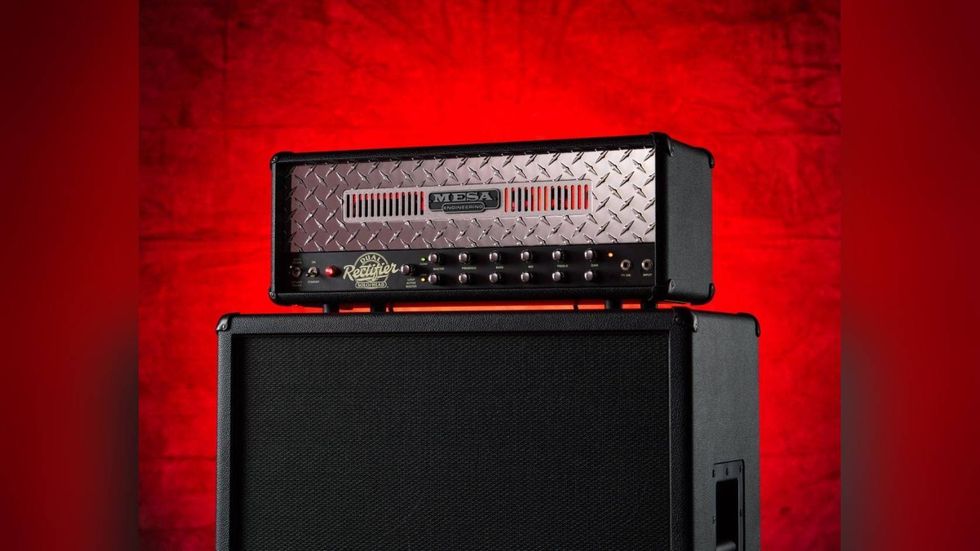
Following last year's return of the 90s Dual Rectifier Standard, MESA/Boogie is reissuing its 150-watt sibling, the 90s Triple Rectifier Standard. Like the original, it's built by hand in Petaluma, California.
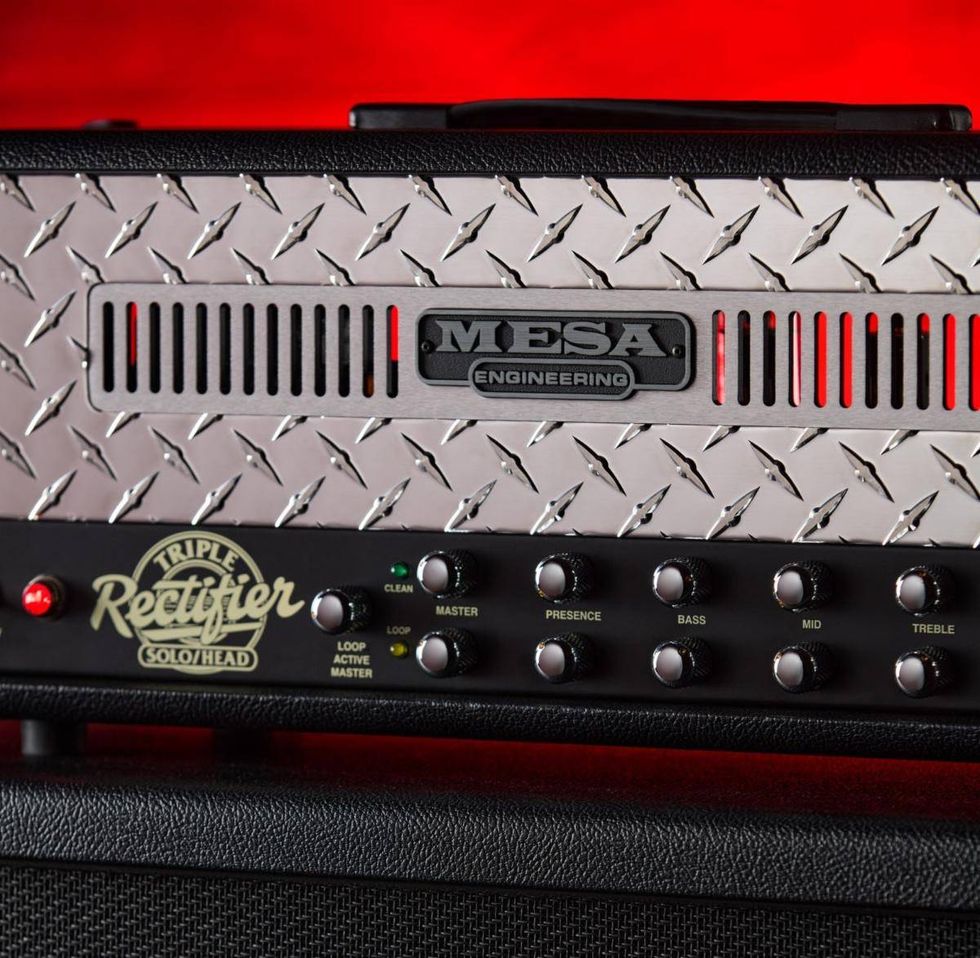
The Triple Rectifier arrived in 1992 alongside the Dual Rectifier Solo Head, scaling the design up to six power tubes and three rectifier tubes. It became a staple of '90s heavy music, especially among players using low tunings. The reissue comes in the original Standard Dress: black chassis, chrome knobs, Black Bronco vinyl, black leather corners, and a polished aluminum Diamond Plate grille.
"For players who tune low and play loud, the Triple Rectifier delivers the massive, unmistakable high-gain sound that changed the way heavy music sounded—and continues to define it today," says Andrew Ladner, MESA/Boogie's marketing manager.
The amp uses the early Rectifiers' two-channel layout. Channel 1 offers Clean and Vintage high-gain (Orange) modes and can be switched to the Modern (Red) voicing. Channel 2 defaults to Modern and can be switched to Vintage, and it adds a Normal/Tight switch for low-end control. Each channel has its own gain, treble, middle, bass, presence, and master controls.
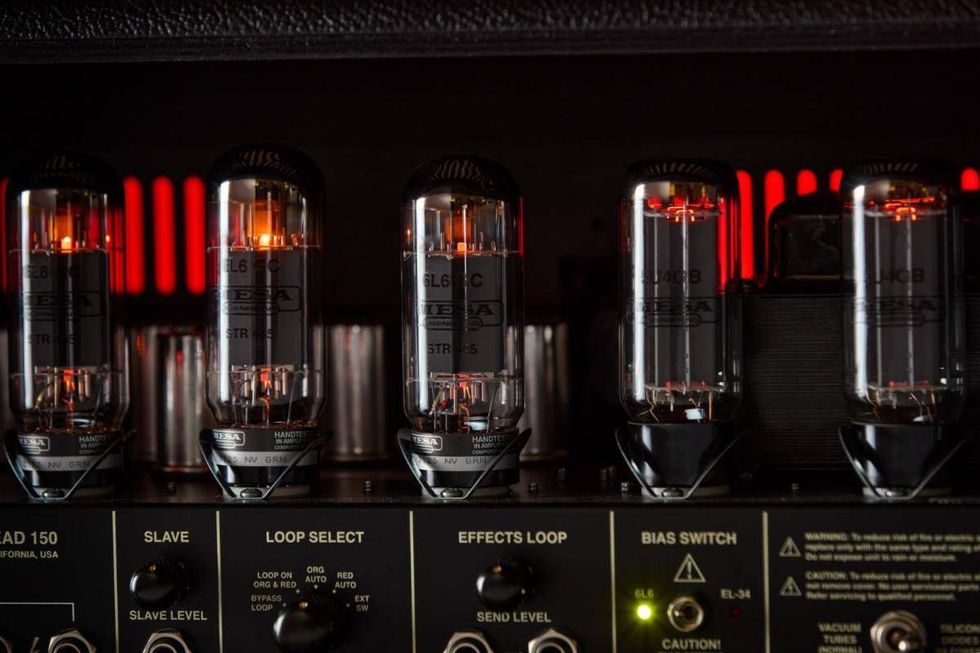
Six 6L6s drive the Class AB power section, and a rear-panel bias switch accommodates EL34s. Players can choose between three 5U4GB tube rectifiers and silicon diode rectification, and a Bold/Spongy switch alters the power section's response. Five 12AX7s run the preamp.
Key features:
- Dual channel simplicity – Simple, straightforward design (as compared to the current three-channel 2010 model), delivering killer tones and ease of use
- Channel Style/Cloning – Allows “cloning” of the mode voicings of either channel
- Patented switchable rectifiers – Tube or silicon diode rectification to tune the sound, character, and feel
- 150-watts of robust Class A/B tube power – Bias Select for stock 6L6 or a swap to EL34 tube types
- BOLD/SPONGY “Variac” switch – Reduced voltage setting for increased harmonics and elastic feel
Other features include a tube-driven series effects loop with a global output level control, external switching jacks, a slave output, and five speaker outputs (one 16-ohm, two 8-ohm, and two 4-ohm). The head is housed in a Baltic birch cabinet with a cooling fan, measures 10" x 25 1/2" x 9 7/8", and weighs 48.6 lb. It ships with a one-button footswitch, a slipcover, and a five-year warranty.
The 90s Triple Rectifier Standard head carries a street price of $3199. For more information visit mesaboogie.com.
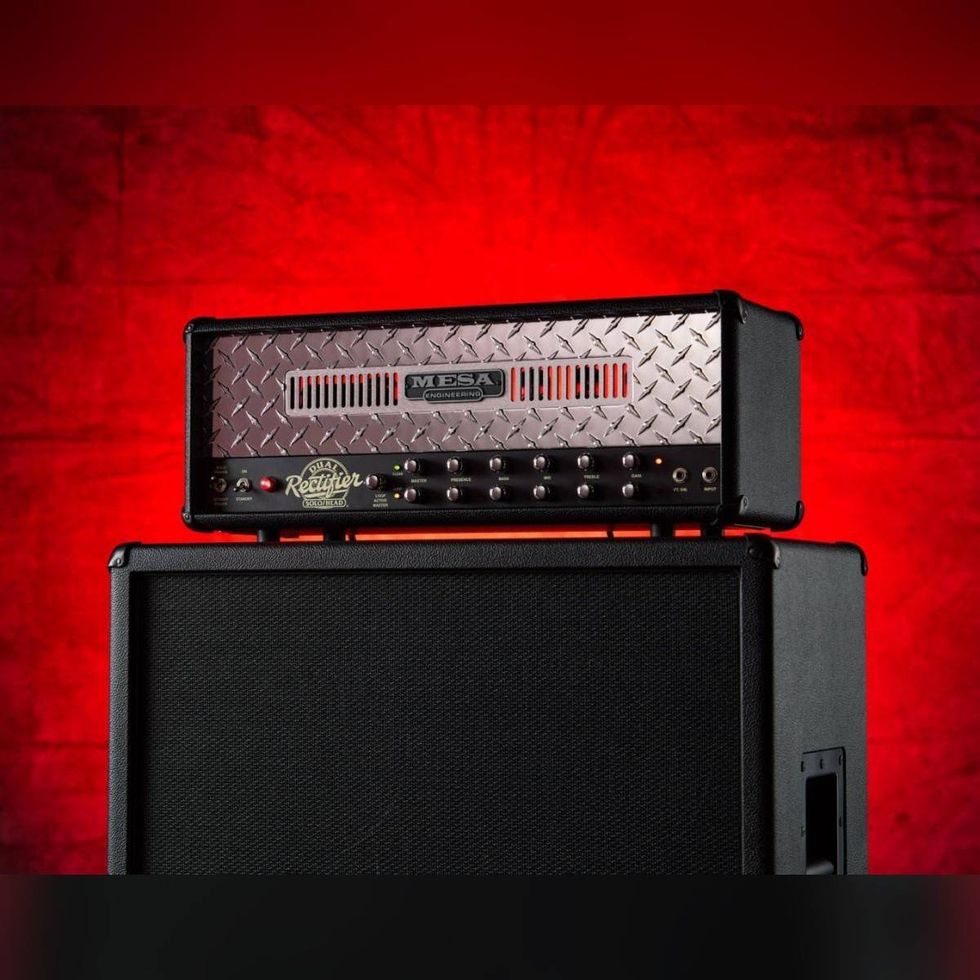
90s Triple Rectifier Standard
Following last year's return of the 90s Dual Rectifier Standard, MESA/Boogie is reissuing its 150-watt sibling, the 90s Triple Rectifier Standard. Like the original, it's built by hand in Petaluma, California.
Esoterica Electrica: Why I Quit Making, and Playing, Guitars
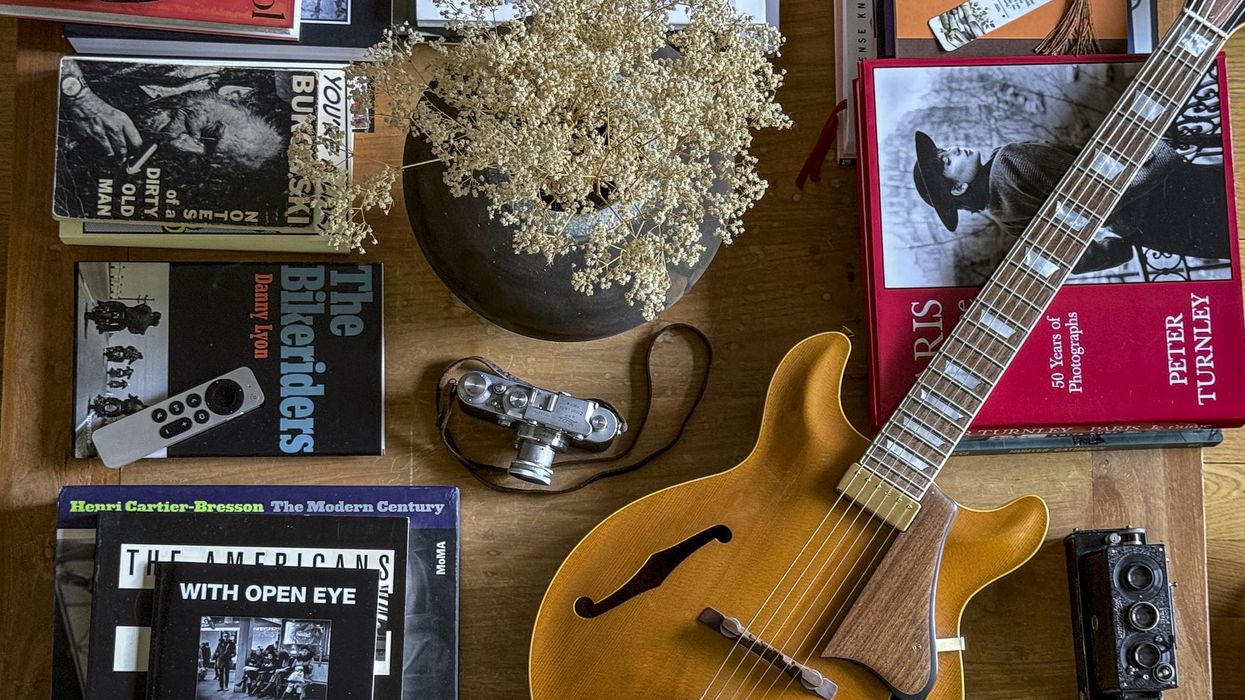
Have you ever wanted a reset? Not exactly a clean slate, total erase, and start over, but maybe a window into a fresh perspective? Most of us want to get better at what we do, and expand our vocabulary within our craft. You can double down on your work or spend more time reading, watching, practicing, and experimenting with your artistry. Those are the building blocks of mastery, but sometimes you get stuck. Inadvertently, I found something that broke the cycle of repetition both in my playing and my building. I stopped.
I wasn’t planning to quit, but a series of events conspired to allow me to pause two of the practices closest to my heart. Going on vacation was the most obvious of breaks, but even before wheels up, I had stepped away from playing and making guitars, something I’ve done almost every single day of my life for six decades. It wasn’t a conscious decision—it happened slowly and almost invisibly. I was just tired, mentally and physically. I’ve written previously about creative block (“Jump Start,” in the October 2019 issue), but this was something totally different, closer to indifference. I felt guilty about it. I have to confess that, as puzzling as it was, it also felt like relief. What I hadn’t known was that there are actually names and tactics for doing what happened organically for me—I’d become a “reframer.”
In psychology and skill development, the name for this action is known as a strategic reset, or sometimes habit unbundling. I don’t care much for bullshit jargon, but the theory is legit. Playing an instrument or almost any other pursuit for a long time, your brain develops deep neural pathways. Over time you naturally plateau and/or pick up habits that are difficult to abandon. Stepping away for an extended period completely forces your brain to forget, or at least diminish automatic and stale routines. When you begin again, you can rebuild skills more consciously, sort of like from the ground up.
“The distance reminds you why you fell in love with music in the first place, which injects soul back into your own playing later.”
Refraining from the actual act of your pursuit is also called de-coupling. It can be done for short periods—or, as in my case, months. This doesn’t necessarily mean you shouldn’t enjoy listening to music, but there are some strategies to employ. Guitarists naturally pick out the guitar track in any recording, just as drummers and bass players have a tendency to focus on their own instrument’s role in any song. This unconscious habit is what I call “player brain.” Musicians tend to automatically translate the sounds they hear into the physical actions required to make them, which is natural, but can also make you deaf to the total ecosystem and emotion of the music. It can be intimidating as well because it focuses on technique. Turning off the “player brain” allows you to feel the raw tension, release, and mood of a track. That’s why stepping away can be important. The distance reminds you why you fell in love with music in the first place, which injects soul back into your own playing later.
Interestingly, the time I’d spent immersing myself in the world of guitars had also been a reset. I found that my retreat from guitar and my workshop bench opened up time to rekindle other passions that had laid dormant. Before I made guitars I went to school for photography, but life happened and playing and making instruments became my focus. When I picked up my camera again, it felt like the first time I played an electric guitar to make beautiful sounds and express myself. So instead of playing and building, I buried myself in photography, and surrounded myself with books, and doubled down on museums. It is a world that feels new, yet deeply familiar, in a satisfying way.
Lately I’ve returned to the guitar with a newfound appreciation for sounds beyond my old go-to licks and patterns. I’m no Allan Holdsworth, but I’m happy to make noise again. The workshop bench now beckons with the old feeling of getting to the end of the day and having something rewarding to show for it. In my case, it wasn’t a planned abeyance, but that doesn’t mean it can’t be. I hope that, if you are in need of a reset yourself, you’ll find the chance to join me in walking away—and returning to find more than what you left.
Rig Rundown: Mr. Phylzzz
Chris Kies met up with Clinton Jacob of Mr. Phylzzz at the Cobra in East Nashville, where the two-piece was touring behind Fear the Lord. His rig is built to survive a player who squeezes guitars to death and plays anywhere that’ll have him—including, once, a public restroom. Have a look at some quick highlights below, and tune into the new Rig Rundown for all the details.
Brought to you by D’Addario.
Buzz Told Him So
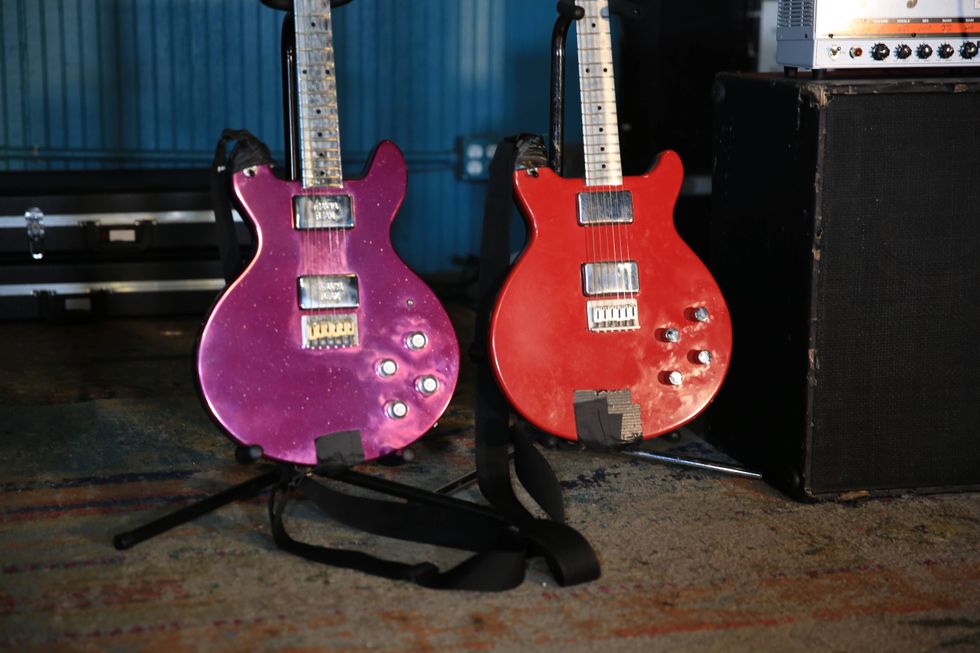
On the Twins of Evil tour with the Melvins and Boris, Clinton watched King Buzzo go almost 40 nights without adjusting a thing on his guitar, while his own guitars kept cracking and breaking. Buzzo’s pitch: you’ll get one, you’ll hate it, then you’ll love it. Clinton ordered an Electrical Guitar Company King Buzzo model, hated the paper-thin neck, and two weeks later couldn’t imagine playing anything else. It’s hollow with a plastic back, it’s a tank, and the strap locks are a wad of gaffer tape.
Hannah Montana Purple
The newest EGC arrived the night before the shoot. Clinton asked for something the builder had never done before, then handed the color chart to his partner, who picked it. It’s got a side-mounted toggle and the same pickups as the original Travis Beans, which run hot. Two things here aren’t standard: the hollow plastic back, done because Clinton wants his guitars light, and the slim neck, since this model normally comes with a chunky C.
Wood Tones
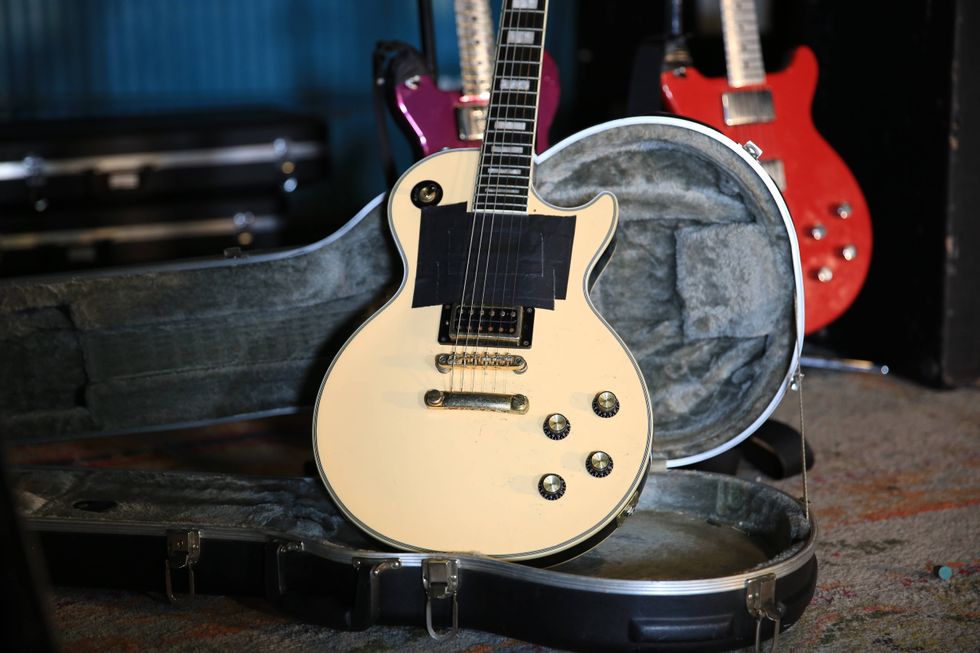
This Epiphone is named Chase—a gift from Clinton’s partner in Texas after he snapped the neck off an earlier one—and it was his main guitar for years before the EGCs arrived. It’s been “dumbed down” to a volume knob and the bridge pickup. Now it’s what saves him from getting electrocuted: an EGC is metal all the way through, so a ground tester is mandatory equipment, and any venue with an open ground means wood or nothing.
Both On, All Night
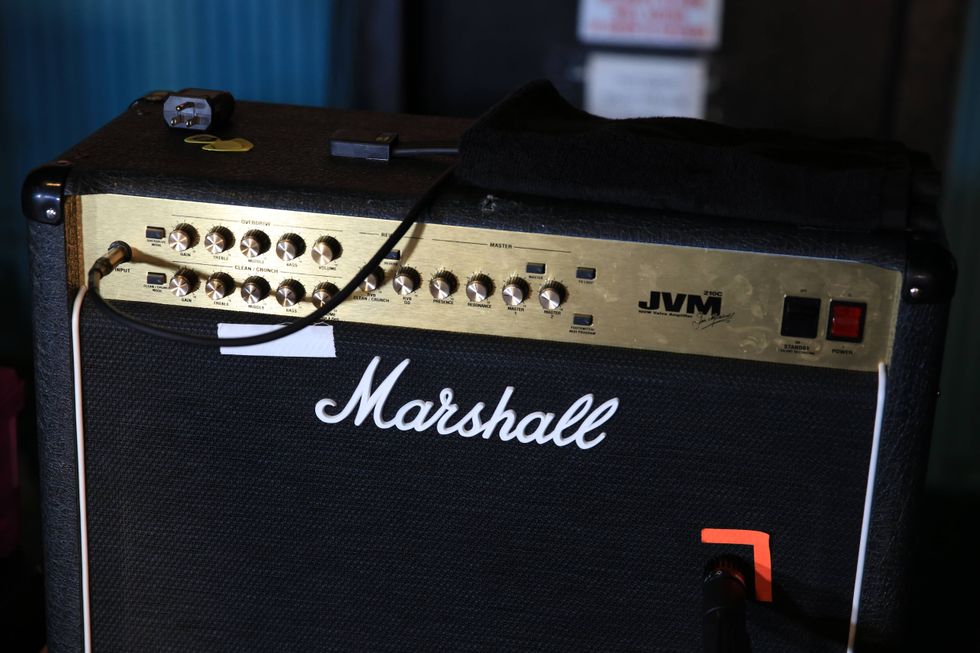
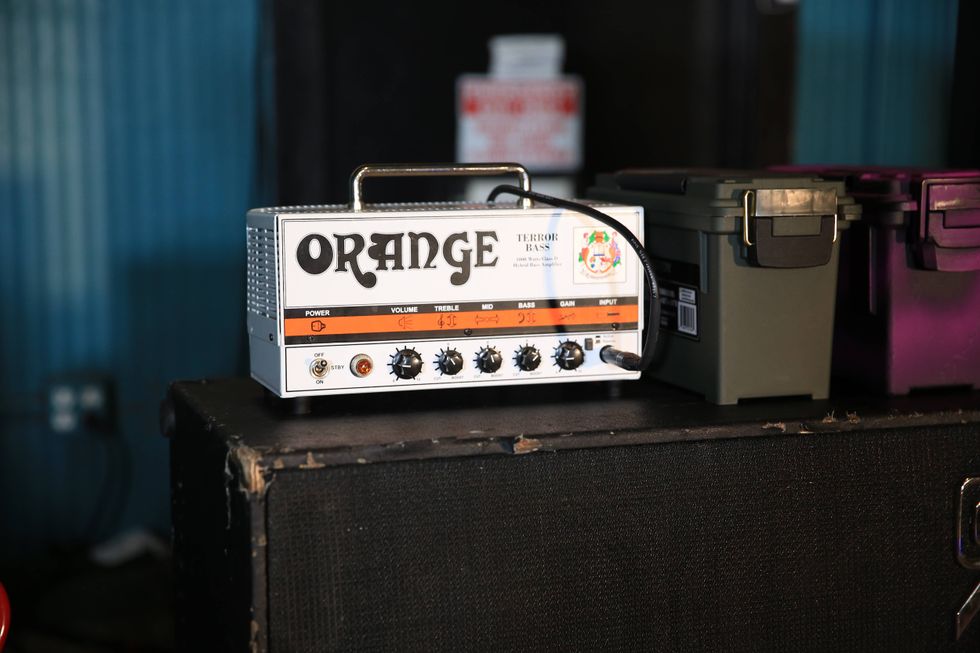
A Marshall JVM410 combo and an Orange Terror Bass run at the same time and never get switched off. He keeps it on one channel at three and watches for the green light. The Orange is dialed darker to offset how bright the aluminum guitars are, and both run clean—the guitars are nasty enough on their own. Cabs are a 2x12 and a 4x10.
Mr. Phylzzz’s Pedalboard
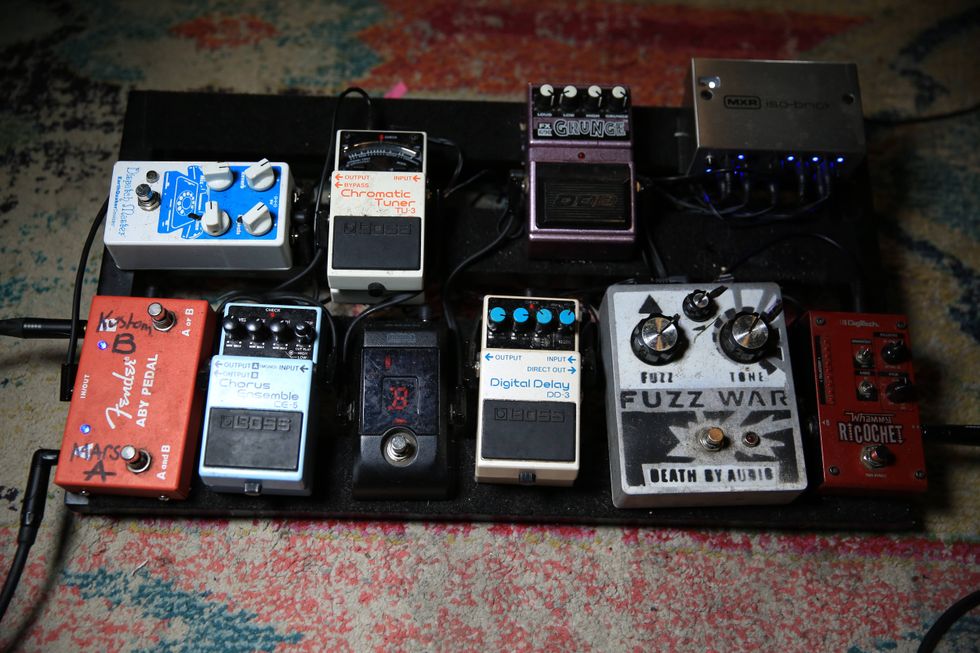
The Death by Audio Fuzz War is the whole tone, with everything set at 2 o’clock and marked so it stays there. A DOD Grunge, everything peaked, supplies a thin AM-radio nastiness for dynamic drops. A Boss DD-3 holds the wall of noise out longer before he cuts it, an EarthQuaker Devices Dispatch Master handles the haunted-house material, a Boss CE-5 Chorus Ensemble adds a little color for “Emma Draws a Dog,” and a DigiTech Whammy Ricochet covers dive bombs.
Unlock the crucial wah tone of Iron Maiden’s Killers album with this discounted signature Cry Baby pedal

Calling all Iron Maiden fans – you can now get your hands on the signature Iron Maiden x Dunlop Cry Baby wah pedal that launched earlier this year at The NAMM Show for less.
Now reduced to £169 at Thomann as part of its Guitar Day deals for a limited time only, fans and collectors alike can own the crucial wah tone used across the band’s landmark Killers album from 1981, which is certified Gold in both the US and UK.
- READ MORE: The best picks for electric guitar and acoustic guitar, from Jim Dunlop, Fender, Ibanez and more
The pedal has a rather cool design on its face, featuring none other than the band’s skeletal mascot, Eddie, taken right from the Killers album artwork. It also features the Killers title in the same font it appears in on the album’s cover, while the band’s logo runs along the side of the unit.
At the time of its release earlier this year, Metallica’s Kirk Hammett was one of the first artists to get his hands on the pedal. He shared a video to Instagram opening the pedal, in which you can also get a glimpse of its packaging – also worthy of display.
Beneath its Iron Maiden design and fittingly metal exterior, the pedal itself is essentially the classic GCB95 Cry Baby Standard Wah. Find out more and get a better look in the short video below:
Iron Maiden were inducted into the Rock & Roll Hall of Fame this year, five whole decades after their debut. But interestingly, the band haven’t felt like making much of a fuss about it.
Speaking to Metal Hammer in June, bassist Steve Harris and frontman Bruce Dickinson made it clear that while they’re grateful for the recognition, it’s never been something they’ve spent much time thinking about.
Harris said, “It’s never really bothered me one way or the other, because awards aren’t what we do this for. But in a weird way I’m glad it’s happened so the Americans will stop banging on about it. To me, if you get offered something, you say, ‘Thank you very much.’ But did I lose sleep over getting it or not getting it? No.”
Shop the Iron Maiden CryBaby pedal at Thomann now.
The post Unlock the crucial wah tone of Iron Maiden’s Killers album with this discounted signature Cry Baby pedal appeared first on Guitar.com | All Things Guitar.
“I’m going to play in front of how many? 40,000?!”: America’s Got Talent winner Nene Royal on being invited to open for Avenged Sevenfold
![Nene Royal [main], M Shadows of Avenged Sevenfold [inset]](https://guitar.com/wp-content/uploads/2026/09/Nene-Royal-hero@2000x1500.jpg)
It’s the stuff dreams are made of. Just months ago, 16-year-old Rattikarn Amloy was a relatively unknown guitar player. But following an audition on the 2026 season of America’s Got Talent – during which she performed a blistering cover of Cranberries classic Zombie – her life changed forever.
Performing as Nene Royal, the guitar sensation – who originally hails from Phuket, Thailand – stormed her way through the competition, dazzling audiences and the nation with covers of Soundgarden’s Black Hole Sun, The White Stripes’ Seven Nation Army and Muse’s Hysteria, and even joining Linkin Park themselves for a performance of their track The Emptiness Machine, before going on to win the entire show last week.
Yep, Amloy is just 16 years of age and she’s already achieved success most musicians only dream of. But she’s just getting started. In fact, her whirlwind story continues, as she’s been invited to open for one of metal’s biggest bands, Avenged Sevenfold, for their upcoming Singapore show on 13 October.
In the past few months, she’s gained considerable experience performing to large audiences – not to mention millions viewing from home. But opening for A7X, one of her favourite bands? The pressure’s on…
Speaking to Metal Hammer in a new interview, the guitarist explains how she landed the gig to open for Avenged. “The managers in Singapore text me: ‘Oh, I hear you wanna play with Avenged Sevenfold?’” she recalls.
“I was like, ‘Yeah!’ They said, ‘Well, Avenged Sevenfold want you to support them.’ They asked for me, ‘Do you wanna do it?’ And I was like, ‘Yeah!’”
As for her feelings in the runup to the show, she confesses she’s both excited and scared in equal measure.
“It’s my first time playing support to Avenged Sevenfold, so I was like, ‘I’m scared!’ And I’m going to play in front of how many? 40,000!”
Elsewhere in the interview, the Royal reveals she had no idea she was going to perform with Linkin Park before doing so during the AGT final. “I was practising on my own. I thought I was going to play alone,” she says. “But when I practised, a cameraman just came in, and then Linkin Park came in. I was like, ‘What’s going on?!’ I don’t know if Linkin Park are just gonna come and take a video, some shot, that’s all. But actually, [they] say, ‘We’re gonna join together onstage,’ and I was like, ‘There’s no way!’ My dream’s come true.”
You can catch Nene Royal opening for Avenged Sevenfold on 13 October at the Singapore Indoor Stadium. Tickets are available via the Avenged Sevenfold website.
The post “I’m going to play in front of how many? 40,000?!”: America’s Got Talent winner Nene Royal on being invited to open for Avenged Sevenfold appeared first on Guitar.com | All Things Guitar.
John Mayer thinks big guitar makers have “punished” affordable guitars by making them look worse than expensive ones
![John Mayer performing live [main], PRS Silver Sky Defender [inset]](https://guitar.com/wp-content/uploads/2026/09/John-Mayer-PRS-colour-hero@2000x1500.jpg)
One of the coolest guitar releases of the year so far – hell, in recent memory – was the spate of limited-edition PRS Silver Skys outfitted in classic Land Rover Defender colourways launched last earlier this month.
It marked the announcement of an unexpected partnership between the guitar maker and Jaguar Land Rover, driven chiefly by the Silver Sky’s namesake John Mayer’s love of the legendary SUV.
The collab consists of eight Silver Sky models boasting Defender finishes: four USA-made ones sporting classic Defender colourways like Arles Blue and Sandglow Yellow, and four SE models wearing some more contemporary finishes, like Petra Copper and Woolstone Green.
 Credit: PRS
And a big part of the collaboration for Mayer was ensuring those with more SE-adjacent budgets weren’t being shortchanged in terms of the look of the guitars in comparison to the more expensive USA-made models.
In a new interview with Guitar World following the launch, the guitar maestro – who has also just announced a huge six-night residency at the Las Vegas Sphere, his second stint at the venue after a lengthy residency with Dead & Company in 2024 and 2025 – explains why it was important to make sure the more budget-friendly Silver Sky Defenders also looked the part.
Notably, the SE models – which despite their limited run are priced at a reasonable £799 apiece – are the first Silver Skys to feature a highly requested black pickguard.
“It’s almost like the first appearance of Wolverine. Everyone’s waiting for it,” Mayer says. “I think it’s interesting that it makes its appearance on the SE line as opposed to just having it trickle down from the Core line.”
“I thought it was nice to give something to the SE,” he continues. “When I was growing up, the more accessible guitar got punished for being more accessible. I learned a lot from the SE.
 Credit: PRS
“I originally had the idea like, ‘Oh, you tier it.’ Then guitar lovers of the world spoke to me. I learned that some people are going to have an SE forever. It doesn’t have to be a consolation and someday you’ll work your way up. That’s when I thought, ‘There should be a little bit to separate the lines.’”
It is, indeed, common for guitar companies to separate colourway options for their differently priced guitar lines, and some argue that the more aesthetically pleasing colours tend to be available on more expensive models. But that was the opposite of Mayer’s approach to the Defender collaboration.
“Teaming up with Defender to offer the Silver Sky guitar in their legendary 4×4 colors is a dream come true,” said Mayer, a keen Defender enthusiast, when the collab was announced.
“I’ve always chosen colourways based on objects and materials that inspire me in the world, and as a collector and lover of Defenders, this collaboration is the perfect crossover between two great passions of mine.”
Learn more about the new limited-edition Silver Sky Defender guitars at PRS.
The post John Mayer thinks big guitar makers have “punished” affordable guitars by making them look worse than expensive ones appeared first on Guitar.com | All Things Guitar.
Need a new guitar? Pining for a pedal? Get 30% off loads of gear goodies with Guitar Center’s Guitar-A-Thon

[Editor’s note: Guitar Center caters to US customers. If you’re reading from elsewhere, you’ll be shown similar deals.]
Guitar Center is currently offering up to 30 percent off a range of popular gear across its website, all thanks to its big Guitar-A-Thon event.
Running right now all the way through 7 October 2026, you can save on guitars from Fender, Epiphone, Squier, and even on a range of popular pedals too.
- READ MORE: Want to test the prototype from Guitar Center’s new in-house guitar brand? Here’s how you can
If you’re new to guitar, or perhaps you’re looking to upgrade your rig, then we’ve found some great deals to help you out. We’ve rounded up some of the best highlights for players of all tastes and abilities below.
Fender Player II
Get up to 30 percent off on a range of Fender Player II models, including GC exclusive models such as the Fender Player II Telecaster in British Racing Green (now $679.99), Fender Player II Stratocaster HSS Plus Top in Blue Burst (now $650.99), and the Fender Player II Stratocaster HSS in Ocean Turquoise (now $622.99) – just to name a few.
Epiphone Les Pauls
Epiphone offers a range of Les Paul models for a more accessible price point than your typical Gibson models, but with even more savings on top, you can really grab a bargain. Most of these discounted models are also GC exclusives, with some particularly spectacular finishes. Get a Les Paul Modern Pro model in Wine Red for $499 or a Les Paul Custom Quilt model in Cobra Burst for $649.
 Credit: Guitar Center
Squier starter kits
Perfect for beginner players of all ages, Squier guitars make for a great starting point, and these discounted packs come with everything you need to get learning. For just under $300, you can get a Stratocaster in either Arctic White or Sonic Blue, with a compact Squier Frontman 10G amplifier, a gig bag, instrument cable, plus a strap and picks.
Save on big-brands across pedals
In need of a new distortion pedal? Obsessing on the idea of an overdrive? Grab a colourful BOSS Super Overdrive or Distortion pedal with a matching colour-coordinated cable included, now for $69.99 each, discounted from $99.99.
You can also save on further pedals such as an MXR EVH 5150 Bumblebee Overdrive, now down to $199.99, the ProCo RAT2 for $88, and many more, as well as deals on pedalboards and accompanying cases.
 Credit: Guitar Center
To view all Guitar-A-Thon deals, head over to the Guitar Center website.
The post Need a new guitar? Pining for a pedal? Get 30% off loads of gear goodies with Guitar Center’s Guitar-A-Thon appeared first on Guitar.com | All Things Guitar.
Warm Audio Announces Mod Series Pedals, Including Black Keys Peach Fuzz
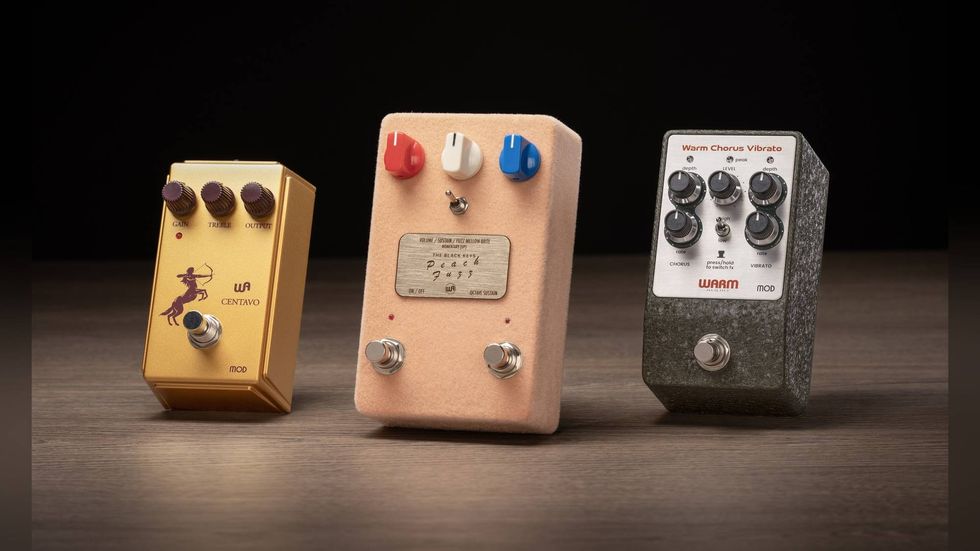
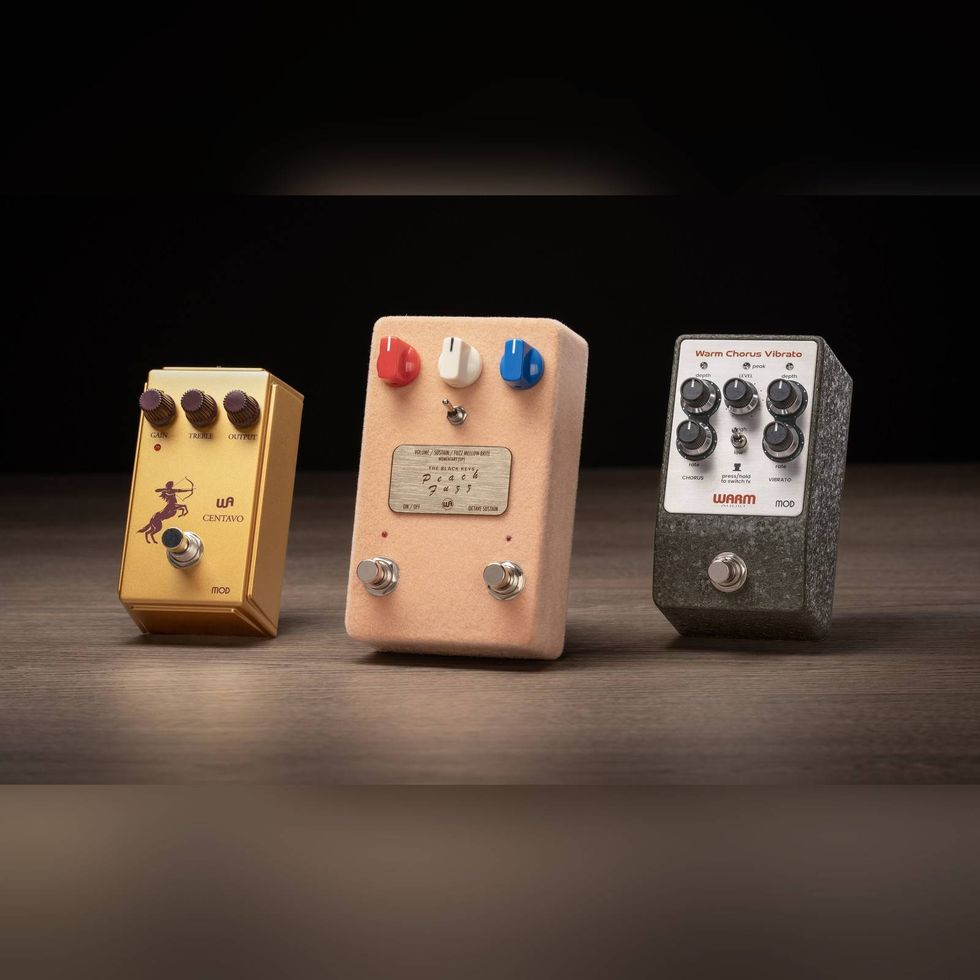
Warm Audio has introduced the Mod Series, a new line of guitar pedals that redesigns select Warm Audio recreations with slimmer, more pedalboard-friendly footprints and added features on select models.
The Mod Series debuts with three modified pedals, establishing a new and expanding lineup within the Warm Audio pedal family:
- Centavo Mod | A slimmer, pedalboard-friendly design of Warm Audio’s recreation of the most sought-after golden overdrive, while preserving the same vintage-accurate circuit and premium components.
- WA-C1 Mod | A compact design of Warm’s faithful recreation of the celebrated all-analog chorus and vibrato circuit, now with an added preamp bypass.
- The Black Keys Peach Fuzz | Developed in collaboration with Dan Auerbach, guitarist for The Black Keys, a pedalboard-friendly version of Warm Audio’s vintage-inspired ’70s Foxy-style fuzz and octave circuit, customized with selectable momentary or latching octave-up control.
Centavo Mod: Compact High-Headroom Professional Overdrive Pedal
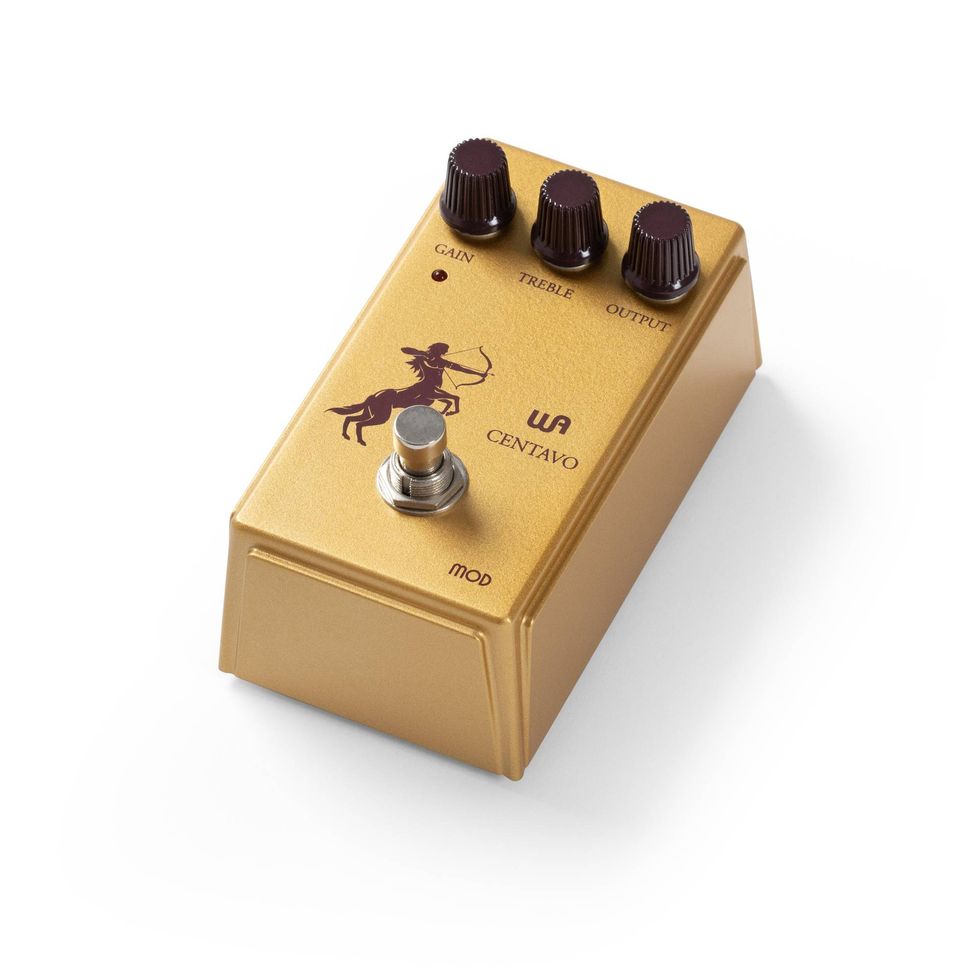
The Centavo Mod delivers the same vintage-accurate circuit and premium components as the full-sized Centavo in a slimmer design with top-mounted jacks for easier pedalboard integration. Built for everything from clean boosts and transparent overdrive to pushing an already-driven amp, it retains the familiar gain, treble, and output controls along with the MOD switch from Warm Audio’s original recreation, which extends low-end response for a fuller, throatier character on the lower strings. Inside, carefully selected components including TL072 op amps and premium diodes preserve the signature clean boost, edge-of-breakup, and hard-clipping tones of the original circuit.
Enjoy the videos and music you love, upload original content, and share it all with friends, family, and the world on YouTube.
WA-C1 Mod: Compact Stereo Chorus & Vibrato Pedal With Added Preamp Bypass
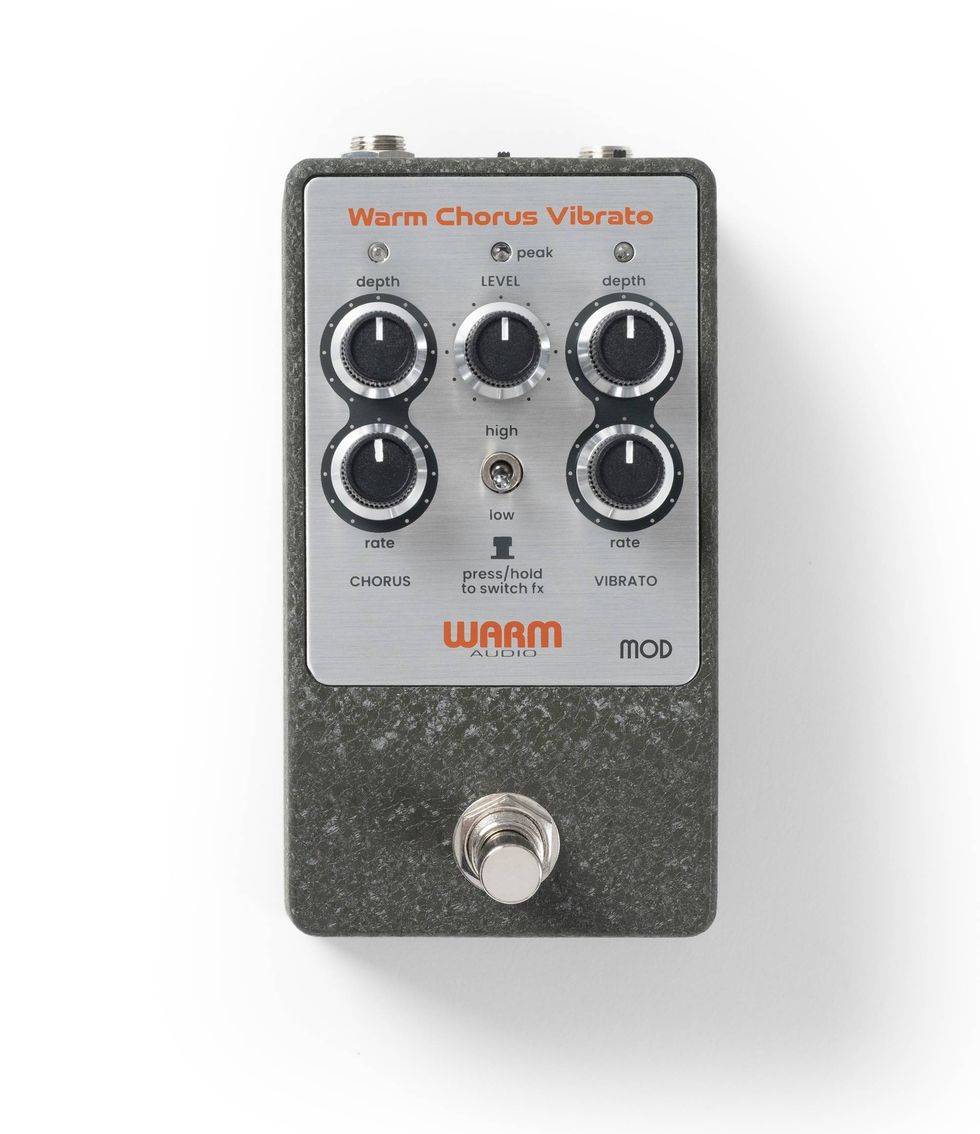
The WA-C1 Mod preserves the rich, all-analog chorus and vibrato character of Warm Audio’s original recreation in a slimmer, more pedalboard-friendly design with top-mounted jacks. New to the Mod version, the celebrated analog preamp can now be bypassed for greater control over gain staging in complex signal chains. The WA-C1 Mod retains the expanded control of Warm Audio’s original recreation, including independent chorus depth and rate controls, selectable Hi-Z impedance, wet/dry stereo outputs, and the lush BBD chorus and three-dimensional vibrato at the heart of the legendary circuit.
Enjoy the videos and music you love, upload original content, and share it all with friends, family, and the world on YouTube.
The Black Keys Peach Fuzz: Fuzz FX Pedal With Selectable Octave-Up Hold
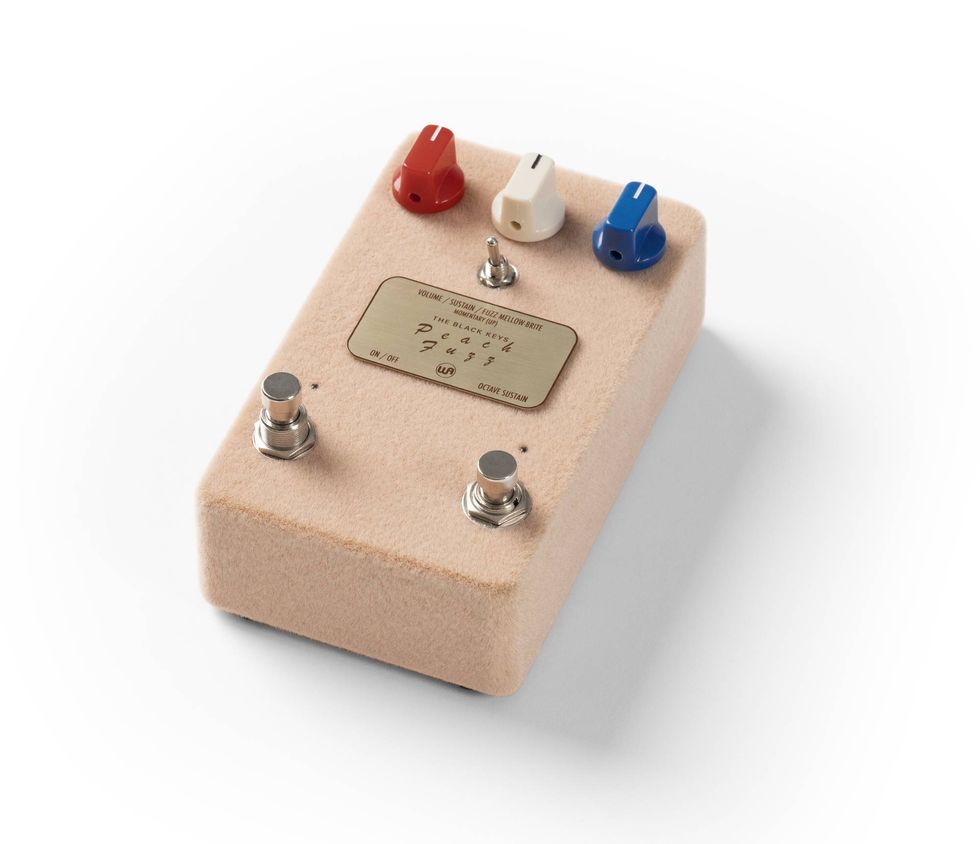
A collaboration between The Black Keys and Warm Audio, the limited-edition Peach Fuzz delivers Warm Audio’s vintage-inspired ’70s Foxy-style fuzz and octave circuit in a new slimmer design, with the searing saturation and octave-up solo magic that define the original. Covered in thick flocked velvet in a special peach color celebrating The Black Keys’ 2026 release, Peaches!, the pedal moves from mellow fuzz and gritty crunch to huge, saturated tones and soaring octave leads. Working closely with The Black Keys guitarist and frontman Dan Auerbach, Warm Audio added a selectable momentary/latching octave-up hold switch, making it easy to kick in octave tones for riffs, solos, and creative studio moments.
Like all Warm Audio gear, the Mod Series pedals are meticulously hand-tested and inspected and come with a 5-year warranty.
Enjoy the videos and music you love, upload original content, and share it all with friends, family, and the world on YouTube.
The Warm Audio Mod Series pedals carry the following street prices:
Centavo Mod — $189 USD | €219 inc. VAT | £189 inc. VAT
WA-C1 Mod — $199 USD | €229 inc. VAT | £199 inc. VAT
The Black Keys Peach Fuzz, Limited Edition — $199 USD | €229 inc. VAT | £199 inc. VAT
Mod Series
Warm Audio has introduced the Mod Series, a new line of guitar pedals that redesigns select Warm Audio recreations with slimmer, more pedalboard-friendly footprints and added features on select models.
How to Play “Heart of Gold,” Neil Young’s Simple but Enduring Hit

Martin D-X2E Molly Tuttle review: “if I closed my eyes, I really could tell myself I was playing a 1940s guitar”

$999/£999, martinguitar.com
The world of bluegrass flat-picking acoustic guitar is in rude health at the moment, as a new generation is elevating and propagating the form to new audiences and new levels – from Billy Strings and Trey Hensley, to Chris Eldridge and Cody Kilby, and many others.
And then there’s Molly Tuttle. The 33-year-old Californian is a two-time IBMA guitar player of the year and back-to-back winner of the Grammy Award for Best Bluegrass Album, and was even nominated in its hugely prestigious Best New Artist category in 2023. That’s an honour shared in recent years by everyone from Noah Kahan and Gracie Abrams, to Ice Spice and Chappell Roan.
All of which to say is that Tuttle is not just a flatpicking guitarist of rare talent, but one whose artistry is crossing the floor to bring a whole new audience into the realm of bluegrass and Americana.
As is usually the case with flatpickers, Tuttle has been a great exponent of the Martin dreadnought throughout her career, and so it makes all the sense in the world that Martin would honour her not just with one signature model, but two. There’s a fancy Nazareth-made D-18 for the well-heeled ($4,199.99), but interestingly also a more affordable Mexico-made version, we’re looking at the latter.
What is it?
The DX-2E Molly Tuttle is, like its US-made sibling, inspired by Tuttle’s most beloved and cherished Martin: a 1943 D-18. The most notable thing that sets it apart from a regular X Series dreadnought is the neck profile, which is a fast, comfortable 1940s carve with the same 1 11/16″ nut width. This 1941 carve has a soft V to it, and unlike most of the X Series guitars, it has a standard taper, so it doesn’t get narrower as you move up the neck.
The other striking differences are mainly cosmetic – the spruce top is finished with a lovely vintage sunburst, while the satin-finished HPL back and sides have a vintage mahogany pattern. The ebony fingerboard features a faux abalone and pearl custom Moon Phase pattern on it, and you also get a silver logo on the headstock, plus a set of open-gear tuners with custom oval buttons.
Otherwise, it’s pretty much the same as a standard Martin DX-2E – with a solid top, HPL back and sides, a select hardwood neck, and Martin E-1 electronics. You also get a plush Martin-branded gig bag.
 Image: Press
Build and playability
Upon pulling the guitar out of the aforementioned gig bag, the aesthetics of Tuttle’s DX-2E really grabbed my attention. The satin-finished top with its vintage sunburst gives a very ‘old’ vibe, and sat on a guitar stand across from my desk, it really does look like a pre-war Martin, at first glance at least. The more rounded shape of the headstock compared to a modern Martin, combined with those open-gear tuners, really does change the vibe of the guitar and make it seem more classic and worn in – a nice touch.
Picking it up, and on close inspection I’m less taken with the lack of binding – a feature common to all X Series but one that really does make the guitar feel less premium. I understand that there are likely cost and range-differentiation reasons behind this (the Road Series exists after all!) but on a signature model like this, especially one that costs $200 more than a regular DX-2E, it’s a shame to have the illusion broken so easily.
Because when you play the thing, it’s very easy to forget that you are in fact playing an X Series, because this satin-finished 1941 neck is an absolute superstar. I’ve played a few pre-war Martins, and you can tell the care and attention that’s gone into getting this profile and feel just right. When I closed my eyes, I really could tell myself I was playing a 1940s guitar.
What’s more, in contrast to say, the slimmer nut of the Billy Strings model that seemed more readily designed for bluegrass picking at speed, the fingerboard here feels like a nice, accommodating middle ground that will suit any playing style. It’s something that the original 40s Martin dreadnoughts did so well, and it’s very impressive that the company has recreated it here.
 Image: Press
Sounds
It might be damning the DX-2E with faint praise to say that it sounds like a standard Martin dreadnought, but in truth that’s exactly what it’s supposed to be. It’s absolutely not going to trick my ears into thinking that it’s a 1940s guitar in the way it fooled my eyes and hands, but this is a sub-$1,000 guitar we’re dealing with here, c’mon!
What it offers is a powerful, strident voice that’s warm and subtle, and I do notice a bit more treble and mid-frequency bite than a typical Martin dread, which is all rather pleasant.
Plugged into an amplifier, I found the E-1 system to be very usable and effective – it does a nice job of replicating the unplugged sound. The subtle soundhole controls are really handy in the heat of battle, as is the onboard tuner, which looks up at you from inside the bottom of the soundhole. Some may not love what it does to the aesthetics of the guitar, but I like how the E-1 system’s battery is stowed behind a flip-up plastic cover around the strap button – it’s a lot easier than fishing around the guitar for a velcro’d battery inside!
 Image: Press
Should I buy one?
This is another really impressive Mexico-made signature model from Martin – the Navojoa team is doing some really fantastic work right now, and we’re seeing the best of it in how they’re being entrusted with artist guitars like these.
The great thing about this guitar in particular is how much of a great all-rounder it is – that neck is one of the finest Martin carves I’ve felt outside of the Nazareth factory, and you can tell it’s put a lot of time and effort into nailing the playability and feel of Tuttle’s guitar.
It’s a shame that the aesthetic appointments let things down somewhat, but the thing about looks is that they’re subjective – and the rest of the package far outstrips its price tag.
Alternatives
The regular D-X2E ($/£749) doesn’t have the wonderful neck of the Tuttle version, but it’s still a fine guitar for a lot less money. The other signature guitar in the X Series is the D-X2E Billy Strings ($949) and is another fine guitar that’s more ready to shred. Taylor’s Academy 10E ($799) is another quality Mexico-made dreadnought for not a lot of money.
The post Martin D-X2E Molly Tuttle review: “if I closed my eyes, I really could tell myself I was playing a 1940s guitar” appeared first on Guitar.com | All Things Guitar.
Pages
