
Music is the universal language
“Glory to God in the highest heaven, and on earth peace to those on whom his favor rests.” - Luke 2:14
Norse Guitar Feeds
The best deals from Thomann Guitar Days – save up to 60% on guitars from Fender, Gibson, Strandberg, Solar and more

In the market for a new guitar? Perfect timing, as Thomann has just launched its Guitar Days sale, which across the rest of September, offers discounts of up to 60% on a huge range of guitar gear.
Whether you’re looking for your first guitar or simply another instrument to add to the collection, Guitar Days has deals running the gamut of price points, so regardless of your budget, you’ll find your perfect new guitar in no time.
Naturally, as there’s hundreds of deals on offer – over 500, to be precise – it’s a bit of a task to sift through them all to find the right one for you. Thankfully, though, we’ve scanned the entire sale to find the very best deals to make your life a little easier.
Budget-constrained/looking for something entry level? There’s a huge range of Thomann-owned Harley Benton electric guitars up for grabs, like the shred-ready Fusion-IV HSS RW SGD, discounted by 20%, down from £429 to £345. Or if you’re after a single-cut, try the SC-Custom III in Purple Satin, down 10% to just £232. This one’s fitted with Tesla humbuckers and a raft of player-friendly features, and could very well be your next riff machine for under £250.
Headless guitars are all the rage these days in the virtuosic prog metal world, so if this is your bag, you’ll need one in your collection. And during Guitar Days, there’s some solid headless options discounted until the end of September.
The top-rated Strandberg Boden Prog NX 7 Deep Blue has seen a massive 31% knocked off its price tag, taking this seven-string beauty down from £2,259 to just £1,555. Obviously fifteen hundred quid ain’t cheap, but £700 in savings is nothing to be sniffed at. Specs include a swamp ash body with a flame maple veneer, a carbon fibre reinforced neck, Fishman Fluence pickups and a headstock featuring – oh no, wait, that’s missing.
Meanwhile, there’s a six-string option available, too – the Strandberg Boden Metal NX 6 in Black Granite, discounted by 26%, now just £1,350 instead of £1,825. This one sports Suhr Aldrich humbuckers, a carbon fibre-reinforced neck, and a basswood body.
If you want a headless guitar at a fraction of the price, try the Hils Next HN5 Met. in Coral Orange, with nearly half off the price tag at just £291 down from £511.
In the guitar world, Fender and Gibson remain the two big dogs. So if one is missing from your collection, now’s the time to branch out… There’s a number of Fender and Gibson guitars on offer during Guitar Days, like this Les Paul Studio, down 18% to just £1,135 from £1,390.
Or if you’ve got a little more budget to play with, a Gibson Firebird is a prestigious addition to any guitar collection. This Firebird Custom is discounted by £600, and is now £3,490 throughout the Guitar Days sale.
On the Fender side, you can get this Made-in-Japan ‘60s Jazzmaster for just £1,199 down from £1,350.
If none of these tickle your fancy, take a look at some other highlights we’ve picked out below!
And if there’s still nothing here that’s tempting you, feel free to head over to Thomann to browse the full Guitar Days sale yourself!
The post The best deals from Thomann Guitar Days – save up to 60% on guitars from Fender, Gibson, Strandberg, Solar and more appeared first on Guitar.com | All Things Guitar.
Spark PEDAL: Positive Grid crams an entire guitar rig – with amps, effects, a looper and Bluetooth – into a compact pedal format

In just 15 years, Positive Grid has established itself as one of the most innovative guitar gear makers in the game. Lately, most of the San Diego-based brand’s equipment has seen AI as a key selling point. Take BIAS X, for example, a comprehensive in-the-box amp suite featuring AI-driven text-to-tone capabilities. Or the Reactor, a physical amplifier that ships with an AI chatbot…
But its latest release sees the company foray into the world of floor-based amp modellers, placing less emphasis on AI this time around and returning to the basics that made its flagship Spark amps so popular: top-quality tones, Bluetooth connectivity for jamming and practice, and a massive suite of digital amps and effects to play with.
Built on Positive Grid’s HD Tone Engine – the same DSP architecture found in the flagship Spark 2 – the Spark PEDAL offers guitarists 33 onboard amp models and 43 effects, as well as access to over 100,000 tones via PG’s online ToneCloud tone-sharing community.
The Spark PEDAL features an intuitive set of controls, with multi-function knobs depending on the mode selected. In Amp Mode, these knobs adjust your standard amp parameters, like Gain, Bass, Mid and Treble. Meanwhile, switching to FX Mode makes these knobs control Drive, Modulation, Delay and Reverb depth. The centre multi-function knob can be held down to activate a built-in tuner, while guitarists can also store up to six presets across two banks via the onboard footswitches.
There’s also an onboard 60-second looper, which can be operated via the unit’s footswitches, meaning no menu navigation and seamless looper access. Guitarists can also jam along to tracks via a mobile Bluetooth connection, and practice silently using the stereo headphone out.
In terms of connectivity, the Spark PEDAL can function in a range of scenarios. Alongside its functionality as a standalone floor-based amp pedal, the amp section can be bypassed and the unit used as an effects unit in front of an existing rig, it can be used on an existing pedalboard, and even as an audio interface for desktop recording.
AI has made up a big part of many of Positive Grid’s most recent products, and via the free Spark app, Spark PEDAL users can also utilise Text to Tone to describe and be delivered any tone they can imagine. These tones can then be either saved or manually tweaked further.
 Credit: Positive Grid
Additionally, the Spark PEDAL features an impressive onboard battery, with up to seven hours per charge.
The Spark PEDAL is available now for $199. For more information, head to Positive Grid.
 Credit: Positive Grid
The post Spark PEDAL: Positive Grid crams an entire guitar rig – with amps, effects, a looper and Bluetooth – into a compact pedal format appeared first on Guitar.com | All Things Guitar.
Sweetwater CEO Mike Clem on what makes them different: “It’s not about profits. It’s about how we introduce a new generation to the joy of making music”

When Mike Clem joined Sweetwater back over 20 years ago, the Indiana-based retailer was a $2 million a year business. Nowadays, the US retail giant is knocking on the door of $2 billion. In that time, Clem has steered Sweetwater’s evolution into America’s biggest music eCommerce brand. But despite his technical background, his love of music has driven his rise to the top of the brand.
“I was a band geek by day, and a rock star at night!” Clem chuckles. “I’d be in smoky bars till 3am and then up in the morning playing at church. I just absorbed as much music as I possibly could.”
Clem nearly went to music college, only deciding at the last minute to pivot to his “second love” of computer science. Armed with the software skills to take advantage of the earliest days of the internet, Clem became something of a pioneer in the world of online retail.
In 2003, the Indiana native had an opportunity to “combine passions” with a job at Sweetwater. “We were building technology and figuring out how to make that experience great online,” he explains. “You know, Sweetwater.com went live in 1994. It was one of the very first websites on the internet, let alone this industry! And from day one, it was about educating, and it was about community: commerce came later.”
Servant Hearts
A huge part of why Sweetwater has become the billion-dollar behemoth it is today is their unique approach in an era where online retail is about as impersonal as it gets. Every customer gets assigned a “Sales Engineer”: a highly trained and knowledgeable customer service representative who will remain their permanent point of contact at the company. It’s a level of personalised service that comes straight from Sweetwater founder Chuck Surack.
“There’s definitely a love of the game here,” Clem explains. “We’re in it for more than just the business part. Music is a high-passion industry, and success is moving you along that musical journey. And so that’s why this relationship model pays off. We’re picking up the phone, saying, ‘Hey, tell me about your goals. Where are you trying to get to?’ And then we can be a companion along that journey. We’re actually understanding customers at a personal level – it’s not just transactional and through a spreadsheet.”
 Image: Press
Economies of Scale
Another part of Sweetwater’s success has been a different approach to growth – “Chuck was smart enough to say there,” Clem says, “there’s such a thing as growing a company too quickly.” The company, which was founded 1979, has intentionally ensured it didn’t grow too fast or expand too hastily at the expense of that customer-centric focus.
“It’s easy to get one customer experience right. It’s hard to do that consistently across 14 million,” Clem freely admits. “It requires you to create structure, to create culture. We have to hire the right people that come in with a mindset to serve others. There’s a culture of obsessing over details like I’ve never seen in any other company. No detail is too small.”
For Clem, there’s something unique and special about music makers that makes this approach even more effective.
“Y’know, music resonates with our souls and in ways we can’t understand,” he explains. “Those moments when you get goose bumps on the arm. Nothing can ever replace that core human feeling.”
Passing The Torch
After decades working on Sweetwater’s multifaceted digital offering, Clem took over from Surack as the CEO/President of the brand in 2023. But rather than try to put his own stamp on the brand, Clem has proven passionate about preserving their founder’s core values and ethos above all else.
“Part of my promise to Chuck was to maintain the heart of the company, not the growth,” Clem explains. “Chuck would always say, we just take care of one customer at a time, one detail at a time. If we come in every day and do that with passion and precision, the growth will follow, the money will follow, but we stay focused on the customers.”
Instead of pursuing growth for growth’s sake, Sweetwater is instead focused on doing things that benefit all musicians and music lovers.
“That’s really the north star at Sweetwater: how do we grow the entire industry?” he reveals. “It’s not about growing the company or sales or profits. It’s about how we introduce a new generation to the joy of making music.”
The post Sweetwater CEO Mike Clem on what makes them different: “It’s not about profits. It’s about how we introduce a new generation to the joy of making music” appeared first on Guitar.com | All Things Guitar.
Mannheim Rosengarten is Turning Into A Guitar Lover’s Paradise

From September 26–28, 2025, the Mannheim Rosengarten once again transformed into Europe’s hub of guitar culture. The GUITAR SUMMIT 2025 – now in its seventh edition – exceeded all expectations, drawing 14,600 visitors, more than ever before. The share of international guests rose once again, and around 30 percent of attendees experienced the Guitar Summit for the very first time.
The audience was as diverse as the guitar scene itself: curious newcomers, active musicians from every genre, and seasoned players who have witnessed decades of music history. Autograph hunters got plenty of signing sessions – with long lines and a warm, welcoming atmosphere.
The exhibition floors on all levels were packed throughout the weekend. The booths reflected the state of the art: over 614 brands from more than 50 countries showcased the full depth of the market – from finely curated boutique instruments and hand-wired amps to cutting-edge solutions in digital amplification, effects, and software technology. Here, classics and innovations stood not in opposition but side by side.
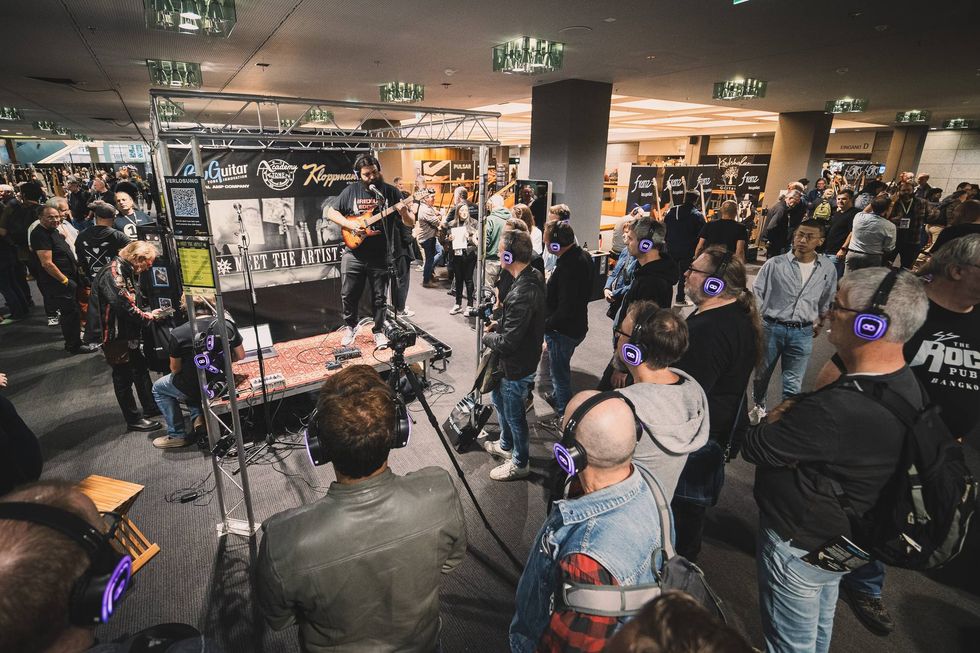
A hallmark of the Guitar Summit is its workshops and masterclasses – and this year’s lineup delivered an unprecedented level of intensity and quality. Across 7 stages, there were 113 workshops and interviews, while the 25 exclusive masterclasses were mostly sold out in advance – giving fans the chance to experience international top artists up close. Notable guests included Tosin Abasi, Billy Sheehan, Philip Sayce, Misha Mansoor, Dweezil Zappa, Plini, Andy Timmons, Chris Buck, Petteri Sariola, Andy Wood, Martin Miller, Alex Skolnick, Kaki King, Rabea Massaad, The Bros. Landreth, and many more.
On the Rock Antenne Stage, renowned figures of the scene gathered for inspiring talks in a relaxed setting. The conversations – hosted in part by “Captain” Lee Anderton – were streamed live, reaching an even broader audience beyond the Rosengarten’s walls.
The concerts in the Mozartsaal marked the musical high points of the weekend. Friday’s program opened with Sophie Chassée, followed by standout performances from Petteri Sariola & Mike Dawes, Chris Buck & Cardinal Black, Kaki King, and The Bros. Landreth –
an evening that showcased masterful songwriting and dynamic range. Saturday brought a captivating contrast in moods: Wallis Bird with boundless energy, Yolanda Charles & Instra_Mentals delivering world-class groove, funk, and fusion, Philip Sayce setting the stage ablaze with raw blues-rock power and a signature tone – culminating in the Allstar Jam led by Andy Wood alongside Andy Timmons, Billy Sheehan, Frank Bello, Alex Skolnick, Martin Miller, Chris Buck, Ben Eller, and more − spontaneous, virtuosic, and real.
The GUITAR SUMMIT remains the ultimate platform, where the full picture of the instrument, genuine interaction with artists, and a true sense of community are not just expected, but deeply felt.
The next GUITAR SUMMIT will take place from September 25–27, 2026, once again at the Mannheim Rosengarten. Don’t miss it – limited Early Bird tickets are on sale now! www.guitarsummit.com
Take a Thrill Ride with Keeley’s Tube Drive
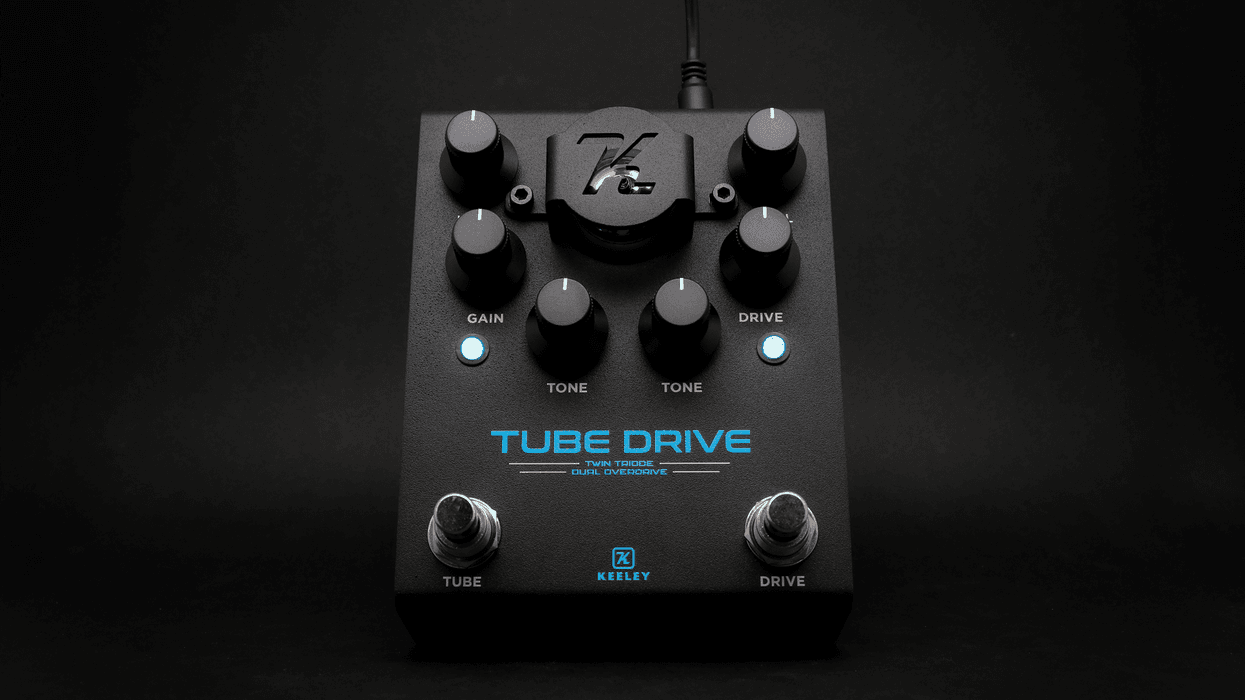
If you’re the kind of guitarist that craves highly responsive overdrive—something that instantly responds to your pick attack and volume knob, like a well-tuned sportscar that hugs the road when you touch the wheel—Keeley Electronics’ new Tube Drive might be the vehicle of your dreams.
The powerful dual-overdrive pedal packs two distinct voices into one rugged, smart-looking enclosure. On one side, you get a genuine high-voltage (168V) vacuum tube overdrive featuring a 12AX7 tube. On the other side, Keeley’s iconic Super Phat Mod—a beefed up take on the beloved blues driver circuit.
You can use one circuit at a time or combine them for even more crazed fun. And with a simple foot gesture, you can switch effect order on the fly. “So, the pedal truly has four different sounds,” says Robert Keeley. “You have the tube channel, the drive channel, and then—depending on the order you choose—you have two other stacked-drive sounds. And this thing is just a dynamics monster,” he laughs. “It feels and sounds so natural when you control the dynamics with the volume on your guitar.”
Buckle Up and Blaze Away
Built from start to finish in the company’s Oklahoma City headquarters, the Tube Drive is Keeley’s very first tube pedal, and it explores an intriguing new direction as the company celebrates its 25th anniversary.
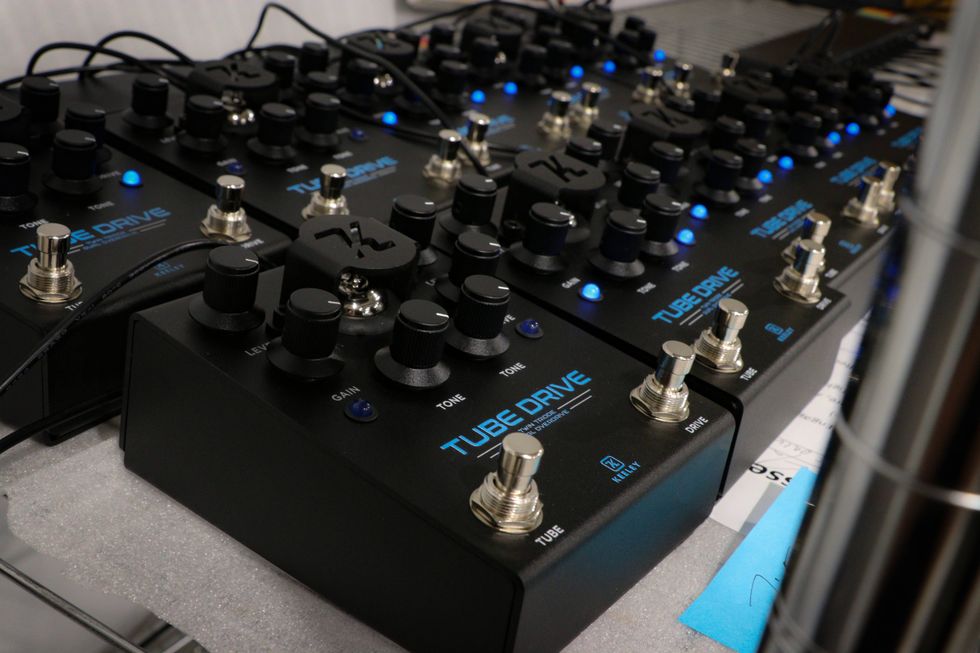
The new pedal delivers a gargantuan array of tones—ranging from subtle, edge-of-breakup overdrive to full-throttle fury—via a highly approachable control set. Each channel is activated by a dedicated footswitch and offers three control knobs: output level, gain, and tone. It’s all super intuitive, with no need to do a deep dive in an instruction manual—just plug in and start riffing.
With its straightforward layout and specially voiced circuitry, it’s strikingly easy to find your sound. It only takes a few minutes to dial in everything from warm, touch-sensitive tube grit to uber-thick, stacked overdrive tones. “We carefully picked the resistors to shape the bass response in such a way that it keeps all of your low notes nice and tight,” Keeley notes. “We wanted something well defined that wouldn’t get muddy. That is so important to the whole charisma of this pedal.”
About that single tone knob: “Yeah, it is a double-edged sword,” Keeley says. “On one hand, you have to make it simple so that people don’t have control-knob phobia. And you need to make sure that you offer enough range, so they can brighten their tone without making it shrill, but also make it nice and warm if you want. It’s a balancing act.”
Like a high-powered sportscar, the Tube Drive offers a streamlined, stripped-down aesthetic that emphasizes performance over posturing, while still benefitting from important hallmarks of the Keeley line—there are rugged construction and modern touches, such as soft switching and the ability to easily choose between true bypass and Keeley’s silent buffered switching.
Designed By Ear
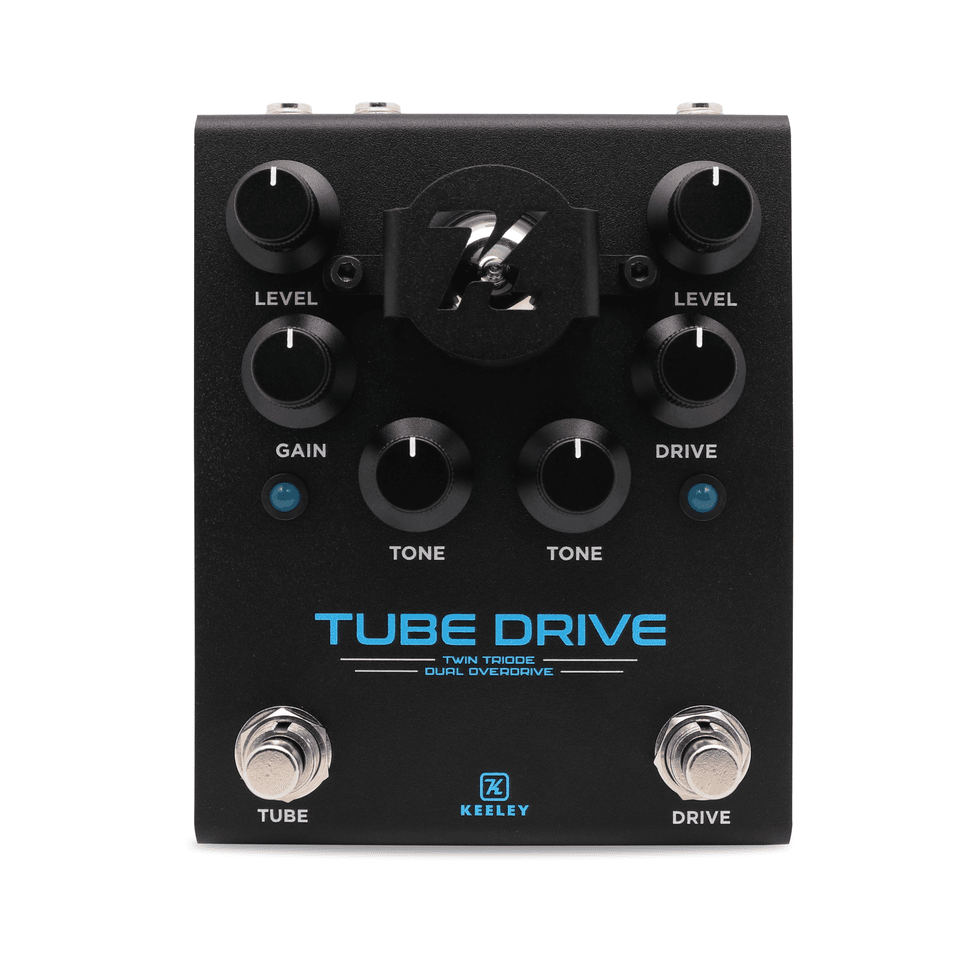
As the company’s first tube pedal, the Tube Drive marks a milestone in the company’s expanding line of overdrive pedals created by Keeley Electronics’ design team. Craighton Hale (lead designer and engineer), Aaron Pierce (the “golden ears” of the team), and Aaron Tackett were all involved in the development of this pedal—a meticulous process even by Keeley’s exacting standards.
“Yes, it took us a long time,” Keeley nods. “We've been working on it for two-and-a-half years, largely due to all the tuning that we did by ear.” The company has eagerly embraced analytic audio measuring instruments in the design and building process, and for this reason Keeley’s lineup of pedals maintains a remarkably consistent tone and quality.
But there is no substitute for the most important element in pedal design: the human factor.
So, through multiple iterations and modifications, the team painstakingly nailed the Tube Drive sound. Keeley admits it was a challenge, but the results have paid off. “One, it has a huge dynamic range. And two, we tuned it by ear instead of by designing something very conventional. You’ll get the best results by focusing not just on what sounds good in your mind, but on what sounds good when you build it and put it together.”
And of course, there’s the added challenge of creating an entirely new design/build approach around the organic, sometimes unpredictable vacuum tube.
“Yes, the world of tubes is very strange,” Keeley laughs.
Gentlemen, Start Your Tubes!
At the center of every Tube Drive pedal is a premium Keeley-branded 12AX7 tube, carefully burned-in, fully tested, and proudly displayed behind a custom tube shield brandishing the stylized “K” of the Keeley logo. Keeley has invested in machines to systematically test each tube and ensure that each pedal sounds just right.
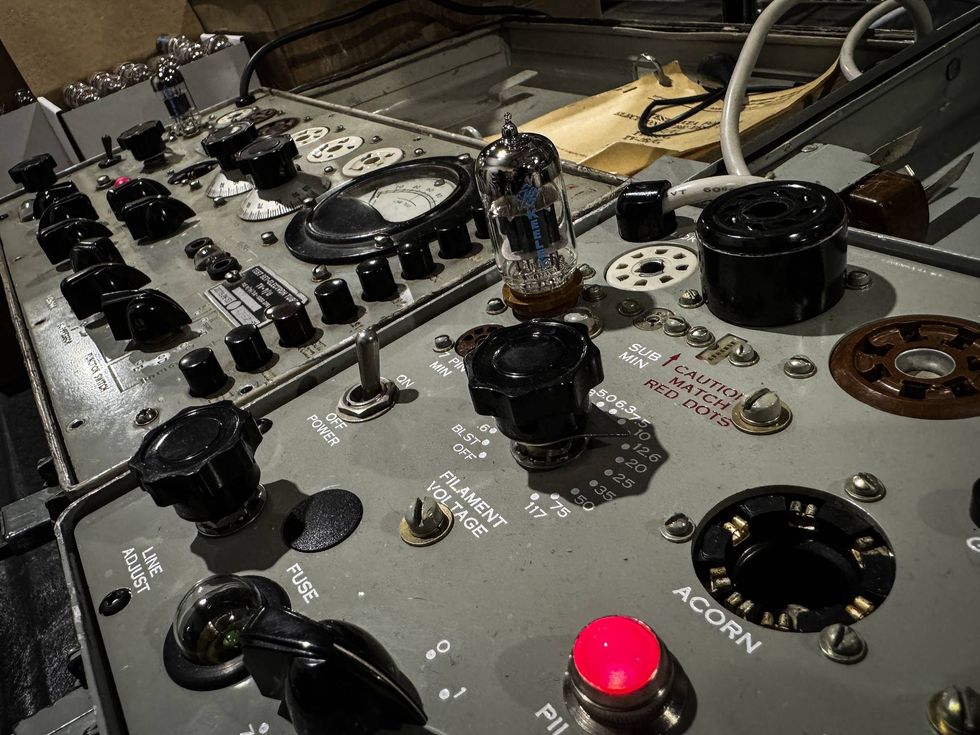
The high-voltage internal circuit—168 volts—is a key factor in the pedal’s sound. As Keeley puts it, “You have to get the tube properly cooking for it to do its magic. At that voltage it creates a whole different world of distortion. You’re going to get improved response and dynamics. So, by moving up to such a significantly higher voltage, that puts us in a much different class than most pedals. I think you get a unique tone print that’s very satisfying.”
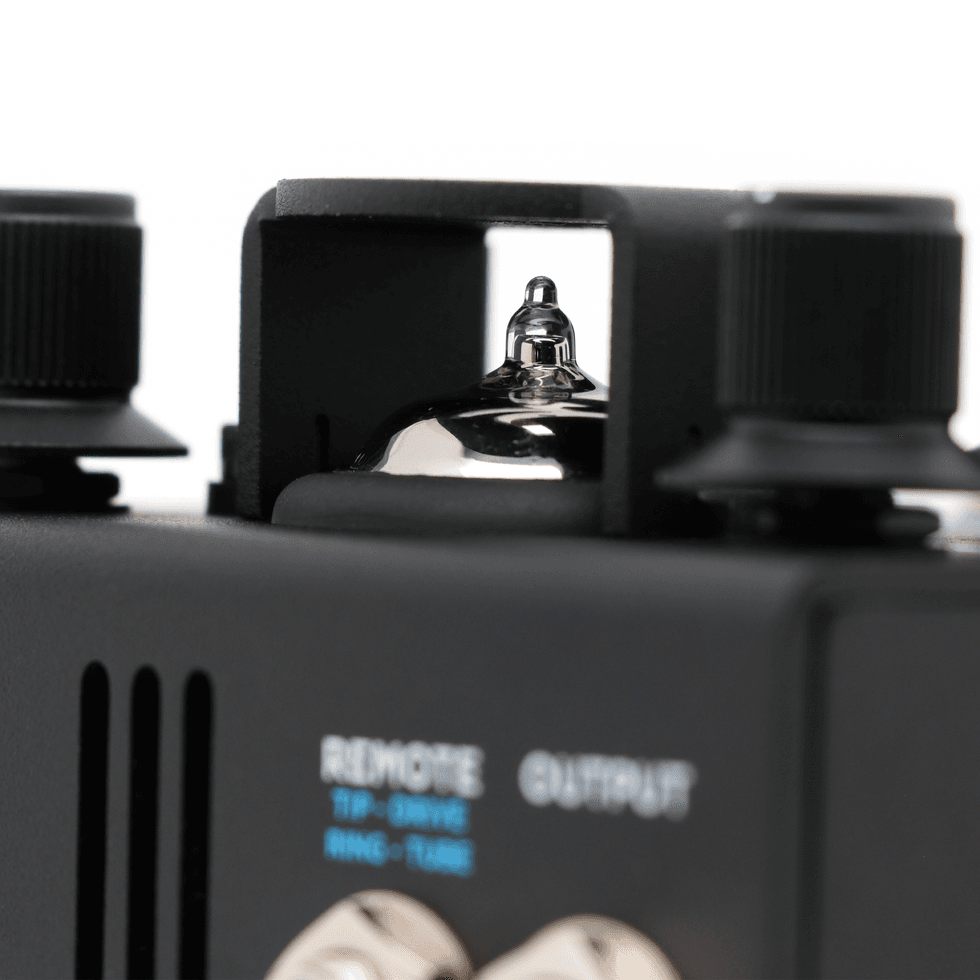
The tube is held in place with a rubber grommet, so it’s always securely protected, and microphonics are minimized. “The rubber grommet keeps all the microphonics out of the signal,” Keeley says. “And even when you put it in a position where the drive channel’s gain comes after the tube—using the tube circuit feeding into the drive circuit—it’s still very microphonic free.”
If necessary, owners can easily replace the tube themselves. No need to take it to a tech—it’s fully self-service. But Keeley notes that it’s unlikely you’ll ever need to replace a worn-out tube. “I fully expect our tubes to last 10,000 hours. That’s 3,300 three-hour jams. I mean, you could have three-hour jams every night for 10 years before I expect these tubes to go bad. And I’m offering a two-year warranty on all our tube products.”
This Ain’t Keeley’s First Tube Rodeo
Robert Keeley’s first experience with tubes came before he even launched his pedal company. “In about 1996 or 1997, I got a book by Gerald Weber of Kendrick Amplifiers. I read it and was hypnotized by tube amps. And long before I ever thought about pedals, I got into modifying Fender tweed amps according to Weber’s books. That’s how I eventually came up with modding for pedals. Tube amps are where it all started. Eventually, an idea came to me in April of 2001. I thought, ‘Hey, I should build my own compressor since I can't afford these Ross compressors on eBay.’ I got parts from the military surplus and hand-wired a little Radio Shack perf board. That’s how it all began. I was into tubes way before pedals.”
The release of the Tube Drive and his return to the world of vacuum tubes represent a full-circle moment in Keeley’s journey—as well as a new chapter in his pedal design process. “This pedal comes out September 1, 2026, and that's the 25th anniversary of the company, which I launched in September of 2001. It’s funny how that works out.”
As Keeley Electronics begins its next 25 years of innovation, the new Tube Drive pedal offers a perfect bridge between the past, present, and future—combining classic tube technology with cutting-edge design and construction.
Do yourself a favor and rev up a Tube Drive and take it for a spin. Your ears will thank you.
Dave Mustaine’s new memoir, In My Darkest Hour, has arrived, and he’s embarking on a three-stop US book tour

As the end of Megadeth looms ever closer, Dave Mustaine is getting existential. While the guitarist has put pen to paper in the past, with 2020’s Rust In Peace autobiography reflecting on the band’s iconic 1990 album of the same name, his new biography is a far more personal. Released today, In My Darkest Hour tells the tale of how a cancer survivor, family man and legendary thrashman “saved himself” when the pressure was on.
To spread the word of his new memoir, Mustaine is also embarking on a three city US book tour. The first stop on release day will be extra special, with a New York fan Q&A where Mustaine will be discussing In My Darkest Hour, adding further depth to the release and answering audience questions. After, he’ll before stopping by Boston on 9 September and Manassas on 10 September for meet and greet events.
While the Virginian meet and greet in Manassas is already sold out, New York’s launch event and Boston’s event both still have some spots left. Each ticket purchase also includes a signed copy of the book. Each of the three events has also been planned to align with Megadeth’s slot on Iron Maiden‘s Run For Your Lives World Tour, so there’s no need to worry about missing the show.
As for the memoir itself, In My Darkest Hour is set to be, unsurprisingly, pretty dark. When the book was first announced, Mustaine revealed that it explores the “harrowing” experience that followed his stage three throat cancer diagnosis in June 2019. “One of most harrowing experiences of my adult life has been my seven-year journey through cancer treatment and onward into remission,” he wrote on the Megadeth website.
“This story is considerably more than just go to the doctor, get diagnosed, get treatment and hopefully I live happily ever after,” he continued. “This was a journey of me saving myself, staying alive, keeping my family together, and continuing to make music through it all.”
The memoir is set to explore Mustaine’s experience balancing chemotherapy and studio sessions, all leading up to the band’s 2022 record, the Sick, The Dying…and the Dead! As the press release explains, it also explores how Mustaine confronted “his own mortality” throughout this period, which “brought him closer to his family, taught him how to ask for help, strengthened his faith, and challenged the vulnerability of his art”.
As for Megadeth, the band are continuing to enjoy their final victory lap before calling it a day. After earning a Billboard #1 record with their last ever album, the self-titled Megadeth, the band’s global farewell tour is set to run until at least 2027.
In My Darkest Hour is out now. For news on Megadeth’s final tour, head to the band’s website.
The post Dave Mustaine’s new memoir, In My Darkest Hour, has arrived, and he’s embarking on a three-stop US book tour appeared first on Guitar.com | All Things Guitar.
Fender Introduces Squier Paranormal Troy Van Leeuwen Telecaster XII
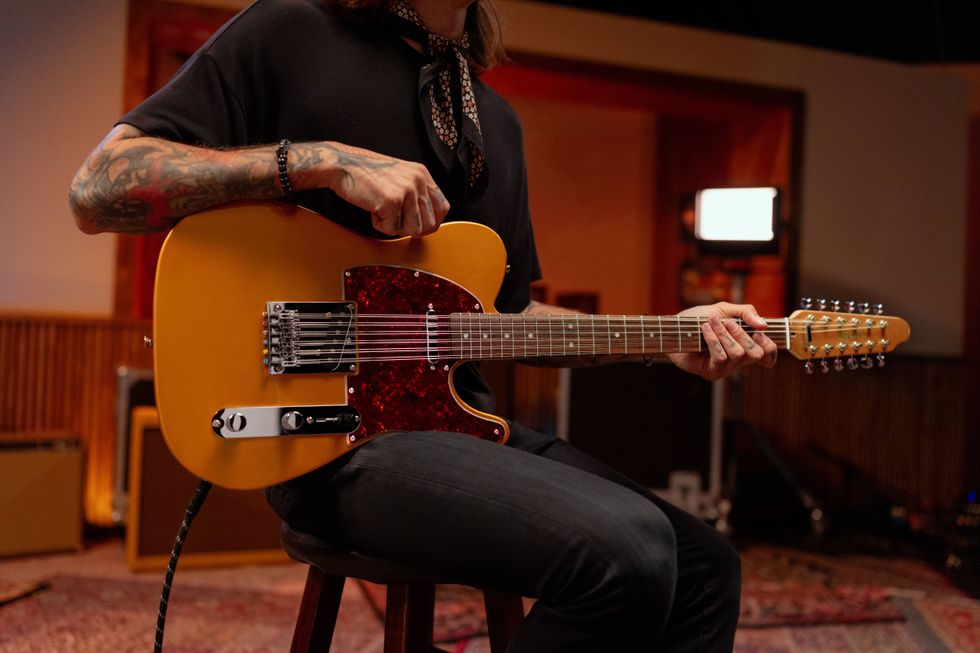
Fender has introduced the Paranormal Troy Van Leeuwen Telecaster® XII, a new Squier® signature model developed with the acclaimed guitarist to bring the expansive sound and unmistakable character of a 12-string Telecaster to a new generation of players. Inspired by Van Leeuwen's genre-defining work with Queens of the Stone Age, A Perfect Circle, Failure, Gone Is Gone and The Armed, the guitar captures the shimmering ambient textures, layered harmonics and unmistakable bite that have become hallmarks of his playing.
For more than three decades, Van Leeuwen has built a reputation as one of alternative rock's most inventive and versatile guitarists. His second signature model with Fender captures that creative approach, offering players a unique instrument designed to inspire everything from expansive textures to powerful, chord-driven riffs.
“When creating my second signature with Fender, I wanted an instrument at an affordable price point that could inspire anyone who’s ever been curious about playing a 12-string,” said Troy Van Leeuwen. “Having worked with the team for over a decade, they easily connected with my vision for a guitar that’s designed for functionality, aesthetically striking, and would sound great right out of the box.”
“Troy has always approached the guitar differently. He hears texture, harmony and space in a way that’s uniquely his own — and with Troy’s impeccable sense of style, we knew the guitar had to look every bit as cool as it sounds,” said Justin Norvell, Chief Product Officer, Guitar. “It captures his creative spirit from every angle while making the magic of a 12-string Telecaster more accessible than ever for the next generation of players.”
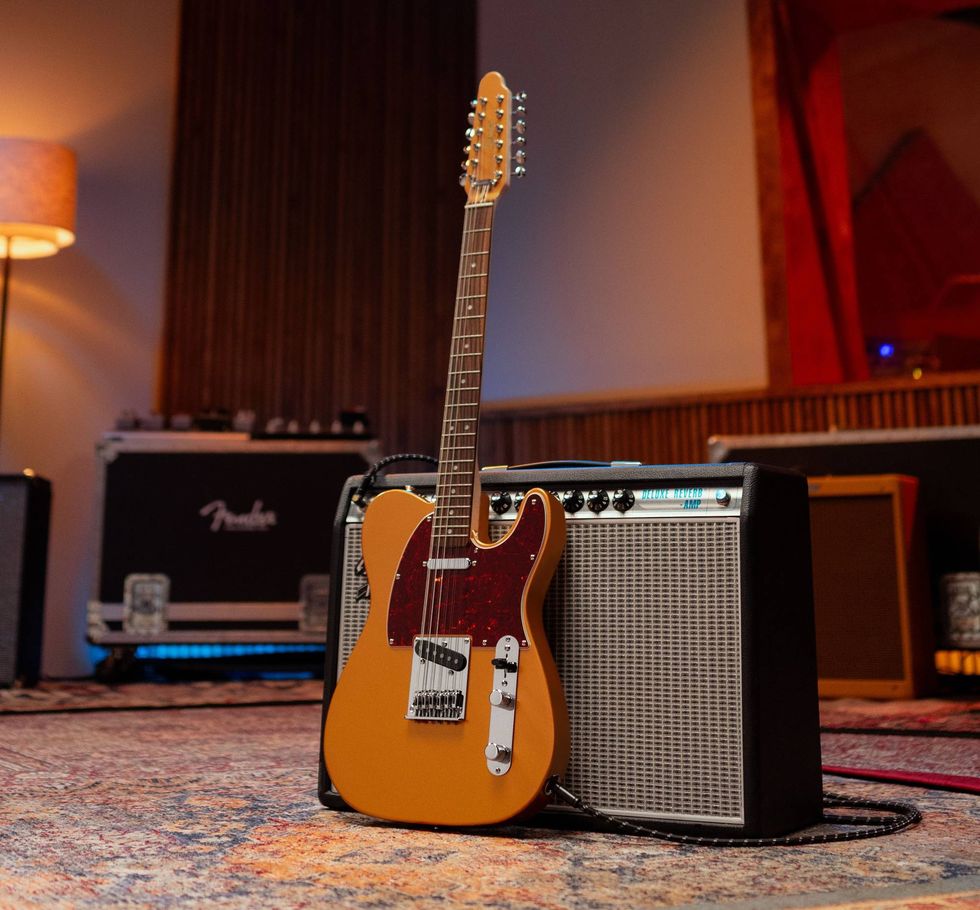
The Paranormal Troy Van Leeuwen Telecaster® XII takes inspiration directly from his own Paul Waller Fender Custom Shop Masterbuilt 12-string Telecaster, combining signature styling with thoughtful, player-focused design. Finished in a striking custom Copper Age finish, the guitar features a resonant Nyatoh body, a custom Telecaster® XII headstock and a player-friendly 12-string top-load/string-through bridge that makes restringing easier while improving tuning stability.
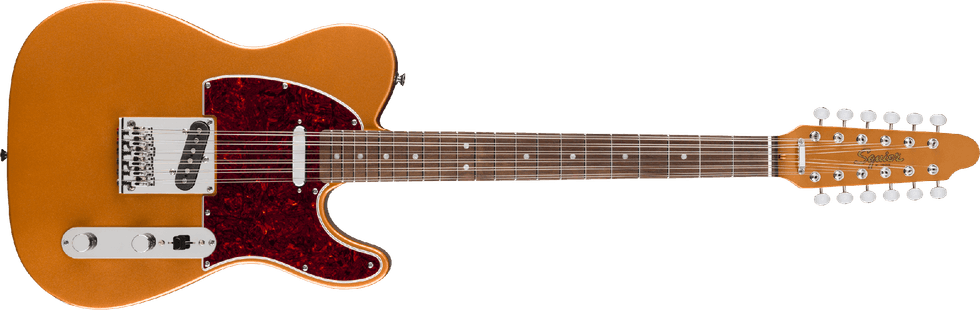
Key Features Include:
- Custom Copper Age Finish: A distinctive custom finish that gives the instrument a bold visual identity worthy of Van Leeuwen's unmistakable style.
- Fender Designed Alnico Telecaster single-coil pickups for expanded sonic range – all without sacrificing that signature Tele bite.
- Custom Telecaster® XII Headstock: A unique headstock design that pays homage to the classic Telecaster XII while immediately setting this signature model apart.
- Player-Friendly 12-String Bridge: A top-load/string-through bridge makes restringing easier while improving tuning stability—addressing one of the biggest pain points for 12-string players.
- Nyatoh Body: Provides a resonant foundation that complements the guitar's rich harmonic character and dynamic response.
- Signature 12-String Voice: Delivers shimmering harmonics, layered textures and unmistakable Telecaster attack, making it equally suited for atmospheric soundscapes and powerful rhythm playing.
The Squier Paranormal Troy Van Leeuwen Telecaster® XII carries a street price of $599.99. For more information visit fender.com.
The Warning: Falling Into Place
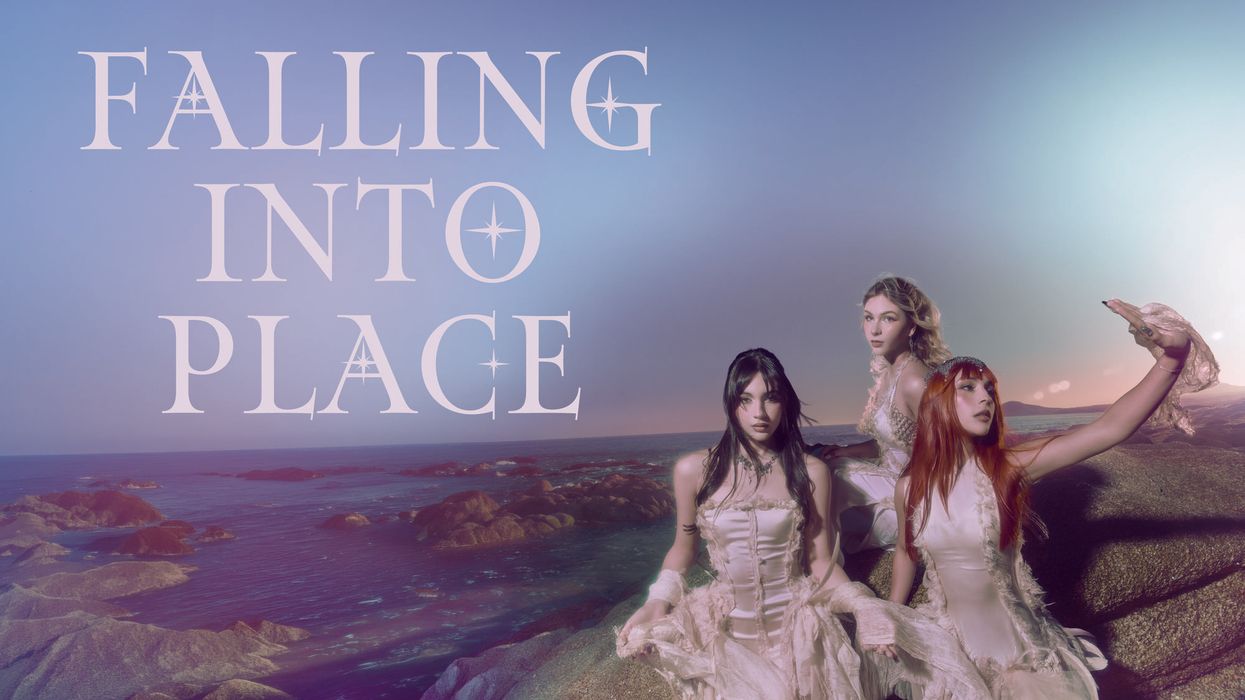
Twelve years ago, few could have predicted that Daniela Villarreal’s teenaged hobby would one day see her commanding the stage in major rock capitals around the world. Back then, the Warning were three sisters in Monterrey, Mexico—singer-guitarist Daniela (“Dany”), bassist Alejandra (“Ale”) and drummer Paulina (“Pau”)—having a School of Rock-style good time knocking around on Metallica covers. Soon enough, their homemade YouTube videos caught fire, and it wasn’t long before the group began appearing on international TV shows. Fast-forward to today, and the Warning are big-time stuff—they’ve issued a string of knockout albums and EPs, and they’re touring pros holding their own on bills with the likes of Muse, Foo Fighters, Def Leppard and Yungblud. Their newest album, Everything’s Falling, is a super fuzzed-out, industrial-tinged hard-rock doozy that could raise their stock even higher.
For Dany, looking back on those early daydreams makes her current reality seem both heady and deeply grounding. “There’s so much going on all the time, every day, so when I get a chance to think about it, it’s like, ‘Whoa, I can’t believe how far we’ve come,’” she says. “We’re visiting all these places and having fun, but at the same time, it’s so much work. That’s what surprised me the most, how overwhelming it feels.”
She pauses, then adds, “But we wouldn’t want it any other way. We know what it takes to make it, and we’re ready to take it all the way.”
hat ambition puts a massive weight on Dany’s shoulders. As the sole guitarist in a power trio, she’s tasked with creating the bulk of the band’s sonic footprint, all while stepping up to the mic as their primary vocalist. She admits that taking on a new member—or even a touring guitarist—would free her up to focus on singing and performing, but it’s not something the band is considering for the time being. “To bring in somebody else who isn’t a sister would feel very unnatural,” she says. “Doing what I do takes a lot of concentration, and I’d love to make things easier, but I kind of like the challenge, and I’m stubborn.”
“When we’re meeting in the middle—Ale’s trying to sound like me, and I’m trying to sound like her—that’s the sassiest part of the record.”
A practice routine just shy of punishing keeps Dany in tip-top performance shape. “I rehearse my guitar parts over and over till I don’t have to think about them,” she says. “I want everything to be automatic so I can get into the emotions I’m trying to convey.” Another solution is writing what she calls “festival songs,” built around mega-sized riffs and anthemic choruses geared toward maximum audience impact. “On this record, we asked ourselves, ‘How is this going to feel live? Is it going to make people jump up and down?’” she says. “That solved a lot of problems for the future me once we got out of the studio.”
There’s nothing subtle about Everything’s Falling—“Kerosene” is a high-velocity banger and “Ritual” froths and rages, while the Spanish-language “Ego” gnashes and snarls—yet there’s no rigidity in its bold power moves. It’s all delivered with the kind of intuitive finesse one would expect from a trio of siblings who are 100 percent dialed in.

Dany Villarreal’s Gear
Guitars
- PRS Custom 24 (standard tuning)
- PRS Custom 24 (drop-D tuning)
- Backup PRS Customs 24s in each tuning
- PRS Dany Villarreal Custom 24 Signature Astryx
- Fender Stratocaster baritone w/ black finish (B-standard tuning)
- Fender Stratocaster baritone w/ white finish (drop-A tuning)
- (Both Strats are loaded with Seymour Duncan JB/59 sets)
Amps & Cabinet
- Orange Pedal Baby 100 power amp
- Kemper Profiler Stage
- Mesa/Boogie 4x12 slant cab
Effects
- Mission Engineering EP1-KP-GN expression pedal
- One Control Looper
- Tallon Electric x Alphawolf The Noise
Wireless
- Shure Axient ADX5D receiver
- Radial SGI TX/RX line driver system
- Levy’s Leathers Wireless Bodypack Holder
Strings, Picks, & Straps
- D’Addario NYXL .010–.046 (for PRS Custom 24s)
- D’Addario NYXL .014–.060 (for Fender Strats)
- Custom-made guitar picks
- Gruv Gear straps
That telepathic creative shorthand is all the more impressive when you consider the fact that the band recorded their parts entirely separate from one another. “Usually, people record drums first, but I laid down my guitars and vocals to drum demos,” Dany explains. “It was funny because I’d stand up and move all around, just to get the excitement going like I was playing onstage.”
Some of the record’s harshest guitar sounds were, in fact, produced by Ale on bass, while various booming bass tracks were generated by Dany’s guitar. “When we’re meeting in the middle—Ale’s trying to sound like me, and I’m trying to sound like her—that’s the sassiest part of the record,” Dany enthuses. It turns out you don’t need to be in the same room to stand shoulder to shoulder.

“It’s really something to have a guitar that’s literally me. I see it as my twin.”
The better part of her guitar collection is present and accounted for on Everything’s Falling—there’s a Strat, a Tele, a Les Paul Standard, and a PRS Custom 24. One instrument she’s added since is particularly close to her heart—her newly announced first-ever signature model, the limited-edition PRS Astryx. “From the time I visited the factory and we started talking about it to the time we were done, the whole process took well over a year,” she says.
“There’s so much I love about the Custom 24, but I put my own spin on it,” Dany continues. This means a custom color fade and her signature on the truss rod cover, alongside core Custom 24 specs like a maple top, mahogany back, and DMO humbuckers. “There’s also an inlay of the sun on the 12th fret, and it says, ‘Solecito,’ which is Spanish for ‘little sun,’” Dany says. “That’s what everybody calls me on the internet, so it was nice to include my fans in this guitar.”
She laughs. “I changed my mind a couple times while we were planning things out, but the PRS people were so understanding about everything.”

Onstage, Dany’s idea of sonic bliss is when her guitar sound is “big and chunky and heavy,” with just enough high-end to cut through Ale’s bass tone. To that end, she plays through a Kemper Profiler as well an Orange Pedal Baby 100 power amp. Both units respond beautifully to her PRS Astryx, which she recently took possession of on tour.
“Nobody told me I’d be getting the guitar, so it was a total surprise,” she says. “There’s always that thing when you get a guitar and you have to break it in, but from the second I started playing it, it felt and sounded amazing. It’s really something to have a guitar that’s literally me. I see it as my twin.”
Metalheads: this sleek AF Cort guitar could be your new favourite affordable singlecut

South Korean guitar maker Cort has expanded its single-cut electric guitar lineup with the all-new CR300MT.
Focusing on “traditional material choice” and seemingly aimed squarely at metal players, the CR300MT features a solid mahogany body configured for “sustained resonance and low-end warmth”, finished in a luxurious Black Satin designed to highlight the “physical architecture of the guitar body without distraction”. Elsewhere, the guitar sports a multi-ply black-and-white binding around the perimeter of the body and headstock.
The CR300MT also features a mahogany set-neck – which helps transfer string vibrations across the whole instrument more effectively – as well as a 24.75” scale length, a Micarta fingerboard with 24 frets with a 12” radius and nickel-silver frets (because what modern metal machine is complete without 24 frets?) and a premium Graph Tech TUSQ nut.
 Credit: Cort Guitars
Electronics come by way of a pair of active EMG humbuckers – the classic metal-ready pairing of an 81 in the bridge position and a 60 in the neck position – controlled via two separate volume and two separate tone knobs and a standard three-way toggle switch.
 Credit: Cort Guitars
Finally, the guitar boasts Grover Rotomatic tuning machines for rock-solid tuning stability and precise micro-adjustments, and a Tune-O-Matic-style bridge paired with a secure stop tailpiece.
The CR300MT is available now, priced at $899.99.
Learn more at Cort.
 Credit: Cort Guitars
The post Metalheads: this sleek AF Cort guitar could be your new favourite affordable singlecut appeared first on Guitar.com | All Things Guitar.
Seymour Duncan Introduces Joe Bonamassa “Pawn Shop Special” 1961 P90 Set
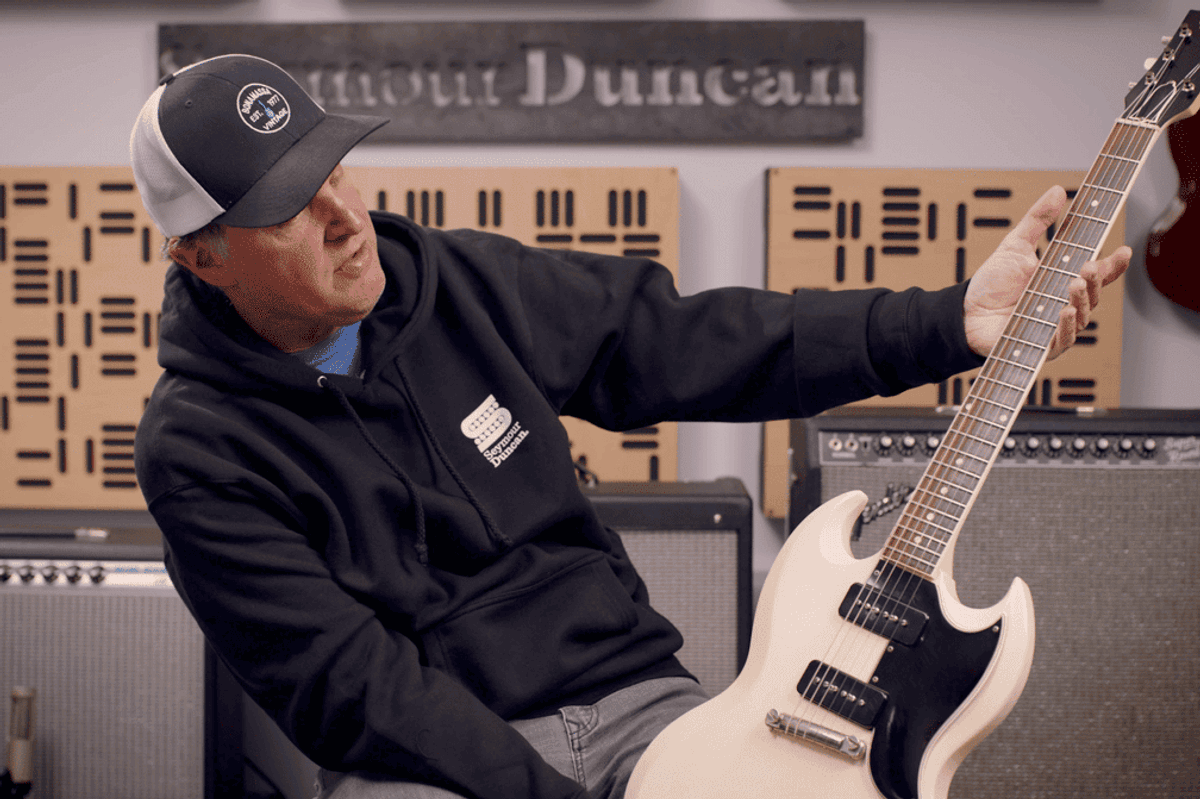
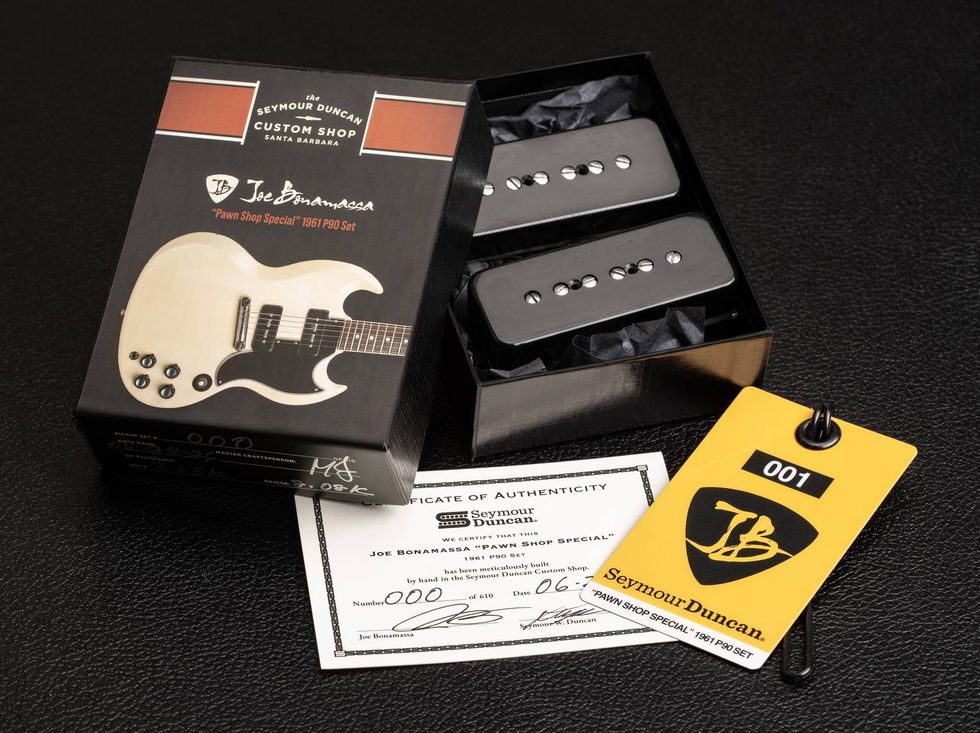
Seymour Duncan, has unveiled The Joe Bonamassa “Pawn Shop Special” 1961 P90 pickup set. These Custom Shop P90s replicate the vintage pickup set that sparked Joe Bonamassa's love affair with P90s, delivering airy highs, expressive midrange, and snarling overdrive response. Alnico 4 magnets, a custom wind, and historically accurate components bring this coveted Nerdville tone within reach of every P90 aficionado.
Key features include:
- First P90 collaboration between Joe Bonamassa and the Seymour Duncan Custom Shop
- Directly replicates the exact tone of the soapbar P90s from Joe's own 1961 SG Special
- Alnico 4 magnets and custom wind capture the airy top end and sizzle of the original pickups
- Vintage style output: Bridge 8.4k / Neck 7.8k DC resistance
- Historically accurate dimpled P90 bottom plate, covers, and period-correct details
- Wax potted per Joe's preferences for reliable live performance
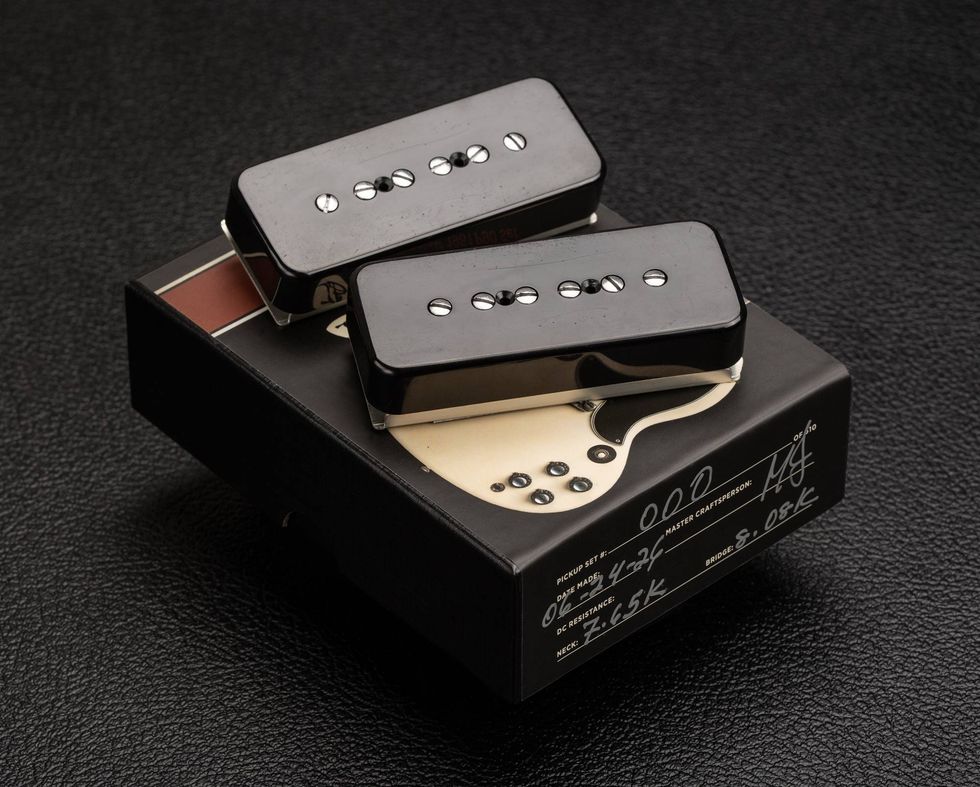
First 610 sets include a Nerdville #001 luggage tag, certificate of authenticity signed by Joe Bonamassa and Seymour, and limited-edition packaging
Most guitar players have had the experience of walking into a pawn shop, hoping to strike gold, only to find a limited selection of instruments that are far from inspiring. But sometimes with the right combination of luck, a great guitar can be found hanging on the wall of your local pawnbroker. Joe Bonamassa found one such gem, a 1961 Gibson® SG™ Special, at a pawn shop while on tour in 2010. Not only was it a pristine example of a first-year SG Special, but it also had a set of pickups that marked the beginning of Joe’s love affair with P90s. The pickups in this guitar exemplified the tone of his heroes who played these pickups in the ‘60s. Players like Pete Townshend, Carlos Santana, and Leslie West.
After many years of recreating pickups from some of Joe’s favorite instruments, Seymour Duncan and Bonamassa have teamed up to replicate the soapbar P90 pickups from this very special guitar as the Joe Bonamassa “Pawn Shop Special” 1961 P90 Set – the Custom Shop’s first P90 collaboration with Joe.
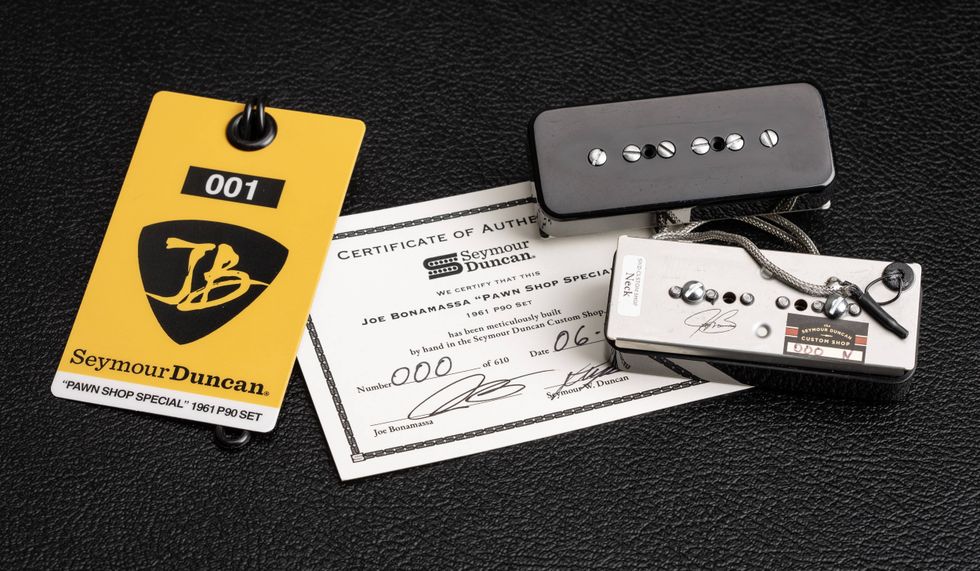
Sonically, these vintage P90s sit somewhere between a single coil and a humbucker: articulate and responsive, but with plenty of bark, especially when overdriven. The output specs are: Bridge 8.4k / Neck 7.8k DC resistance.
The “Pawn Shop Special” 1961 P90 Set is built with Alnico 4 magnets and a custom wind to duplicate the airy top end and sizzle that make the pickups in Joe’s guitar so captivating. Seymour Duncan created a historically accurate dimpled P90 bottom plate specially for this project, taking care to replicate the covers and other intricacies of pickups from this era. These P90s are wax potted per Joe’s preferences and are ready for any live performance (no matter how many Overdrive Specials™ and Silver Jubilees™ are turned up behind you).
The Pawn Shop Special occupies a unique place in Joe's extensive guitar collection. As he began to log and inventory his instruments, this guitar was the very first instrument to be cataloged thus garnering an inventory tag as item #001. To celebrate this, the first 610 sets will come with a Nerdville #001 inventory tag, similar to the ones Joe uses to catalog his own instruments. Other features exclusive to the first 610 sets include a certificate of authenticity signed by Joe and Seymour, as well as limited edition packaging.
The Joe Bonamassa “Pawn Shop Special” 1961 P90 Set carries a street price of $375. For more information visit seymourduncan.com.
Bruce Springsteen would sweat so much during gigs that his guitar would short out – here’s the bizarre thing he did to fix it

Being a rockstar isn’t always glamorous. Yes, there’s the glitzy world tours and hoards of adoring fans, but performing can also get a little… sweaty. For over 50 years, Bruce Springsteen has been strutting onstage looking like a drowned rat. Seriously – his perspiration is so excessive that fans have genuinely wondered how he’s avoided being electrocuted from sweat dripping onto his guitar.
Finally, Springsteen has addressed the sweaty elephant in the room. In a new interview with Fender celebrating the Telecaster’s 75th anniversary, the guitarist reveals that his sweat really has been an electrocution hazard in the past. “I was sweating so much that halfway through the show, the guitar would short out,” he reveals, adding that, at one point, it was happening “regularly halfway through shows”.
Luckily, he found a solution to protect both himself and his Tele: “I had to insulate the entire inside of the guitar with rubber.”
At the time, Springsteen wasn’t quite at the height of his fame; he couldn’t afford having multiple axes to hand on tour. “I would lose all my highs and would just sound like crap…” he recalls. “I was only using one guitar for the entire show. You didn’t have three or four others that you could switch with. So they insulated the entire guitar with rubber, so when water came pouring down, it continued to play.”
Despite his sweat shorting out his Telecaster, Springsteen doesn’t hold it against the iconic Fender model. Instead, he has nothing but praise for the humble Tele. “At the beginning, when I signed my first record contract, I was going to get to buy a new guitar, but I knew I wanted a Telecaster…” he explains.
“[The Tele] is your working man’s axe,” he continues. “First of all, it’s just a hunk of wood with strings and a neck – it’s your fundamental tool for rock and roll, or soul music, or whatever you want to use it for.”
He later explains how the Tele truly feels like an “extension” of himself. “When I have this guitar on, I don’t feel like I have a guitar on,” he notes. “It feels like my arm… like an extension of your physical self. I may take it in the coffin with me if I go… I’ve identified myself with this guitar and with the Fender Telecasters my whole life, and I will continue to do so until it’s over.”
The post Bruce Springsteen would sweat so much during gigs that his guitar would short out – here’s the bizarre thing he did to fix it appeared first on Guitar.com | All Things Guitar.
Elevate your coffee table with this new book showcasing some of the most stunning vintage guitars ever

Picture this: you’ve just made the most beautiful artisanal coffee. You head over to your couch, set it down on the coffee table, and realise the only thing missing is some appropriately relaxing reading to accompany this moment of utter tranquility.
Yep, no coffee table is complete without a coffee table book, and thanks to this new offering from photographer, author and former Guitar.com contributor Eleanor Jane, you can now complete yours.
The Guitar Chronicles, arriving 17 September via Welbeck and available via all major bookstores, shines a spotlight on some of the most beautiful and history-rich vintage guitars that exist today, including classic instruments owned by Jeff Beck, Jack White, Jeff Tweedy, Mike Bloomfield and Jake Kiszka.
 Credit: Eleanor Jane
Also showcased are “beaten-up, barfly Telecasters thick with nicotine stains and battle scars from dive bars across America and catalogue guitars modified with mailbox stickers by eager kids in the ‘50s emulating the elaborate neck inlays of country heroes”.
Indeed, it’s not just guitars wielded by some of the most iconic guitarists in history that are showcased in The Guitar Chronicles; you’ll also feast your eyes on pawnshop classics plus even survivors of fires and tornadoes.
“These are instruments that inspired the artists you love, along with countless others who may not have been household names but helped shape the landscape of music in their own way,” Jane explains.
“I’m beyond thrilled with how this project turned out, the stories I’ve been able to tell, and all the beautiful new work I have to share.”
 Credit: Eleanor Jane
The book has even received praise from Gibson Director of Brand Experience Mark Agnesi, and Hollywood A-lister and bass guitar aficionado Jason Momoa.
“I love seeing these amazing guitars that are so life-worn, with all that mojo, through Eleanor’s eyes and lens. Beautiful,” says Momoa.
“Eleanor has a unique ability to tell stories through her photographs,” adds Agnesi.
The Guitar Chronicles will be available from 17 September. You can pre-order now from Amazon, Barnes & Noble, Waterstones, or your local bookseller.
The post Elevate your coffee table with this new book showcasing some of the most stunning vintage guitars ever appeared first on Guitar.com | All Things Guitar.
Inside the music shop where rising guitar band Westside Cowboy formed: “It helped me find my love for guitar again”

“This is Johnny Roadhouse Music, where Westside Cowboy technically started,” is Jimmy Bradbury’s welcome address at his former workplace, ushering us upstairs with his bandmate Reuben Haycocks. The two live around the corner from the music shop, which is located on Manchester’s Oxford Road: the nucleus of student life in the city. 300m away is the Royal Northern College Of Music, where Haycocks met bassist Aoife Anson O’Connell – who we run into shortly after this conversation – and drummer Paddy Murphy back in 2021.
Bradbury recalls his ‘interview’ to become the shop’s guitar tech: “‘Can you use a soldering iron? Done. I’ll see you tomorrow at 11 o’clock.’” Founded in 1955 by the late saxophonist John Roadhouse, the family-owned business specialises in second-hand instruments, meaning you get “crazy guys knocking on the back door, like, ‘I’ve got 30 guitars in the back of this van. Do you want to buy them?’” Roadhouse’s son now runs it with his wife, who both sing Westside Cowboy’s praises before Bradbury and Haycocks enter like returning heroes.
“You see so many different types of playing in here,” reflects Bradbury. “Everything from shredders to really old country guys and Flamenco players. Wandering around the shop, I feel like the guitar is a very open, welcoming instrument. There’s so much you can do by just learning a couple of small things on it.” When Murphy started bringing Haycocks and Anson O’Connell here to meet his pal Bradbury, the four began congregating here multiple times per week.
“I had never really come across gear before, [growing up in] Shropshire,” says Haycocks, who is easily distracted by the newly-arrived 1976 Martin D-28 on the wall. “I hadn’t been around people who were bothered about cool old guitars. I’d watch James pick up a guitar and play random shit. You can’t play the songs that you’ve learned in a guitar shop – because you look like a knob – so if I wanted to play this really cool ’70s Gibson SG, I had to pick it up and play some classical things, rather than going through my rolodex of songs that I knew. And then maybe one AC/DC song…”
 Image: Clementine Schneidermann
The University Of Life
Having decided on a whim at Johnny Roadhouse to form Westside Cowboy, the quartet have transformed into one of Britain’s most exciting guitar acts. Although the title of 2024 debut single I’ve Never Met Anyone I Thought I Could Really Love (Until I Met You) sounds like it belongs on an early Arctic Monkeys or Fall Out Boy album, their alt-country twang straddles folk, indie and Americana soundscapes. Their live show alone won them a slot at Glastonbury 2025, and they’re now signed to a major label and Fontaines D.C.’s management.
Initially cutting their teeth in local bands DieKaiDai and Katz at venues like Fuel, Manchester’s musical landscape proved pivotal to Westside Cowboy’s eventual path. “Being in a scene is the most rewarding part about being in music, seeing all your friends do really well,” says Haycocks. In a city where Live Nation and Mission Mars continue to swoop in on independent venues, community-driven spaces – be it a café or Johnny Roadhouse – are essential to meet like-minded folk, reckons Bradbury. “So many musicians come in and speak to someone who they [wouldn’t] in the street, because you have common ground.”
Although a primary school Bradbury and an early teenage Haycocks fell out of love with guitar, a friend who played Guns N’ Roses riffs and reduced focus on musical grades respectively re-ignited both guitarists’ love affairs with their instrument. Though Haycocks describes a “musical rebirth” upon coming to Manchester, both bring up the inhibitive nature of their university studies. “People telling you, ‘You have to play these chords and scales,’ it can really beat you into a corner,” says Bradbury. “[Working] at Johnny Roadhouse, it helped me find my love for guitar again, seeing so many different types of instruments and playing.”
Haycocks whips out his 1979 Gibson SG, which “feels like the scale length of a Fender with the sound of a Les Paul on an SG body”, while Bradbury grabs some water. “It has a really thick neck, and you have to really fight it,” Haycocks continues. “When I’m on stage, if something feels too nice, it creeps me out. I need to be slightly uncomfortable.” Bradbury has named his 1987 Jackson Charvel (when the two companies were co-owned) ‘Peggy’, having replaced its “horrible” high-output metal pickup with a simpler ’50-style Esquire. “It’s just got one volume knob,” he shrugs. “I don’t like too many buttons – it gets in the way!”
 Image: Clementine Schneidermann
It’s Not Rocket Science
Simplicity is a guiding principle for Westside Cowboy, who’ve made the previous mistake of “songs that have way too many chords in”, Bradbury recalls. Earlier earworms Can’t See and Don’t Throw Rocks tap into punchy riff-work and cosy changes in velocity; both are visibly moulded into shape by their impulsive live show. Three-chord hit Kick Stones (The Boys), the lead single of their debut album It Goes On, is arguably their most precise work to date, recorded to ensure Haycocks’ gritty strumming is audible like it’s an entire instrument itself.
“There are certain bits of ear candy like that which make you feel more connected to the song and make it feel more real than a DI would,” explains Haycocks. “We’re always looking for it to sound like you’re standing in the middle of the room [with us], and I think that adds to the ‘authenticity’ of the sound,” he smiles, reluctant to toot his own horn. “In terms of a rock band versus a rock ‘n’ roll band, Westside Cowboy has more of the ‘roll’ in it,” adds Bradbury, who prefers not to overcook songs with distortion or pedals. “When you hear Reuben strum, you can feel the roundness of the individual strings that brush through it.”
The band’s approach draws parallels with recent comments from Wet Leg’s Rhian Teasdale, who described her “epiphany” upon realising “you don’t have to be a virtuoso guitarist to enjoy playing music with your friends”. She’s “very right”, Bradbury responds. “By no means is this a new idea,” elaborates Haycocks, “but it’s a personal thing when you actually realise. Everyone is aware that lots of chords don’t make a great song… but it’s taking that step yourself and actually believing what you’re saying. Westside Cowboy was that, for us: the epiphany moment.”
It’s why, as their self-named ‘Britainicana’ tag follows their sound onto whatever heights they will achieve, those core values will serve them well. All four write music, individually, in their spare time, but there is a shared understanding of what defines a Westside Cowboy song. Accordingly, it’s no surprise that It Goes On retains a clear consistency from top to bottom, solidifying the buzz that their first two EPs and talked-about gigs helped generate.
“Your uncle always tells you that a good song will still be a good song on an acoustic guitar, and at the start of the band, we just ran with that,” admits Haycocks. “Without guitars, ‘Britainicana’ wouldn’t have existed.” Bradbury adds the final layer. “The idea of ‘Britainicana’ comes down to the values around that song. If you can’t play it with either a guitar or piano and your voice, where it still resembles that piece of music, then maybe it’s not very Westside Cowboy.”
It Goes On is out now via Island
The post Inside the music shop where rising guitar band Westside Cowboy formed: “It helped me find my love for guitar again” appeared first on Guitar.com | All Things Guitar.
Jake Kiszka claims guitar was his ticket to self-expression as a kid: “I had so much taken away at a young age, and the guitar was an object of fighting for freedom, like Excalibur”

Growing up in a “romanticised Americana” town, the grit of hard rock didn’t quite match up with Jake Kiszka’s ‘white picket fence’ childhood. However, the Greta Van Fleet guitarist couldn’t resist the rockstar lifestyle – and his guitar helped him escape suburban mundanity.
Speaking to Guitar World, Kiszka describes his first experience with a guitar as almost spiritual. “When I picked up a guitar when I was a kid, it was this object or artifact,” he explains. “It was a monolith of freedom and self-expression. Being raised in the place we were raised in [the small town of Frankenmuth, Michigan]… we’re learning who we are, what we’re meant to do and where we belong… There’s this sense of great repression in some ways – social confines.”
While Greta Van Fleet are currently one of the world’s most prominent (and divisive) newer hard rock groups, there was a time when Kiszka didn’t know whether his dreams would become a reality. So he clung onto his guitar, and refused to abide by the “social confines” around him. “To me, the guitar was something no one could take away,” he says. “I had so much taken away at a young age, and this was sort of a defiance against structure and systems.”
“[My guitar] was an object of fighting for freedom, like Excalibur or something… I really felt that way,” he emphasises.
Of course, Kiszka’s upbringing wasn’t dreadful. Speaking to radio station 102.1 The Edge in 2018, he describes his “romanticised Americana” childhood, where he was “playing in the fields, exploring the forests and [swimming in] the many streams and rivers” that surrounded his hometown. However, “there wasn’t much going on” – which was a perfect catalyst for focusing on music.
It’s a similar case for Queens Of The Stone Age’s Josh Homme. Last month, Homme told the Queer the Music podcast that growing up in a “very empty, very idyllic small town” in Palm Desert was pretty boring… but “boredom” lead him to music. “The gift of nothing is a very real thing,” he explained. “In the boredom… you’re allowed to practice playing guitar, piano, or drums.”
As for Greta Van Fleet, Kiszka is keen to continue wielding his Excalibur to inspire other budding guitarists to pursue the art of rock ‘n’ roll. “We’re trying to bring a sense of imagination, hope and love to a generation through rock ‘n’ roll,” he tells Guitar World.
Back in May, Greta Van Fleet sparked breakup rumours after releasing a cryptic social media video. However, they’ve recently confirmed that they’re still together, and their fourth album, Palace For The People, is dropping on 9 October. The group have already shared a pair of new singles: Saw You Stand and Play Your Games.
Palace For The People is out 9 October. You can pre-order it now.
The post Jake Kiszka claims guitar was his ticket to self-expression as a kid: “I had so much taken away at a young age, and the guitar was an object of fighting for freedom, like Excalibur” appeared first on Guitar.com | All Things Guitar.
Eric Clapton reveals why he always starts writing songs on acoustic “It makes you play a certain way”

Eric Clapton is widely regarded as one of the greatest guitar players to ever live. His hits like Layla and Wonderful Tonight showcase his extraordinary ability to craft timeless electric guitar lines, but as he explains in a new interview with Guitar Center, he prefers to practice using an acoustic guitar.
As the guitar legend explains, he started out his guitar journey as a teenager playing an acoustic guitar. “I started on the acoustic. That’s the thing,” he says. “And when I practice, I practice on the acoustic. It makes you play a certain way.”
“I always revert back to what I heard as a kid that made me wanna play, and it is acoustic blues. Then I heard electric blues,” he continues.
Clapton explains how the arrival of Muddy Waters to the UK in the ‘50s had a profound effect on his dream of becoming a professional guitarist himself.
“I remember when Muddy [Waters] came here with an electric guitar, and it was like, ‘What’s all this?’ It was like Bob Dylan, just 50 years before, you know. And so he had to come back again, acoustically.
“So it was very much [that] the skiffle thing was going on. It was really big, and that’s what gave me… I thought, I’m not doing well at school with what I’m being taught, and I’d gotten so much out of music, I’m gonna try and play the guitar, because it moved me so much – the sound of solo guitar.”
Elsewhere in the same interview, Eric Clapton remembers the release of his now classic Unplugged live album. As he explains, he didn’t even want the album to be released, and even bet his label boss $100 that it would be a flop. Of course, the album has since gone on to sell over 25 million copies…
“I wanted to do a deal with them… to put it out as a limited edition,” he says. “Just 500 copies or something. I just didn’t want to hear it anymore… I had a real aversion to it for a long time.”
The post Eric Clapton reveals why he always starts writing songs on acoustic “It makes you play a certain way” appeared first on Guitar.com | All Things Guitar.
“I’ve learned grown-up chords”: Anthrax’s Scott Ian says playing with these experimental rockers stopped him being a “caveman” on guitar

He may play a part in the Big Four of Thrash, but Anthrax’s Scott Ian has never been that fussed about shredding. As far back as 2015, he’s branded himself as a “caveman rhythm guitarist”, ignoring advanced technicality in favour of using the guitar as a “tool” for shaping rhythms and songwriting.
However, that all changed in 2019 when Ian joined Mr. Bungle. In a new interview with Guitar World, Ian explains how the band’s experimental funk-metal-jazz-rock clusterfuck entirely transformed his approach to guitar. “Being around the guys in Mr. Bungle for six years has opened my caveman world,” he says.
Rather than treating his axe like a basic tool to carve out songs, he’s understanding that there’s a lot more to guitar playing than he thought. “Outside the basic realm of major and minor, I didn’t really know a lot of other stuff,” he admits. “Getting to play with them has definitely made me a better player. And playing a lot of crazy cover songs like Olivia Newton John’s Hopelessly Devoted, I’ve learned grown-up chords.”
While he admits that he still doesn’t know many official terms or techniques, he’s just having fun fleshing out his palette. “I still don’t know the names of most of [the chords I’m playing], but I know how to play them, and I’m moving them around the neck now,” he says. “I also learned a lot of cowboy chords playing on and off with [my wife] Pearl Aday [in hard rock band Motor Sister] over the years.”
He closes off with his ultimate piece of advice for any other stubborn “cavemen” guitarists out there: “Any time you dip your toes into another genre, it’s only going to make you a better musician.”
Back in 2015, Ian explained what his “caveman” approach entailed. “I look at guitar in a completely different way than most people,” he told Guitar Interactive. “I would rather listen to [AC/DC’s] Malcolm Young play an A chord than anything else on guitar… other than maybe Eddie Van Halen.”
“I’m a caveman when it comes to guitar,” he said. “Guitar, for me, has only ever been a tool to write songs. Guitar is a tool used to create music and to play with other people. That’s what guitar is for me. That’s what makes me happy as a guitar player… From a technical standpoint, [shredding] is amazing… But I didn’t become a lead guitar player, and I didn’t focus on that, because the work wasn’t fun for me. I just wanted to get up there and rip big chords.”
Of course, when he’s not dabbling in his avant-garde Mr. Bungle antics, Ian has still been ripping up big chords with Anthrax. The band’s latest album, Cusum Perficio, is set to drop on 18 September.
The post “I’ve learned grown-up chords”: Anthrax’s Scott Ian says playing with these experimental rockers stopped him being a “caveman” on guitar appeared first on Guitar.com | All Things Guitar.
“I looked up to him like a hero”: World pays tribute to Every Time I Die guitarist and pro wrestler Andy Williams, who has tragically died aged 48

Andy Williams – former Every Time I Die guitarist who turned pro wrestler under the ringname ‘The Butcher’ – has died aged 48, prompting an outpouring of tributes from the guitar and metal worlds and beyond.
According to a report by TMZ, Williams was participating in a tag team wrestling match in Pennsylvania when he collapsed, and later died in hospital.
While a pro wrestler as part of All-Elite Wrestling for 10 years, Andy Williams was also a founding member of Every Time I Die, and was an integral part of the Buffalo, New York heavy metal outfit until its disbandment in 2022. He played on all nine of their studio albums, most recently 2021’s Radical.
- READ MORE: Thin Lizzy’s Scott Gorham reveals the “most ridiculous question” he’s ever been asked about guitar
Since the news of his death broke, musicians far and wide have penned tribute to Andy Williams, with Bring Me The Horizon’s Lee Malia regretting the pair never having made music together.
Converge guitarist Kurt Ballou writes: “Today we mourn the loss of an old friend, musical visionary, storyteller, force of nature and all around rad dude, Andy Williams. I’m not ready to put on a smile and play a show, but the only way through grief is forward.”
Balaguer Guitars – the guitar brand with whom Williams had a number of signature models – writes in a post: “You were a light in a darkening world and anyone who knew you, loved you. What a devastating loss. Andy was hilarious, caring, and loving. He always went out of his way to make sure you knew he cared about you. He was one of a kind.”
“Andy was the nicest guy ever. And he was one of the greatest to ever do it,” says Scott Ian of Anthrax. “If you don’t know, do yourself a favour and go down an ETID wormhole on YouTube and watch him destroy.”
Fit For an Autopsy guitarist and Grammy-winning record producer Will Putney writes: “If you knew Andy, you understand why he is so universally loved. A testament of hard work and artistic creativity. One of the funniest, kindest, and craziest dudes. A perfect storm of a human. He could accomplish anything he wanted, and he did.
“Last week he told me he would bite someone for me if I asked him to, I woke up still laughing about it today. I loved talking shop about gear, I loved his excitement for music, his drive, his overwhelming kindness.
“I loved seeing his rise as a wrestler when the odds were against him, I loved making records with him, and challenging ourselves to be better. I loved the inside jokes, the banter, and everything else you can’t even explain. There will never be another person like Andy. I looked up to him like a fucking hero.”
Back in 2021, shortly after the release of Radical, Williams spoke to Guitar.com about the difficult act of balancing wrestling with playing guitar in one of metalcore’s most dominant bands. He explained how the Covid pandemic led him to commit further to his pro wrestling career.
“You spend all this creative energy doing this beautiful record, you get out, you play one show and the entire world shuts down,” he said. “At that point in time I had been working with AEW but I was getting paid by appearance. If they booked me for a show, that was the only time I got paid. It seemed like that was what they were going to do with me and my [tag team] partner. But then they offered us the full contract.
“It was right when things started getting dicey with the pandemic. I was like, ‘The universe is really speaking to me. I have to do this.’ I’ve been listening to that record for almost two years, and every time our manager would hit us up because it was looking like we could book some shows, they would get cancelled. I dove headfirst into wrestling – if the other thing doesn’t come back, I need to set myself up. I went full on, to say the least.”
The post “I looked up to him like a hero”: World pays tribute to Every Time I Die guitarist and pro wrestler Andy Williams, who has tragically died aged 48 appeared first on Guitar.com | All Things Guitar.
Moth Electric P. Isabella Fuzz (Ram’s Head) review – is this the ultimate Muff-type fuzz pedal?

$189.99/£189, mothelectric.com / northernstomps.com
Have you ever met a sheep? They’re strange little fellas, but one thing they absolutely do not look like is the face on the front of a mid-70s Electro-Harmonix Big Muff Pi. Apparently that logo was never actually supposed to be a ram’s head, but the nickname stuck so here we are – and here is the latest American boutique fuzz box to take inspiration from its thick, creamy, endlessly sustaining tones.
Up-and-coming pedal brands don’t get much upper or cominger than Moth Electric, based in the Pacific Northwest. There are six pedals in its current range, and two of them carry the P. Isabella name – the other is based on the wonderfully evil green Big Muff made in Russia in the 90s. All are newly available in the UK via Northern Stompboxes.
 Image: Richard Purvis
What is it?
It’s all very well being able to design and build exquisite hand-soldered guitar pedals, but how do you expect to get by in life if you can’t manage basic arithmetic? Everyone knows a Muff-type fuzz has three knobs – this one’s got five! There’s even an added toggle switch for flipping between ‘classic’ and ‘modern’ modes, taking this pedal far beyond the realm of straight-up clones.
And what are those extra knobs? Joining the standard trio of volume, tone and fuzz are a mids control – a familiar mod for avoiding the Big Muff curse of vanishing in a band mix – and, less predictably, one for clean blend. All of this is presented in a large and quite beauteous enclosure with top-mounted jack sockets… and a picture of a moth that does actually look like a moth.
 Image: Richard Purvis
Sounds
For some of us – including David Gilmour, who famously used one for the solos on Comfortably Numb – the sound of the 1973 Big Muff v2 circuit is about as good as distorted guitar tones get. Certainly you’ll never separate me from my Stomp Under Foot Ram’s Head… but there’s no denying that Moth’s effort comes pretty close to matching it. The sound is huge, naturally, but what’s just as important is the impeccable balance of roaring rage and tonal discipline. There’s no flab in the bottom end and no scratchiness in the top – just pure all-round fuzzy goodness.
And of course, the P. Isabella also has those extra controls to take it to places no ordinary Muff can reach. The mids knob has a wide and well-judged sweep, from exaggerated scoopage to something much more forthright than the norm yet no less smooth; and while mixing in some clean signal with a sound this saturated is never going to be a good idea, the blend knob can be surprisingly useful when you have another dirt pedal on the go. Sometimes, it turns out, the only thing better than combining a Rat with a Muff is combining a Rat with two-thirds of a Muff.
The output level takes a big jump when you switch to modern mode, and most of that seems to be happening in the midrange: it’s a more solid kind of voice that reminds me a little of the EHX Big Muff 2, and it’s also less compressed than classic mode. Maybe that makes it a smidge less likeable, but it’s definitely a worthwhile addition to this unit’s armoury.
 Image: Richard Purvis
Should I buy one?
This really boils down to a simple choice between simplicity and flexibility. For Big Muff purists, the P. Isabella’s added controls will be nothing more than a distraction – and there are already plenty of options for getting those core tones from a compact enclosure with three knobs.
If, on the other hand, you wish you could enjoy the best of this celebrated circuit in a more tweakable package, a red and white Moth should probably be winging its way onto your pedalboard at the earliest opportunity.
 Image: Richard Purvis
Alternatives
If you’re happy to stick to the three-knob formula, your high-class contenders include the Stomp Under Foot Ram’s Head ($199.99/£189) and Wren And Cuff Caprid Small Foot ($199/£177). For a Muff that’s actually allowed to call itself a Muff, check out the Electro-Harmonix Ram’s Head Big Muff Pi ($114/£99), also available in J Mascis signature livery for a few dollars more.
The post Moth Electric P. Isabella Fuzz (Ram’s Head) review – is this the ultimate Muff-type fuzz pedal? appeared first on Guitar.com | All Things Guitar.
Camp Is Almost Here – And The Guitar Is Finally Cooperating
Labor Day weekend. Camp starts Thursday. Which means I’ve been doing what I always do before camp – brushing up on the flashier tunes I haven’t touched in a while. The ones that require your fingers to actually remember what they’re doing. This week that meant Pharaoh’s Rag by John Renbourn – from his 1976 […]
The post Camp Is Almost Here – And The Guitar Is Finally Cooperating appeared first on On The Beat with Totally Guitars.
Hagstrom Megin Review
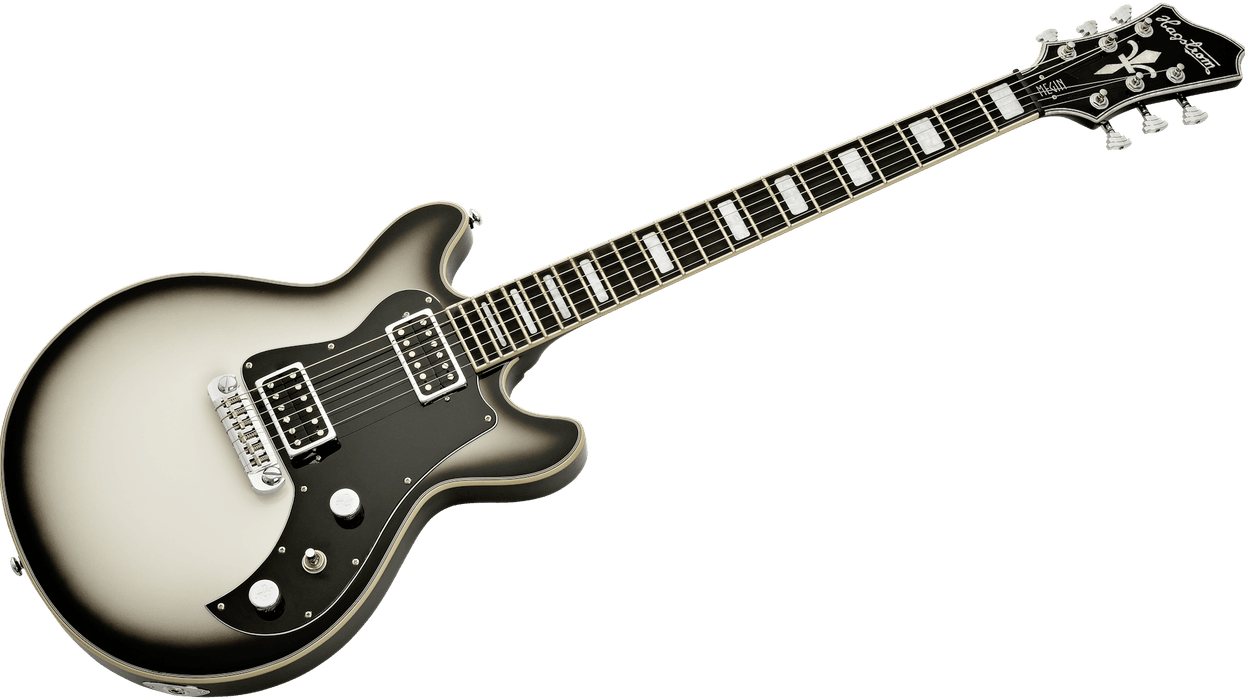
Though they never made major inroads into the North American guitar market, Swedish maker Hagstrom’s guitars have always had cool cred to spare. Hagstroms in the hands of ABBA’s Bjorn Ulvaeus and Rutger Gunnarsson might not surprise anyone. But they were also used by a range of icons spanning from Jimi Hendrix, David Bowie, Frank Zappa, and Elvis Presley, to Nels Cline, Mark Arm of Mudhoney, and Pat Smear of the Germs, Nirvana, and Foo Fighters. Hagstroms are often unique in sound and feel. The thin necks on many 1960s models, for example, make them favorites among players who like to riff at speed.
The new China-made Megin isn’t quite as quirky as, say, a 1960s Hagstrom III. It’s closer to a traditional rock machine and priced for what you could call the quality-entry-level range of the market, selling for a sum just south of a grand, including the tweed-style hardshell case.
Arctic Charm
At a glance, the Megin evokes thoughts of Gibson’s Les Paul DC, as well as Hagstrom’s own very Les Paul-like Swede, though there are plenty of departures from those formulas that give the Megin a unique identity and personality. What’s familiar here? Well, there’s a set neck, two humbuckers, and a mahogany body and neck. Unlike a Les Paul, though, there’s no maple cap. And the extra space and stretch you feel is the Megin’s 25.5" scale length, which translates to tighter bass tones on the wound strings and a little more shimmer on the higher strings.
The neck is carved to a slim-C profile that tapers only slightly as you climb it, and although the bound fingerboard looks like a slice of ebony, it’s actually a composite material Hagstrom calls “resonator wood.” Hagstrom’s unique H-Expander truss rod encloses the adjustable round rod within an H-shaped sleeve of lightweight alloy that increases stability—and, Hagstrom claims, the guitar’s resonance. The 22 medium-jumbo frets are smoothly dressed, and the guitar plays easily from nut to joint.
“The Megin cuts straight to the beefy humbucker rock tones that its looks suggest.”
The Megin has a lot going on in the style department, and deluxe details abound, including 5-ply body binding and rounded block inlays. The headstock is classically Hagstrom—ornate and bristling with Art Deco touches, including the Empire-style tuners. Our test guitar came in a grey burst finish that’s happily reminiscent of Gibson’s circa 1979 silverburst, which is one of four options including black gloss, crème, and sky blue. Taken as a whole, it’s fancy without being over the top.
Northern Lights
Hagstrom loads the Megin with a pair of the company’s own Custom 62 humbuckers, including a medium-output unit at the neck measuring 8.2k-ohms resistance and a high-output bridge pickup rated at 13.8k ohms. They’re routed through a simple 2-knob volume and tone setup, which includes a treble-bleed network on the volume control. A 3-way selector switch is positioned between the knobs.
Played through a 1964 Fender Bassman head and 2x12" cab, a recent Vox AC15, and a Fractal FM9 modeler, the Megin projects beefy humbucker rock tones, just as its looks—and those pickups’ resistance ratings—suggest. Guitars like this one have a way of sparking big leads and riffs, and the Megin excels in these rowdy musical settings. There’s lots of sizzle, tons of girth, and sustain enough for any situation I can imagine. Generally speaking, this might sound like a very same-old-humbucker-meets-mahogany-solidbody formula, but the Megin’s 25.5" scale adds articulation that cuts more effectively though distortion and lends the guitar a distinct personality.
Rock modes may be this guitar’s primary mission. Even so, I wonder about the need for such a high-output bridge humbucker. It ramps up dirt and saturation—often in a welcome way— but also makes it tougher to dial in pristine clean tones. A lot of the appeal in less potent humbuckers is that they make it easier to remove distortion and retain a big, clear signal. On the Megin, reducing the guitar’s volume control doesn’t always add up to crystal clear notes.
The Verdict
At $949, you start to expect a lot from a guitar in terms of quality. On that front, the Megin delivers. It’s extremely well put together and exhibits impressive care from just about every design and assembly perspective. That translates to easy playability and a lively resonance.
Guitarists familiar with Gibson-like 24.75" standard scale length might have to adjust to the slightly stiffer feel that comes with the longer scale, but the tone payoff from the extra chime and tight low end can be worth the sacrifice, depending on your style and preferences. The other factor to consider is the pickups. The high output may not be for players who work outside hot-rocking realms, and it can offset the charms of that extra chime and tight bass. But if that’s your lane, the Megin can be magical.
Pages
